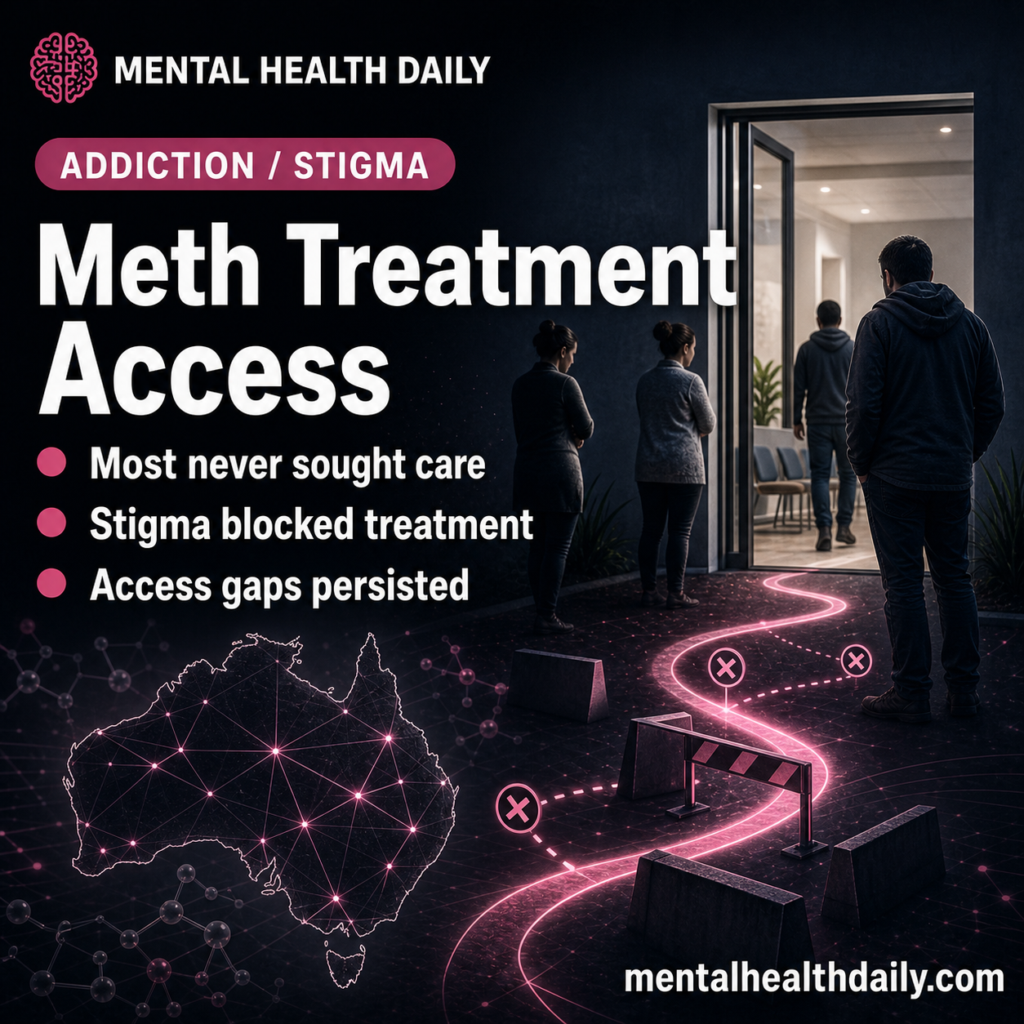
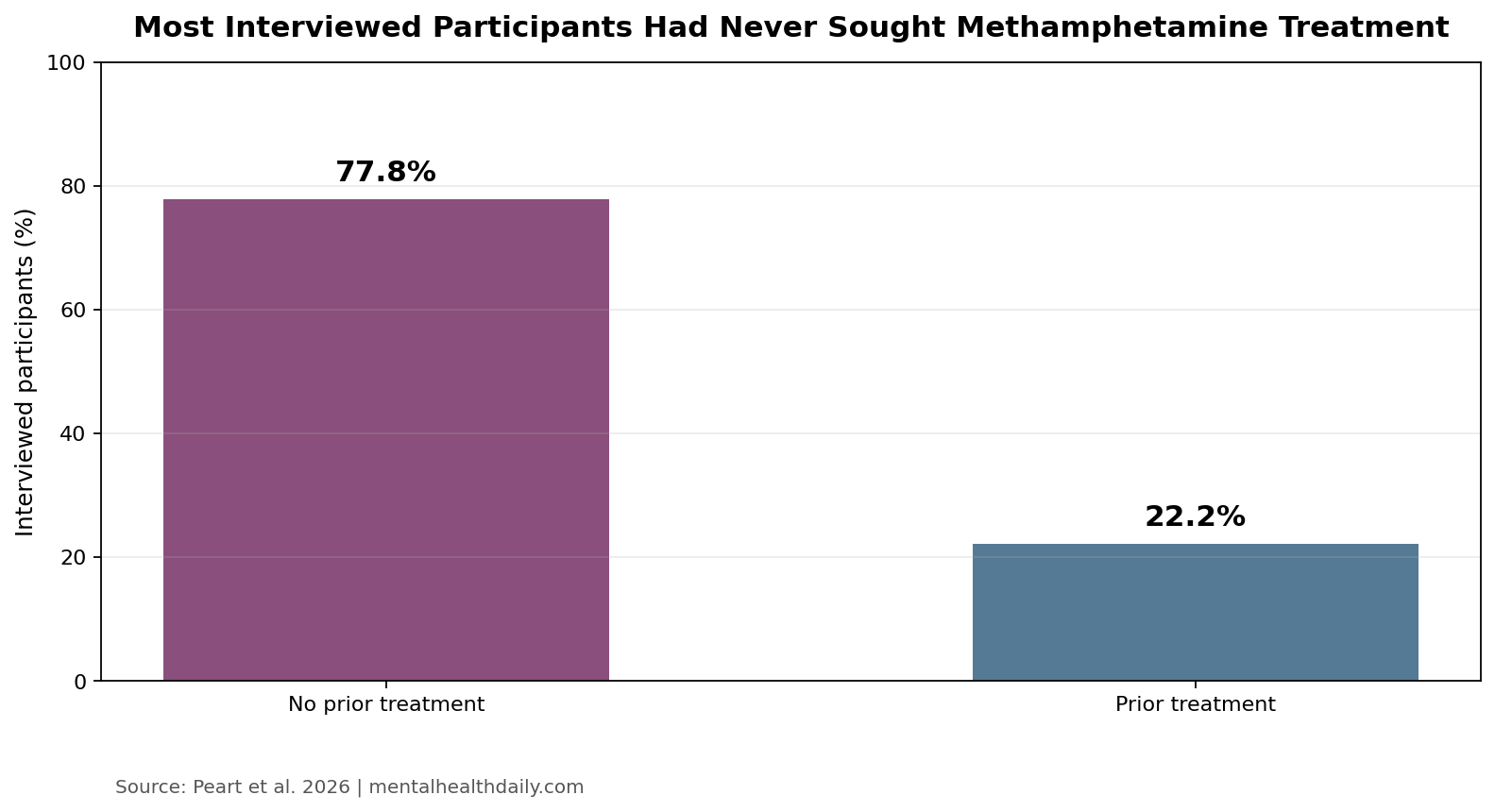
A 2026 Australian interview study involving 27 adults with methamphetamine use problems found that 21 participants, or 77.8%, had never previously sought treatment for methamphetamine use.
Research Highlights
- Most had never sought treatment: Peart et al. interviewed 27 adults and found that 77.8% had not previously sought methamphetamine treatment before entering the parent trial.1
- 3 access barriers dominated: participants described not seeing use as a problem, doubting or fearing treatment, and expecting stigma from services or other people.1
- Medication is still limited: systematic reviews continue to find stronger evidence for psychosocial interventions than for a simple medication solution for methamphetamine use disorder.2,3
- Stigma was operational: fear that treatment would be recorded, isolating, or socially damaging shaped whether care felt acceptable.1,4
Methamphetamine is a potent stimulant that increases dopamine and norepinephrine signaling. That reinforcement pathway can make several problems worse over time — sleep, motivation, mood, psychosis risk, and cardiovascular stress. For many people, treatment-seeking starts only after harm, stigma, or practical disruption becomes impossible to ignore.
27 Adults With Methamphetamine Use Disorder Described 3 Access Barriers
Peart et al. conducted a descriptive qualitative study embedded in an Australian telephone-delivered intervention trial. Participants were adults with mild-to-moderate methamphetamine use disorder at trial enrollment, but the interview sample had a mean Structured Clinical Interview for DSM-5 substance-use score of 5.8, indicating severe methamphetamine use disorder.1
- Sample: 27 participants, including 15 men and 12 women.
- Age: mean 42.0 years, standard deviation 10.7, range 27 to 63.
- Use history: mean 13.6 years of regular methamphetamine use.
- Prior treatment: 6 participants had sought treatment; 21 had not.
Researchers mapped interview themes onto the Levesque access-to-care model, which treats access as an interaction between people seeking care and services offering care. The 3 dominant themes were the perceived problem of methamphetamine use, beliefs about treatment, and the impact of stigma.1,5
Telephone Trial Enrollment Exposed the Gap Before Specialty Care
The interview sample had already crossed one threshold: participants entered a telephone-delivered intervention trial. The access problem was more specific than refusal of all help. Many participants had been using methamphetamine for years before a low-friction research pathway made discussion possible.
- Approachability: people need to know that treatment exists before they can judge whether it fits.
- Acceptability: care has to feel confidential, nonjudgmental, and compatible with work, family, and housing realities.
- Engagement: first contact is not enough if sleep disruption, shame, missed appointments, or paranoia interrupt follow-up.
That distinction helps explain why 21 of 27 participants had never previously sought methamphetamine treatment despite long use histories. A service can be clinically available while still feeling socially dangerous, logistically unrealistic, or irrelevant to a person who does not yet describe their use as a treatment problem.
Some Participants Did Not See Methamphetamine Use as a Treatment Need
Recognition barrier: Several participants described long-term methamphetamine use without framing it as an immediate treatment problem. Some linked problem recognition to whether work, money, parenting, motivation, or daily function had clearly deteriorated. That makes screening language important: asking only whether someone wants treatment may miss people who are open to support but do not identify with a severe-treatment label.
Adjacent evidence: Quinn et al. previously found a similar pattern in Melbourne: 41% of surveyed people who used methamphetamine were categorized as service avoiders because they did not perceive a need for services or treatment, even though many still reported financial or relationship problems.6
Implementation implication: early-intervention options need to be visible before a person accepts a crisis narrative. A menu that includes brief counseling, telephone support, harm-reduction planning, sleep help, contingency management, and relapse-prevention counseling may feel more usable than a single pathway labeled rehabilitation.
Stigma Made Treatment Feel Costly Before It Started
Disclosure cost: Participants described treatment as potentially isolating, reputation-damaging, or incompatible with work and family obligations. Some worried that a treatment record would affect future employment. Others expected judgment from family, community members, or health services.
External fit: This fits adjacent research on methamphetamine stigma in Australia. Deen et al. described stigmatizing attitudes toward crystal methamphetamine use, and Clifford et al. reported treatment-seeking barriers among women who use methamphetamine in Sydney.4,7
Stigma changes the acceptability of service formats, the willingness to disclose use, and the perceived cost of being seen in care.
Low-Friction Behavioral Care Fits the Access Barriers
Systematic reviews have not produced a clean medication-first answer for methamphetamine use disorder. AshaRani et al. reviewed nonpharmacological interventions, while Tran et al. summarized psychosocial intervention reviews; both point toward behavioral and psychosocial care as central parts of treatment infrastructure.2,3
Evidence-strength note: the Peart study was qualitative and used convenience sampling from people already enrolled in a trial. It can explain lived barriers in depth; it cannot estimate national prevalence or prove which service design would increase treatment uptake.
Access model: Levesque's access-to-care model is useful here because it does not reduce treatment entry to motivation. A person has to recognize a health need, decide care is acceptable, find a reachable service, afford the cost, and stay engaged after first contact.
Methamphetamine use can disrupt every step through sleep loss, shame, unstable housing, work conflict, paranoia, depression, or fear that disclosure will create legal or family consequences.
Ability to perceive: participants could recognize some harms while still treating methamphetamine as a tool for energy, confidence, or coping. Services that wait for a person to say "I am addicted" may miss people who are ready to talk about sleep, finances, anxiety, relationship damage, or stimulant comedowns.
Ability to seek: treatment seeking requires a person to believe the available service is worth the exposure risk. A referral can fail if the person expects moral judgment, a permanent record, loss of control, or pressure into residential treatment before they are ready.
Ability to engage: engagement is the repeated-contact problem. Methamphetamine use disorder often brings unstable sleep, missed appointments, mental-health symptoms, and fluctuating readiness. Reminder systems, same-week appointments, peer navigation, phone-based follow-up, and practical help with transport or privacy can matter as much as the therapy model itself.
The interviews also separate stigma from ordinary embarrassment. Stigma becomes operational when it changes what a person is willing to disclose, where they are willing to be seen, and whether they trust clinicians to treat methamphetamine use as a health problem instead of a character verdict.
Medication gap: opioid treatment has a simple public explanation: medications can reduce withdrawal, craving, overdose risk, and illicit opioid use. Methamphetamine treatment does not have an equivalent one-sentence medication anchor, so service explanation has to be more concrete.
Behavioral care can be concrete:
- Contingency management: reinforces stimulant-negative tests or treatment attendance.
- Cognitive behavioral therapy: helps people identify cues, cravings, sleep disruption, and high-risk routines.
- Motivational interviewing: helps people examine ambivalence without forcing a fake commitment.
- Harm-reduction counseling: addresses safer use, psychosis warning signs, hydration, overheating, safer sex, and when to seek urgent care.
Evidence strength: Peart et al. did not test those service models against each other. The interviews point to why low-friction, confidential, clearly explained care may be more usable than a crisis-only pathway.
Clinical implication: the first contact should not require a person to summarize their life as failure. A better first contact asks what methamphetamine is doing for them, what it is costing them, what they want protected, and which form of help would be acceptable this week. That framing still treats the disorder seriously, but it gives the person a route into care before crisis language feels honest.
The interviews also support outreach beyond specialty addiction clinics. Primary care, emergency departments, sexual-health services, mental-health clinics, housing services, and telephone counseling can all become entry points if staff know how to ask about stimulant use without turning the conversation into a lecture.
For intake teams, frequency of use is only 1 screening target. Sleep collapse, paranoia, missed work, relationship damage, risky sex, injection or pipe-sharing practices, and stimulant comedowns may be the doorway into an honest treatment conversation.
Service-design implication: clinics should make the first step small and legible. A same-week phone call, confidential explanation of options, and permission to discuss sleep or comedown problems before abstinence goals can turn vague concern into an actual care pathway. The offer needs to feel usable before crisis.
Questions About Methamphetamine Treatment Access
Does this study show that stigma causes treatment avoidance?
No. The interviews show that stigma, treatment beliefs, and problem recognition shaped participants’ accounts of care access. The design cannot isolate causal effects.
Why is telephone or low-threshold support relevant?
Several participants saw residential treatment as isolating, expensive, or incompatible with work. Lower-burden formats may reach people before they identify as ready for intensive treatment.
What should services explain first?
Services should explain what options exist, what confidentiality means, what treatment does and does not require, and how someone can get support without immediately leaving work, family, or housing obligations.
References
- Peart A, Petukhova R, Sin J, et al. “I’ve Never Seen It as a Real Problem”: Experiences of Access to Care for People Who Use Methamphetamine. Substance Abuse and Rehabilitation. 2026;17:564520. doi:10.2147/SAR.S564520
- AshaRani PV, Hombali A, Seow E, Ong WJ, Tan JH, Subramaniam M. Non-pharmacological interventions for methamphetamine use disorder: a systematic review. Drug Alcohol Depend. 2020;212:108060. doi:10.1016/j.drugalcdep.2020.108060
- Tran MTN, Luong QH, Le Minh G, Dunne MP, Baker P. Psychosocial interventions for amphetamine type stimulant use disorder: an overview of systematic reviews. Front Psychiatry. 2021;12:512076. doi:10.3389/fpsyt.2021.512076
- Deen H, Kershaw S, Newton N, et al. Stigma, discrimination and crystal methamphetamine: current attitudes in Australia. Int J Drug Policy. 2021;87:102982. doi:10.1016/j.drugpo.2020.102982
- Levesque JF, Harris MF, Russell G. Patient-centred access to health care. Int J Equity Health. 2013;12:18. doi:10.1186/1475-9276-12-18
- Quinn B, Stoove M, Papanastasiou C, Dietze P. Self-perceived non-problematic use as a barrier to professional support for methamphetamine users. Int J Drug Policy. 2013;24:619-623. doi:10.1016/j.drugpo.2013.05.015
- Clifford B, Van Gordon K, Magee F, et al. “There’s a big tag on my head”: barriers to treatment seeking with women who use methamphetamine. BMC Health Serv Res. 2023;23:162. doi:10.1186/s12913-023-09125-z