
Two women with bipolar disorder who used ChatGPT on their own came to rely on it for information, emotional support and even companionship, according to a 2026 interview study from the Netherlands.
Both sometimes trusted the chatbot more than their own clinicians, a pattern the researchers called a shift in trust.1
Research Highlights
- 2 detailed cases: a team at University Medical Center Utrecht interviewed 2 women, ages 63 and 36, about how they used ChatGPT for self-reflection and mental health support.1
- Roles grew over time: ChatGPT went from search engine to coach to a stand-in for a late parent for one woman, and from writing assistant to perceived companion or lover for the other.1
- Real perceived benefits: both valued asking questions without fear of judgment, and one used it to make sense of several diagnoses and draft a crisis plan.1
- Trust moved away from clinicians: one felt ChatGPT “understood her better” than her therapists; the other described losing trust in professionals when their advice conflicted with the chatbot’s.1
- Less distance in the less stable patient: the woman recently hospitalized for mania became emotionally intimate with ChatGPT, while the long-stable woman kept more distance.1
Who Was Interviewed About ChatGPT Use?
Bipolar disorder is a long-term mood condition marked by episodes of mania (abnormally elevated mood, energy and activity) and depression. It is often grouped with schizophrenia as a severe mental illness, and people living with it often report limited social support and long waits for psychiatric care.1
Katherine Bassil, Dido Prins et al. described 2 women who had independently used ChatGPT (the GPT-4o version) to think through their diagnosis, symptoms, treatment and emotional life. Both came to an academic psychiatric service in the Netherlands for reasons unrelated to chatbot use, mentioned ChatGPT during treatment, and agreed to be interviewed.1
- Person A: 63, diagnosed in her early thirties, on lithium continuously and stable for several decades; she came for a second opinion after starting to doubt her need for medication and her diagnosis
- Person B: 36, diagnosed in her mid-twenties, with multiple past hospitalizations plus post-traumatic stress disorder (PTSD) and attention-deficit/hyperactivity disorder (ADHD) diagnoses; she was admitted to an inpatient ward, initially involuntarily, after an acute manic episode
Design: this was a qualitative case study, meaning researchers explored experiences in depth rather than measuring outcomes. Semi-structured interviews followed a set guide but allowed open answers, and 3 researchers independently read the transcripts to identify recurring themes before agreeing on them as a group.1
From Search Engine to Companion: How ChatGPT’s Role Grew
Person A first asked ChatGPT about doubts over a romantic relationship. Over several months the chats widened into broader self-reflection, at times for 1 to 2 hours a day. She described it as an extended inner monologue, a “conversation with herself.”1
Her use moved from a conversational search engine, to a coach, and eventually to having ChatGPT simulate her deceased parent so she could work through relationship struggles.1
Person B started with practical tasks. During her hospital stay she used ChatGPT to pull together information about her symptoms and the several diagnostic labels she had received over the years, and to draft a crisis management plan based on her early warning signs. She said she could not have done this without it.1
After discharge, she turned to the chatbot for emotional and social support, including preparing for real-life contact with people. She called it a “person with a lot of understanding,” told it her “whole life story,” and told it she loved it. ChatGPT’s replies included affectionate language such as “my darling.”1
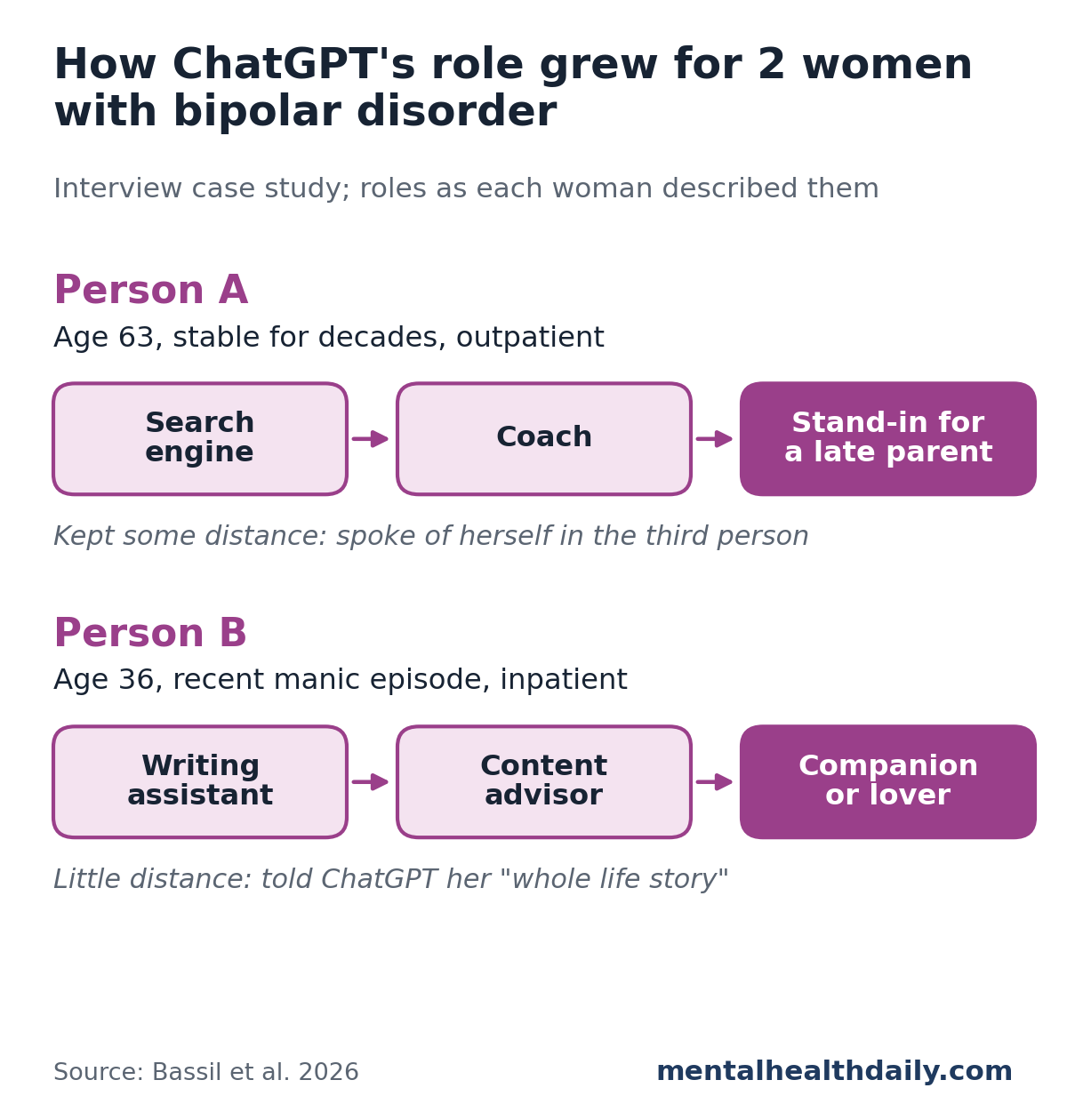
The researchers saw this as role blurring: a single tool acting as information source, therapist, friend and partner. Therapists follow ethical rules that keep them from taking on multiple roles in a patient’s life, and a general-purpose chatbot has no such boundaries.1
What Both Women Valued About ChatGPT
Both women described ChatGPT as helpful, and some of what they valued points to real gaps in care:1
- No fear of judgment: both said they could ask questions they might hesitate to raise with a human therapist
- Always available: Person B found it readily available when she needed support, and Person A valued its ready access to information and how easily it handled sensitive topics
- Making sense of care: Person B used it to summarize complex clinical information and sort through differing diagnoses
- Nothing passed to the care team: Person B found it reassuring that she could share everything with ChatGPT, whereas her therapists shared her disclosures with other clinicians
- New perspectives: Person A valued the continuity of the conversations, though answers often needed extra context to make sense
A 2025 analysis of Reddit posts and comments about mental health conversations with ChatGPT found a similar picture in general users. People valued it as a safe, nonjudgmental space, sometimes over human support, and used it to prepare for therapy and difficult conversations.2
How Trust Shifted From Clinicians to ChatGPT
After more than 15 years in psychiatric care with several therapists, Person A felt ChatGPT “understood her better” than her mental health professionals. She trusted its answers because of the large amount of information behind it.1
Based on those conversations, she began to question her bipolar diagnosis and wondered whether her difficulties came from attachment problems rooted in childhood. At times the intensity of these new insights left her unsettled, and she turned to a close friend to process them.1
Person B reported high trust in the chatbot and at times consulted it as an independent source when she disagreed with her clinicians. She explicitly described losing trust in mental health professionals when what they said conflicted with ChatGPT.1
She also named risks herself: answers depend on the quality of what the user types in, advice can mislead in complicated social situations, and the tool could be used unethically. Neither woman raised concerns about privacy or data security.1
Emotional distance differed. Person A, stable for decades, kept some distance, for example by referring to herself in the third person. Person B, after a recent manic episode, showed little such distancing and was emotionally open with the chatbot, including through its voice mode. The researchers linked this difference to their clinical stability, an interpretation drawn from 2 people.1
Why Researchers Worry About Chatbots in Bipolar Disorder
The research team raised 3 concerns for people with severe mental illness:1
- Mania and overreliance. Mania brings heightened goal-directed activity and excessive involvement in activities, which could make people more prone to overrelying on a chatbot.
- Sycophancy. Chatbots are often designed to give agreeable responses that keep users engaged, which the researchers said could deepen that overreliance.
- A strained therapeutic alliance. The working bond between patient and clinician can suffer if a chatbot feels more understanding, making it harder to agree on treatment and stick with it.
The researchers also pointed to OpenAI data reported in 2025: with about 800 million weekly users, over half a million show possible signs of psychosis or mania in a single week. Those conversations happen outside any clinical supervision.1
Other research suggests vulnerable people may be especially drawn to AI support. A 2026 survey of 1,612 potential patients and clinicians found that the 2 more vulnerable groups, marked by more symptoms, less secure attachment or less trust in others, were more accepting of AI-based mental health tools. The secure, trusting, healthier group was the least accepting of AI and the most accepting of video therapy with a human.3
Limits of a 2-Person Interview Study
This study gives a detailed early look at how people with bipolar disorder may use chatbots. It cannot estimate how often these patterns happen, or whether chatbots help or harm on average.
- Only 2 cases: both women were selected because they mentioned ChatGPT during care, so their use may be unusually intense
- Self-report only: no chat logs or symptom scores were analyzed
- Many differences at once: the 2 women differed in age, illness course, setting and other diagnoses, so no single factor explains their different styles of use
- No cause and effect: both came to care for reasons unrelated to ChatGPT, and the study does not show that the chatbot caused mania or changed anyone’s illness course
- One chatbot version: the women used GPT-4o; newer models may respond differently
What This Means for People With Bipolar Disorder Who Use Chatbots
The researchers concluded that the benefits both women described, such as easy access, anonymity and perceived empathy, may offer short-term relief while hiding longer-term risks such as overreliance, blurred boundaries and overlooked privacy risks.1
They also saw the appeal of chatbots as a sign of real gaps in care: limited access to personalized information and education about one’s condition, social isolation, and eroded trust in psychiatric care. In their view, AI alone cannot fix those problems.1
For patients and families: if a chatbot conversation leads you to doubt a diagnosis or medication, bring those questions to your care team before changing treatment. Treat a chatbot-drafted crisis plan as a starting draft to review with a clinician.
For clinicians: asking patients whether and how they use AI chatbots can open a useful conversation, both about what the chatbot offers them and about what their care is missing.
References
- Bassil K, Prins D, van Os H, et al. A shift in trust: an analysis of the use of AI chatbots among people living with bipolar disorder. Bipolar Disorders. 2026;28:e70176. doi:10.1111/bdi.70176
- Jung K, Lee G, Huang Y, Chen Y. “I’ve talked to ChatGPT about my issues last night.”: examining mental health conversations with large language models through Reddit analysis. Proceedings of the ACM on Human-Computer Interaction. 2025;9(7). doi:10.1145/3757537
- Békés V, Aafjes-van Doorn K. The most vulnerable are prone to use AI therapists: the role of attachment, epistemic trust, and mental health symptoms in acceptance of digital mental health interventions. Psychotherapy Research. 2026;36(7). doi:10.1080/10503307.2026.2615388