
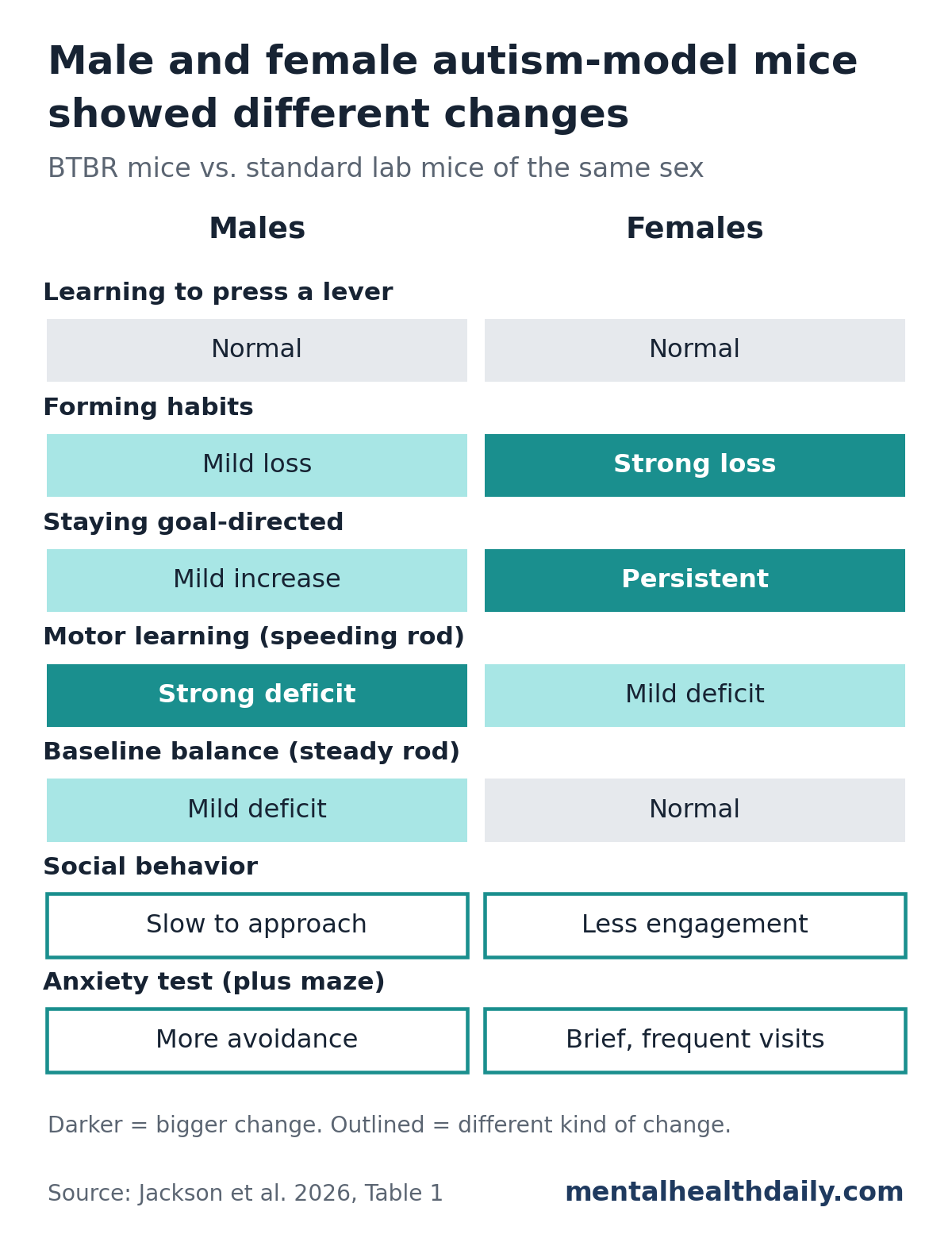
In a 2026 study of BTBR mice, a lab strain used to model autism, males and females showed different autism-like changes.
Female BTBR mice formed fewer habits and engaged less with other mice, while males struggled more to learn a balance task and were slower to approach a stranger.1
Research Highlights
- Small mouse study: 22 BTBR mice (11 male, 11 female) were compared with 20 standard C57BL/6J lab mice (10 male, 10 female) across 4 kinds of behavior.1
- Females stayed goal-directed: after long training meant to build a habit, female BTBR mice still cut back lever pressing when the reward lost its appeal (p = 0.039); standard mice did not.1
- Males had the clearer motor-learning problem: on a speeding rotating rod, standard males improved across 4 tries and BTBR males did not (p < 0.0001 for the strain difference in males).1
- Social changes split by sex: BTBR females approached a stranger mouse less often than standard females (p < 0.0001); BTBR males approached normally but took longer to start (p = 0.015).1
- No broad rise in anxiety: overall anxiety-test scores did not differ by strain, but BTBR males avoided exposed areas more and BTBR females made more, shorter visits.1
What BTBR Mice Are and Why Researchers Use Them
BTBR mice (full name BTBR T+ Itpr3tf/J) are an inbred laboratory strain that naturally shows behaviors resembling core features of autism. No single gene was engineered into them, so researchers call them an idiopathic autism model: the autism-like traits arise from the strain’s own genetic background.
The strain became a standard model after a 2008 study by McFarlane et al. Compared with C57BL/6J mice, BTBR mice showed:2
- Less social behavior: reduced approach to other mice, fewer back-and-forth social interactions, and less juvenile play
- Repetitive behavior: high levels of self-grooming
- Intact basics: normal smell and social recognition, with no sign of high anxiety or motor problems in that study
BTBR mice are also born without a corpus callosum, the thick cable of nerve fibers that links the brain’s 2 hemispheres. Brain sections in the 2026 study confirmed this in the BTBR mice used.1
Why sex was the focus: autism is diagnosed more often in boys and men, and most BTBR research has tested only males or pooled both sexes. Jackson et al., at Michigan Technological University, set out to test whether sex changes which behaviors are affected.1
How the Mice Were Tested
The young adult mice (6 to 8 weeks old at the start) went through a series of standard behavior tests. Each one targets a different kind of behavior:1
- Lever pressing for food: mice learned to press a lever for food pellets, then trained on a schedule that tends to turn pressing into an automatic habit.
- Rotarod: mice balanced on a rotating rod. On day 1 the rod sped up from 4 to 40 rotations per minute over 5 minutes, which tests motor learning. On day 2 it turned at a steady 16 rotations per minute, which tests basic coordination.
- Social approach: a stranger mouse of the same age and sex sat under a wire cup in the center of an arena, and tracking software recorded how often and how quickly the test mouse came close.
- Elevated plus maze: a raised, plus-shaped platform with 2 walled arms and 2 open arms. Mice that stay in the walled arms are usually read as more anxious.
Female BTBR Mice Formed Fewer Habits
Behavior scientists separate 2 ways of acting. A goal-directed action is done because of what it gets you right now. A habit runs on autopilot, triggered by the situation even when the reward no longer matters. With enough repetition, ordinary lab mice shift from the first mode to the second.
Learning was fine: most BTBR mice learned to press the lever, and those that did learned at a similar pace to standard mice, while pressing more often overall. However, 6 of the 22 BTBR mice never learned the task and were left out of the lever tests.1
Habits were weaker in females: during habit training, female BTBR mice pressed less than standard females (p < 0.001). Male BTBR mice pressed about the same as standard males (p = 0.86).1
Researchers then used 2 checks for habit:
- Reward devaluation: mice ate their fill of the training pellets right before a test, so the pellets were worth less. Standard mice kept pressing at similar rates (p = 0.17), a sign of habit. BTBR mice pressed less (p = 0.032), a sign they were still tracking the reward. The drop was significant in BTBR females (p = 0.039) but not males (p = 0.25).
- Omission test: the rules flipped so that each press delayed the next free pellet. BTBR mice cut back faster than standard mice (p = 0.001). In the first 5 minutes, BTBR females pressed much less than standard females (p = 0.0001), while BTBR and standard males did not differ (p = 0.15).
Together, these tests point to female BTBR mice staying in goal-directed mode after training that usually builds a habit. The researchers link this to an altered balance between the 2 modes, which rely on different parts of the striatum, a deep brain region involved in choosing actions and tracking rewards. They did not measure the striatum directly.1
Male BTBR Mice Struggled More With Motor Learning
On the speeding rotarod, standard mice of both sexes stayed on longer with each of 4 tries. BTBR mice as a group did not improve.1
- Males: BTBR males stayed on for less time than standard males and did not improve across tries, while standard males did (p < 0.0001 for the strain difference).
- Females: BTBR females scored somewhat lower than standard females (p = 0.017), but their pattern across tries was similar.
- Steady-speed rod: with the rod turning at a constant speed, the 2 strains did not differ overall (p = 0.85). BTBR males still did worse than standard males (p < 0.001), while females did not differ (p = 0.27).
The researchers read this as a problem adapting to rising motor demands rather than poor balance in general, with males more affected. That finding stands apart from the 2008 characterization, which found no motor impairment in BTBR mice using a different set of tests.2
Social Differences: Less Engagement in Females, Slower Starts in Males
As a group, BTBR mice entered the zone around the stranger mouse less often than standard mice (p < 0.001). Splitting the results by sex showed 2 different patterns:1
- Females: BTBR females made fewer visits to the stranger than standard females (p < 0.0001) and spent less total time near it (p = 0.042).
- Males: BTBR males visited as often as standard males (p = 0.50) but took longer to make the first approach (p = 0.015).
A 2024 study by Bove et al. also found reduced social interaction in both male and female BTBR mice, along with other sex differences: repetitive behavior followed a different pattern in females, and signs of oxidative stress in the hippocampus appeared only in males.3
Anxiety Tests Showed Different Strategies, Not More Anxiety
On the elevated plus maze, BTBR mice overall did not differ from standard mice in how quickly they ran into the walled arms (p = 0.44) or how long they stayed there (p = 0.13). The sexes behaved differently, though:1
- BTBR males: ran into the walled arms sooner (p = 0.016) and spent more time there (p = 0.02) than standard males, a more avoidant style.
- BTBR females: went into the open arms more often than standard females (p = 0.008) but stayed for shorter visits (p < 0.01), a pattern of quick checking rather than settled exploring.
The researchers describe these as different ways of handling risk rather than a general increase in anxiety. That fits the 2008 finding of no high anxiety-like traits in the strain.2
What a Mouse Study Can and Cannot Tell Us About Autism
This is basic animal research. It shows that sex shapes which behaviors change in one autism mouse model, and it supports testing both sexes in this kind of work. It does not show how autism differs between men and women, and it has no direct treatment implications.
Main limits:
- One strain: no single mouse model captures autism. BTBR mice lack a corpus callosum, which most autistic people have, and this alone could drive some of the behavior.
- Small groups: 8 to 11 mice per sex in each strain, with many comparisons and several p-values close to 0.05. The paper reports no effect sizes.
- Different strain as control: the comparison mice were a separate inbred strain, not littermates, so some differences could come from general strain background.
- Behavior only: brain circuits and hormones were discussed as possible explanations but not measured.
- Reporting gaps: some anxiety-test p-values and one group size differ between the text and the figure captions.
The researchers call for studies across other autism models that pair behavior with direct measures of brain circuits, to see which sex differences hold up.1
References
- Jackson J, Houston C, Cornils M, Plummer E, Yu C. Domain-specific and sex-dependent behavioral alterations in the BTBR mouse model of autism. Frontiers in Behavioral Neuroscience. 2026;20:1932380. doi:10.3389/fnbeh.2026.1932380
- McFarlane HG, Kusek GK, Yang M, Phoenix JL, Bolivar VJ, Crawley JN. Autism-like behavioral phenotypes in BTBR T+tf/J mice. Genes, Brain and Behavior. 2008;7(2):152–163. doi:10.1111/j.1601-183X.2007.00330.x
- Bove M, Sikora V, Santoro M, et al. Sex differences in the BTBR idiopathic mouse model of autism spectrum disorders: behavioural and redox-related hippocampal alterations. Neuropharmacology. 2024;260:110134. doi:10.1016/j.neuropharm.2024.110134