hit counter

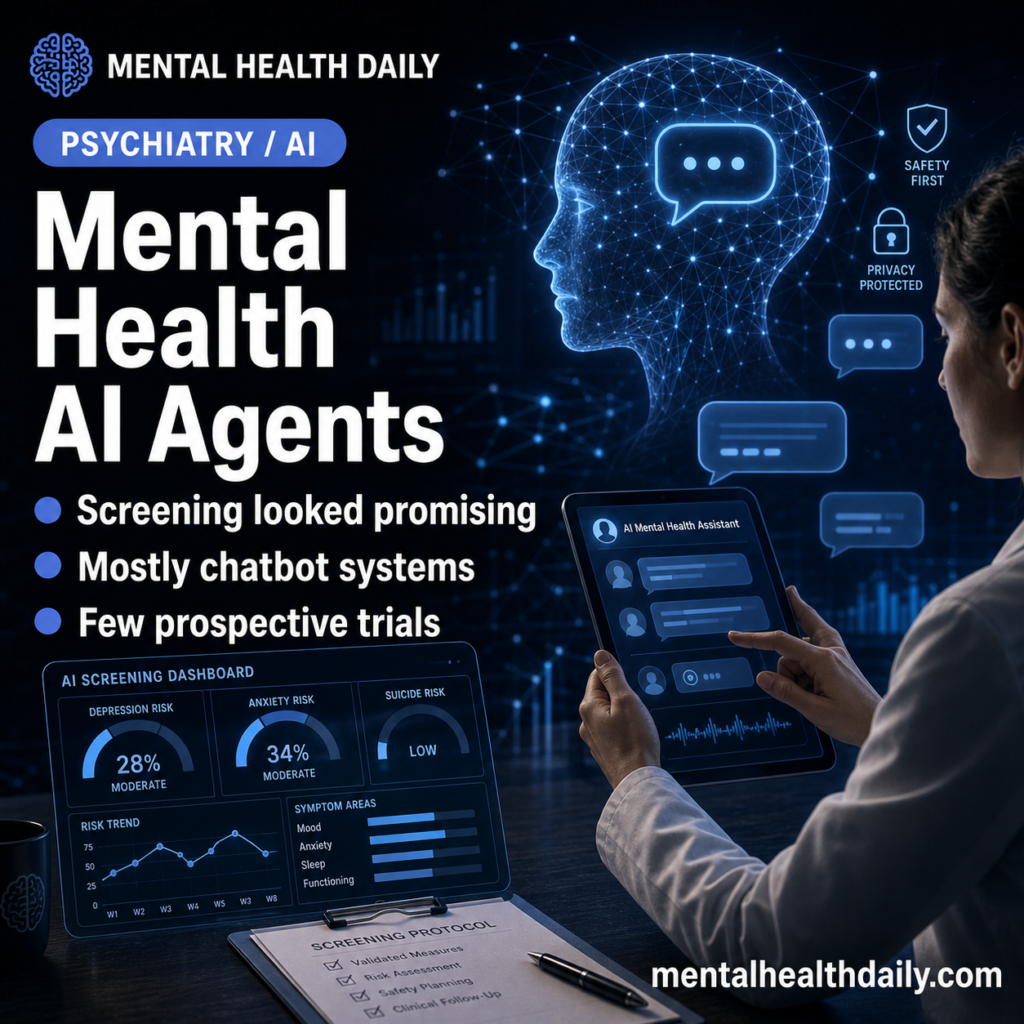
Mental Health AI Agents: 0.80 Sensitivity, Weak Real-World Evidence

Mental-health AI agents are software systems that use artificial intelligence to screen, coach, triage, document, or coordinate care across mental-health workflows. A 2026 systematic review and meta-analysis of systems published from 2023 to 2025 found strong offline diagnostic metrics, but the evidence still leans much more heavily on chatbot demos and benchmark tasks than on …

Read more

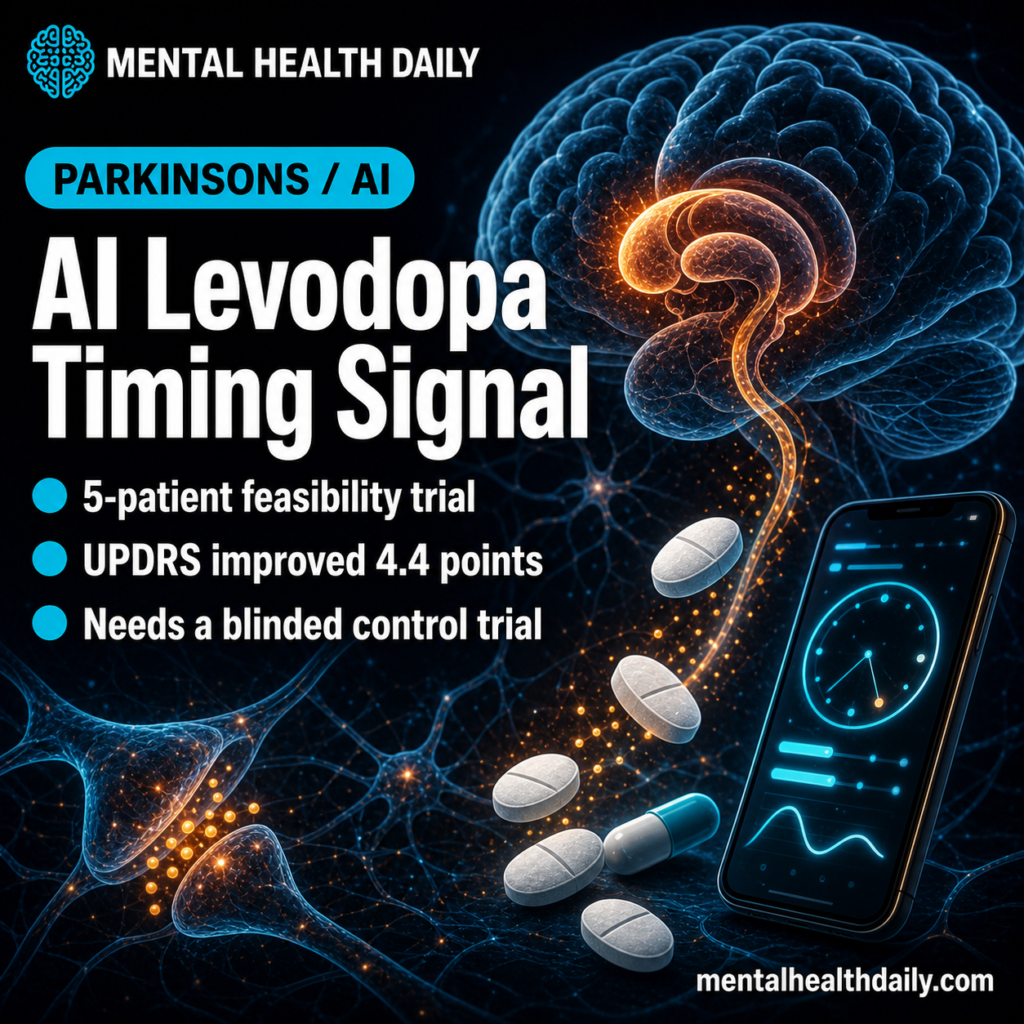
AI Levodopa Timing Improved UPDRS 4.4 Points in 5 Parkinson Patients

MHD featured image for AI-guided levodopa dosing in Parkinson's disease.

A 2026 open-label feasibility trial involving 5 Parkinson’s disease patients found that app-randomized levodopa timing was associated with a mean 4.4-point improvement on the Unified Parkinson’s Disease Rating Scale, but the signal missed conventional statistical significance at p = 0.063.1 The narrow conclusion is feasibility: this was a dosing experiment that justified a blinded controlled …

Read more

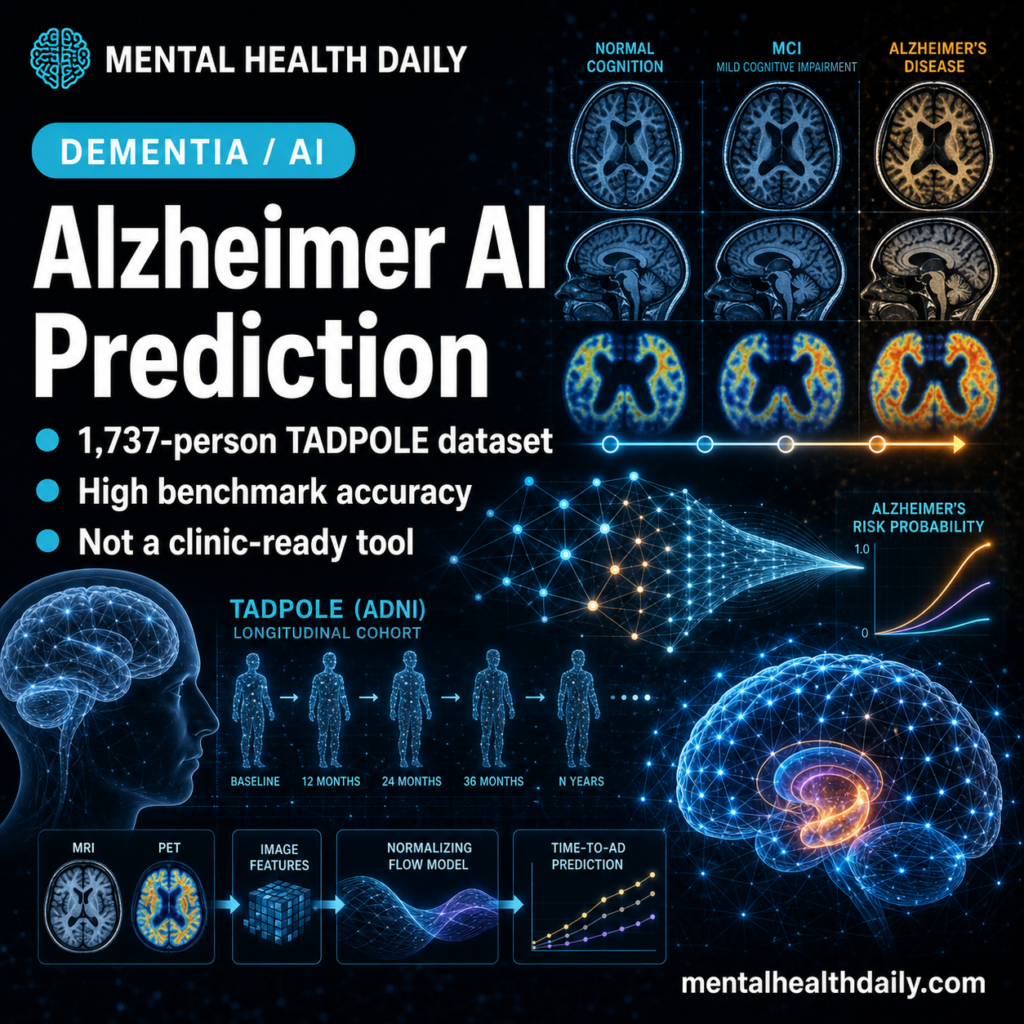
Alzheimer’s Progression AI Model Reaches 0.965 mAUC in TADPOLE Dataset

Editorial card showing Alzheimer progression prediction with longitudinal brain scans, model uncertainty, and TADPOLE cohort data.

A 2026 TADPOLE modeling study reported that a sequential neural process with normalizing flows predicted future Alzheimer diagnostic stage with mAUC 0.965 ± 0.006, ahead of the authors’ earlier sequential-neural-process model at 0.937 ± 0.014.1 The result is a strong benchmark signal for uncertainty-aware disease-progression AI, but it is still retrospective modeling evidence rather than …

Read more

Alzheimer’s AI MRI Diagnosis: ANA-GNN Reaches 85.23% Accuracy in ADNI

MHD featured image for ANA-GNN Alzheimer's AI MRI diagnosis in the ADNI cohort.

A 2026 ADNI study reported 85.23% accuracy for ANA-GNN, a graph neural network that combined structural MRI regional features with clinical variables to classify cognitively normal controls, mild cognitive impairment, and Alzheimer’s disease.1 The result is useful, but the clinical-feature ablation dropped accuracy to 68.35%, so the model should be read as multimodal decision-support research, …

Read more