At a Japanese psychiatric hospital where peer support workers helped patients write their own crisis plans, staff described a ward where patients began asking for the care they wanted and staff responded. A 2026 interview study of 13 nurses, managers and peer workers found that this change appeared only when 3 conditions were in place at once.1
Research Highlights
- 3 conditions worked together: the hospital taking responsibility for clinical risk, peer workers’ lived experience brought into the team in stages, and patients authoring their own crisis plans.1
- Roles reversed on the ward: staff and peer workers described patients moving from being managed to asking for specific care, with professionals responding to those requests.1
- Without peer workers, change faded: at a comparison hospital that ran crisis plans with professional staff only, change stayed with individual patients and was absorbed back into old routines.1
- Small qualitative study: 12 of the 13 interviews came from one hospital with unusually strong management commitment, and no restraint, admission or symptom outcomes were measured.1
- Trials support crisis planning: across 5 randomized trials, crisis plans lowered the risk of compulsory admission by 25%, and a French trial of peer-facilitated advance directives found 27% vs. 39.9% compulsory admission.45
What a Peer-Led Crisis Plan Is
A crisis plan is a document a person with a serious mental illness writes ahead of time, while well, describing their early warning signs, what helps, what does not, and how they want to be treated if they become unwell. It grew out of the Wellness Recovery Action Plan (WRAP), a structured self-management and recovery program, and out of psychiatric advance directives, which give patients a say in future treatment.1
The plan is supposed to be the patient’s own. In practice, Ebihara et al. note, clinicians often end up writing it, turning a rights document into a symptom-management checklist built around avoiding clinical risk.1
Peer support workers are staff hired because they have lived through psychiatric illness and treatment themselves, then trained to support others. In a peer-led crisis plan, peer workers help the patient write the plan in their own words, so the patient rather than the clinician is its author.
Why Japan’s Psychiatric Wards Were the Test Case
Japan has been reported to have the highest number of psychiatric beds per person among OECD countries, with average inpatient stays exceeding 260 days and long-standing concern about physical restraint, the researchers note.1
Ebihara et al. describe 2 features of that system that keep coercive care in place:
- Risk sits with the individual nurse: frontline nurses carry personal responsibility for anything that goes wrong when a patient is agitated or expresses self-harm, suicidal or aggressive impulses, so restraint becomes the safe default.
- Lived experience counts for little: professional knowledge is trusted over what patients and peer workers know, which keeps peer workers outside the team.
One head nurse summed up the first problem: “The standard excuse for not acting is: ‘Who’s going to take responsibility for that?’”1
Who Was Interviewed at the 2 Hospitals
Researchers interviewed 13 people at 2 single-specialty psychiatric hospitals in Japan in October and November 2025. Interviews averaged 44 minutes.1
- Main hospital (12 people): 6 nurses, 3 peer support workers, and 3 decision-makers — the hospital director, the head of medical social work, and an occupational therapy department head who coordinated the peer program
- Comparison hospital (1 person): a day-care unit chief who ran crisis plans and WRAP there; peer workers had not been placed in patient care
The team first coded the interviews from the ground up (a grounded theory approach), then re-sorted the themes using a realist framework, which asks what worked, for whom, and under what conditions. Each finding was framed as a context, the mechanism that changed things, and the outcome that followed.1
3 Conditions Behind the Change in Ward Culture
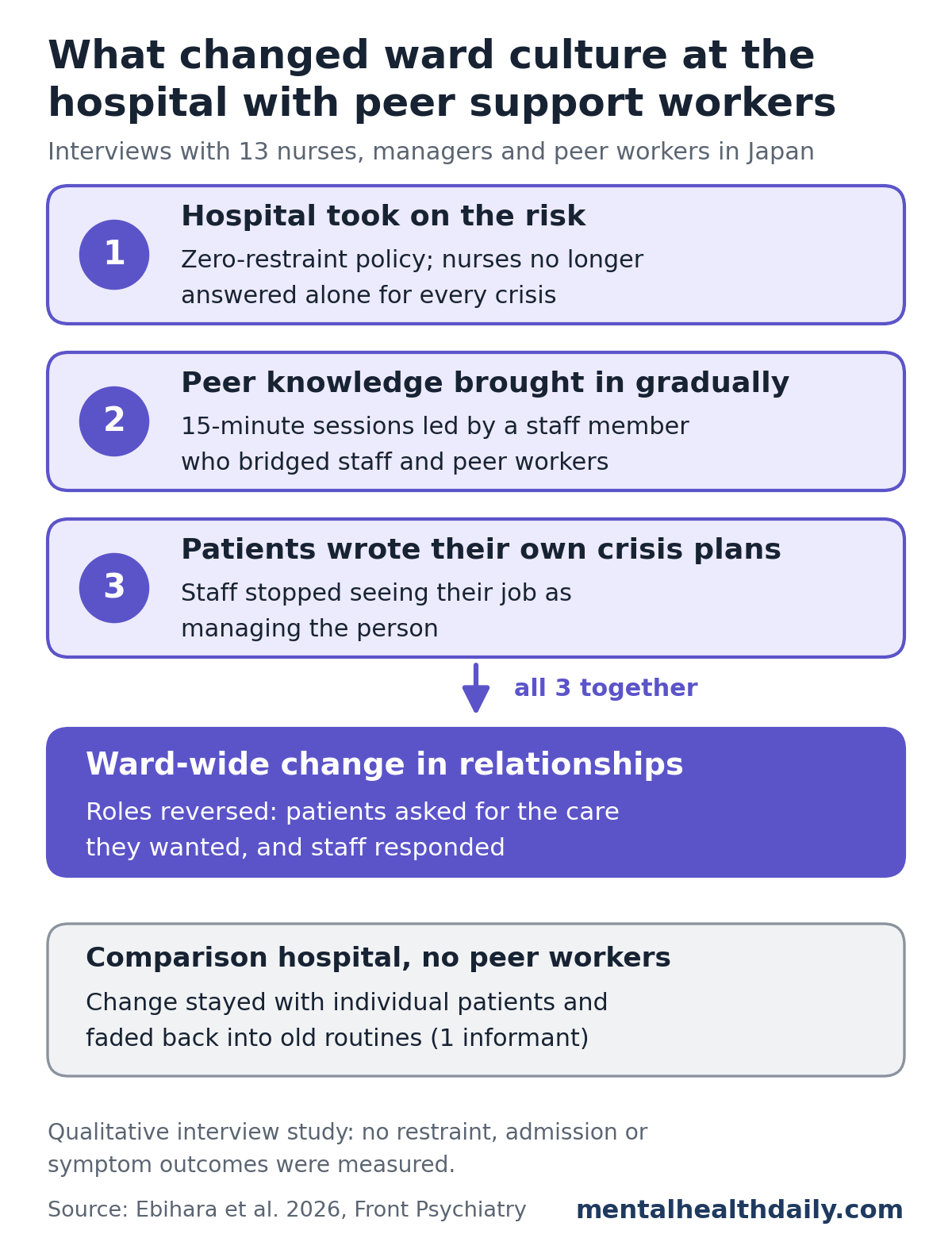
The analysis identified 3 mechanisms at the main hospital:1
- The hospital took on clinical risk. The hospital director set a hospital-wide zero-restraint policy that made the organization, not the nurse at the bedside, responsible for adverse outcomes. Restraint equipment was removed from the ward. “The moment we removed the restraint straps from the ward… our entire response to patients’ crises changed dramatically,” a head nurse said.
- Peer knowledge came in gradually. Hiring peer workers without preparation had failed earlier, leaving staff and peers exhausted. The occupational therapy head then acted as a bridge between the 2 groups, introducing “Choco-WRAP,” 15-minute sessions staff could join during their shifts to hear peer workers describe their own experiences of crisis.
- Patients became the authors. As peer workers helped patients write and own their plans, staff gave up the assumption that their job was to manage someone who could not manage alone.
How peer workers helped nurses: nurses face patients’ anger and fear most directly. Peer workers translated that distress into concrete requests, so nurses knew what to do. “The [peer worker] stops me right when I’m about to become overbearing,” one staff nurse said.1
What the ward looked like afterward: nurses described a unit area where patients could move more freely, a vending machine, and patients keeping their phone charging cables. Two nurses said agitation episodes had decreased significantly; these are staff impressions, not measured rates.1
Patients Asked for Care and Staff Responded
The study’s central outcome was a reversal of roles. Before, care was something done to the patient. After the patient handed over a crisis plan they had written, the patient made requests and the psychiatrist responded.1
The lead peer support worker described it this way: “If you filmed it with a silent camera, you would see the same scene. But the subject had changed.” Another line from the same interview: “[The crisis plan] gave me back the pen.”1
Peer workers also named a check on drift. A dual-role peer worker called it shiensha-shū, “the odor of the helper”: the wariness someone with lived experience feels when a plan written in participatory language still carries the clinician’s logic. The researchers argue that keeping this tension alive, rather than resolving it, stops the new practice from hardening into a new set of fixed rules.1
Crisis Plans Without Peer Workers Stayed Individual
At the comparison hospital, the day-care chief was well aware of the same problems: individual risk burden and clinician-written plans. Without the 3 mechanisms, crisis plans helped individual patients, but nothing in the hospital held those gains in place.1
He described 2 patients. One built a fuller life around his plan, then was transferred on grounds of physical disability to a care facility where the plan had no formal standing. The other had partly reached 2 of the 3 goals in his plan, work and a lasting relationship.1
These accounts come from a single informant and could not be checked, so the researchers present them as illustrations rather than evidence.
Evidence From Crisis Plan Trials
The Japanese study explains how change might happen, while randomized trials test whether crisis planning changes outcomes. That evidence is mostly positive:
- First joint crisis plan trial (England, 2004): among 160 people with psychotic illness or bipolar disorder, 13% of those with a joint crisis plan experienced compulsory admission or treatment vs. 27% with usual care.2
- Larger follow-up trial (England, 2013): the CRIMSON trial randomized 569 people and found no significant reduction in compulsory treatment.3
- Pooled trials (2019): a meta-analysis of 5 randomized trials found a 25% lower risk of compulsory admission with crisis planning (risk ratio 0.75, 95% CI 0.61 to 0.93), with no statistical evidence of fewer voluntary admissions.4
- Peer-facilitated advance directives (France, 2022): in 394 people with schizophrenia, bipolar I disorder or schizoaffective disorder, 27% of those offered peer-worker help with advance directives had a compulsory admission over 12 months vs. 39.9% with usual care.5
- Peer-delivered WRAP (US, 2012): in 519 adults, the 8-week peer-taught program reduced depression and anxiety symptoms more than usual services.6
The Japanese interviews point to one reason trial results vary: a crisis plan changes little when the organization around it does not back it.
Limits of This Crisis Plan Interview Study
The researchers are direct about what their design can support:1
- Best-case site: 12 of 13 interviews came from one hospital with unusually strong management commitment to reducing restraint.
- Thin comparison: the comparison hospital contributed 1 informant, with no nurses or peer workers interviewed there.
- No measured outcomes: restraint use, compulsory admissions, symptoms and incidents were not counted.
- Retrospective accounts: the sequence of change was reconstructed from what people remembered, not observed as it happened.
- One bridge person: the bridging role rested on a single staff member, so it is unclear whether it transfers.
- No patient interviews: service-user experiences came through staff and peer workers.
- Cause unclear: the study cannot tell whether all 3 conditions were required, simply added up, or reflected other differences between the hospitals.
What Hospitals Can Take From Peer-Led Crisis Planning
The researchers propose 4 conditions for making peer-led crisis plans stick, offered as tentative:1
- Formal management commitment to carrying clinical risk at the organizational level
- A designated bridging staff member with institutional protection
- Enough peer workers with crisis plan experience
- Built-in critical tension between professional and lived-experience views, so new practice keeps being questioned
For patients and families, the study’s message is about authorship: a crisis plan is meant to be written by the person who may face the crisis, and peer workers can help make that happen.
References
- Ebihara M, Ban M, Tamura T, Omiya T, Ando K. Why peer-led crisis plan practice does — and does not — transform psychiatric ward culture: a realist-informed qualitative study from Japan. Frontiers in Psychiatry. 2026;17:1915695. doi:10.3389/fpsyt.2026.1915695
- Henderson C, Flood C, Leese M, Thornicroft G, Sutherby K, Szmukler G. Effect of joint crisis plans on use of compulsory treatment in psychiatry: single blind randomised controlled trial. BMJ. 2004;329:136. doi:10.1136/bmj.38155.585046.63
- Thornicroft G, Farrelly S, Szmukler G, et al. Clinical outcomes of Joint Crisis Plans to reduce compulsory treatment for people with psychosis: a randomised controlled trial. Lancet. 2013;381:1634–1641. doi:10.1016/S0140-6736(13)60105-1
- Molyneaux E, Turner A, Candy B, Landau S, Johnson S, Lloyd-Evans B. Crisis-planning interventions for people with psychotic illness or bipolar disorder: systematic review and meta-analyses. BJPsych Open. 2019;5(4):e53. doi:10.1192/bjo.2019.28
- Tinland A, Loubière S, Mougeot F, et al. Effect of psychiatric advance directives facilitated by peer workers on compulsory admission among people with mental illness: a randomized clinical trial. JAMA Psychiatry. 2022. doi:10.1001/jamapsychiatry.2022.1627
- Cook JA, Copeland ME, Floyd CB, et al. A randomized controlled trial of effects of Wellness Recovery Action Planning on depression, anxiety, and recovery. Psychiatric Services. 2012;63(6):541–547. doi:10.1176/appi.ps.201100125