Among people with knee osteoarthritis, fear of movement was linked to everyday capacity problems such as poor vision, low mood and memory trouble, and pain changed several of those links. The findings come from a 2026 survey of 452 patients at a hospital in eastern China.1
Research Highlights
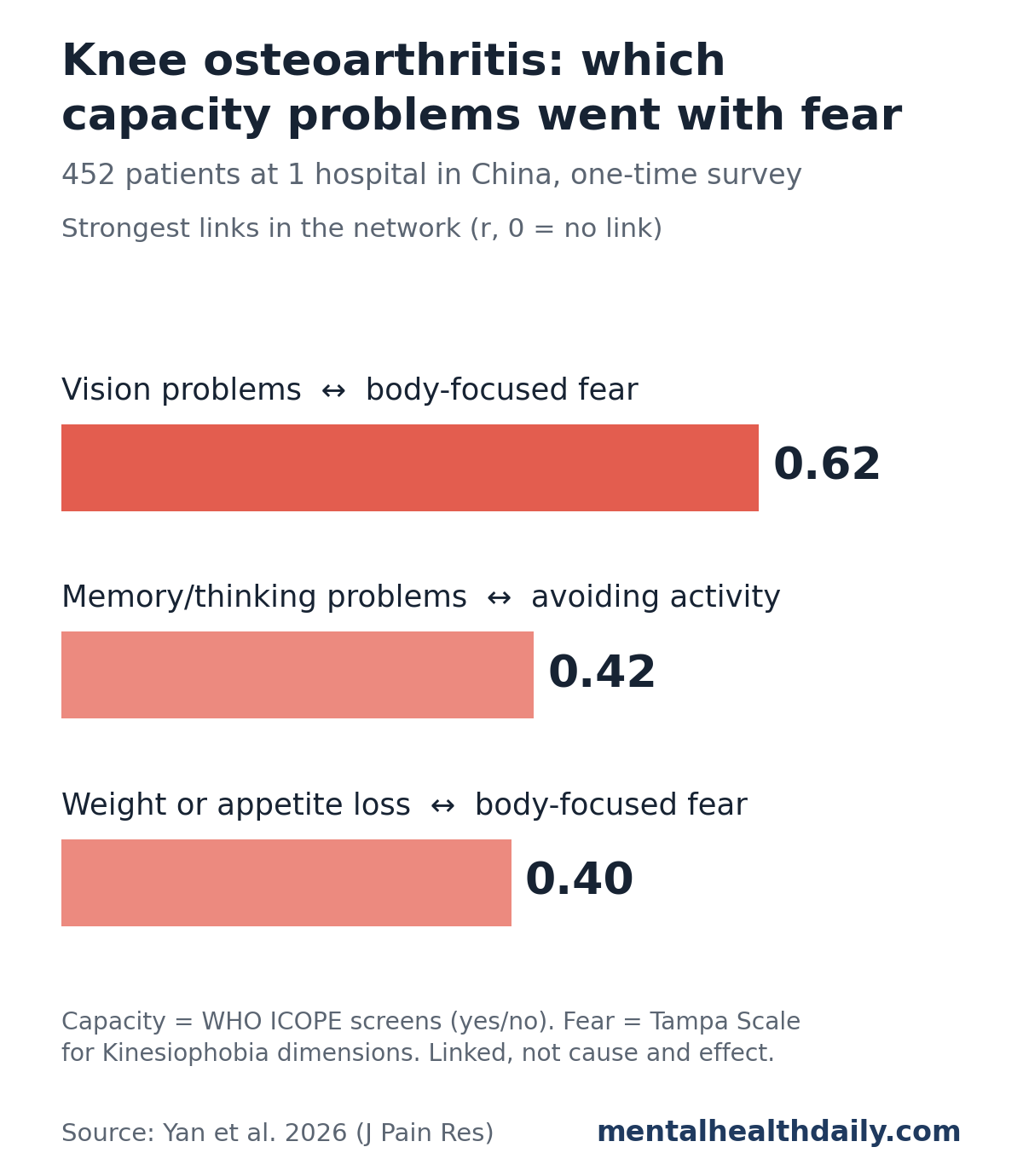
- Vision had the strongest link: a positive vision screen went with more body-focused fear of movement (r = 0.62), followed by memory/thinking problems with avoiding activity (r = 0.42) and weight or appetite loss with body-focused fear (r = 0.40).1
- Body-focused fear sat at the center: worry about what movement does to the body (“somatic focus”) was the most connected part of the network, ahead of psychological well-being and activity avoidance.1
- Higher pain weakened 2 links: the links between low mood and body-focused fear, and between thinking problems and avoiding activity, were significant at lower pain but faded once pain passed about 5 and 4 on a 0–10 scale.1
- Higher pain tightened fear itself: the link between avoidance beliefs and body-focused fear grew stronger as pain rose.1
- One-time survey: the study shows links, not cause and effect, and came from 1 hospital with mostly women.1
Fear of Movement Keeps People With Knee Arthritis From Exercising
Exercise is a core treatment for knee osteoarthritis, yet few patients get enough of it. A 2013 meta-analysis found that only 13% of people with knee osteoarthritis reached 150 minutes a week of moderate-to-vigorous activity in bouts of at least 10 minutes.3
Kinesiophobia, or fear of movement, is one reason. It is an excessive fear that moving will cause pain or injury, and it leads people to avoid the very activity that helps them.1
Across chronic musculoskeletal pain, a 2019 systematic review of 63 studies (10,726 participants) found strong evidence that more fear of movement goes with more pain and disability, and moderate evidence that it predicts worsening disability over time.2
In knee osteoarthritis specifically, a 2022 study of 50 patients found that fear of movement correlated with pain intensity (r = 0.55), poorer sense of knee position and slower sit-to-stand performance.4
How the Study Measured Pain, Capacity and Fear
Zeping Yan et al. recruited 452 patients with primary knee osteoarthritis showing definite but not end-stage damage on X-ray (Kellgren-Lawrence grade II or III) at a tertiary hospital in Shandong province between July 2025 and January 2026. Patients filled out paper questionnaires in a private room.1
- Patients: average age 64, 77.2% women, 66.8% rural, pain for about 5 years on average
- Pain: a 0–10 rating of current knee pain (average 3.4, so mostly mild to moderate)
- Fear of movement: the 11-item Tampa Scale for Kinesiophobia (TSK-11)
- Intrinsic capacity: the World Health Organization’s ICOPE screening tool
Intrinsic capacity is the World Health Organization’s term for the physical and mental reserves a person can draw on: thinking, moving, energy, senses and mood. The ICOPE (Integrated Care for Older People) screen asks short yes/no questions in each area and flags a possible problem.5
In this study the screen covered 7 areas, each scored as preserved or impaired:1
- Cognition: memory and thinking
- Locomotion: getting around
- Vitality: nutrition, flagged by unintended weight loss or poor appetite in the WHO screen
- Vision and hearing: problems seeing or hearing
- Psychological well-being: mood, flagged by feeling down or losing interest in the WHO screen
- Medication use: a 7th area the researchers added from the wider ICOPE framework
The fear scale was split into 3 parts: avoidance beliefs (the idea that pain means harm and activity should stop), somatic focus (worry centered on body sensations and the sense that something is seriously wrong) and activity avoidance (actually holding back from movement).1
What a Moderated Network Analysis Shows
A network analysis treats each measured piece, such as the vision screen or somatic focus, as a node and estimates how strongly each pair is connected after accounting for all the others. Thicker connections mean stronger links.
A moderated network adds one more question: does a third factor change how strong a connection is? Here, pain was the moderator. The researchers then used a method called Johnson-Neyman probing to find the pain level at which each changed link stopped or started being significant.1
Centrality: a node’s expected influence sums the strength of its connections. A highly central node is linked to many others, so researchers often view it as a promising target for future intervention studies.
Vision, Memory and Appetite Problems Were Linked to Fear of Movement
Patients who screened positive for capacity problems tended to report more fear of movement, which supported the researchers’ first hypothesis. Three links between capacity screens and fear stood out:1
- Vision and somatic focus (r = 0.62): the strongest connection in the network between capacity and fear.
- Cognition and activity avoidance (r = 0.42): memory or thinking problems went with holding back from activity.
- Vitality and somatic focus (r = 0.40): weight or appetite loss went with body-focused fear.
Why vision? The researchers suggest that people who see poorly have a harder time judging their surroundings and keeping their balance, which could make movement feel riskier. They note that direct evidence for this explanation is limited.1
A number to watch: 0.62 is a large value for a link between a single yes/no eye screen and a fear score, and the paper does not explore why it is so high. It deserves replication before anyone treats vision as a main driver of kinesiophobia.
Somatic focus was the most central node (expected influence 1.71), followed by psychological well-being (0.90) and activity avoidance (0.78). A bootstrap check, which reran the analysis on smaller subsets of patients, found these rankings stable (stability coefficient 0.70).1
Higher Knee Pain Changed 3 Links Between Capacity and Fear
Pain significantly changed 3 connections, which supported the second hypothesis:1
- Low mood and somatic focus: linked at lower pain, but the link was no longer significant once pain rose above 5.08 out of 10 (t = −3.241, p < 0.01).
- Cognition and activity avoidance: linked at lower pain, but not once pain rose above 4.09 (t = −2.740, p < 0.01).
- Avoidance beliefs and somatic focus: the positive link grew stronger as pain increased (t = 4.574, p < 0.001).
Put simply, mood and thinking problems tracked fear of movement mainly when pain was lower. At higher pain levels those links faded, while beliefs that pain means harm were more closely linked to body-focused worry.
The researchers framed this through the idea that pain drains a person’s coping resources. They also raised central sensitization, where the nervous system becomes more reactive to pain signals, as one possible explanation, but the study did not measure it.1
Average pain was 3.4 out of 10, so the levels where those links faded (about 4 and 5) sit at the more painful end of this sample.
Limitations of This Knee Osteoarthritis Survey
- Cross-sectional design: everything was measured once, so the study cannot say whether capacity problems raise fear, fear erodes capacity, or both. The researchers note that 2-way relationships are plausible.
- One hospital, mostly women: patients came from a single center through convenience sampling, and 77.2% were women.
- Self-report questionnaires: the researchers describe all measures as self-report, which can bring recall and social-desirability bias; no clinical eye exams or objective activity tracking were used.
- Screening, not diagnosis: the ICOPE items flag possible problems rather than confirm, for example, low vision or depression.
- Grade II–III disease only: people with prior knee surgery or knee trauma, and those with the earliest or most advanced X-ray changes, were not included.
What This Means for People With Knee Osteoarthritis
Fear of movement is worth asking about. It has been linked to more pain and disability in earlier research, and can quietly block the exercise that helps knee osteoarthritis most.2,3
Look beyond the knee. Vision, mood, memory and appetite problems all showed up alongside fear in this sample. The researchers suggest that programs combining pain management with work on these capacities could help, and they say longitudinal and intervention studies need to test that.1
Pain level may change what helps. When pain was higher, the beliefs linking pain to harm were more closely linked to body-focused fear. Persistent fear of moving a painful knee is worth raising with a doctor or physical therapist, who can address both the pain and the beliefs behind the fear.
References
- Yan Z, Zhang F, Lu M, Zhang H, Ding H. The relationship among pain, intrinsic capacity, and fear of movement in patients with knee osteoarthritis: a moderated network analysis. Journal of Pain Research. 2026;19:633024. doi:10.2147/JPR.S633024
- Luque-Suarez A, Martinez-Calderon J, Falla D. Role of kinesiophobia on pain, disability and quality of life in people suffering from chronic musculoskeletal pain: a systematic review. British Journal of Sports Medicine. 2019;53(9):554–559. doi:10.1136/bjsports-2017-098673
- Wallis JA, Webster KE, Levinger P, Taylor NF. What proportion of people with hip and knee osteoarthritis meet physical activity guidelines? A systematic review and meta-analysis. Osteoarthritis and Cartilage. 2013;21(11):1648–1659. doi:10.1016/j.joca.2013.08.003
- Alshahrani MS, Reddy RS, Tedla JS, Asiri F, Alshahrani A. Association between kinesiophobia and knee pain intensity, joint position sense, and functional performance in individuals with bilateral knee osteoarthritis. Healthcare. 2022;10(1):120. doi:10.3390/healthcare10010120
- Ma L, Chhetri JK, Zhang Y, Liu P, Chen Y, Li Y, Chan P. Integrated Care for Older People screening tool for measuring intrinsic capacity: preliminary findings from ICOPE pilot in China. Frontiers in Medicine. 2020;7:576079. doi:10.3389/fmed.2020.576079