Advice on how parents and schools should guide children’s use of AI tools like ChatGPT is running well ahead of the evidence. A 2026 review found that only 8 of 46 studies it drew on included anyone under 18, and none measured home and school guidance in the same students.1
Research Highlights
- Mostly college students: of 46 primary-data studies on generative AI and learning, 35 sampled university students and 8 included participants under 18.1
- Mostly one-time snapshots: 26 were cross-sectional surveys; only 4 followed people over time and 2 were experiments.1
- Home and school never measured together: 4 studies measured a family factor and 15 a school factor, but none measured both in the same participants.1
- How AI is used matters more than how often: in older students, outcomes tracked whether learners kept doing the core thinking themselves, not how frequently they used AI.1
- Autonomy support with clear rules: the review proposes guidance that gives children real choices and reasons inside firm limits, and lays out the studies needed to test it.1
Only 8 of 46 AI Learning Studies Included Children
Yaoyao Fan et al. wrote a mini review (a short narrative review rather than a full systematic search) in Frontiers in Psychology, published in September 2026. They gathered research on generative AI — chatbots such as ChatGPT that write text, answer questions and solve problems on request — and its effects on learning.1
Then they did something many reviews skip: they coded every primary-data study they cited by who was studied, how, and whether family or school factors were measured. That audit is the most concrete result of the paper.1
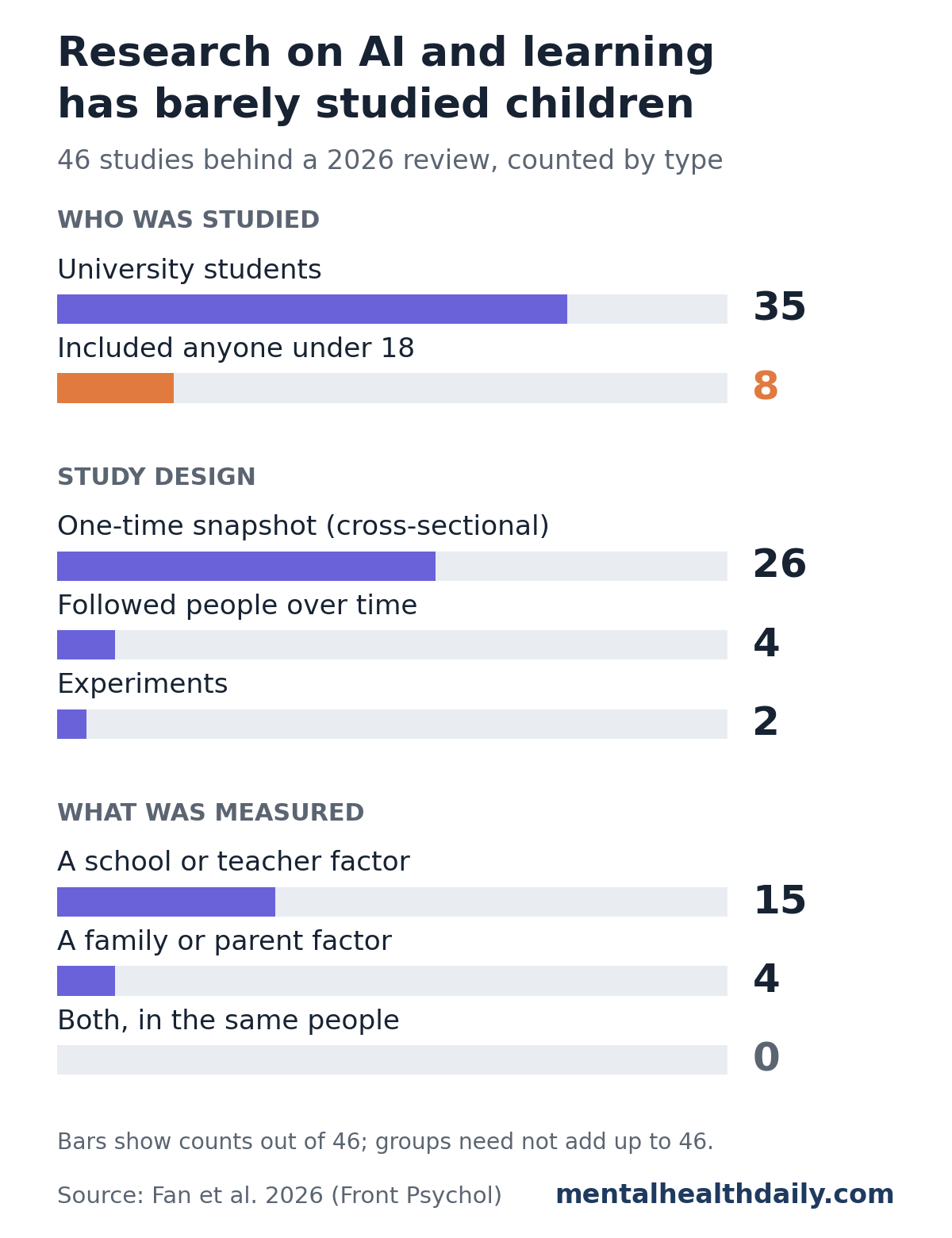
Who was studied: 35 of the 46 studies sampled university students. Only 8 included anyone under 18.1
How they were studied: 26 were cross-sectional, meaning they measured everything at one point in time and can show links but not cause and effect. Just 4 used 2 or more waves of data, and 2 were experiments.1
What was measured: 15 studies measured something about school or teachers and 4 measured something about families. None measured both in the same participants, so no study could show whether home and school guidance work together.1
The researchers state the consequence plainly: every claim about children in their framework is an extrapolation from older learners, and the home-school model they propose is a plan to be tested, not something anyone has observed.1
What Self-Determination Theory and Autonomy Support Mean
The review is built on self-determination theory, a long-standing theory of motivation. It holds that people stay motivated and develop well when 3 basic psychological needs are met:2
- Autonomy: feeling that your actions are your own choice, not forced on you
- Competence: feeling capable and able to improve
- Relatedness: feeling connected to and cared for by others
Autonomy support is the style of guidance that meets those needs. A parent or teacher offers meaningful choices, takes the child’s view into account, and explains the reasons behind rules instead of simply enforcing them.1
Autonomy support is different from letting children do whatever they want. In this theory it comes paired with structure: clear expectations, help building skills, and firm limits. A study of 1,036 high school students found that teachers seen as both autonomy-supportive and clear about expectations had students with the best motivation and self-regulated learning; teachers seen as low on both had the worst outcomes.3
Fan et al. apply this to AI. Detection and punishment alone can’t build judgment, and encouragement without standards leaves students unsure what counts as their own work. Their proposal sits in between: transparent boundaries, plus training in AI literacy, reflection, checking AI output, and disclosing when AI helped.1
Using AI as a Helper vs. Letting It Do the Thinking
Most of what is known about how AI affects learning comes from older students, and it points to the same theme: the pattern of use matters more than the amount.1
- Dependent vs. autonomous offloading: a 3-wave study of 589 university students and early-career knowledge workers separated handing core thinking to AI from using AI as scaffolding while the learner stays in charge. Dependent use was linked to lower intrinsic motivation and poorer perceived thinking outcomes; autonomous use showed the opposite.
- Hidden costs: in that study, both styles gave the same immediate benefit, which makes unhealthy reliance hard to spot from results alone.
- Mixed effects at scale: among 72,615 Chinese university students, AI use was linked to more cognitive and emotional engagement but also to lower academic motivation and less active learning.
Both studies involved university students or working adults. The review uses findings like these to suggest how AI might affect children’s learning, which still has to be checked in children themselves.1
What Research on Schools and Parents Has Found So Far
School side. Teacher-focused studies were more common, and a few involved children. Among German secondary students in classrooms using ChatGPT, perceived teacher support was the strongest predictor of a healthy motivational and emotional profile. AI self-study rooms were linked to gains in motivation, self-regulation, enjoyment and engagement among primary-school learners. None of these studies measured what children experienced at home.1
Family side. Evidence here is thin and mostly descriptive. The 4 family studies were qualitative, cross-sectional or mixed-method, and 3 of them surveyed or interviewed parents rather than children:1
- Parent beliefs: interviews with 16 parents of young children across 9 Chinese cities suggested that parents’ beliefs shape what role AI plays at home and how they manage screen time and content.
- Unequal access: 28.4% of surveyed parents of children with speech and language disorders in Türkiye used ChatGPT for health information, with use varying by gender and education.
- Trust in tools: families managing a child’s chronic illness preferred a condition-specific chatbot to general-purpose ChatGPT.
- Family discussion and ethics: among Chinese middle-school students, independent AI use and family discussion predicted stronger endorsement of AI ethics principles.
None of the 4 family studies measured anything about school or teachers.1
Whether Home and School Guidance Work Together Is Untested
Many guidelines assume that home and school guidance reinforce each other. That idea is plausible: a meta-analysis of 117 studies found that family-school partnership programs improved children’s social-behavioral skills and mental health, with communication and parent-teacher relationships among the helpful ingredients. Nothing comparable exists for AI use.4
The researchers lay out 3 competing versions of how home and school support could combine:1
- Additive: each setting helps on its own, and the benefits simply add up.
- Synergistic: school guidance works better when the child also gets autonomy support at home. This is the version most current guidance assumes, and there is no evidence for it yet.
- Compensatory: support in either setting is enough, so having both adds little.
Telling these apart would take measuring the same children at home and at school, using behavior (what children actually do with AI) rather than self-report alone. The strongest test would be a trial comparing family-only, school-only, coordinated and usual guidance.1
Research the Review Calls For
- Better designs: long-term and experimental studies that track real behavior through log files, screen recordings and children’s actual work, with privacy protections suited to minors.
- Age comparisons: studies across early childhood, primary school, adolescence and college, since AI likely means different things and carries different risks at each age.
- Family mechanisms: how parent beliefs, parenting styles, child temperament and school guidance interact over time.
- Wider reach: research beyond China, the United States and Europe, and designs that include children’s own perspectives.
Limitations of This AI Learning Review
- Narrative, not systematic: the researchers chose studies through a focused, theory-guided search, so the 46 studies are the ones they cited, not a complete count of the field.
- Framework, not findings: most links in their model rest on adult evidence or theory alone; every link involving home-school coordination is untested.
- Audit details in a supplement: the study-by-study coding sits in supplementary tables not included in the main paper.
- Self-report: most underlying studies relied on questionnaires, which can miss how students actually use AI.
What Parents and Teachers Can Take From This
Focus on how children use AI, not just how much. The review’s practical goal is “calibrated delegation”: children learn when AI can support their thinking, when they should work through a problem themselves, and how to check and disclose AI help.1
Pair choice with clear limits. Explaining the reasons for rules, giving children some say within those rules, and teaching them to verify AI output fits decades of motivation research, even though it hasn’t yet been tested for AI specifically.1,3
Treat confident advice with care. Guidance that claims to know how home and school should coordinate around AI is ahead of the research. The studies that could settle it have not been done.
References
- Fan Y, Li X, Zhang R. Family-school autonomy support for children’s responsible use of generative artificial intelligence: a self-determination theory synthesis and developmental research agenda. Frontiers in Psychology. 2026;17:1969217. doi:10.3389/fpsyg.2026.1969217
- Ryan RM, Deci EL. Self-determination theory and the facilitation of intrinsic motivation, social development, and well-being. American Psychologist. 2000;55(1):68–78. doi:10.1037/0003-066X.55.1.68
- Vansteenkiste M, Sierens E, Goossens L, Soenens B, Dochy F, Mouratidis A, Aelterman N, Haerens L, Beyers W. Identifying configurations of perceived teacher autonomy support and structure: associations with self-regulated learning, motivation and problem behavior. Learning and Instruction. 2012;22(6):431–439. doi:10.1016/j.learninstruc.2012.04.002
- Sheridan SM, Smith TE, Moorman Kim E, Beretvas SN, Park S. A meta-analysis of family-school interventions and children’s social-emotional functioning: moderators and components of efficacy. Review of Educational Research. 2019;89(2):296–332. doi:10.3102/0034654318825437