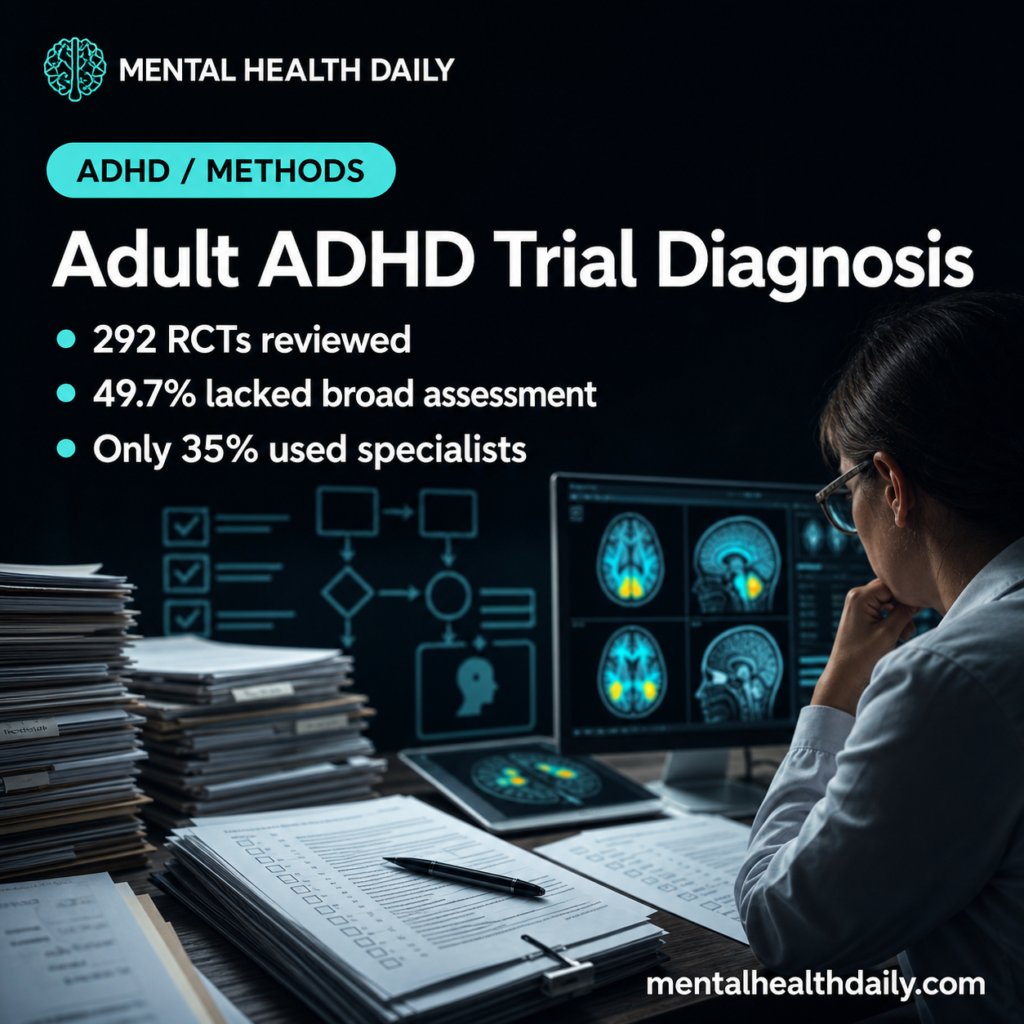
A 2025 scoping review of 292 adult ADHD randomized controlled trials found that 49.7% allocated diagnosis without a general psychopathology assessment, and only 35% reported that psychiatrists or psychologists assigned the ADHD diagnosis.
Research Highlights
- 292 adult ADHD RCTs were reviewed: Studart et al. screened 706 PubMed records and included 292 randomized controlled studies.1
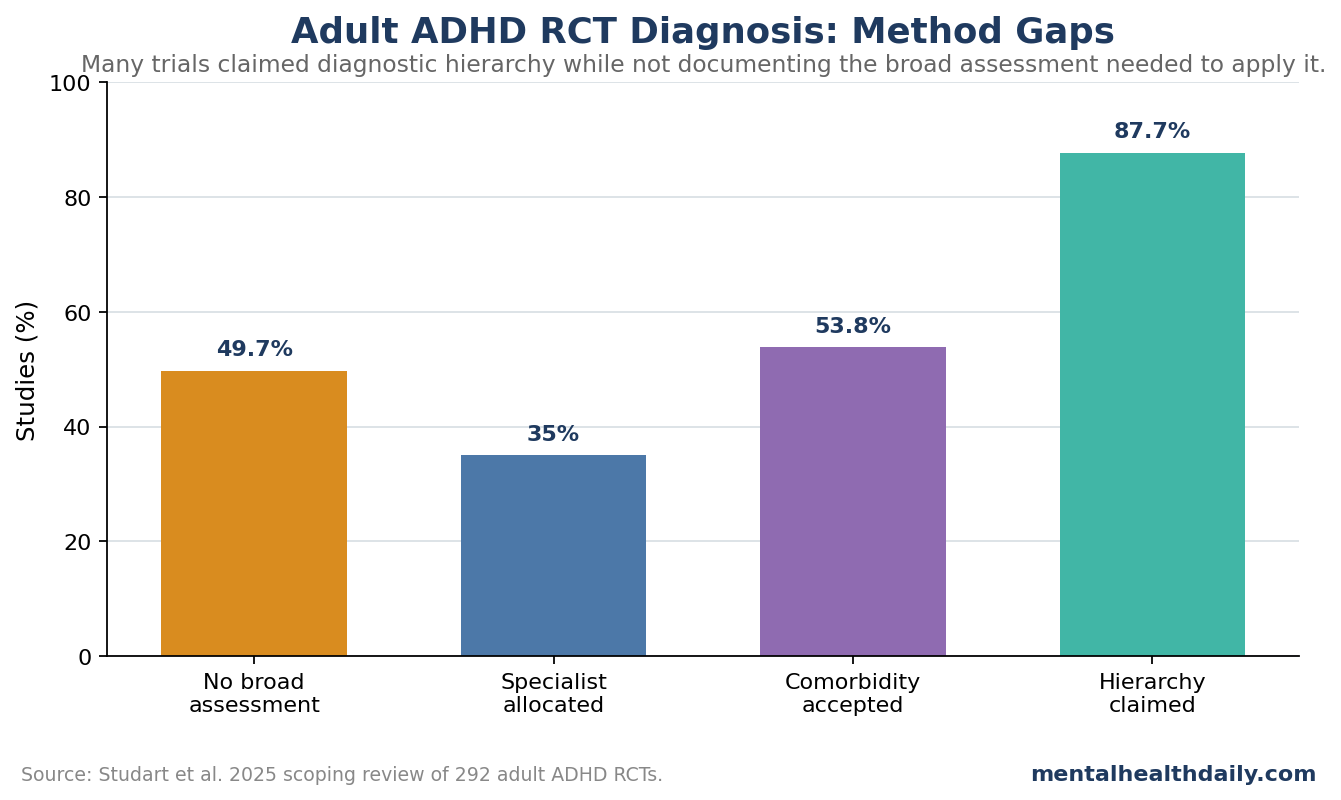
- 49.7% lacked broad diagnostic assessment: nearly half allocated ADHD without assessing general psychopathology, the step needed for differential diagnosis.
- Only 35% used psychiatrists or psychologists: in 190 studies (65%), the diagnostic assessor was not reported, not a psychiatrist or psychologist, or was a computer.
- 53.8% accepted comorbidity: 157 trials included psychiatric comorbidity, making the absence of broad assessment more consequential.
- 87.7% claimed diagnostic hierarchy: 256 studies said they followed hierarchy rules even though many did not describe the assessment needed to apply those rules.
Differential diagnosis means checking whether symptoms are better explained by another condition before assigning a diagnosis. In adult ADHD, that step is not optional because inattention, restlessness, impulsivity, sleep disruption, anxiety, depression, trauma, substance use, and personality pathology can overlap.
Studart et al. did not argue that every adult ADHD trial participant was misdiagnosed. The review makes a narrower methods claim: many RCTs do not document diagnostic procedures strong enough to make the sample clinically interpretable.
Adult ADHD Trial Samples Depend on Diagnostic Workup Quality
ADHD was originally defined around childhood behavior. Adult diagnosis requires translating childhood-observed signs into adult symptom reports, retrospective childhood history, impairment, and exclusion of better explanations. That translation can be valid, but it is harder than counting checklist items.
The review separated diagnostic methods into categories. Some trials relied on clinical diagnosis, some used ADHD-specific scales, and some used structured or semi-structured interviews that assessed broader psychopathology.
- ADHD-specific scale only: 22 studies (7.5%).
- Clinical diagnosis only: 37 studies (12.7%).
- Clinical diagnosis plus ADHD rating scale: 86 studies (29.5%).
- Structured general interview plus ADHD rating scale: 91 studies (31.2%).
- Semi-structured general interview methods: 11 studies across 2 categories.
The key split is not structured vs. unstructured paperwork. It is whether the method included enough general psychopathology assessment to rule out competing explanations.
49.7% of RCTs Did Not Assess General Psychopathology
The 49.7% figure combines studies using only clinical diagnoses, clinical diagnoses plus ADHD-specific rating scales, or ADHD-specific interviews/scales without broader assessment. Those methods may identify people who look ADHD-like, but they cannot fully test whether the presentation is better explained by another mental disorder.
That limitation is amplified by comorbidity. A trial can include patients with anxiety, depression, substance use, or personality pathology and still be clinically useful. The problem is including comorbidity while failing to show how researchers distinguished ADHD from those overlapping presentations.
Clinical implication: when an adult ADHD RCT reports medication or psychotherapy effects, readers need to ask who entered the trial. A weak diagnostic gate can make treatment effects harder to generalize to careful psychiatric practice.
Specialist Allocation Was Reported in Only 35% of Studies
The review found that 190 studies (65%) either did not report who conducted the diagnostic assessment, used someone other than a psychiatrist or psychologist, or relied on a computer. That does not automatically invalidate every study, but it weakens confidence in diagnostic comparability.
Psychiatric diagnosis requires more than symptom counting. A skilled assessment can identify mania, psychosis, sleep disorders, substance effects, traumatic stress, autism, learning disorders, medication effects, and cognitive problems that can mimic or modify ADHD symptoms.
Adjacent prevalence work explains why this standard is important. The World Federation consensus statement estimated adult ADHD at 2.5%,2 while a global meta-analysis estimated symptomatic adult ADHD at 6.75% in 2020.3 Symptom prevalence is not identical to diagnosis, and trial methods need to hold that line.
Social Visibility Raises the Stakes for Trial Methods
Adult ADHD awareness has increased quickly. Social media can make adults recognize real impairment and seek help, but it can also circulate broad symptom lists that fit many problems. Yeung et al. found variable-quality ADHD content on TikTok,4 which makes careful research diagnosis more important, not less.
Evidence-strength note: this was a scoping review of published trial methods. It can show reporting gaps and method variation; it cannot prove how many participants were misdiagnosed. The practical verdict is still serious because RCTs influence guidelines and prescribing.
The review also lands in a clinical environment where adult ADHD diagnosis is doing more work than it used to. Diagnosis can influence stimulant access, workplace accommodations, academic supports, disability claims, and patient identity. If trials do not show how they separated ADHD from anxiety, depression, bipolar disorder, substance use, sleep debt, trauma, and autism, the evidence base becomes harder to apply to the exact adults now presenting for evaluation.
RCT Reports Should Show How Adult ADHD Was Separated From Mimics
A useful adult ADHD trial report should let readers reconstruct the diagnostic gate. The minimum standard is not a perfect interview label; it is enough detail to know how researchers handled overlapping conditions and who made the final diagnostic call.
For adult ADHD, transparent reporting should name:
- Diagnostic authority: psychiatrist, psychologist, trained clinician, research assistant, computer algorithm, or unclear source.
- Broad interview: whether the assessment covered mood, anxiety, psychosis, trauma, substance use, sleep, autism, learning disorders, and personality pathology.
- Childhood evidence: how researchers established age of onset and whether collateral history was used.
- Functional impairment: whether symptoms caused impairment in work, school, relationships, finances, driving, or daily organization.
- Comorbidity rules: which conditions were excluded, which were allowed, and how active symptoms were handled.
Those details affect how a trial should be used. A stimulant trial with strong diagnostic workup may generalize to specialist ADHD clinics. A trial with scale-based entry and limited comorbidity assessment may still estimate medication response in a symptom-defined population, but its clinical meaning is narrower.
Diagnostic Weakness Can Distort Treatment Effect Estimates
Loose diagnostic entry can pull estimates in either direction. If a trial includes people with attention problems driven by sleep deprivation, depression, anxiety, stimulant misuse, or bipolar symptoms, ADHD-specific treatment effects may look smaller because the intervention is aimed at the wrong mechanism.
The opposite distortion is also possible. A trial sample filtered for uncomplicated, treatment-responsive, checklist-positive patients may overstate benefit compared with a real clinic where ADHD overlaps with trauma, mood disorder, learning disability, and substance use.
Clinical implication: adult ADHD evidence should be graded partly by diagnostic rigor. Treatment effect size, adverse events, and dropout rates are easier to interpret when the sample actually resembles the patients clinicians are trying to treat.
Diagnostic rigor also affects adverse-event interpretation. If a sample includes undetected bipolar disorder, substance use disorder, sleep disorder, or trauma-related hyperarousal, stimulant tolerability and discontinuation rates may reflect mixed pathology rather than ADHD treatment response alone.
That does not make strict exclusion the only answer. Some trials should study complicated real-world ADHD with comorbidity. The reporting standard is the same: name the comorbidity, document the diagnostic process, and explain whether the trial is testing a clean efficacy sample or a pragmatic clinical population.
Reader translation: when two adult ADHD RCTs disagree, diagnostic entry criteria may explain part of the conflict. A scale-only sample and a specialist-diagnosed sample are not automatically measuring the same clinical population.
The review also highlights a transparency problem. A paper that says participants "met DSM criteria" without explaining who assessed them and how competing disorders were evaluated gives readers a conclusion without the method needed to trust it.
Adult ADHD research does not need to exclude every complicated patient to be valid. It needs to stop hiding complexity behind thin diagnostic labels. A pragmatic trial can include comorbidity and still be high quality if it states what was present, what was excluded, and how diagnostic uncertainty was handled.
That reporting standard is also fair to patients. A person seeking ADHD care should not have to guess whether trial results came from people with the same diagnostic complexity, medication exposure, and comorbidity burden they bring to clinic.
Trial evidence is more useful when that match is visible in ordinary methods language before clinicians extrapolate.
None of this argues for gatekeeping adults out of ADHD treatment. It argues for cleaner evidence labels. A trial can be valuable if it studies narrowly defined ADHD, broadly comorbid ADHD, primary-care ADHD, or symptom-screen-positive attention problems. The failure is when those populations are blurred together under a single diagnostic heading, then used as if the treatment estimate applies equally to every adult with concentration problems.
Questions About Adult ADHD Trial Diagnosis
Does this mean adult ADHD is not real?
No. Adult ADHD is a valid clinical diagnosis when assessed carefully. The review criticizes inconsistent trial diagnosis methods, not the existence of adult ADHD.
Why is general psychopathology assessment so important?
Because ADHD-like symptoms can come from multiple causes. Without a broad assessment, a trial can accidentally study a mixed group and call it adult ADHD.
Should existing adult ADHD treatment trials be ignored?
No. They should be read with diagnostic-method weight. Trials with specialist assessment and broad differential diagnosis deserve more confidence than trials relying mainly on checklists or unclear clinical labels.
References
- Diagnosing ADHD in Adults in Randomized Controlled Studies: A Scoping Review. Studart I et al. European Psychiatry. 2025;68(1):e64. doi:10.1192/j.eurpsy.2025.2447
- The World Federation of ADHD International Consensus Statement: 208 Evidence-Based Conclusions About the Disorder. Faraone SV et al. Neuroscience & Biobehavioral Reviews. 2021;128:789-818. doi:10.1016/j.neubiorev.2021.01.022
- The Prevalence of Adult Attention-Deficit Hyperactivity Disorder: A Global Systematic Review and Meta-Analysis. Song P et al. Journal of Global Health. 2021;11:04009. doi:10.7189/jogh.11.04009
- TikTok and Attention-Deficit/Hyperactivity Disorder: A Cross-Sectional Study of Social Media Content Quality. Yeung A et al. Canadian Journal of Psychiatry. 2022;67(12):899-906. doi:10.1177/07067437221082854