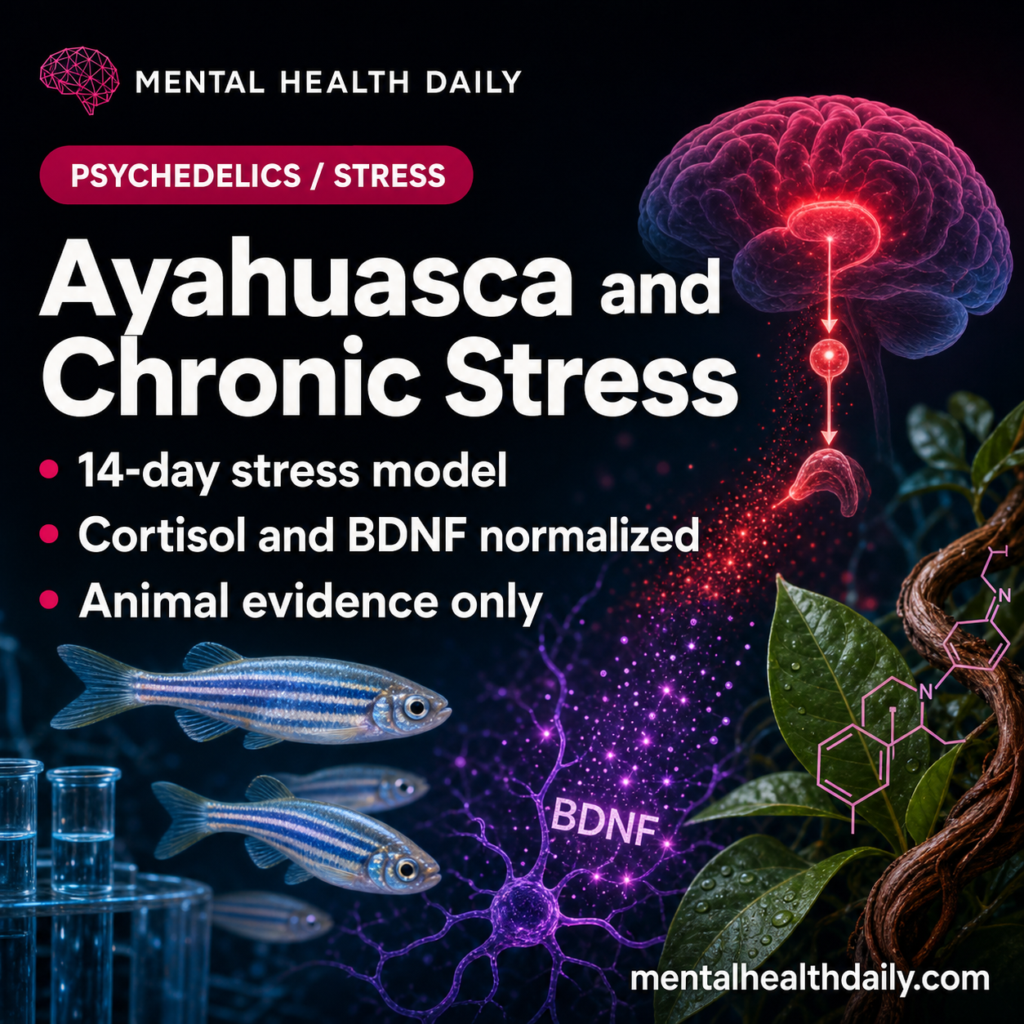
A zebrafish experiment found that one 1-hour ayahuasca exposure reversed several effects of 14 days of unpredictable chronic stress: impaired sociability, anxiety-like behavior, stress-related hyperlocomotion, elevated cortisol, and reduced whole-brain BDNF.1 The result is mechanistic animal evidence, not a clinical trial of ayahuasca for human depression or anxiety.
Research Highlights
- 14 days of chronic stress changed behavior: unpredictable chronic stress reduced zebrafish sociability and increased anxiety-like behavior before ayahuasca exposure.1
- 1 exposure reversed multiple markers: ayahuasca at 0.5 or 1 mL/L for 1 hour restored social behavior, anxiety-like behavior, cortisol, and whole-brain BDNF patterns.1
- BDNF moved with stress recovery: the stress-induced whole-brain BDNF decrease was reversed within 24 hours of exposure.1
- Cortisol normalized too: whole-body cortisol elevation after chronic stress was attenuated by ayahuasca exposure.1
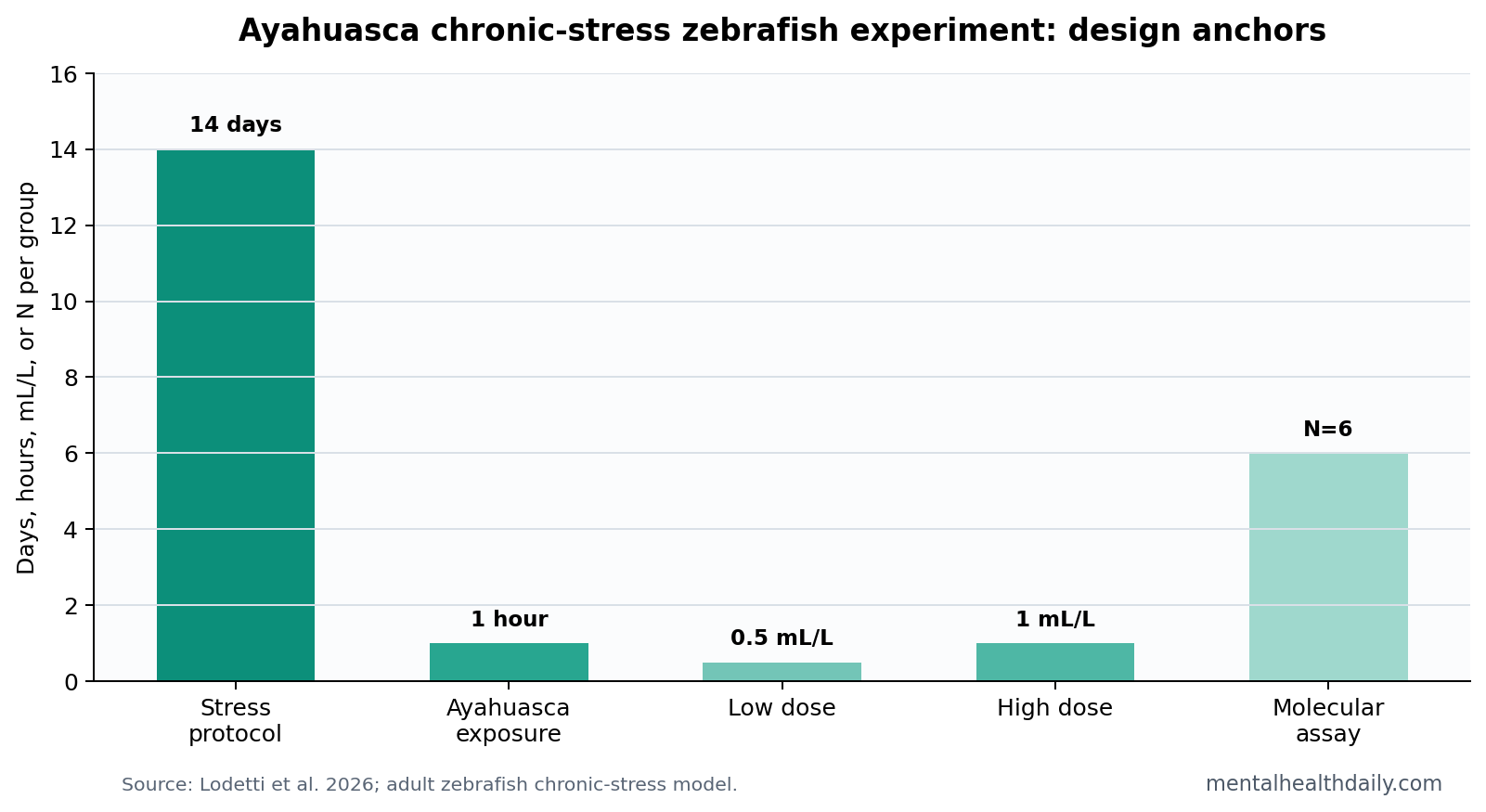
- Clinical claims stay off-limits: molecular assay group size was N = 6 per group, and zebrafish behavior cannot establish human treatment efficacy.1
Ayahuasca is a psychoactive brew containing compounds that affect serotonin signaling and monoamine metabolism. In this experiment, the relevant question was not ceremonial use or psychotherapy; it was whether a single exposure changed stress-linked behavior and biomarkers in a controlled animal model.
BDNF (brain-derived neurotrophic factor) is a growth-supporting protein involved in synaptic plasticity, stress adaptation, and antidepressant biology. Cortisol is a major stress hormone. In zebrafish, whole-body cortisol and whole-brain BDNF are crude but useful stress-biology readouts.
14 Days of Unpredictable Chronic Stress Set Up the Test
Lodetti et al. exposed adult zebrafish to unpredictable chronic stress for 14 days, then added ayahuasca to the tank on day 15 for 1 hour at 0.5 or 1 mL/L. Behavioral testing followed on day 16 with sociability and novel-tank tests, plus biochemical assays for cortisol and BDNF.1
Novel-tank testing measures anxiety-like behavior by observing how fish explore a new tank. Stressed zebrafish often spend more time in the bottom area and show altered locomotion. Sociability testing measures preference for staying near other fish.
Behavior and Stress Biomarkers Recovered Together
Chronic stress reduced sociability and increased anxiety-like behavior. Ayahuasca exposure restored social interaction and reduced the anxiety-like profile. The same treatment also attenuated stress-induced hyperlocomotion.1
Biochemical results moved in the same direction. Chronic stress increased whole-body cortisol and decreased whole-brain BDNF. Ayahuasca reversed those changes, bringing both stress hormone and plasticity-marker readouts closer to non-stressed control patterns.1
The key point is coordination across levels. A behavior-only result could be dismissed as nonspecific arousal. A biomarker-only result could be hard to interpret. Behavior, cortisol, and BDNF moving together make the stress-recovery interpretation stronger inside the limits of the model.
Zebrafish Evidence Can Clarify Mechanisms, Not Prescribe Treatment
Zebrafish are useful in stress research because they allow controlled exposure, rapid behavioral testing, and whole-body biochemical assays. Prior work has used unpredictable chronic stress to produce anxiety-like behavior and cortisol changes in zebrafish.3 Adult zebrafish anxiety tests also have a conceptual literature warning against one-to-one translation to human symptoms.4
Evidence-strength note: this was an adult zebrafish experiment. It can support a mechanism hypothesis about stress recovery, cortisol, and BDNF. It cannot estimate antidepressant response, anxiety response, dose safety, psychological experience, or long-term outcomes in humans.
Human Ayahuasca Depression Data Remain Separate
Human ayahuasca research includes small clinical and naturalistic studies, including a randomized placebo-controlled trial in treatment-resistant depression.2 Those studies ask a different question than the zebrafish experiment. They involve human expectations, setting, adverse-event monitoring, psychological content, and clinical symptom scales.
The Lodetti experiment is valuable because it narrows the biological question: can ayahuasca-like exposure reverse stress-linked behavioral and biochemical changes quickly in a controlled model? The answer was yes within the model. The next question is which compounds, receptors, and downstream plasticity pathways produced that reversal.
Whole-Brain BDNF Is a Broad Plasticity Marker
BDNF is often discussed as if higher is automatically better, but the biology is more context-specific. It varies by brain region, stress exposure, developmental timing, sex, receptor signaling, and behavioral state. Whole-brain BDNF in zebrafish is therefore a broad signal, not a map of which circuit recovered.
The limitation does not erase the result. Chronic stress reduced whole-brain BDNF, and ayahuasca reversed that reduction.1
The honest interpretation is that the treatment moved a plasticity-linked marker in the expected recovery direction. It does not identify whether social behavior improved because BDNF changed, whether BDNF changed because behavior and stress physiology changed, or whether both moved downstream of another pathway.
A stronger mechanism study would manipulate BDNF signaling directly. If blocking BDNF signaling prevents the behavioral recovery, the causal case becomes stronger. If behavior still recovers while BDNF signaling is blocked, BDNF may be a marker rather than the driver.
Cortisol Adds a Stress-System Readout
Whole-body cortisol gives the experiment a second biological layer. Chronic stress elevated cortisol, and ayahuasca attenuated that elevation.1 In a stress model, that result is more directly interpretable than BDNF alone because cortisol is part of the stress-response system.
Still, whole-body cortisol in a fish is not the same as a human hypothalamic-pituitary-adrenal axis profile. Hypothalamic-pituitary-adrenal axis refers to the hormonal stress system linking the brain, pituitary gland, adrenal signaling, and cortisol output. Human studies would need timing-sensitive cortisol measures, symptom scales, adverse-event monitoring, and context about set, setting, and psychological experience.
Drug-Science Category Requires Safety Boundaries
Ayahuasca belongs in a drug-science category because it is a psychoactive substance with pharmacological effects. That classification is not an endorsement, a usage recommendation, or a claim that unsupervised use is safe.
Human ayahuasca exposure can involve acute psychological distress, cardiovascular effects, vomiting, drug interactions, and serious risk in vulnerable psychiatric or medical contexts. People taking serotonergic medications, stimulants, monoamine oxidase inhibitors, or multiple psychiatric drugs need especially careful medical oversight. None of those safety questions can be answered by zebrafish behavior.
For MHD purposes, the value of this study is mechanistic discipline. It keeps the claim specific: a single exposure reversed chronic-stress changes in a fish model across social behavior, anxiety-like behavior, cortisol, and BDNF. Everything beyond that needs human evidence.
Dose Translation Is the Wrong Shortcut
The experiment used ayahuasca concentrations of 0.5 and 1 mL/L in tank water for 1 hour.1 Those values should not be converted casually into a human dose. Aquatic exposure, absorption route, body size, metabolism, and compound mixture all differ from oral ceremonial or clinical ingestion.
That point is not a technicality. Psychedelic studies are especially vulnerable to dose-story overreach because readers want a practical number. This paper does not provide one. It provides a controlled exposure condition that produced measurable reversal of a stress phenotype in fish.
The right follow-up is pharmacological decomposition. Researchers would need to test whether the effect depends on DMT-like serotonergic signaling, beta-carboline monoamine oxidase inhibition, downstream BDNF pathways, cortisol regulation, or a combined mixture effect. Without that work, “ayahuasca reversed stress” is a headline, not a mechanism.
The Behavioral Labels Are Model Terms
“Anxiety-like” and “depression-like” are model terms, not diagnoses. Fish do not report worry, hopelessness, rumination, trauma memories, or suicidal thoughts. Researchers infer anxiety-like behavior from movement, avoidance, bottom dwelling, exploration, and social patterns.
Those measures are still useful when used carefully. They let researchers test whether stress shifts behavior in a predictable direction and whether a compound reverses that shift. The limitation is translation: the model can identify candidate pathways, but human clinical meaning requires human outcomes.
The Lodetti study is strongest when read as a convergence result inside one model. Chronic stress moved social behavior, anxiety-like behavior, locomotion, cortisol, and BDNF in a stress-consistent direction; ayahuasca exposure moved those same layers back toward control patterns.1 That pattern is more coherent than a single isolated behavioral change, but it is still not a substitute for receptor-level causality.
Several follow-up tests would make the mechanism cleaner. Researchers could separate candidate pathways instead of treating the full brew as one black box:
- Compare isolated compounds against the full mixture.
- Block candidate serotonin receptors.
- Test monoamine oxidase inhibition separately.
- Measure region-specific BDNF signaling.
- Follow behavior beyond the first 24-hour window.
If the same recovery pattern survives those tests, the claim shifts from “ayahuasca exposure reversed a stress phenotype” toward a more precise account of which pathway mattered.
Until then, the article’s boundary should stay narrow. The zebrafish data support a stress-biology hypothesis. They do not tell a reader whether human ayahuasca use is safe, whether 1 session is enough, whether psychological setting is necessary, or whether similar biomarker changes would appear in people with depression, anxiety, trauma, or substance-use disorders.
Questions About Ayahuasca and Chronic Stress
Does this show ayahuasca treats depression?
No. It shows reversal of stress-model behavior and biomarkers in zebrafish. Human depression treatment requires human trials.
Why are BDNF and cortisol important here?
They connect behavior to stress biology. Cortisol reflects stress-hormone activation, while BDNF reflects plasticity-related signaling that often changes in stress and antidepressant models.
Could the result be nonspecific stimulation?
The paper argued against a simple nonspecific effect because ayahuasca selectively restored stress-induced abnormalities rather than merely increasing activity in all groups. That still needs receptor-level follow-up.
References
- Lodetti R, et al. Single exposure to Ayahuasca reverses chronic stress effects on sociability, anxiety, cortisol, and BDNF in zebrafish. Psychopharmacology. 2026. https://doi.org/10.1007/s00213-026-07058-z
- Palhano-Fontes F, et al. Rapid antidepressant effects of the psychedelic ayahuasca in treatment-resistant depression: a randomized placebo-controlled trial. Psychological Medicine. 2019;49:655-663. doi:10.1017/s0033291718001356
- Piato AL, et al. Unpredictable chronic stress model in zebrafish: behavioral and physiological responses. Progress in Neuro-Psychopharmacology and Biological Psychiatry. 2011;35:561-567. https://doi.org/10.1016/j.pnpbp.2010.12.018
- Stewart A, et al. Modeling anxiety using adult zebrafish: a conceptual review. Neuropharmacology. 2012;62:135-143. https://doi.org/10.1016/j.neuropharm.2011.07.037