hit counter

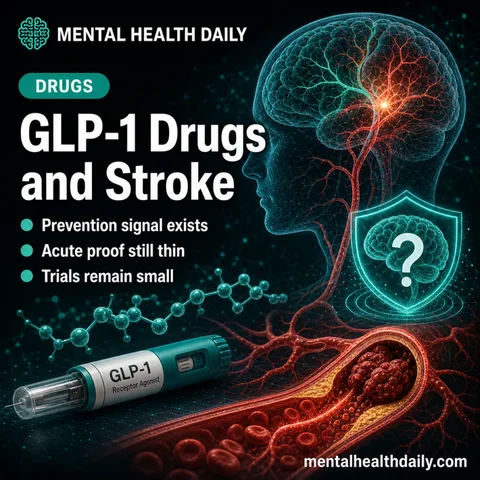
GLP-1 Stroke Review Finds Prevention Signal, No Acute Neuroprotection Proof

MHD featured image for GLP-1 receptor agonists and stroke neuroprotection.

A 2026 review concluded that GLP-1 receptor agonists have plausible stroke biology and modest prevention signals, but current human evidence does not support routine use as acute ischemic stroke neuroprotection.1 The useful clinical split is prevention in cardiometabolic patients vs. acute brain-rescue treatment after stroke onset. Research Highlights Acute neuroprotection is not established: the 2026 …

Read more

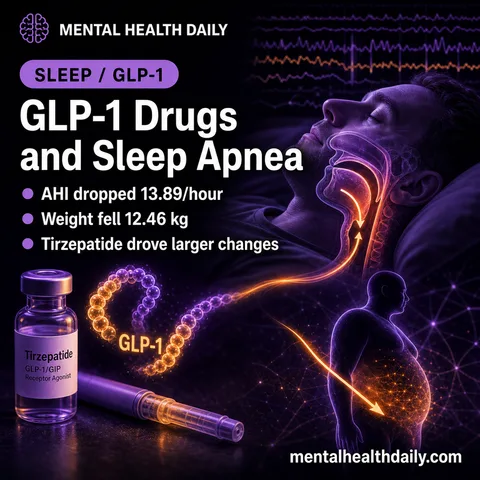
GLP-1 Drugs Reduced Sleep Apnea AHI by 13.89 Events per Hour

MHD featured image for GLP-1 receptor agonists reducing sleep apnea severity and weight.

A 2026 meta-analysis of 4 randomized trials found that GLP-1 receptor agonists reduced obstructive sleep apnea severity by 13.89 apnea-hypopnea events per hour compared with placebo, alongside 12.46 kg more weight loss than placebo.1 The effect looks clinically meaningful for obesity-linked sleep apnea, but high heterogeneity means the result should not be flattened into “GLP-1 …

Read more

Semaglutide Did Not Increase Suicidality in 102,361 Veterans

MHD featured image for semaglutide and suicidality risk in veterans with type 2 diabetes.

A 2026 target-trial emulation involving 102,361 U.S. veterans with type 2 diabetes found no increased suicidality risk after starting semaglutide vs. sodium-glucose cotransporter-2 inhibitors (SGLT2 inhibitors): suicidal ideation HR 0.99 and suicide attempt/death HR 1.05 after overlap weighting.1 That does not prove semaglutide prevents suicide, but it weakens the broad claim that semaglutide initiation itself …

Read more

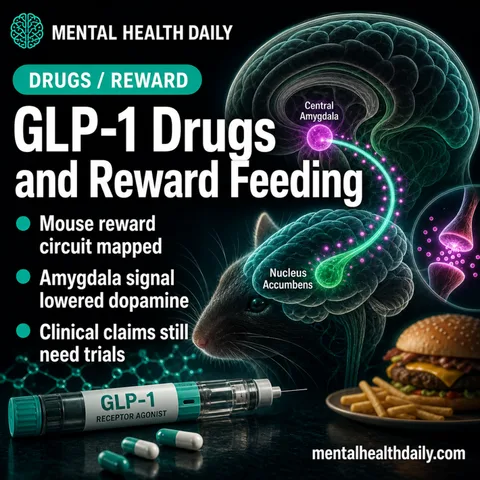
GLP-1 Drugs Suppress Reward Feeding Through an Amygdala-Dopamine Circuit

MHD featured image for GLP-1 drugs, reward feeding, amygdala signaling, and dopamine circuitry.

GLP-1 drugs are usually described as appetite drugs, but a 2026 Nature mouse study mapped a more specific reward circuit: small-molecule GLP-1 receptor agonists suppressed palatable-food intake through Glp1r-expressing central-amygdala neurons that reduced dopamine release in the nucleus accumbens during high-fat-food retrieval.1 That mechanism makes binge-eating and substance-use hypotheses more plausible without turning an animal …

Read more

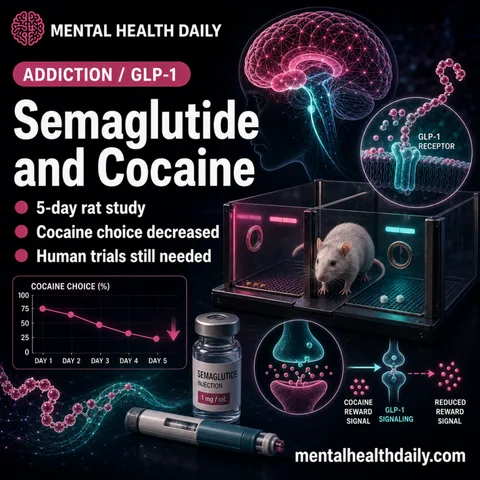
Semaglutide Reduced Cocaine Choice in Rat Study

Semaglutide is not close to being an approved cocaine-use-disorder medication, but a 2026 rat study gives the idea a more demanding preclinical test than ordinary self-administration experiments. After 5 days of treatment, rats shifted away from cocaine choice without losing total operant responding, which separates the result from a broad appetite-suppression artifact. Research Highlights Semaglutide …

Read more