
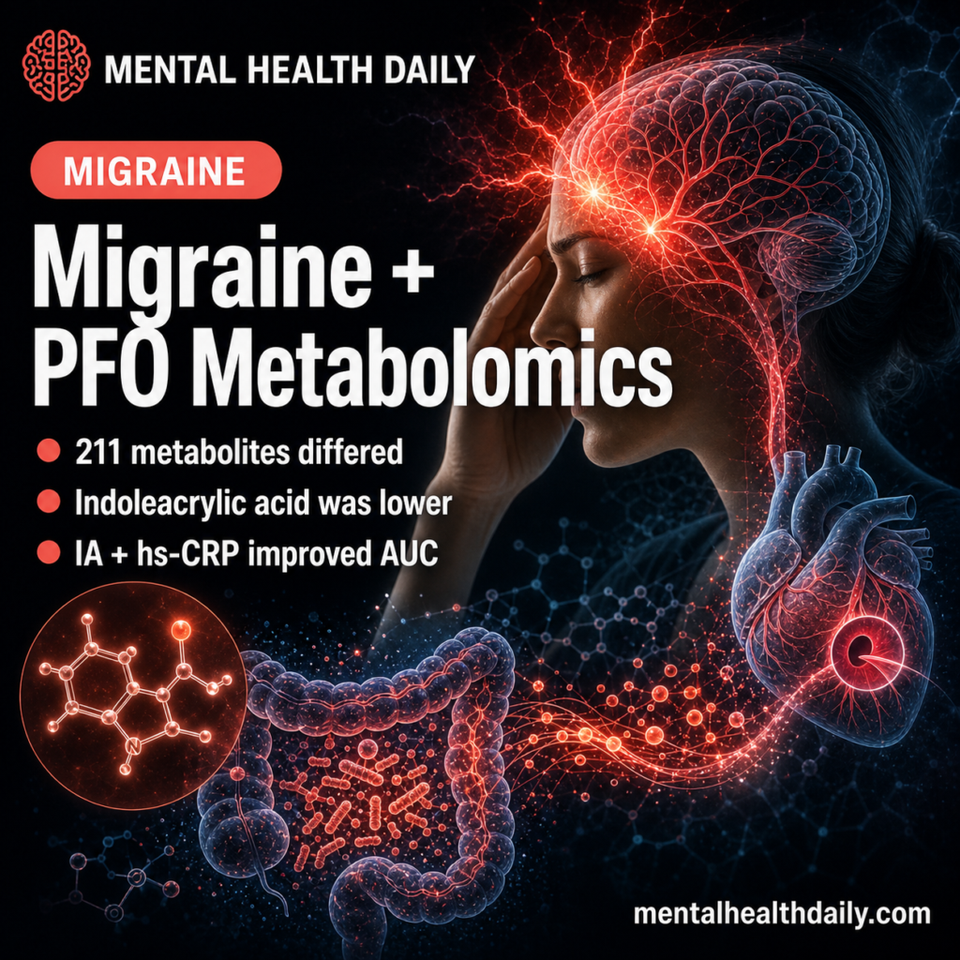
A 2026 iScience metabolomics study found 211 differentially expressed metabolites in migraine patients with patent foramen ovale; in a 220-person validation cohort, lower indoleacrylic acid plus hs-CRP reached AUC 0.722 for distinguishing migraine with PFO from controls.1
Research Highlights
- Metabolomics found a broad signal: The discovery cohort included 30 migraine-with-PFO patients and 17 controls, with 211 differentially expressed metabolites.1
- Indoleacrylic acid was lower: In validation samples, IA averaged 57.01 vs. 72.93 ng/L in PFO-M patients vs. controls.1
- IA alone was moderate: IA had AUC 0.647, 95% CI 0.574 to 0.719, with 47.27% sensitivity and 80.01% specificity.1
- IA plus inflammation exceeded either marker alone: IA combined with hs-CRP reached AUC 0.722, 95% CI 0.653 to 0.790.1
- The evidence is exploratory: The strongest claim is metabolic stratification, not a clinical blood test or proof that PFO closure treats migraine through IA.1
Patent foramen ovale (PFO) is a persistent opening between the right and left atria of the heart. It can allow venous blood constituents to bypass the lung filter and enter arterial circulation. PFO is more common in migraine with aura than in the general population, but closure trials have produced mixed enough results that mechanism still matters.
Indoleacrylic acid is a gut microbiota-derived tryptophan metabolite with anti-inflammatory and barrier-related biology. Luo et al. did not prove it causes migraine. They tested whether it belongs to a metabolic signature in migraine patients with PFO.
211 Metabolites Differed in Migraine With PFO
The discovery cohort included 30 migraine patients with PFO and 17 age- and sex-matched healthy controls. Using LC-MS/MS and GC-MS, the researchers detected 4,858 metabolites and identified 211 differentially expressed metabolites by VIP greater than 1.0 and p < 0.05 criteria.1
The altered pathways were not random. Enrichment pointed toward branched-chain amino acid metabolism, neurosteroid pathways, tryptophan metabolism, phenylalanine metabolism, fatty-acid biosynthesis, and other energy/inflammatory routes.
- Energy metabolism: branched-chain amino acids can feed mitochondrial and neurotransmitter-related pathways.
- Neurosteroids: steroid metabolites can modulate GABAergic and stress-responsive signaling.
- Tryptophan biology: gut-derived indoles and kynurenine-pathway metabolites sit at the immune-brain interface.
Indoleacrylic Acid Was Lower in the 220-Person Validation Cohort
The validation cohort compared 110 migraine-with-PFO patients with 110 age- and sex-matched controls. Indoleacrylic acid measured by ELISA was lower in the migraine-with-PFO group, 57.01 vs. 72.93 ng/L.1
Multivariable logistic regression kept IA as an independent protective factor, while high-sensitivity C-reactive protein remained a risk factor. As a single marker, IA had moderate discrimination, AUC 0.647. Combining IA with hs-CRP improved discrimination to AUC 0.722.
The Gut-Brain Axis Signal Is Plausible but Not Diagnostic
The gut-brain interpretation is reasonable because IA is microbiota-derived, tryptophan-linked, and inversely associated with migraine severity measures in the study. But the diagnostic numbers are not strong enough for clinical screening. AUC 0.722 means moderate separation, not a reliable individual test.
Adjacent evidence: migraine metabolomics literature has already implicated lipid, amino-acid, mitochondrial, and inflammatory pathways.2 PFO closure trials show that the PFO-migraine relationship is clinically real for some patients but not simple enough to treat as one mechanism.3
Luo et al. add a metabolic layer: PFO-comorbid migraine may involve immune-metabolic and gut-derived signatures that standard headache diaries cannot capture.
Exploratory Omics Needs Replication Before Clinical Use
Evidence-strength note: untargeted metabolomics is discovery science. It is excellent for finding candidate pathways, but it is sensitive to diet, medication, sex, inflammation, vascular comorbidity, sample handling, and statistical thresholding.
The study’s best use is hypothesis generation. Replication should test whether IA remains lower after controlling for diet and microbiome composition, whether it predicts response to PFO closure or migraine prevention, and whether changing IA biology changes migraine burden. Until then, IA is a candidate marker, not a treatment target.
PFO-Migraine Biology Is Probably Not One Mechanism
PFO has several plausible routes into migraine biology. A right-to-left shunt can allow vasoactive substances, platelet products, inflammatory mediators, or small embolic material to bypass pulmonary filtering. PFO is also associated with migraine with aura more than migraine without aura in many studies, which keeps neurovascular susceptibility in the foreground.
Metabolomics adds another layer. If PFO-comorbid migraine patients have lower IA, altered tryptophan metabolites, branched-chain amino acid changes, and inflammatory-marker differences, the phenotype may combine vascular shunting with immune-metabolic state. That would help explain why closure trials can show partial benefit without looking like a universal migraine cure.
Clinical interpretation: PFO may identify a subgroup of migraine patients, but subgroup does not equal treatment indication. The relevant question is whether metabolic and inflammatory markers can distinguish patients whose headaches are actually linked to shunt physiology from patients who merely have both migraine and an incidental PFO.
AUC 0.722 Is Useful for Research, Not Diagnosis
The IA plus hs-CRP model reached AUC 0.722. Area under the curve (AUC) summarizes how well a marker separates 2 groups across possible thresholds. A value of 0.5 is chance, while 1.0 is perfect separation. AUC 0.722 is a moderate signal.
Moderate discrimination can be valuable in research because it helps prioritize pathways and define phenotypes. It is not enough to tell an individual patient that they do or do not have a PFO-migraine metabolic subtype. Sensitivity was 57.27% and specificity was 82.73% for the combined IA plus hs-CRP model, meaning many cases would still be missed at that threshold.
Reader check: a moderate AUC can support cohort enrichment, but it should not be translated into a patient-facing binary result without calibration and external validation.
Sex and Aura Subgroups Need Cautious Reading
Luo et al. explored sex and aura stratification inside the 30-person discovery cohort. Those analyses are biologically interesting because migraine, PFO prevalence patterns, sex hormones, neurosteroids, and aura biology can interact. They are also underpowered.
Subgroup caution: when a metabolomics study splits 30 patients by sex or aura, the estimates become unstable. Findings can guide the next experiment, but they should not drive clinical interpretation unless they replicate in a larger prespecified cohort.
Targeted validation: the stronger near-term move is to measure IA, hs-CRP, tryptophan-pathway metabolites, PFO anatomy, aura status, migraine frequency, and response to closure or preventive therapy in the same prospective design.
That would show whether the metabolic signal predicts outcomes rather than only separating cases from controls.
Replication target: the next cohort should pair metabolomics with aura status, shunt size, inflammation, and treatment response.
Indoleacrylic Acid Should Be Read as a Pathway Marker
IA is attractive because it sits at the intersection of tryptophan metabolism, microbial output, immune tone, and barrier biology. That is also why it is hard to interpret. Diet, antibiotics, gut microbiome composition, inflammatory disease, body weight, medications, and sample timing could all affect measured IA levels.
Pathway marker: lower IA may indicate a gut-derived anti-inflammatory signal is reduced in PFO-comorbid migraine. It does not yet identify the cause of migraine attacks, the need for PFO closure, or the right preventive medication.
The study’s hs-CRP result is useful because it moves the interpretation away from a single exotic metabolite. High-sensitivity C-reactive protein is a broad inflammation marker. Combining IA with hs-CRP performed better than either alone, which suggests the phenotype may involve both reduced gut-derived protective metabolites and higher systemic inflammation.
What Would Make This Clinically Useful?
A clinically useful test would need to predict something a clinician can act on. For migraine with PFO, that could mean identifying patients more likely to improve after closure, patients who need anti-inflammatory or gut-targeted strategies, or patients whose headaches are unlikely to be shunt-related.
That requires prospective outcome data in addition to case-control separation. The key comparison is “PFO-M patient who improves after a targeted intervention vs. PFO-M patient who remains symptomatic.” Until that comparison exists, IA remains a research marker for phenotype discovery.
The same logic applies to gut-targeted interventions. A lower IA signal does not automatically justify probiotics, diet changes, antibiotics, or tryptophan supplementation. Those ideas would need mechanistic trials showing that the intervention changes IA or related metabolites and that the metabolic change tracks migraine outcomes.
For now, the paper is most useful for patient stratification research. It gives investigators a short list of candidate systems to measure alongside PFO anatomy: tryptophan-derived indoles, hs-CRP, branched-chain amino acids, neurosteroids, aura status, migraine disability, inflammation, and treatment response.
The clinical risk is overreading a plausible biomarker into a supplement narrative. IA may eventually become an intervention-linked marker, but this study only shows association and moderate discrimination. The right next step is replication with outcomes, not immediate metabolic self-treatment.
Questions About Migraine, PFO, and Indoleacrylic Acid
Does low IA mean someone has migraine with PFO?
No. IA alone had only moderate discrimination, and the paper did not propose it as a clinical diagnostic test.
Does this support PFO closure for migraine?
Not directly. The study measured metabolites, not closure outcomes. It may help explain why the PFO-migraine phenotype is biologically heterogeneous.
Why combine IA with hs-CRP?
IA captures a gut-derived tryptophan signal, while hs-CRP captures systemic inflammation. Their combination performed better than either marker alone in the validation cohort.
References
- Luo Y, et al. Exploratory metabolomic profiling in migraine with PFO reveals dysregulated pathways and highlights indoleacrylic acid. iScience. 2026. doi:10.1016/j.isci.2026.115587
- Migraine metabolomics reviews and pathway studies. PubMed
- Patent foramen ovale closure and migraine trials. PubMed
- Gut-derived indoles, inflammation, and brain signaling. PubMed