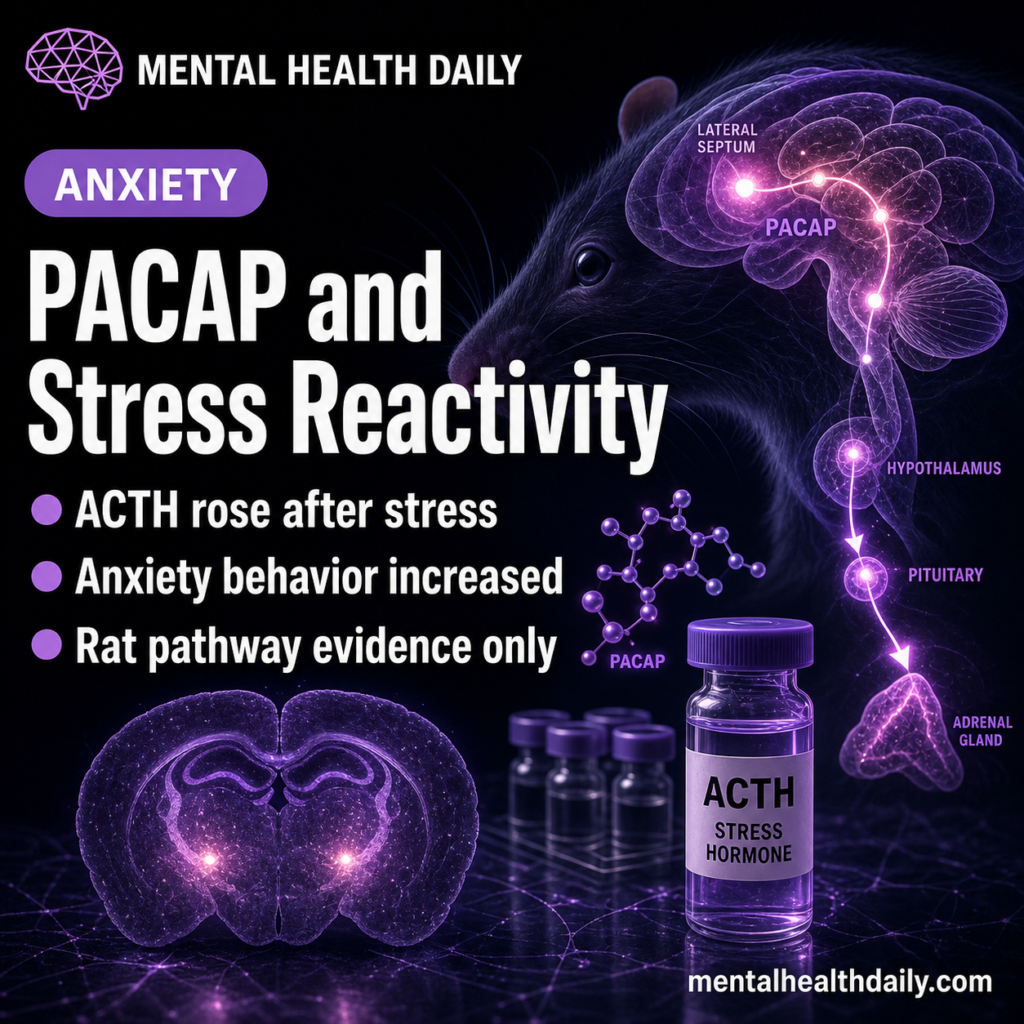
A 2026 rat study found that activating PACAP signaling in the lateral septum amplified stress-hormone release and anxiety-like behavior, while blocking endogenous PACAP receptors produced an anxiolytic pattern.1 The result makes the lateral septum look less like a passive relay and more like a stress-reactivity node in the PACAP pathway.
Research Highlights
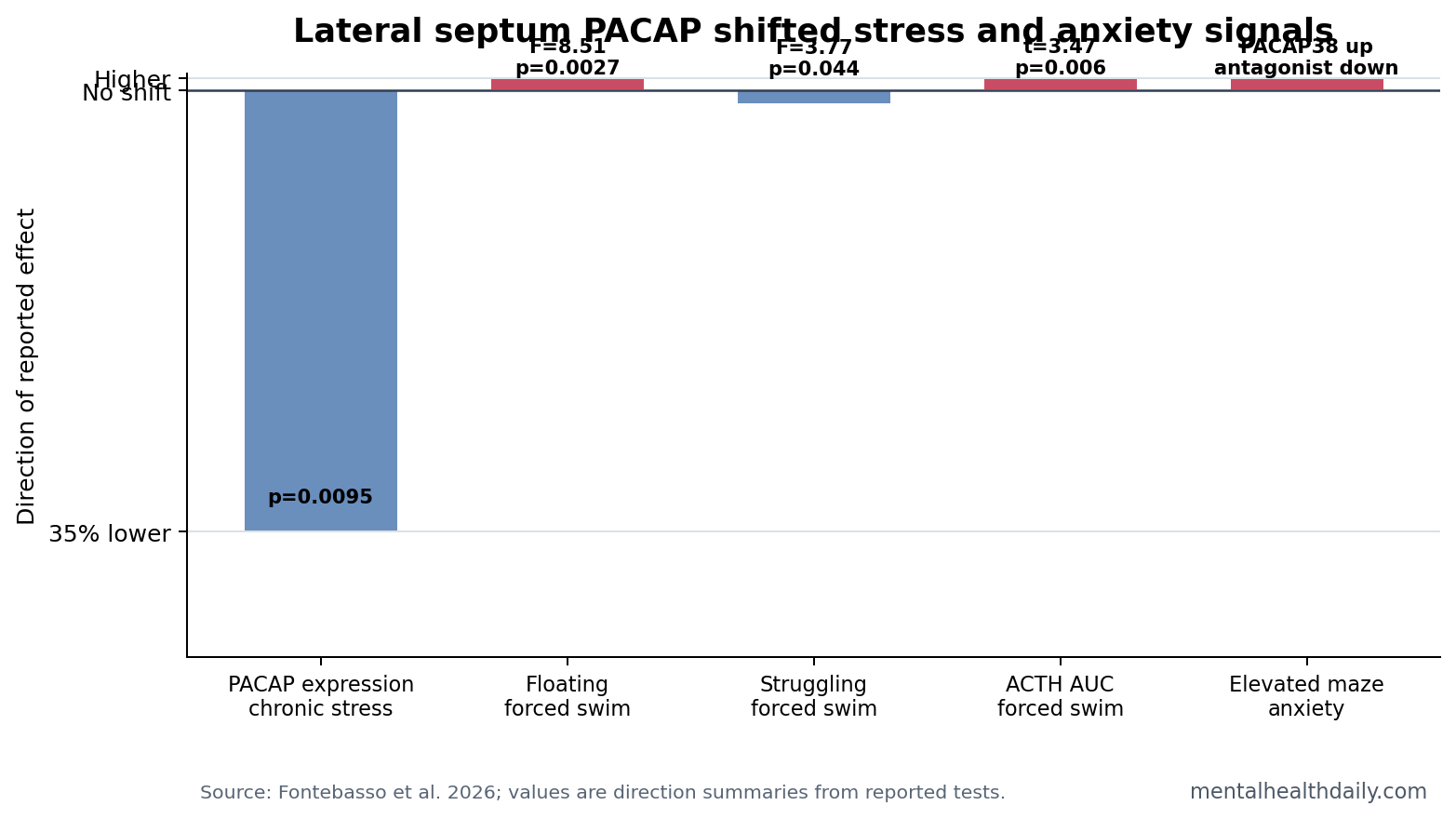
- Stress hormones rose: Intra-lateral-septum PACAP38 increased forced-swim ACTH output, with an ACTH area-under-the-curve difference of t(10) = 3.466, p = 0.0061.1
- Passive coping increased: PACAP38 changed forced-swim behavior, increasing floating with F(2,17) = 8.51, p = 0.0027, and reducing struggling with F(2,17) = 3.769, p = 0.0442.1
- Anxiety behavior shifted both ways: PACAP38 increased elevated-plus-maze anxiety-like behavior, while PACAP(6-38), a PACAP receptor antagonist, produced a robust anxiolytic phenotype.1
- Chronic stress changed the same node: Chronic variable mild stress reduced lateral-septum PACAP expression by 35%, p = 0.0095, while sparing most other tested regions.1
- Translation stays preclinical: The study used rats, local peptide infusion, and behavioral proxies; it supports a pathway hypothesis, not a human anxiety treatment claim in 2026.
Pituitary adenylate cyclase-activating polypeptide (PACAP) is a neuropeptide, meaning a small signaling molecule used by neurons and endocrine tissues. It binds PAC1, VPAC1, and VPAC2 receptors, with PAC1 showing especially high affinity for PACAP. Stress biology has repeatedly pulled PACAP into view because the peptide can modulate corticotropin-releasing factor, hypothalamic-pituitary-adrenal axis output, fear learning, and autonomic arousal.
The lateral septum is a limbic forebrain region connected with the hippocampus, hypothalamus, amygdala, and bed nucleus of the stria terminalis. That anatomy makes it plausible as a switchboard for contextual threat, social behavior, and stress coping. Fontebasso et al. tested whether PACAP in this region was doing functional stress work rather than merely being present.
Why this circuit is interesting: the lateral septum sits between memory-context systems and stress-output systems. A threat signal there can plausibly change both what an animal does and how strongly the hypothalamic-pituitary-adrenal axis responds. That makes the region a good test site for a peptide that might coordinate behavior and hormone release during stress.
Stress-reactivity node is the useful framing. The study is not claiming that the lateral septum is the only anxiety center or that PACAP is the master anxiety chemical. It asks whether a specific peptide signal in a specific limbic node can bias the animal toward stronger endocrine output and more defensive behavior under stress.
Lateral Septum PACAP38 Amplified ACTH After Forced Swim Stress
The strongest endocrine result came from adrenocorticotropic hormone (ACTH), the pituitary signal that tells the adrenal glands to release glucocorticoids. After local PACAP38 infusion into the lateral septum, forced swim stress produced higher ACTH output than vehicle infusion.
ACTH timing: the researchers reported significant treatment, time, and treatment-by-time effects. The interaction was F(5,50) = 3.854, p = 0.005, and the ACTH area under the curve was higher after PACAP38, t(10) = 3.466, p = 0.0061.1
The intervention changed both visible anxiety-like behavior and a core neuroendocrine stress output after a real stressor.
The endocrine result also helps separate the finding from a simple exploratory-behavior artifact. If PACAP38 only changed maze movement, interpretation would lean heavily on a behavioral proxy. Raising ACTH after forced swim stress shows that the manipulation reached a physiological stress system alongside open-arm exploration and immobility scoring.
ACTH also sits upstream of glucocorticoid release, so the finding ties the septal manipulation to the body’s hormonal stress cascade. The rat result is therefore more mechanistically coherent than an isolated open-field or maze result, while human translation still needs separate evidence.
PACAP38 Increased Floating and Reduced Active Struggling
Forced-swim behavior is a stress-coping assay in which rodents alternate between active escape-like movement and passive floating. It is often overinterpreted as a depression model; here the better read is stress-coping allocation after a local neuropeptide manipulation.
PACAP38 shifted that allocation. Treatment affected floating behavior, F(2,17) = 8.51, p = 0.0027, and struggling behavior, F(2,17) = 3.769, p = 0.0442. The higher PACAP38 dose increased floating and reduced struggling, while swimming did not significantly differ across groups.1
- Active coping signal: struggling fell after higher-dose PACAP38.
- Passive coping signal: floating increased after higher-dose PACAP38.
- Motor confound check: swimming was not significantly changed, which weakens a simple locomotor explanation.
The motor-confound point is important because many peptide or drug manipulations can make animals less active in ways that mimic anxiety or passive coping. Here, the pattern was more selective: struggling and floating changed, while swimming did not carry the same signal. That does not eliminate all interpretation problems, but it supports a stress-coping interpretation more than a broad sedation explanation.
PACAP Receptor Blockade Produced the Opposite Elevated-Plus-Maze Pattern
The elevated plus maze measures how much time rodents spend in exposed open arms vs. enclosed arms. More open-arm exploration is usually interpreted as lower anxiety-like behavior, assuming locomotion is not grossly impaired.
Fontebasso et al. reported 2 complementary findings: adding PACAP38 into the lateral septum increased anxiety-like behavior, and blocking local PACAP receptors with PACAP(6-38) produced an anxiolytic phenotype. Directionally, that is the more persuasive circuit pattern: pathway activation and pathway blockade moved behavior in opposite directions.1
Opposite-direction pharmacology is useful because it tests the pathway from 2 angles. An agonist result alone could reflect nonspecific peptide effects or local disruption. An antagonist result alone could reflect blockade of a broader receptor environment. Seeing activation and blockade push anxiety-like behavior in opposite directions makes the PACAP/PAC1 pathway interpretation more credible.
Chronic Stress Lowered Lateral-Septum PACAP Expression by 35%
Acute forced swim stress increased PACAP messenger RNA across several limbic areas, including the lateral septum, bed nucleus of the stria terminalis, and basolateral amygdala. Chronic variable mild stress produced a more selective pattern: lateral-septum PACAP expression fell by 35%, p = 0.0095.1
That chronic-stress reduction may look counterintuitive next to the PACAP38 infusion result. The simplest interpretation is adaptive regulation rather than a one-direction disease marker. A system that amplifies acute stress output can be downregulated after repeated mild stress exposure. The paper does not prove whether that downregulation is protective, exhausted, compensatory, or maladaptive.
That uncertainty is important for drug-target thinking. A pathway can be pro-anxiety during acute activation and still show lower expression after chronic stress because the system has adapted, depleted, or shifted receptor sensitivity. Treating the 35% reduction as a straightforward “low PACAP equals low anxiety” marker would flatten the circuit biology.
Human Anxiety Translation Requires a Separate Evidence Step
Human-adjacent context: PACAP is already connected with stress-related illness. Prior PTSD work linked PACAP pathway variation and circulating PACAP biology with symptom burden, and broader reviews place PACAP inside stress, fear, and arousal circuits.2,3
The 2026 lateral-septum study adds a circuit-level mechanism that can be manipulated directly.
Evidence-strength note: this is animal pathway evidence. It can support target biology, generate hypotheses about stress-reactivity circuits, and sharpen what future human biomarker studies should test. It cannot show that a PACAP antagonist treats generalized anxiety disorder, panic disorder, PTSD, or depression in people.
For clinical thinking, the useful point is narrower: anxiety biology includes neuropeptide systems that couple stress hormones to limbic behavior. That biology may help explain why some stress reactions are endocrine, motivational, and threat-attentional at the same time.
Future human work would need a different evidence stack: peripheral PACAP measures, genetics, imaging of septal-hypothalamic circuitry, stress-challenge physiology, and treatment studies that can show symptom change without broad endocrine disruption. The rat data identify a plausible node; they do not decide whether that node can be targeted safely.
Sex is another translation caveat. The study used male rats, while some human PACAP/PTSD findings have emphasized sex-linked patterns. A serious translational program would need female-animal studies, hormone-state analysis, and human replication before treating lateral-septum PACAP as a general anxiety mechanism.
Receptor specificity: PACAP can signal through more than one receptor family, and local infusion does not mimic a drug that reaches the whole brain and body.
Future studies would need receptor-selective tools, dose-response mapping, and region-specific controls before the pathway becomes a credible therapeutic target.
For now, the result is best used to refine stress-circuit models, not to advertise a new anxiety-drug class or patient-ready intervention.
The practical research value is therefore model selection: which stress assays, circuit nodes, and peptide-receptor tools deserve deeper replication before human claims are made.
Questions About PACAP and Anxiety
Does this mean PACAP causes anxiety disorders?
No. The study showed that lateral-septum PACAP signaling can increase anxiety-like behavior and stress-hormone output in rats. Human anxiety disorders involve development, learning, genetics, environment, sleep, threat appraisal, and many neurotransmitter systems.
Is PACAP(6-38) an anxiety drug?
No. PACAP(6-38) was used as a local experimental receptor antagonist in a rat brain region. That is a circuit probe, not an approved or tested treatment for anxiety disorders.
Why does the lateral septum matter for stress reactions?
The lateral septum connects hippocampal context processing with hypothalamic and extended-amygdala stress circuitry. A signal there can plausibly affect both endocrine output and behavioral coping during threat or stress.
References
- Fontebasso AM, et al. Lateral septal PACAP signaling regulates stress and anxiety reactions. Neuropsychopharmacology. 2026. doi:10.1038/s41386-026-02409-y
- Ressler KJ, et al. PACAP and PAC1 receptor biology in post-traumatic stress symptoms. Nature. 2011. PubMed
- Stroth N, et al. PACAP and stress-related neuropeptide signaling. Annals of the New York Academy of Sciences. 2011. PubMed
- Hammack SE, et al. PACAP signaling in extended-amygdala stress and anxiety circuits. Psychoneuroendocrinology. PubMed