
A 2026 Drosophila Parkinson’s model exposed male and female flies to 500 μM rotenone. By 60 days, male flies had worse survival/climbing than female flies; the paper is a vulnerability screen, not evidence that the same genes are ready human biomarkers.1
Research Highlights
- 500 μM rotenone split male and female flies: Iyer et al. used continuous rotenone feeding and reported lower survival and climbing ability in male flies than female flies across the 60-day model.1
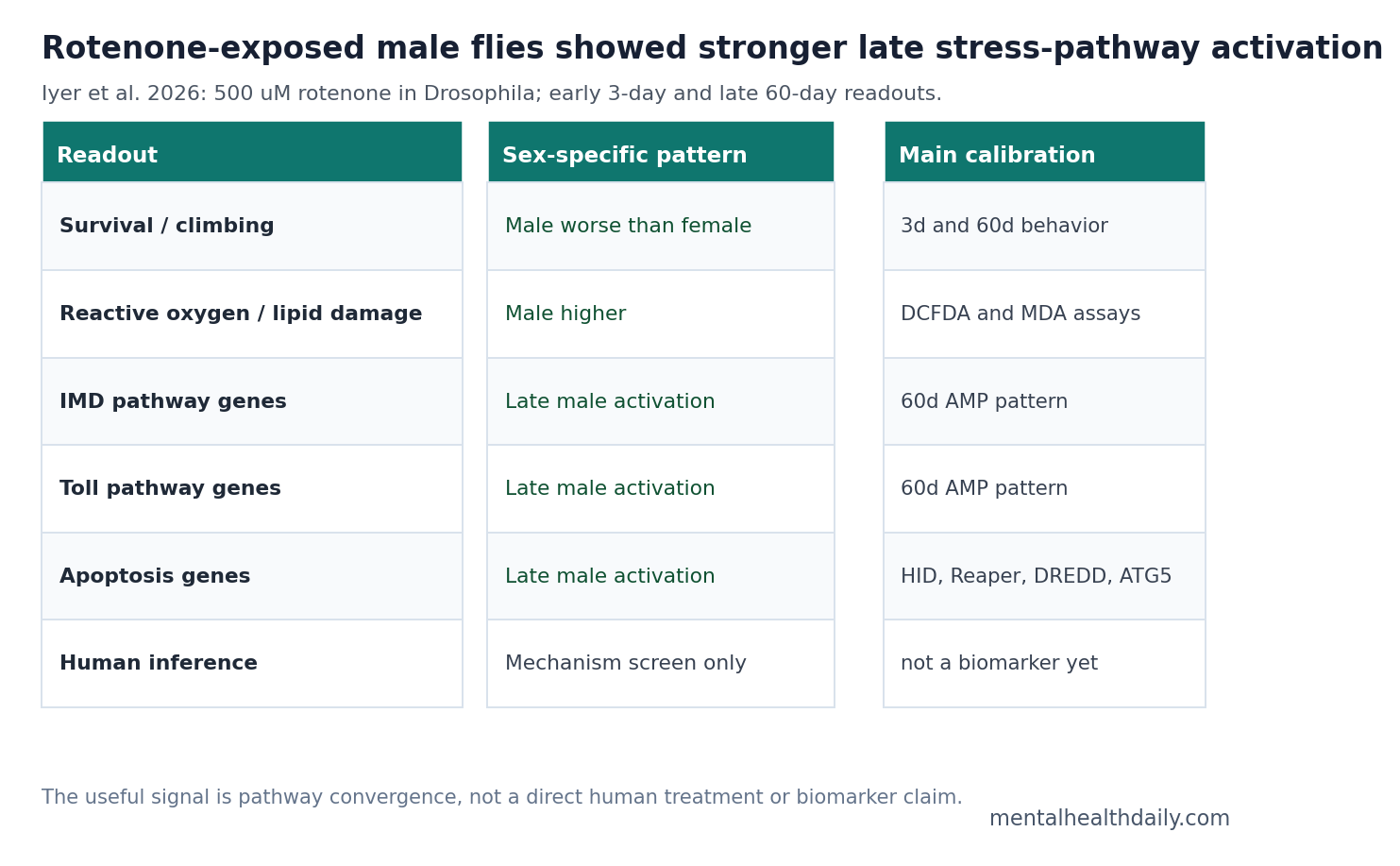
- Late immune-gene activation skewed male: at 60 days, male flies showed higher IMD/Toll pathway antimicrobial-peptide transcripts, while female flies showed lower or more regulated downstream immune expression.1
- Oxidative stress matched the behavior: DCFDA and MDA assays showed higher reactive oxygen/lipid-peroxidation signals in rotenone-exposed males than females at 3-day and 60-day time-points.1
- Apoptosis and autophagy genes diverged: HID, Reaper, DREDD, and ATG5 were higher in 60-day rotenone-exposed males, while PINK-1 and Parkin were lower in males and closer to control in females.1
- Human translation remains indirect: Parkinson’s disease is reported about 1.5–2x more often in males, but this fly study used whole-body qPCR and cannot assign patient-level treatment or biomarker rules.1,4
Rotenone is a pesticide and mitochondrial complex-I inhibitor. In animal models, it is used because mitochondrial stress, oxidative damage, and dopaminergic neurodegeneration overlap with several Parkinson’s disease mechanisms.
Drosophila melanogaster, the fruit fly, is not a tiny human nervous system. Its value is speed and genetic tractability: researchers can expose large numbers of flies to a toxin, measure survival and climbing behavior, and screen pathway-level gene responses over time.
Male Flies Showed Worse 60-Day Survival and Climbing After Rotenone
Iyer et al. used wild-type Oregon.R flies, sorted them by sex, and maintained them on standard food or food supplemented with 500 μM rotenone.1 Survival was tracked for 60 days using 90 flies of each sex, divided into 3 sets of 30. Climbing ability was tested with the negative-geotaxis assay, a standard fly behavior test that measures how quickly flies climb upward after being tapped down.
Negative geotaxis matters here because rotenone models Parkinson-like motor impairment through mitochondrial stress. A fly that climbs poorly is not “parkinsonian” in the human clinical sense, but the behavior gives a measurable readout of locomotor decline.
The paper reported that rotenone-fed males had significantly lower survival than rotenone-fed females. Climbing impairment also appeared by the 3-day time-point and persisted to 60 days, with males more affected than females at both time-points.1
- Model exposure: 500 μM rotenone in food.
- Early readout: 3 days after exposure began.
- Late readout: 60 days after exposure began.
- Survival sample: 90 male flies and 90 female flies, split into 3 sets of 30.
Evidence-strength note: this was an insect toxin model with behavior, oxidative-stress assays, and whole-body gene-expression profiling. It can identify sex-specific pathway responses under controlled exposure. It cannot prove that the same pathway ordering drives human Parkinson’s disease progression.
Oxidative-Stress Markers Were Higher in Rotenone-Exposed Males
Oxidative stress means reactive oxygen molecules are being produced faster than cells can neutralize them. In Parkinson’s disease models, oxidative stress is closely tied to mitochondrial dysfunction, lipid damage, protein damage, inflammation, and cell death.
Iyer et al. measured oxidative stress with 2 main assays. DCFDA measured reactive oxygen species, while MDA measured lipid peroxidation, a marker of oxidative damage to cell membranes. Both markers increased after rotenone exposure, and the paper reported higher levels in males than females at both 3-day and 60-day time-points.1
Protein carbonylation, a marker of oxidative damage to proteins, was less clean. At 3 days it followed the same male-skewed pattern, but at 60 days females showed higher carbonylation than males, and the increases relative to controls were not significant. That mixed protein-damage result keeps the article away from a simple “males have more of every damage marker” claim.
Mechanistic implication: the behavioral sex difference lined up most clearly with reactive oxygen and lipid-peroxidation signals. The protein-carbonylation result suggests that different oxidative-damage channels may diverge during long exposure.
IMD and Toll Pathways Shifted From Early Shock to Late Male Activation
IMD and Toll pathways are the 2 major innate-immune signaling systems in Drosophila. They are not identical to human neuroinflammation, but they share enough pathway logic with mammalian immune signaling to make them useful screens for inflammatory stress responses.
IMD pattern: Relish, an NF-κB-like transcription factor, drives antimicrobial peptide genes such as Diptericin, Cecropin, and Attacin. At 3 days, several antimicrobial-peptide transcripts rose in both sexes or showed stronger female early response.
By 60 days, the pattern changed: males showed higher downstream IMD antimicrobial-peptide expression, while females showed downregulation of Diptericin, Cecropin, and Attacin compared with age-matched males.1
Pirk, a negative regulator of IMD signaling, moved in the opposite direction. At 60 days, Pirk decreased in males and increased in females after rotenone exposure. That supports the paper’s interpretation that female flies regulated the inflammatory pathway differently after the same toxin exposure.
Toll pattern: at 3 days, Toll and several downstream transcripts were upregulated in both sexes. At 60 days, male flies showed higher Toll, Drosomycin, Metchnikowin, Bomanin S5, and Baramicin expression, while female flies showed lower expression for several of those downstream genes.1
Reader translation: the early response looked like a broad toxin shock. The later response looked more sex-specific, with male flies maintaining stronger inflammatory gene activation and female flies showing more pathway dampening.
HID, Reaper, DREDD, and ATG5 Pointed Toward Late Male Cell-Death Pressure
Apoptosis is programmed cell death. In neurodegeneration research, apoptosis-related genes are often measured because stressed neurons and support cells can shift from repair to death signaling after mitochondrial injury.
Iyer et al. measured HID, Reaper, and DREDD, Drosophila genes involved in cell-death signaling. At 3 days, rotenone increased expression in both sexes, with some early female-skewed responses. At 60 days, males showed higher HID, Reaper, and DREDD expression than females after rotenone exposure.1
The same section measured PINK-1, Parkin, and ATG5. PINK-1 and Parkin help mark damaged mitochondria for removal, a process known as mitophagy. ATG5 is an autophagy-related gene that helps form the machinery for cellular cleanup, but it can also interact with apoptosis signaling.
At 3 days, PINK-1, Parkin, and ATG5 rose in both sexes. At 60 days, PINK-1 and Parkin were lower in males and closer to control in females, while ATG5 was higher in males and lower in females. The authors interpreted that pattern as more late apoptosis/autophagy stress in male flies.1
The pathway-level pattern is stronger than any single gene result. Male flies climbed worse, and their late gene-expression pattern pointed toward more persistent oxidative/inflammatory/cell-death pressure after the same toxin exposure.
Human Parkinson’s Sex Differences Need This Calibration
Parkinson’s disease is commonly reported more often in males than females. Iyer et al. cited a 1.5–2x male excess and 2021 global prevalence estimates of 6.44 million males vs. 5.33 million females.1 Reviews also describe sex differences in motor presentation, non-motor symptoms, cognition, autonomic function, and treatment complications.4
Animal models fit part of that picture. De Miranda et al. reported that sex differences in rotenone sensitivity reflected the male-to-female ratio in human Parkinson’s disease incidence.2 Costa et al. found sex-specific neurodegeneration and neuroinflammation patterns in an A53T alpha-synuclein mouse model.3 Reviews of autophagy biology also point to sex-specific mechanisms that could intersect with PINK1/Parkin and mitochondrial cleanup.5
Calibration: convergence across models makes the male-vulnerability pathway plausible. It does not make a fly qPCR pattern a patient biomarker.
Design limit: the fly paper used whole-body RNA from 20 flies per extraction, repeated across 3 biological replicates. That design is useful for screening broad sex-specific pathways, but it does not tell which human cell types, disease stages, exposures, or treatment histories would show the same pattern. It is a mechanism screen, not a substitute for patient-stage validation.
Questions About Rotenone, Sex Differences, and Parkinson’s Models
Does this study show why men get Parkinson’s disease more often?
No. It supports one plausible mechanism: under rotenone-driven mitochondrial stress, male flies showed stronger late oxidative-stress, immune, and apoptosis-gene responses than female flies. Human Parkinson’s disease also involves age, genetics, environmental exposure, hormones, occupational patterns, diagnostic differences, and survival effects.
Why use flies for a Parkinson’s disease question?
Flies allow controlled toxin exposure, fast aging-like time courses, and pathway-level genetic readouts. They are good for screening mechanisms. They are weak for direct clinical inference because the fly brain, immune system, endocrine biology, and exposure history differ sharply from humans.
Which finding carries the most human-relevant signal?
The strongest signal is not any single antimicrobial peptide or apoptosis gene. It is the repeated late-stage pattern: male flies had worse motor/survival readouts and stronger inflammatory/cell-death pathway activation after the same rotenone exposure.
What would make this more clinically useful?
The next useful step would be cell-type-specific validation in mammalian models and human tissue or blood datasets, especially under pesticide exposure, mitochondrial dysfunction, or prodromal Parkinson’s disease risk. Human work would need to test whether immune or mitochondrial markers improve risk stratification beyond age, sex, exposure history, genetics, and prodromal symptoms.
References
- Iyer SM, Tare M. Gender-specific gene profiling in Drosophila sporadic model of Parkinson’s disease. IBRO Neuroscience Reports. 2026;20:548-558. https://doi.org/10.1016/j.ibneur.2026.04.001
- De Miranda BR, Fazzari M, Rocha EM, Castro S, Greenamyre JT. Sex differences in rotenone sensitivity reflect the male-to-female ratio in human Parkinson’s disease incidence. Toxicological Sciences. 2019;170(1):133-143. https://doi.org/10.1093/toxsci/kfz082
- Costa G, Sisalli MJ, Simola N, Della Notte S, Casu MA, Serra M, et al. Gender differences in neurodegeneration, neuroinflammation and Na+-Ca2+ exchangers in the female A53T transgenic mouse model of Parkinson’s disease. Frontiers in Aging Neuroscience. 2020;12:118. https://doi.org/10.3389/fnagi.2020.00118
- Cattaneo C, Pagonabarraga J. Sex differences in Parkinson’s disease: a narrative review. Neurology and Therapy. 2025;14(1):57-70. https://doi.org/10.1007/s40120-024-00687-6
- Cucinotta L, Mannino D, Filippone A, Romano A, Esposito E, Paterniti I. The role of autophagy in Parkinson’s disease: a gender difference overview. Frontiers in Pharmacology. 2024;15:1408152. https://doi.org/10.3389/fphar.2024.1408152