A 12-item questionnaire built around the worries of new motherhood held up well in a 2026 study of 189 Brazilian mothers. Its total score was reliable and tracked general anxiety and depression, though 2 of its 3-item subscores were weaker.1
Research Highlights
- Four worry areas held together: the Brazilian version of the Postpartum Specific Anxiety Scale short form (PSAS-BR-RSF-C) fit its intended 4-part structure well (CFI 0.978, RMSEA 0.060), while a single-score model fit poorly.1
- Reliable total score: overall reliability was 0.85 on a 0-to-1 scale, close to the 0.87 reported for the English original.1
- Tracked related symptoms: scores correlated with general anxiety (r = .52), depression (r = .61) and self-criticism (r = .52).1
- Weaker subscores: worries about feeding and routine (0.62) and about adjusting to motherhood (0.44) fell below the usual 0.70 bar when scored on their own.1
- Screening, not diagnosis: the scale was tested in a small, mostly well-educated online sample and was not checked against clinical interviews.1
What Postpartum-Specific Anxiety Is
Postpartum anxiety is persistent, hard-to-control worry in the months after giving birth. Much of it centers on the baby and on being a mother: whether the baby is breathing at night, eating enough or gaining weight, and whether you are doing a good enough job.
It is common. A meta-analysis of 102 studies and 221,974 women found that 15% of women had elevated self-reported anxiety symptoms between 1 and 24 weeks after birth, and 9.9% had a diagnosed anxiety disorder.2
Much of the research still measures it with general anxiety questionnaires such as the GAD-7. The GAD-7 asks about general worry, tension and irritability, and it can miss excessive worry about the baby and the mother’s role. In Brazil, studies have relied entirely on general measures.1
The Postpartum Specific Anxiety Scale (PSAS) was designed to fill that gap. Fallon et al. built its 51 items from interviews with 19 postpartum women, then tested it online. The items grouped into 4 areas of worry, and the scale showed good reliability and tracked other anxiety measures.3
Why a 12-Item Short Form Was Created
The full PSAS takes about 10 minutes, which is a lot to add to a survey or a busy postnatal visit. During the COVID-19 lockdowns, Silverio et al. picked 12 items, 3 from each area, and tested this short form in 710 UK mothers of babies up to 12 weeks old. The same 4 areas emerged, with excellent reliability.4
The 4 areas and an example item from each:1
- Bonding and confidence as a mother: “I have felt unconfident or incapable of meeting my baby’s basic care needs.”
- Baby’s safety: “I have worried that my baby will stop breathing while sleeping.”
- Practical baby care: “I have worried about my baby’s milk intake.”
- Adjusting to motherhood: “I have felt tired even after a good amount of rest.”
Each item is rated on a 4-point scale, and higher totals mean more anxiety. A total of 26 or more is used as a sign of clinically significant anxiety.1
How the Brazilian Study Tested the Scale
Cardoso Gerhardt et al. did not translate anything new. They took the 12 short-form items from an existing Brazilian Portuguese translation of the full PSAS and checked how well they worked together.1
- Sample: 189 Brazilian mothers aged 18 to 44 with babies 15 days to 12 months old, recruited on social media between March and November 2022
- Comparison questionnaires: the GAD-7 for general anxiety, the Edinburgh Postnatal Depression Scale (EPDS) for depression, and the negative items of the Self-Compassion Scale as a self-criticism score
- Structure test: confirmatory factor analysis, which checks whether answers cluster into the groups a scale is supposed to have
- Reliability test: McDonald’s omega, a 0-to-1 measure of how consistently a set of items measures one thing; 0.70 or higher is usually considered acceptable
The mothers were mostly from southern and southeastern Brazil, and most were married (84.1%) and college-educated. For about 70%, this was their first pregnancy, and 53.4% reported a past mental health diagnosis.1
Four Worry Areas Held Together as Intended
The 4-area model fit the data well on every standard index: CFI 0.978 and TLI 0.970 (0.95 or higher is good), RMSEA 0.060 (0.06 or lower is good) and SRMR 0.077 (0.08 or lower is good). A model treating all 12 items as one undivided score fit poorly, with an RMSEA of 0.114.1
Every item loaded clearly on its intended area, with standardized loadings from 0.38 to 0.84. The strongest was worry that the baby will stop breathing during sleep (0.84). The weakest was worrying more about the relationship with a partner than before the birth (0.38).1
One item performed better than expected. “I have felt that my baby would be better cared for by someone else” had been dropped from an earlier analysis of the full Brazilian PSAS, but here it loaded well (0.64) and stayed in.1
The 4 areas were related but distinct, with correlations between them of 0.42 to 0.61. That is the pattern expected from separate facets of one broader kind of anxiety.1
Total Score Was Reliable, but 2 Subscores Were Weak
Across all 12 items, reliability was 0.85, nearly matching the English version’s 0.87. The picture changed when each 3-item area was scored separately.1
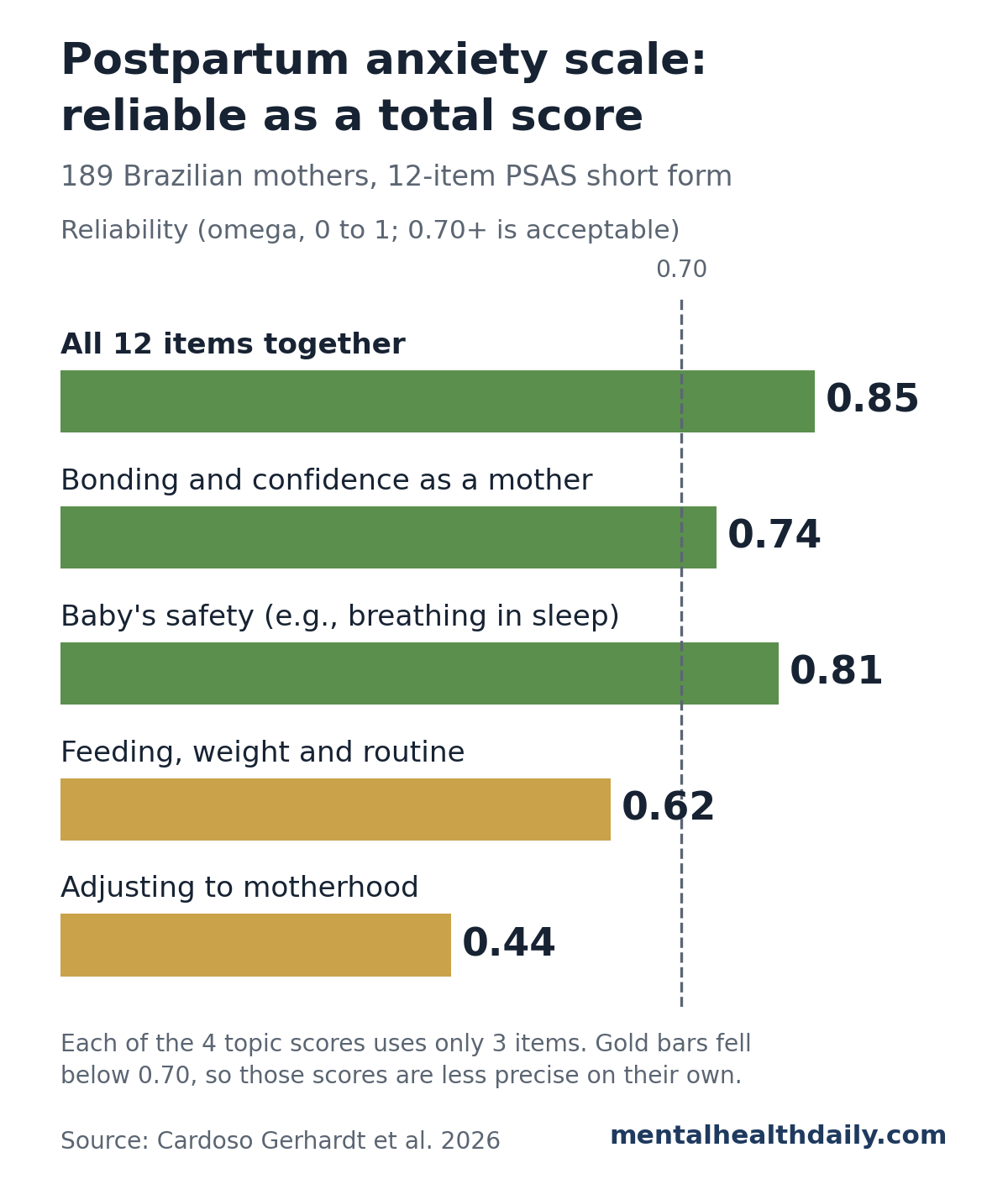
- Baby’s safety: 0.81 (English version 0.83)
- Bonding and confidence as a mother: 0.74 (English 0.88)
- Practical baby care: 0.62 (English 0.82)
- Adjusting to motherhood: 0.44 (English 0.74)
Three items is a small base for any score, and the adjusting-to-motherhood items cover quite different things: tiredness, resentment toward a partner and worry about the relationship. The researchers advise caution in reading those 2 area scores on their own and suggest testing new or replacement items.1
In practice: the total score is the part of this scale with solid support. The 4 area scores are better used as a rough guide to what a mother is worried about than as precise measurements.
Postpartum Anxiety Scores Tracked General Anxiety and Depression
Mothers with higher PSAS totals also tended to score higher on the other questionnaires. Correlations (r, where 0 means no relationship and 1 a perfect one) were:1
- Depression (EPDS): r = .61
- General anxiety (GAD-7): r = .52
- Self-criticism: r = .52
Correlations in this range fit a scale that measures something closely related to anxiety and low mood. The study did not test how well the PSAS separates postpartum-specific anxiety from depression or general anxiety, so its added value over the GAD-7 remains an open question in Brazil.1
High scores overall: the average PSAS total was 26.89, just above the 26-point cutoff, and the average EPDS score of 12.03 was above its usual cutoff of 10. The survey ran during the COVID-19 pandemic, and over half the mothers reported a past mental health diagnosis, so this group may not reflect Brazilian mothers in general.1
What This Means for Mothers and Clinicians in Brazil
The PSAS-BR-RSF-C gives Brazilian researchers and clinicians a short, culturally adapted way to ask about the worries that general anxiety scales miss. Its brevity suits routine postnatal checkups, including in Brazil’s public health system, where mental health specialists can be scarce.1
Like any questionnaire, it is a screening tool. A high score is a reason for a closer conversation with a doctor, midwife or mental health professional, not a diagnosis. The 26-point cutoff comes from earlier work and was not checked against clinical interviews in this study.1
For mothers anywhere, the items themselves are a useful reminder: constant checking on a sleeping baby, fear of harm, or feeling incapable of basic care are recognized forms of postpartum anxiety and worth raising with a provider when they become hard to switch off.
Limitations of This Brazilian Validation Study
- Small, unrepresentative sample: 189 mothers, mostly from the South and Southeast, with higher income and education than the Brazilian average.
- Online, self-selected recruitment: mothers with internet access and an interest in postpartum mental health may differ from others; there were no attention checks or bot screening, though duplicate IP addresses were checked.
- Self-report only: no clinical interviews, so the study could not test how accurately the scale identifies an anxiety disorder.
- No separation test: the researchers did not assess how well the scale distinguishes postpartum-specific anxiety from depression or general anxiety.
- One time point: stability of scores over time and sensitivity to change were not measured.
- Structure may vary by culture: a Persian version of the short form reportedly found 3 areas rather than 4, so results from one country may not carry over.1
References
- Cardoso Gerhardt B, Zimmer C, Serra J, Souza Torres de Araújo KM, Fallon V, Silverio SA, Arteche AX. Psychometric evaluation of the Brazilian version of the Postpartum Specific Anxiety Scale – Research Short-Form for Global Crises (PSAS-BR-RSF-C). Archives of Women’s Mental Health. 2026;29:133. doi:10.1007/s00737-026-01771-6
- Dennis CL, Falah-Hassani K, Shiri R. Prevalence of antenatal and postnatal anxiety: systematic review and meta-analysis. British Journal of Psychiatry. 2017;210(5):315–323. doi:10.1192/bjp.bp.116.187179
- Fallon V, Halford JCG, Bennett KM, Harrold JA. The Postpartum Specific Anxiety Scale: development and preliminary validation. Archives of Women’s Mental Health. 2016;19(6):1079–1090. doi:10.1007/s00737-016-0658-9
- Silverio SA, Davies SM, Christiansen P, et al. A validation of the Postpartum Specific Anxiety Scale 12-item research short-form for use during global crises with five translations. BMC Pregnancy and Childbirth. 2021;21:112. doi:10.1186/s12884-021-03597-9