About 1 in 5 adults receiving outpatient psychiatric care for mood or anxiety-related conditions in Japan met full diagnostic criteria for generalized anxiety disorder, a 2026 study at 22 clinics found. Most of them had a different main diagnosis on file, usually depression.1
Research Highlights
- 20.4% had GAD: 83 of 407 outpatients met DSM-5 criteria for generalized anxiety disorder in a structured diagnostic interview.1
- Often listed under another diagnosis: only 17 of the 83 had GAD recorded as their diagnosis before the study, and depressive disorders were the most common comorbid condition (65.1%).1
- Heavier burden than other patients: people with GAD reported lower quality of life, more depression and distress, and more disruption to social and family life than outpatients without GAD.1
- Questionnaires missed many cases: the widely used GAD-7 at its standard cutoff of 10 caught 54% of people with GAD; the K6 distress scale caught more but flagged far too many people without it.1
- Drug-company funded: Viatris Pharmaceuticals Japan sponsored the study, and 3 of the 5 authors are Viatris employees.1
What Generalized Anxiety Disorder Is and How the Japan Study Checked for It
Generalized anxiety disorder (GAD) is persistent, hard-to-control worry about many everyday things — work, health, family, money — on most days for at least 6 months. It comes with physical and mental symptoms such as restlessness, fatigue, poor concentration, irritability, muscle tension and sleep trouble.
Because those symptoms overlap with depression and other anxiety disorders, GAD is easy to miss or fold into another diagnosis. In community surveys across 26 countries, about 3.7% of adults met DSM-5 criteria for GAD at some point in their lives.2
Keisuke Nomoto et al. wanted to know how common GAD is among people already in psychiatric care in Japan. Their PRADO study enrolled adult outpatients at psychiatric departments of 22 medical facilities:1
- Who was included: adults aged 18 to 79, past their first visit, whose main recorded diagnosis was a mood disorder or an anxiety, stress-related or somatoform condition
- Who was left out: people with psychotic disorders, dementia, recent substance-use disorders, seizure disorders or imminent suicide risk
- Sample: 407 of 506 screened patients; mean age 43.9, 60.9% women
Each patient sat for the SCID (Structured Clinical Interview for DSM-5), a scripted interview in which a clinician walks through the official diagnostic criteria question by question. It is the research standard for psychiatric diagnosis because it does not rely on a clinician’s impression in a short visit.1
Patients also filled out questionnaires on anxiety, depression, distress, quality of life and daily functioning, and the team pulled prior diagnoses from medical records.1
1 in 5 Outpatients Met Criteria for GAD, Most Alongside Depression
At the study visit, 83 of 407 patients (20.4%) met criteria for current GAD. Counting anyone who had ever met criteria, the lifetime figure was 28.3%. Only major depressive disorder was more common, at 33.9% of the sample.1
The 20.4% figure is far above the 6.5% the researchers expected when planning the study. It is also higher than earlier estimates they cite from psychiatric outpatients in Turkey (10.3%) and Spain (13.7%). The researchers partly attribute the gap to differences in methods and to leaving out patients with psychotic disorders, which tilts the sample toward mood and anxiety conditions.1
GAD rarely came alone. Among the 83 patients with GAD:1
- Depressive disorders: 65.1%, mostly major depression (53.0%)
- Another anxiety disorder: social anxiety disorder 25.3%, specific phobia 22.9%, agoraphobia 19.3%, panic disorder 16.9%
- Adult ADHD: 20.5%
- Obsessive-compulsive and related disorders: 18.1%
- Bipolar spectrum disorders: 12.0%
GAD was usually not the headline diagnosis. When investigators named each patient’s single most significant current condition, GAD came first for only 33.7% of those with it; a depressive disorder came first for 51.8%.1
Prior diagnoses in medical records showed the same pattern. Only 22 patients had GAD recorded as their diagnosis before the study, and 17 of them were confirmed. Of the 175 patients previously diagnosed with a depressive episode, 37 (21.1%) met criteria for GAD.1
The researchers read this as GAD going under-recognized in routine care. They also note the study was not built to compare interview results with everyday clinical diagnosis head to head, so it cannot measure underdiagnosis directly.1
Patients With GAD Reported Worse Quality of Life and Daily Functioning
The team compared the 83 patients with GAD against 225 outpatients who had some other current psychiatric diagnosis but not GAD. On almost every measure, the GAD group was doing worse:1
- Self-rated health: 48.1 vs. 60.1 on a 0–100 scale
- Quality of life (EQ-5D-5L index): 0.7 vs. 0.8, with more pain or discomfort and more trouble with usual activities
- Depressive symptoms (QIDS-SR): 13.5 vs. 10.6
- Anxiety (GAD-7): 10.6 vs. 6.8
- Psychological distress (K6): 12.8 vs. 9.5
- Disability (Sheehan Disability Scale): 14.5 vs. 11.6 out of 30, driven by social life and family or home responsibilities
Work or school impairment and days missed did not differ significantly, though patients with GAD reported slightly more underproductive days (3.3 vs. 2.6).1
Other differences: patients with GAD were somewhat younger (41.3 vs. 44.6 years), more often women (68.7% vs. 59.0%), more often in households earning under 4 million yen a year (67.5% vs. 53.1%), and reported more adverse childhood experiences. Age and sex were not significant once other factors were adjusted for.1
GAD-7 and K6 Questionnaires Were Only Moderately Accurate for GAD
The study also tested whether 2 common self-report tools could stand in for the interview:
- GAD-7: 7 questions about how often anxiety symptoms bothered someone over the past 2 weeks, scored 0–21; 10 or higher is the usual flag for possible GAD
- K6: 6 questions about general psychological distress, not specific to anxiety
Two numbers describe a screening tool. Sensitivity is the share of people with the condition it correctly flags. Specificity is the share of people without the condition it correctly clears.
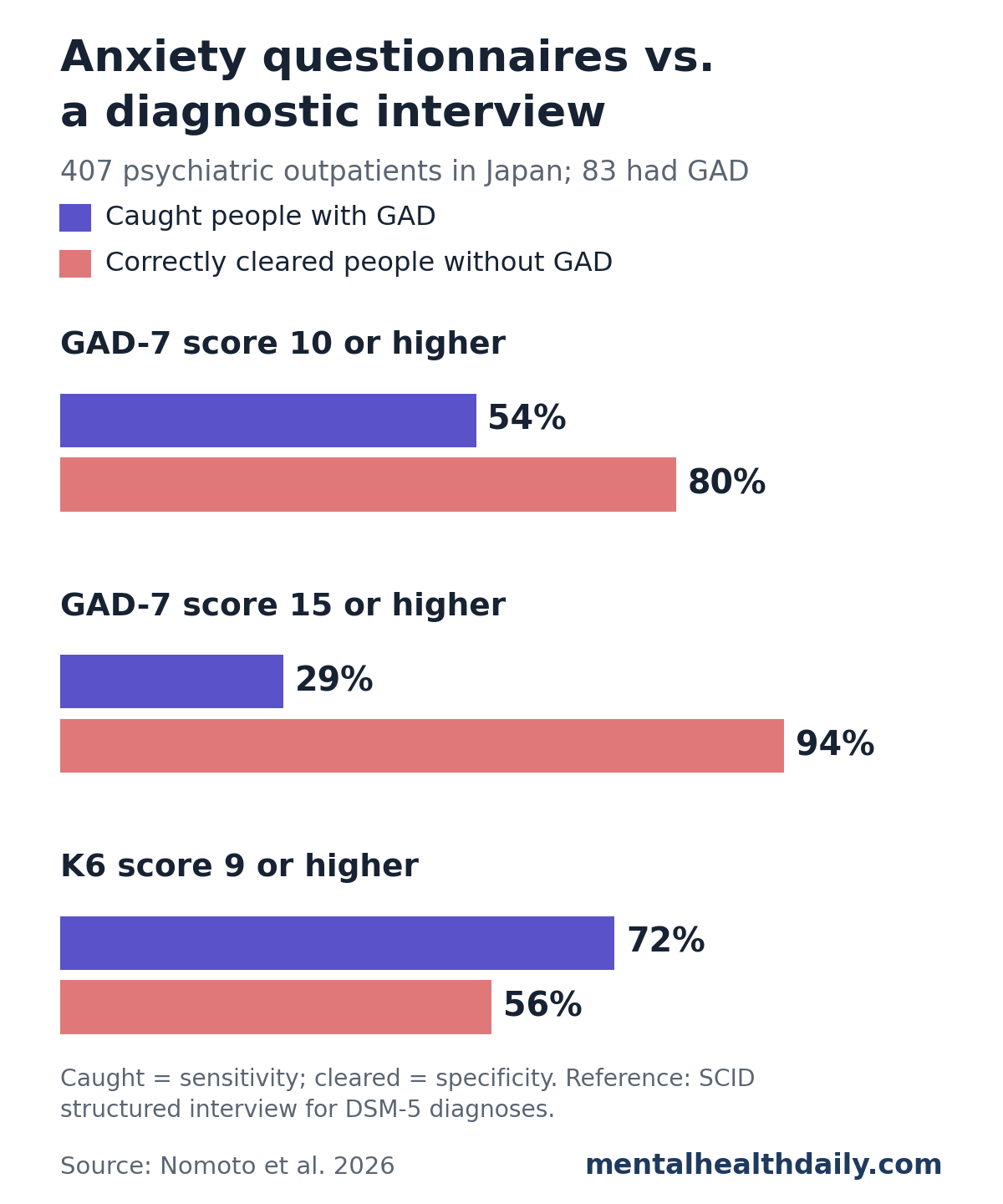
GAD-7 at 10 or higher caught 45 of the 83 people with GAD (54%) and cleared 80% of those without it. Raising the cutoff to 15 cleared 94% but caught only 29%.1
K6 at 9 or higher caught 72% of GAD cases but cleared only 56% of everyone else, so about 7 in 10 of its positive results were false alarms. Agreement with the interview was only fair for the GAD-7 (kappa 0.31, where 1 is perfect) and weaker for the K6 (0.19).1
A negative result was more trustworthy than a positive one: at every cutoff, 82% to 89% of people who screened negative truly did not have GAD.1
Why the GAD-7 Worked Worse Here Than in Primary Care
In the original 2006 validation study of 2,740 primary care patients, a GAD-7 score of 10 or higher caught 89% of GAD cases and cleared 82% of others.3 A 2016 meta-analysis of 11 studies found acceptable accuracy at cutoffs from 7 to 10.4
Specialty psychiatric clinics are a harder test. Nearly everyone there has some anxiety or low mood, so a symptom checklist has trouble separating GAD from depression, panic or social anxiety. In 536 outpatients at a US anxiety and mood disorders clinic, Rutter and Brown concluded the GAD-7 works better as a measure of how severe GAD symptoms are than as a yes-or-no screener.5
The Japan results fit that pattern. Patients with GAD averaged 10.6 on the GAD-7, right at the usual cutoff, and 38 of the 83 scored below 10.1
GAD-Specific Treatment Coverage in Japan
In their 2026 report, the researchers described Japan as lacking an insurance-covered GAD-specific treatment pathway. As a result, care may default to treating depression or another recorded diagnosis rather than GAD itself.1
An earlier survey of the Japanese general population by the same research group estimated GAD prevalence at 7.6% using the GAD-7 and 6.0% using DSM-5-based questions, with lower quality of life among probable cases.6 The new outpatient figure is much higher, as expected for people already seeking psychiatric care.
Funding: Viatris Pharmaceuticals Japan funded and sponsored PRADO. Three authors are Viatris employees, the other 2 report fees or advisory roles with Viatris and other drugmakers, and IQVIA handled statistical analysis and medical writing. Viatris markets psychiatric medicines, so it has a commercial stake in how GAD is recognized and treated in Japan. The interview-based design is a strength, but the funding is worth keeping in mind.1
Limitations of the PRADO Study
- Outpatients, not the general public: 20.4% applies to adults already in psychiatric care for mood or anxiety-related conditions, at selected clinics, with psychotic disorders excluded.
- Cross-sectional snapshot: the links with income, childhood adversity and other conditions are associations at one point in time, not causes.
- Underdiagnosis is inferred: prior diagnoses came from chart codes, and the study did not directly compare interview results with routine clinical diagnosis.
- Selection: only patients who consented and whom investigators judged suitable took part.
- Wide estimates: some adjusted odds ratios for physical conditions rested on a handful of patients, and odds ratios overstate associations when a condition is this common.
- Industry sponsor: the funder employed most of the authors.
What This Means for People Being Treated for Depression or Anxiety
Ongoing worry deserves its own name. If constant, hard-to-control worry is a big part of what you live with, and your diagnosis is depression or something else, it is reasonable to ask your clinician whether GAD fits too. In this study, 1 in 5 people previously diagnosed with a depressive episode met criteria for GAD.1
A screening score is a starting point. A GAD-7 below 10 does not rule out GAD in someone already in psychiatric care, and a high K6 score does not confirm it. A careful diagnostic interview remains the more reliable way to sort out overlapping conditions.1
References
- Nomoto K, Otsubo T, Higa S, Matsuyama S, Inoue T. Prevalence of Generalized Anxiety Disorder in Psychiatric Outpatients (PRADO Study): A Multicenter Cross-Sectional Study in Japan. Neuropsychiatric Disease and Treatment. 2026;22:607540. doi:10.2147/NDT.S607540
- Ruscio AM, Hallion LS, Lim CCW, et al. Cross-sectional comparison of the epidemiology of DSM-5 generalized anxiety disorder across the globe. JAMA Psychiatry. 2017;74(5):465–475. doi:10.1001/jamapsychiatry.2017.0056
- Spitzer RL, Kroenke K, Williams JBW, Löwe B. A brief measure for assessing generalized anxiety disorder: the GAD-7. Archives of Internal Medicine. 2006;166(10):1092–1097. doi:10.1001/archinte.166.10.1092
- Plummer F, Manea L, Trepel D, McMillan D. Screening for anxiety disorders with the GAD-7 and GAD-2: a systematic review and diagnostic metaanalysis. General Hospital Psychiatry. 2016;39:24–31. doi:10.1016/j.genhosppsych.2015.11.005
- Rutter LA, Brown TA. Psychometric properties of the Generalized Anxiety Disorder Scale-7 (GAD-7) in outpatients with anxiety and mood disorders. Journal of Psychopathology and Behavioral Assessment. 2017;39(1):140–146. doi:10.1007/s10862-016-9571-9
- Matsuyama S, Otsubo T, Nomoto K, Higa S, Takashio O. Prevalence of Generalized Anxiety Disorder in Japan: A General Population Survey. Neuropsychiatric Disease and Treatment. 2024;20:1355–1366. doi:10.2147/NDT.S456272