College students who saw the rules on AI use as unclear, AI cheating as easy to get away with, and school guidance as thin reported more AI-assisted cheating, according to a 2026 survey of 863 undergraduates in Vietnam.1 Academic pressure, the usual suspect, did not show the expected link.
Research Highlights
- Unclear rules went with more cheating: students who rated ethical gray areas, easy and hard-to-detect AI, and weak school policies as bigger problems reported more AI-assisted cheating (β = 0.228, p < 0.001).1
- Pressure did not push cheating up: academic pressure and peer comparison were essentially unrelated to cheating on their own, and showed a small negative link (β = −0.148) only after the other factors were accounted for.1
- Men and non-STEM majors reported more: men reported more AI cheating than women, and non-STEM students more than STEM students; year in school made no difference.1
- Most of the story is missing: all of these factors together explained only about 5% of the differences in how much students cheated.1
- Reported cheating was low and likely undercounted: every behavior averaged below the midpoint of the 1-to-5 frequency scale, and an earlier Vietnamese study found that direct questions caught less than half the AI cheating that anonymous indirect methods revealed.1,3
How the Vietnam Survey Measured AI-Assisted Cheating
Hanh Van Nguyen and Mai Thi-Thuy Duong of Hanoi University of Science and Technology ran an anonymous online survey from late October to late November 2025. Of 881 responses, 863 were complete and usable. The study was published in PLOS ONE in September 2026.1
- Sample: 863 undergraduates at one technical university, recruited by convenience
- Mix: 81.3% STEM majors, 71.3% men, and 55.0% second-year students
- Design: a one-time (cross-sectional) self-report questionnaire
AI-assisted academic cheating here meant using AI tools to produce academic work in ways that skip the student’s own effort or break the rules. Students rated how often they had done 10 specific things, from 1 (never) to 5 (very often):1
- Using AI to complete an entire assignment (average 2.24)
- Using AI to answer exam questions (2.20)
- Submitting AI-generated work as their own (2.05)
- Paraphrasing AI text to avoid detection (2.42, the most common)
- Using AI-fabricated references (1.93)
- Using AI to fabricate or manipulate research data (1.66)
- Using AI when the teacher had banned it (1.65, the least common)
The remaining items covered submitting AI work with little of their own input, accepting AI output without checking it, and using AI to take over or rewrite other people’s informally published work, such as reports.
Students also rated how much they agreed that 11 conditions were linked to AI cheating. These items came from an earlier qualitative study in which postgraduate students named 4 drivers of AI cheating: academic pressure, ethical ambiguity, AI’s capabilities, and gaps in university policy.2
Unclear Rules, Easy AI and Weak Guidance Formed One Factor
To see how those 11 items grouped together, the researchers used factor analysis, a statistical method that finds clusters of questions people tend to answer alike. Instead of 4 separate drivers, the answers fell into 2 clusters:1
- Ethical ambiguity, technology and institutional gaps (8 items): unclear boundaries between AI help and cheating, poor understanding of integrity rules for AI, believing AI cheating is harmless, AI being easy to use and hard to detect, overreliance on AI, no clear university AI policy, little instructor guidance, and weak monitoring.
- Academic pressure and peer comparison (3 items): pressure to perform, overloaded schedules, and comparing oneself with classmates.
Students agreed most strongly with the pressure items. Overloaded schedules (average 3.85 out of 5) and performance pressure (3.81) were the 2 highest-rated conditions in the survey.1
Ethics, technology and policy landing in one cluster suggests students see them as connected: uncertainty about acceptable AI use tends to come with a sense that AI work is hard to detect and that guidance from the university and instructors is thin.1
Unclear AI Rules Were Linked to More Self-Reported Cheating
Researchers then used structural equation modeling, which estimates how several measured factors relate to an outcome at the same time while accounting for measurement error. Results are reported as standardized coefficients (β): 0 means no link, positive values mean more cheating, and negative values mean less.1
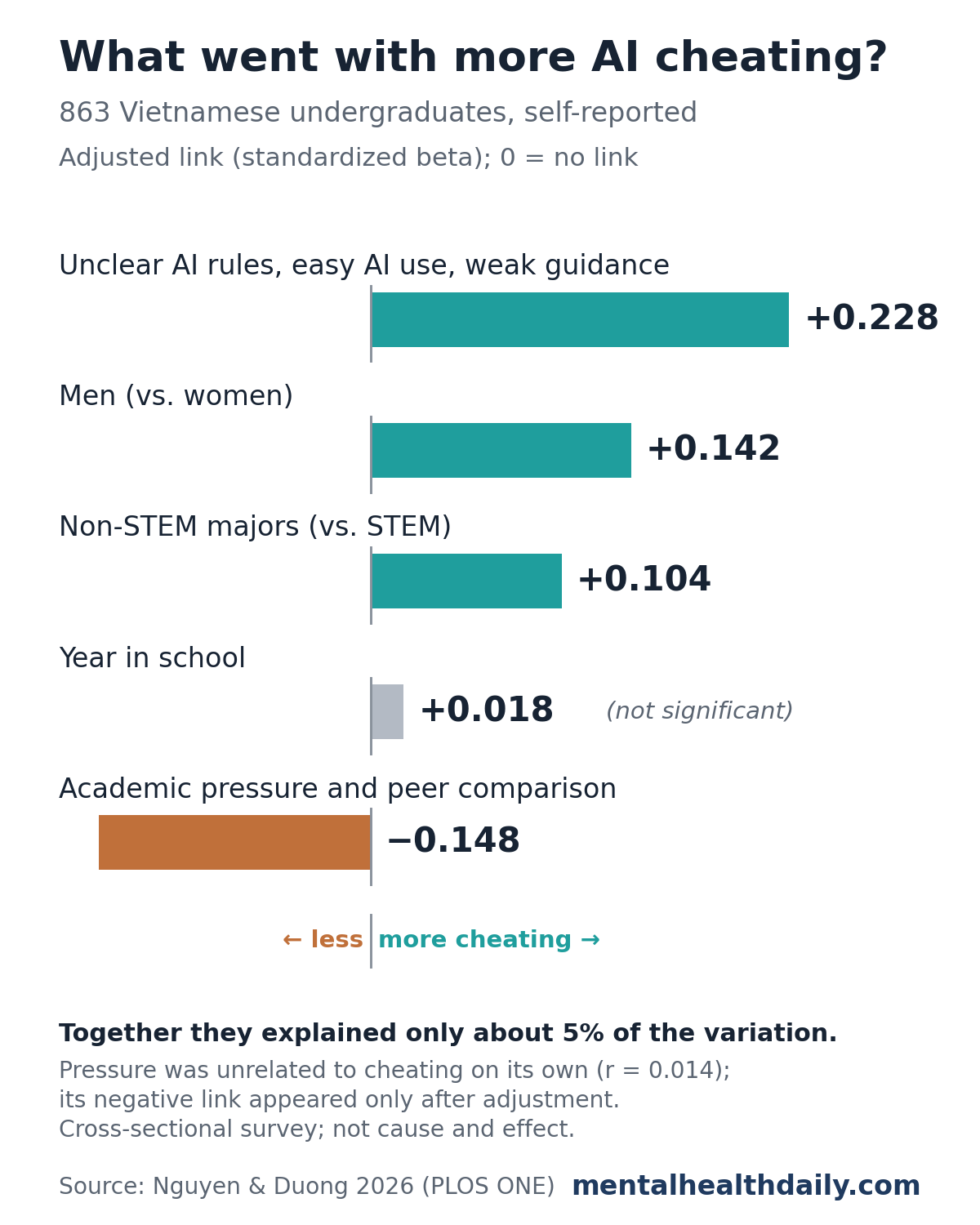
Unclear rules, easy AI and weak guidance: students who rated these problems as more serious reported more AI-assisted cheating (β = 0.228, p < 0.001). This was the largest link in the model.1
Gender: men reported more AI cheating than women (β = 0.142, p < 0.001). That link shrank slightly, from 0.183, once field of study was included; 38.7% of women were in non-STEM programs, compared with 10.6% of men.1
Field of study: non-STEM students reported more AI cheating than STEM students (β = 0.104, p = 0.008). Only 161 students were non-STEM, so the researchers treat this as a side finding.1
Year in school: students in later years reported about the same amount as first-years (β = 0.018, p = 0.622).1
Why Academic Pressure Showed a Small Negative Link to AI Cheating
Pressure and peer comparison showed a small negative link with cheating (β = −0.148, p = 0.022). Read alone, that sounds like stressed students cheat less. The researchers say plainly that it does not show that.1
On its own, pressure was essentially unrelated to cheating (correlation r = 0.014). It was, however, strongly correlated with the unclear-rules factor (r = 0.716), and the negative coefficient appeared only once both were in the same model.1
In plain terms: among students who saw the rules as equally murky, those who also felt more pressure reported slightly less cheating. That is a statistical adjustment between 2 overlapping measures, and the researchers warn against drawing intervention conclusions from it.1
Overlap between the 2 factors: by one standard test (the Fornell–Larcker criterion), the pressure and unclear-rules factors were not cleanly separable. A second test (the heterotrait–monotrait ratio, 0.719) supported keeping them apart. When 2 predictors overlap this much, their separate coefficients are less stable.1
All the Factors Together Explained About 5% of AI Cheating
The full model accounted for about 5% of the variation in self-reported cheating (R² = 0.05). The other 95% reflects things the survey did not capture.1
The researchers list several candidates for that missing share:
- Perceived risk of being caught
- Attitudes toward AI use
- AI literacy
- How assignments and exams are designed
- Moral disengagement, the habit of explaining away one’s own rule-breaking
- Peer norms and trust in university policies
Personal attitudes, which this survey did not measure, have predicted AI cheating elsewhere. In a 2024 study with 610 participants initially and 212 at the 3-month follow-up, attitudes toward AI cheating, perceived approval from others, and a sense that cheating would be easy predicted intentions to cheat with chatbot-written text, and those intentions predicted actual use 3 months later.6
Earlier Research on AI Cheating, Detection and Clear Policies
AI text is hard to catch. A 2023 test of 12 public detection tools plus 2 commercial systems, Turnitin and PlagiarismCheck, found them neither accurate nor reliable. They tended to label AI text as human-written, and paraphrasing or manual editing made detection worse, with about half of disguised AI text passing as human.4 Paraphrasing to avoid detection was also the most common behavior in the Vietnam survey.
Students undercount AI cheating when asked directly. A 2024 study of 1,386 Vietnamese undergraduates used a list experiment, a survey method that hides any one person’s answer inside a count of several behaviors. Only 9.6% admitted AI cheating when asked directly, but the list method estimated 23.7%.3 That study also found year-level differences in AI cheating that the 2026 survey did not.
Context shaped cheating long before AI. A classic 1993 survey of 6,096 students at 31 colleges linked academic dishonesty to whether a school had an honor code, how likely students thought they were to be reported, how severe the penalties were, and how much their peers cheated.7
AI has not obviously raised overall cheating. At 3 high schools surveyed before and after ChatGPT’s release, self-reported cheating stayed relatively stable. Most students said having a chatbot write a whole paper should not be allowed, while many supported using AI to get started on an assignment or to explain new concepts.5
That last finding shows where the gray zone sits. Students broadly agree on the extremes; the uncertainty is in the middle, where clear course-level rules are most needed.
Limitations of This AI Cheating Survey
- Cross-sectional design: perceptions and cheating were measured at the same moment, so the study shows links, not cause and effect. Students who cheat might also be more likely to describe the rules as unclear.
- Self-reported cheating: even anonymous answers about cheating tend to run low, and low average scores can shrink the links researchers are able to detect.
- One university, uneven sample: a convenience sample from a single Vietnamese technical university, mostly men and mostly STEM majors.
- Perceptions in general: students rated conditions they thought were linked to AI cheating, not necessarily their own reasons for cheating.
- Measurement: the unclear-rules factor fell slightly short of a common standard for how well its items hang together, and overall model fit was acceptable rather than good.
What Colleges Can Take From This Study
Spell out the rules course by course. The researchers recommend concrete explanations of which AI uses are allowed, which must be disclosed, and which count as misconduct. Their data cannot show that clearer rules reduce cheating, but unclear rules were the factor most closely linked to it.1
Do not lean on AI detectors. Detection tools miss much AI text, especially once it has been edited or paraphrased, so assignment design and clear expectations have to carry more of the load.4
Do not read pressure as protective. The negative pressure coefficient came from statistical adjustment, and the researchers say institutions should not base interventions on it.1
Give guidance to everyone. The gender and field differences were small and came from one uneven sample, so the researchers advise against targeting particular groups and recommend AI-use guidance across all programs and years.1
References
- Nguyen HV, Duong MT-T. Perceived factors associated with self-reported AI-assisted academic cheating among undergraduate students: Evidence from ethical ambiguity, technological affordances, institutional gaps, academic pressure, and peer comparison. PLOS ONE. 2026;21(9):e0359549. doi:10.1371/journal.pone.0359549
- Hanh NV, Duyen NT. AI-assisted academic cheating: a conceptual model based on postgraduate student voices. Frontiers in Computer Science. 2025;7:1682190. doi:10.3389/fcomp.2025.1682190
- Nguyen HM, Goto D. Unmasking academic cheating behavior in the artificial intelligence era: evidence from Vietnamese undergraduates. Education and Information Technologies. 2024;29:15999–16025. doi:10.1007/s10639-024-12495-4
- Weber-Wulff D, Anohina-Naumeca A, Bjelobaba S, Foltýnek T, Guerrero-Dib J, Popoola O, Šigut P, Waddington L. Testing of detection tools for AI-generated text. International Journal for Educational Integrity. 2023;19:26. doi:10.1007/s40979-023-00146-z
- Lee VR, Pope D, Miles S, Zárate RC. Cheating in the age of generative AI: a high school survey study of cheating behaviors before and after the release of ChatGPT. Computers and Education: Artificial Intelligence. 2024;7:100253. doi:10.1016/j.caeai.2024.100253
- Greitemeyer T, Kastenmüller A. A longitudinal analysis of the willingness to use ChatGPT for academic cheating: applying the theory of planned behavior. Technology, Mind, and Behavior. 2024;5(2). doi:10.1037/tmb0000133
- McCabe DL, Trevino LK. Academic dishonesty: honor codes and other contextual influences. Journal of Higher Education. 1993;64(5):522–538. doi:10.1080/00221546.1993.11778446