About 1 in 7 adults in Spain who use illicit drugs reported using them to enhance sex in the past year, according to a 2026 analysis of a large web survey. Far fewer, about 3%, reported going to a chemsex party, and most drug use was simply for fun.1
Research Highlights
- Sex was a minority motive: 874 of 6,399 respondents (13.66%) used drugs to enhance sexual pleasure or performance at least once in the past 12 months.1
- Chemsex was rarer still: 206 people reported attending at least one chemsex party, about 3% of the sample. Most were men, but 22 were women.1
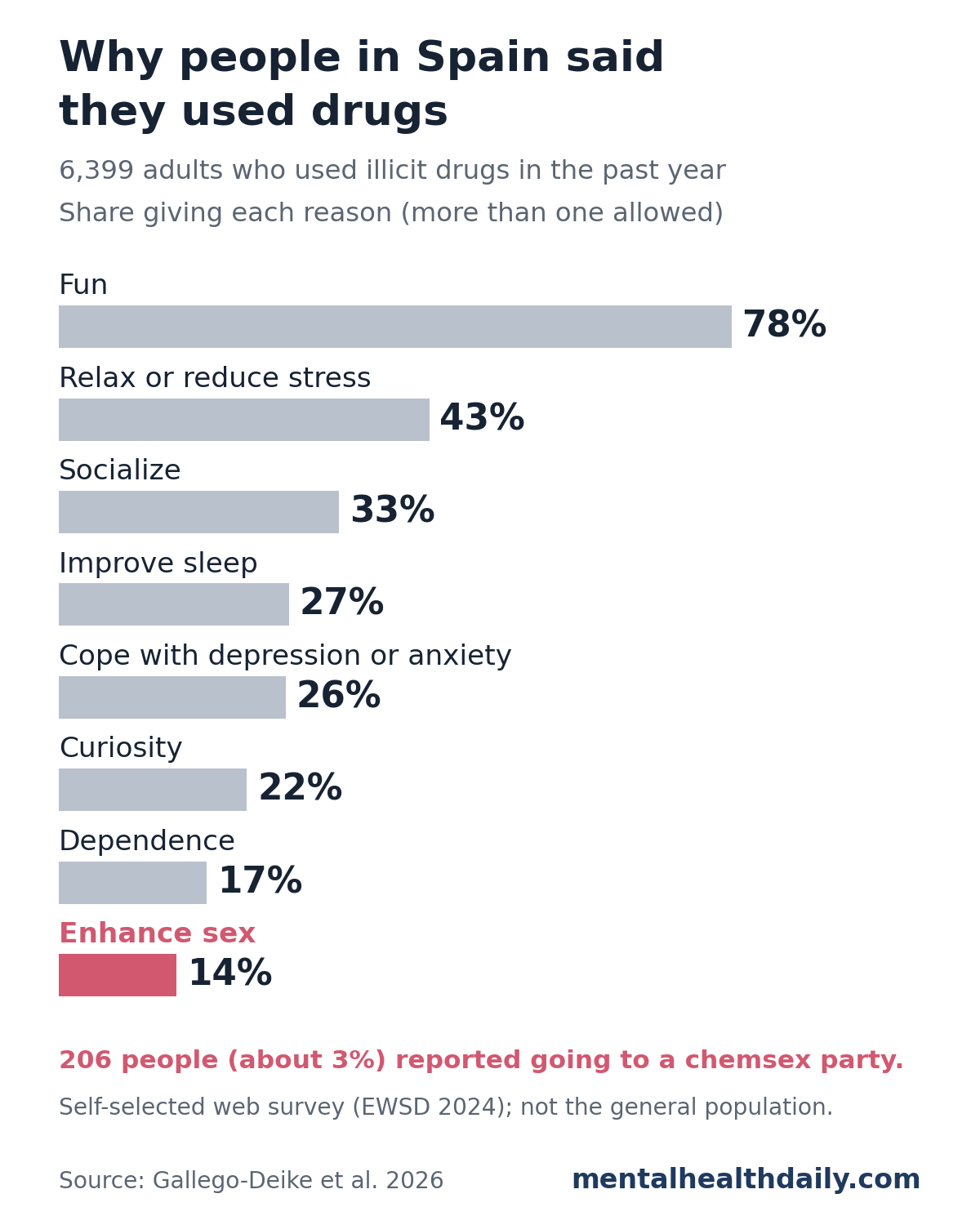
- Fun came first: 78% named recreation as a reason for using drugs, followed by relaxing or reducing stress (43%) and socializing (33%).1
- Many used drugs to cope: 27% used them to improve sleep and 26% to manage depression or anxiety, most often with cannabis.1
- Methamphetamine stood out: it was the drug its users most often took for sex (10%) and the one its users most often took at chemsex parties (10%).1
- Survey of people who use drugs: respondents chose to take part online, so these figures describe this group, not all adults in Spain.1
What Sexualized Drug Use and Chemsex Mean
Sexualized drug use (SDU) means deliberately taking a drug to enhance or prolong sex. It is a broad label with no agreed definition, covering everything from cannabis with a partner to stimulant use at group sex events.1
Chemsex is a narrower pattern that began as a term in the UK. It usually describes extended sex sessions, often in groups, fueled by stimulants and sedatives such as methamphetamine, mephedrone and GHB/GBL. Research has focused mainly on men who have sex with men (MSM), because that is where the practice was first documented.1
Chemsex is linked to higher risk of HIV, hepatitis C and other sexually transmitted infections, and to mental health problems. In a 2021 systematic review of 12 studies, MSM who practiced chemsex were more likely to have depression, anxiety or substance dependence, although not every study found this. Symptoms were more severe among men who injected drugs during sex.1,2
How the European Web Survey on Drugs Reached 6,399 People in Spain
Lucia Gallego-Deike et al. analyzed the Spanish portion of the European Web Survey on Drugs (EWSD), an anonymous online survey run by the European Union Drugs Agency in 30 countries. It asks people who use drugs what they take, how often, where, why and how they buy it.1
- When: May to June 2024
- Who could take part: adults 18 and older who had used cannabis, cocaine, MDMA, amphetamine, methamphetamine, heroin or new psychoactive substances (NPS) in the past year
- Recruitment: mostly social media posts and paid ads
- Sample: 6,399 valid respondents living in Spain, average age 31, about 62% cisgender men
For each drug they used, respondents picked their reasons and the settings where they used it. One of the setting options was “chemsex party.” Anyone who chose it for at least one drug was counted as practicing chemsex.1
Fun, Relaxing and Socializing Were the Top Reasons for Drug Use
Recreation was by far the most common reason people gave. Using drugs to enhance sex ranked well down the list.1
Where people used drugs: home was the most common setting for most drugs, including 80% of cannabis users, 60% of heroin users and 49% of cocaine users. MDMA was mainly a festival drug, with 70% of its users taking it at a music festival or party. Cocaine was also common in clubs and bars (52%).1
Coping, not partying: cannabis broke from the recreational pattern. Half of cannabis users (50%) used it to relax or reduce stress, 35% to improve sleep and 28% to manage depression or anxiety. The smaller group of heroin users showed a similar pattern, with 30% citing stress and 30% citing depression or anxiety.1
Dependence was also common. 22% of cannabis users and 27% of heroin users said they used the drug because they were dependent on it.1
1 in 7 Used Drugs for Sex, Mostly Just One Drug
Of the 874 people who used drugs to enhance sex, 712 (81%) used only one drug for that purpose. Another 113 (13%) used 2 or more different drugs for sex over the year, and 5 or more was rare.1
Which drugs: among users of each drug, those most likely to take it for sex were:1
- Methamphetamine: 10% of its users
- Cannabis: 9%
- MDMA: 8%
- Cocaine powder: 6%
Cannabis is far more widely used than methamphetamine, and it was the drug most often used for sex overall in every gender group.1
Who reported it: compared with other respondents, people who used drugs for sex were more often cisgender men (66% vs. 61%) and slightly more often transgender or non-binary (3.7% vs. 2.4%). They were also slightly younger on average (30.8 vs. 31.5 years). Education, income, living situation and where they lived made no significant difference.1
Chemsex Parties: 206 People, Mostly Men, Mostly Stimulants
Of the 206 people who reported attending a chemsex party in the past year, 170 were men, 22 were women and 14 were transgender or non-binary.1
Methamphetamine and NPS were the drugs most closely linked to this setting. Nearly 10% of all methamphetamine users and 5% of NPS users had used them at a chemsex party, compared with about 2% or less for cannabis, cocaine and MDMA. NPS are newer synthetic drugs designed to mimic established ones; the survey did not break them down by type.1
Riskier routes: chemsex-party attendees more often reported injecting drugs or smoking them from a pipe. For methamphetamine, 14% of attendees reported injecting it, compared with 4% of all methamphetamine users. Injecting during sex, called slamsex, is especially risky, raising the chances of infection, overdose, psychosis and addiction.1
How Spain Compares With Other Chemsex and Drug-Use Studies
Estimates from other studies vary widely depending on who was surveyed and how chemsex was defined:
- MSM worldwide: a 2025 meta-analysis of 238 studies with 380,505 participants estimated that 25% of MSM had engaged in sexualized drug use and 22% in chemsex.3
- Women: a 2025 meta-analysis of general-population studies pooled 25.78% for any sexualized substance use among women but only 3.50% for chemsex.4
- A Spanish STI clinic: among 145 patients diagnosed with a sexually transmitted infection at a Spanish hospital, 44% reported past-year drug use and 33.8% reported chemsex, most often with poppers and cannabis.5
The finding that sex-linked drug use extends beyond gay and bisexual men is consistent with the 2013 Global Drug Survey of 22,289 people. Substance-linked sex was reported across sexes and orientations, at least 20% of every group had used drugs to enhance sex, and alcohol, cannabis and MDMA were the most common choices. Classic chemsex drugs were still used more by gay and bisexual men.6
Limitations of This Spanish Web Survey
- Not the general population: everyone in the sample had used illicit drugs and chose to answer an online survey, mostly found through social media. The 1-in-7 figure applies to them, not to all adults in Spain.
- Loose chemsex definition: anyone who ticked “chemsex party” for any drug was counted, whether or not classic chemsex drugs were involved. Sexual orientation was not analyzed, so the study cannot say how many were MSM.
- One snapshot in time: the researchers suggest chemsex is spreading to women and heterosexual people, but a single survey cannot show change over time.
- Self-report only: drug use was not confirmed by testing, and NPS were not identified by type.
- Reporting inconsistencies: some counts and percentages in the paper do not match exactly (for example, 206 chemsex attendees works out to 3.2%, while the abstract gives 3.31%), so small subgroup figures deserve caution.
- Coping is not treatment: people using cannabis for sleep, stress or depression reported a motive; the survey did not measure whether it helped or harmed their mental health.
What the Spanish Chemsex Findings Mean for Care
Most drug use is social and recreational. In this sample, sex was one reason among many and chemsex a small niche. Still, among people who use drugs, enhancing sex was common enough that health services can ask about it routinely and without judgment.1
Prevention needs a wider lens. The researchers call for health education, harm reduction, inclusive care and professional training. Campaigns built only for gay and bisexual men may miss the women and transgender or non-binary people who also reported chemsex.1
Coping use is worth noticing. About 1 in 4 respondents used drugs to improve sleep, and a similar share used them to manage depression or anxiety. Anyone relying on drugs to cope with mood, stress or sleep can raise it with a doctor or an addiction service, where effective treatments are available.
References
- Gallego-Deike L, Bella-Fernández M, López-Sánchez LM, Brime-Beteta B, Ruiz-Medina S, Blasco-Fontecilla H. Patterns of drug use across social and sexual contexts in Spain: insights from the European Web Survey on Drugs 2024. Archives of Sexual Behavior. 2026. doi:10.1007/s10508-026-03525-y
- Íncera-Fernández D, Gámez-Guadix M, Moreno-Guillén S. Mental health symptoms associated with sexualized drug use (chemsex) among men who have sex with men: a systematic review. International Journal of Environmental Research and Public Health. 2021;18(24):13299. doi:10.3390/ijerph182413299
- Georgiadis N, Katsimpris A, Vatmanidou MA, Vassilakou T, Beloukas A, Sergentanis TN. Prevalence of chemsex and sexualized drug use among men who have sex with men: a systematic review and meta-analysis. Drug and Alcohol Dependence. 2025;275:112800. doi:10.1016/j.drugalcdep.2025.112800
- Karibayeva I. Prevalence of sexualized substance use and chemsex in the general population and among women: a systematic review and meta-analysis of cross-sectional studies. Healthcare. 2025;13(8):899. doi:10.3390/healthcare13080899
- Rosas Cancio-Suárez M, Ron R, Díaz-Álvarez J, Martínez-Sanz J, Serrano-Villar S, Moreno S, Sánchez-Conde M. Prevalence, characteristics, and associated risk factors of drug consumption and chemsex use among individuals attending an STI clinic (EpITs STUDY). Frontiers in Public Health. 2023;11:1285057. doi:10.3389/fpubh.2023.1285057
- Lawn W, Aldridge A, Xia R, Winstock AR. Substance-linked sex in heterosexual, homosexual, and bisexual men and women: an online, cross-sectional “Global Drug Survey” report. Journal of Sexual Medicine. 2019;16(5):721–732. doi:10.1016/j.jsxm.2019.02.018