New Brazilian Psychiatric Association guidelines put cognitive behavioral therapy (CBT) first for bulimia and binge-eating disorder, with fluoxetine and lisdexamfetamine as the preferred medications. For anorexia, no single therapy has proven best, and drugs play only a small supporting role.1
Research Highlights
- Binge-eating disorder: clinician-led CBT is first-line and leads to remission of binge eating in 48–53% of patients, with effects lasting up to 24 months. Lisdexamfetamine is the first-choice drug when medication is needed.1
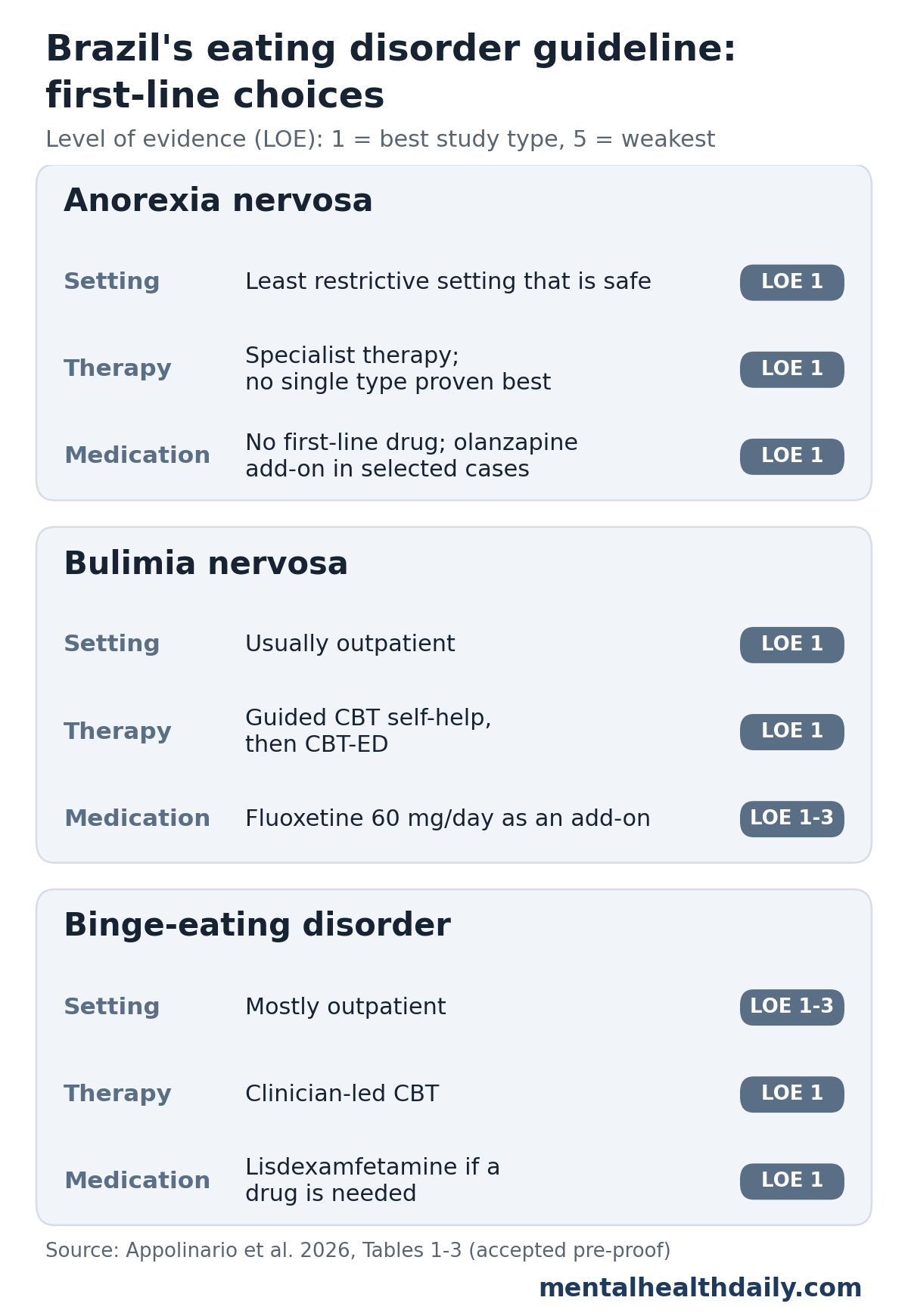
- Bulimia nervosa: guided CBT self-help comes first for mild to moderate cases, stepping up to individual CBT for eating disorders (CBT-ED) if needed. Severe cases start with CBT-ED. Fluoxetine 60 mg/day is the first-line add-on drug.1
- Anorexia nervosa: specialist therapies help, but none has beaten the others.1
- Medication for anorexia: antidepressants are not recommended for weight restoration or core anorexia symptoms. Olanzapine may be added in selected severe cases because it has a small effect on weight gain.1
- Version: this is the accepted pre-proof of the guideline in the Brazilian Journal of Psychiatry, posted before final copyediting and typesetting.1
How the Brazilian Eating Disorder Guideline Was Built
The Brazilian Association of Psychiatry (ABP) asked a group of psychiatrists, psychologists and dietitians to review treatment evidence for 3 eating disorders: anorexia nervosa, bulimia nervosa and binge-eating disorder. The guideline covers adults and adolescents and was written mainly for clinicians in Brazil’s public health system.1
The team searched 6 databases through June 30, 2025, giving priority to systematic reviews and meta-analyses and filling gaps with randomized trials. Recommendations were then agreed in 5 expert meetings, and each needed more than 75% agreement.1
Each recommendation carries a level of evidence (LOE) from the Oxford Centre for Evidence-Based Medicine scale:
- Level 1: systematic reviews of randomized trials
- Level 2: individual randomized trials
- Levels 3–5: nonrandomized studies, case series and expert reasoning
The level describes the kind of studies behind a statement, not how well a treatment works. Level 1 evidence can show that a treatment is no better than usual care, and that happens more than once for anorexia.
First-Line Treatments for Anorexia, Bulimia and Binge Eating at a Glance
Across all 3 disorders, the guideline starts with psychotherapy and adds medication only as part of broader care. The strength of the case for specific options differs sharply by disorder.1
Bulimia Nervosa: CBT Self-Help First, Then CBT-ED
Bulimia nervosa involves repeated binge eating followed by behaviors meant to compensate for it. The guideline recommends a stepped approach:1
- Guided CBT self-help (a structured CBT program worked through with brief clinician support) for mild to moderate bulimia. About one-third of patients stop binge eating and purging, though only 14.7% stay symptom-free after treatment ends.
- Individual CBT-ED (CBT adapted for eating disorders, delivered by a clinician) if self-help is not enough. It has the highest remission rates in the evidence reviewed and is the starting treatment for severe bulimia.
- Other therapies, such as behavioral therapy, interpersonal therapy, dialectical behavior therapy, family-based therapy or psychodynamic therapy, when CBT-ED is unavailable or unsuitable.
CBT-ED had a large effect on eating-disorder symptoms compared with a waitlist or no treatment (standardized mean difference 1.01). Against other active treatments, the edge was small (g = 0.27).1
Fluoxetine Is the First-Line Drug for Bulimia
Fluoxetine (Prozac) is the most studied medication for bulimia and the only one approved for bulimia by Brazil’s regulator, ANVISA. Its US Food and Drug Administration approval covers moderate-to-severe bulimia nervosa in adults.
At 60 mg/day, fluoxetine leads to more binge-eating remission and fewer dropouts than placebo, with small-to-moderate effects (LOE 1). It is meant as an add-on to therapy, not a stand-alone treatment.1
- Topiramate, a seizure medication, may be considered in selected cases, with monitoring for cognitive side effects.
- Ondansetron, an anti-nausea drug, is reserved for exceptional cases that have not responded to other treatment (LOE 3).
- Bupropion should not be prescribed for bulimia because of a higher seizure risk.
- Not recommended: trazodone, mirtazapine, naltrexone, spironolactone and lithium, which have not shown efficacy.
Binge-Eating Disorder: CBT Leads, Lisdexamfetamine When Medication Is Needed
Binge-eating disorder involves recurrent binge eating without the compensating behaviors seen in bulimia. For moderate to severe cases, the guideline recommends clinician-delivered CBT, which leads to remission of binge eating in 48–53% of patients.1
- Guided self-help CBT: 42–46% remission, offered when access to a therapist or adherence is limited.
- Interpersonal therapy or dialectical behavior therapy: 33–63% remission, an option if CBT is unavailable or does not work.
- Behavioral weight-loss programs: smaller and less durable effects, 23–41% remission.
- Third-wave therapies such as acceptance and commitment therapy and mindfulness-based approaches: moderate effects on binge frequency, with limited long-term data.
Treatments were generally well tolerated. Dropout was 19% for psychotherapy and 24% for self-help formats. The guideline also says weight loss should not be the first goal; any weight management comes after binge eating has settled, using gradual, non-restrictive methods.1
Lisdexamfetamine and Other Binge-Eating Medications
Lisdexamfetamine (Vyvanse), a stimulant also used for ADHD, is the only medication approved for binge-eating disorder by ANVISA. Its FDA approval covers moderate-to-severe binge-eating disorder in adults. Pooled data from 3 randomized trials show it reduces binge frequency and increases remission, with medium effect sizes (LOE 1). It did not significantly improve depressive symptoms.1
- Topiramate may be used off-label in selected patients, particularly those with a higher BMI or a poor response to first-line treatment.
- SSRIs such as fluoxetine and sertraline reduce binge frequency and depressive symptoms.
- GLP-1 drugs such as semaglutide and liraglutide showed early promise in small, short studies but are not yet considered established first-line treatments.
Anorexia Nervosa: Weaker Evidence for Any Single Therapy or Drug
For anorexia nervosa, the guideline pairs nutritional rehabilitation under medical supervision with psychotherapy. The goals are to restore weight, ease eating-disorder symptoms and keep people in treatment.1
Several therapies help, but none has clearly beaten the others:1
- Enhanced CBT (CBT-E), MANTRA and SSCM: MANTRA is the Maudsley model of anorexia treatment for adults, and SSCM is specialist supportive clinical management. Each improved eating-disorder symptoms with moderate to large effects, with no clear winner.
- Individual family therapy: in adult trials, about 3.5 times as likely as usual care to lead to remission or clinical improvement.4
- Fewer dropouts: CBT and CBT-E had lower dropout rates than comparison treatments (odds ratio 0.54).
The guideline still calls specialist psychotherapy first-line for anorexia. It should follow a manual, be adapted to the person, and be delivered by clinicians experienced with eating disorders.1
Antidepressants Do Not Restore Weight in Anorexia; Olanzapine Has a Small Role
Systematic reviews do not support antidepressants for weight gain or core anorexia symptoms (LOE 1). The overall quality of drug studies in anorexia is low.1
Olanzapine, an antipsychotic, is the exception. The largest trial, with 152 participants, found a small effect on weight gain. Later meta-analyses found small-to-medium effects on weight but not on eating-disorder or general symptoms.
Olanzapine is not approved for anorexia. The guideline allows it as an add-on to therapy in selected cases, with monitoring of blood sugar and lipids.1
Care Settings and Nutrition
For anorexia, reviews comparing full-time inpatient care with outpatient care or partial hospitalization found no clear difference in weight restoration or symptoms (LOE 1). The guideline recommends the least restrictive setting that keeps the person safe, decided case by case based on medical risk, severity and social support.1
Bulimia and binge-eating disorder are usually treated as outpatients. A higher level of care is for severe symptoms, serious medical or psychiatric problems, or failed outpatient treatment.1
Nutrition care works best when it is built into therapy rather than delivered alone. For bulimia and binge eating, the guideline recommends regular, structured meals and snacks to break the cycle of skipping meals and bingeing, along with education about hunger and fullness cues. Dietitians also help with gradual, supported exposure to feared foods.1
How the Brazilian Guideline Compares With US Recommendations
The authors say their recommendations are consistent with existing international guidelines.1 The 2023 American Psychiatric Association (APA) guideline covers the same 3 disorders.2
A summary of the APA guideline lists the same core choices for adults: renourishment plus psychotherapy for anorexia, CBT plus fluoxetine 60 mg daily for bulimia, and CBT or interpersonal therapy for binge-eating disorder, with antidepressants or lisdexamfetamine when medication is indicated.3
An earlier umbrella review of meta-analyses reached a similar ranking. It found that treatment effects for eating disorders are modest overall, family-based therapy outperformed active controls in anorexia, CBT-ED had the broadest efficacy in adult bulimia, and psychotherapy and lisdexamfetamine outperformed active controls in binge-eating disorder.4
The Brazilian guideline adds local details. For example, it notes that sibutramine, a weight-loss drug withdrawn in many countries over heart concerns, is still available in Brazil and reduces binge frequency, but requires special prescribing forms and signed consent.1
Limitations
- Pre-proof version: the text has not been through final editing, and some details may change. One example: the binge-eating summary table says naltrexone–bupropion “should be used during the maintenance phase,” while the main text says it does not reduce binge frequency or improve remission.1
- Thin evidence for anorexia: the authors note that psychological treatment research is more advanced for bulimia and binge eating, and drug studies in anorexia tend to be small, short and often lack placebo controls.
- Limits of the underlying trials: small samples, short follow-up, heavy reliance on self-report, and few men, adolescents or ethnic minorities.
- Scope: the guideline excludes children, pregnant women and older adults, does not cover avoidant/restrictive food intake disorder (ARFID), and does not address prevention, screening or assessment.
- Expert judgment: final recommendations reflect panel consensus and Brazil’s public health system, not only the evidence grades. The first author reports consulting and speaker fees from drug companies.
What This Means for Patients and Families
- Therapy is the backbone: for all 3 disorders, medication is an add-on rather than a replacement for psychotherapy.
- Bulimia and binge eating have clear starting points: CBT, in self-help or clinician-led form, has the strongest support.
- Anorexia needs specialist care: no specific therapy has won out, so the guideline stresses structured, personalized treatment from clinicians experienced with eating disorders.
- Decisions are individual: the right setting and treatment depend on medical risk and severity, so these steps are best worked out with a clinician.
Support: If you or someone you know is struggling with an eating disorder in the US, the National Alliance for Eating Disorders runs a free helpline staffed by licensed therapists at 1-866-662-1235. In a crisis, call or text 988 for the 988 Suicide & Crisis Lifeline, or call 911.
References
- Appolinario JC, Nunes MAA, Mourilhe C, et al. Brazilian Psychiatric Association guidelines for the treatment of eating disorders. Brazilian Journal of Psychiatry. 2026 (accepted pre-proof). doi:10.47626/1516-4446-2026-5102
- Crone C, Fochtmann LJ, Attia E, et al. The American Psychiatric Association practice guideline for the treatment of patients with eating disorders. American Journal of Psychiatry. 2023;180(2):167–171. doi:10.1176/appi.ajp.23180001
- Arnold MJ. Treating patients with eating disorders: guidelines from the American Psychiatric Association. American Family Physician. 2024;109(2):185–187. PubMed 38393813
- Monteleone AM, Pellegrino F, Croatto G, et al. Treatment of eating disorders: a systematic meta-review of meta-analyses and network meta-analyses. Neuroscience & Biobehavioral Reviews. 2022;142:104857. doi:10.1016/j.neubiorev.2022.104857