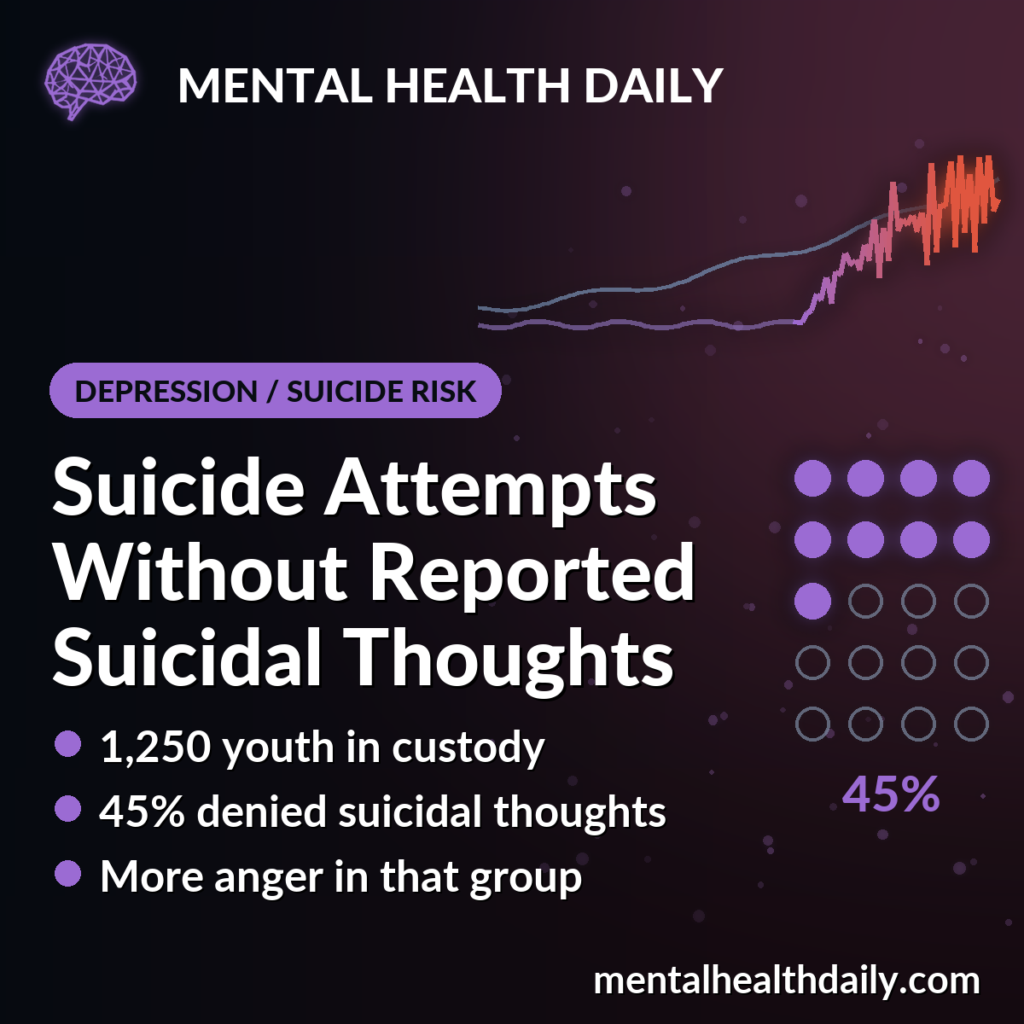
A 2026 study of 1,250 Florida youth in juvenile-justice programs who had attempted suicide found that 557 (45%) denied serious suicidal thoughts or a plan. Anger or irritability was more common among them than among youth reporting suicidal thoughts (40% vs. 30%).1 An earlier 427-youth sample found a 40% denial rate.2 Screening that starts with suicidal-thought questions could miss these youth.
Research Highlights
- 45% attempted without reported ideation: 557 of 1,250 youth with a lifetime suicide attempt denied serious suicidal thoughts or a plan, up from 40% in the original 427-youth study.12
- Anger and irritability replicated as the distinguishing trait: 40% of youth who denied ideation had that history vs. 30% of youth who reported it, with 43% higher odds after adjustment.1
- Depression was still common in both groups: 80% of youth who denied ideation had a depression history, compared with 89% of those who reported it.1
- “Denied” is not the same as “never had”: in other studies, the share shrank when passive thoughts were counted, and teens often failed to report thoughts they had logged days earlier.34
45% of Youth in Custody Who Attempted Suicide Denied Suicidal Thoughts
Most models of suicide are ideation-to-action theories: a person first thinks about suicide, and a smaller share of those people later move from thinking to an attempt. Screening follows the same logic, starting with questions about suicidal thoughts and escalating when the answer is yes.
Padron et al. tested whether that sequence fits youth in the juvenile legal system, a group whose suicide rate is 2 to 3 times higher than that of youth outside custody.1
Where the data came from: every youth admitted to a Florida Department of Juvenile Justice residential program gets an intake interview within 30 days, using a structured risk-and-needs tool called the R-PACT (Residential Positive Achievement Change Tool). Trained case managers ask about criminal history, demographics, mental health history, and suicidal thoughts and behavior.
Out of 17,420 youths in the years analyzed, 1,250 (7%) reported a lifetime suicide attempt. The researchers skipped the 2009–2012 records used in the original study, so the replication sample contained different youth.1
- Age: average 16.5 years (range 11 to 19)
- Sex: 66% male
- Race and ethnicity: 51% White, 38% Black, 11% Hispanic
- Offense: 88% were placed for a felony
Youth counted as having ideation if they endorsed either of 2 interview items: having had serious thoughts about suicide, or having made a suicide plan. By that definition, 557 of the 1,250 (45%) attempted suicide without ever reporting ideation. The original study, using earlier Florida records, found 171 of 427 (40%).12
Anger and Irritability Were Higher in Youth Who Denied Ideation
The 2 groups did not differ by age, sex, felony status, or weapon offenses. They did differ clinically, and in the same direction as the original study.1
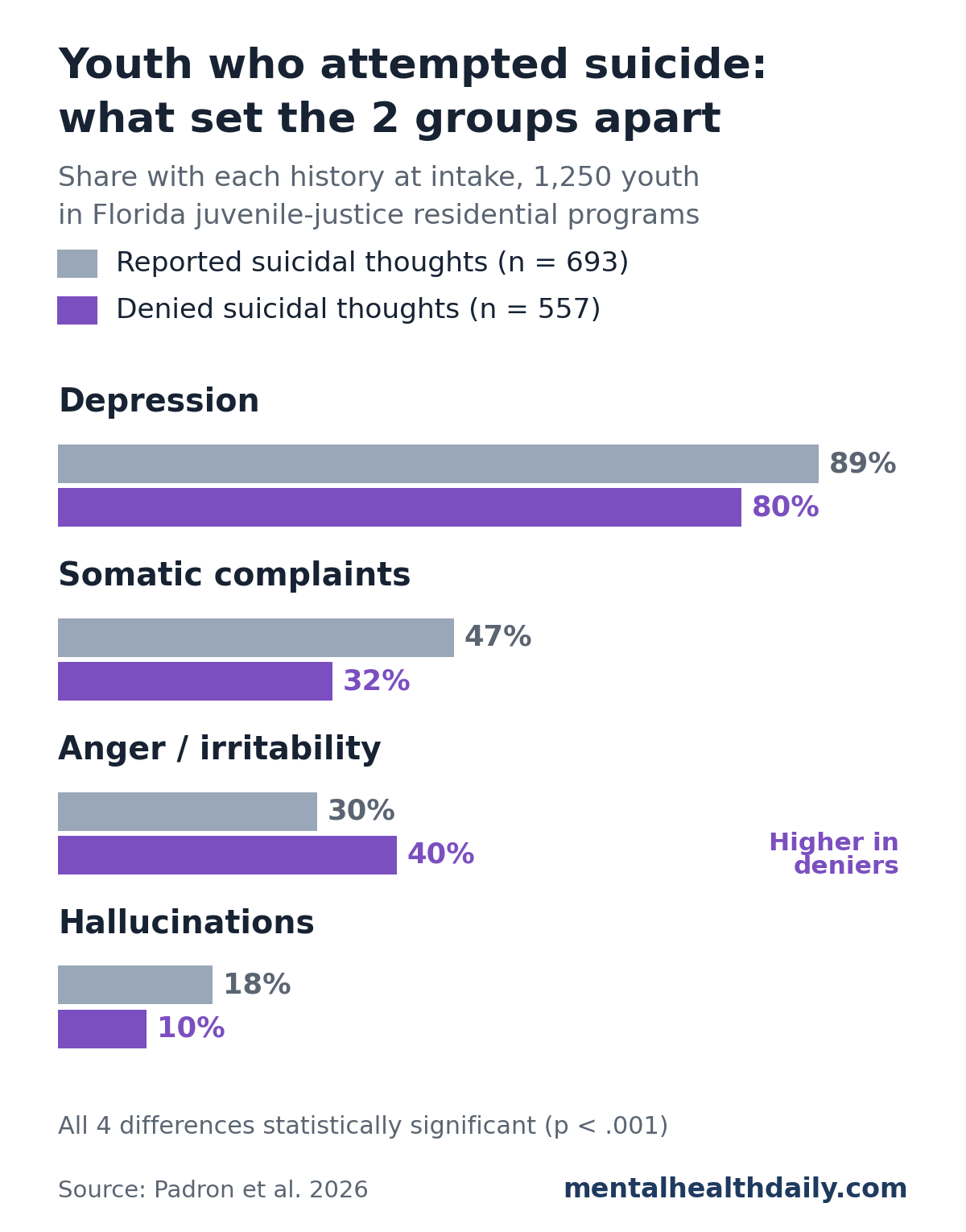
Irritability here means a tendency to become angry easily. Youth who denied ideation were more likely to have a history of anger or irritability (40% vs. 30%). The other clinical histories ran the opposite way, with lower rates of:
- Depression: 80% vs. 89%
- Somatic complaints (physical symptoms such as headaches or stomach pain that often accompany distress): 32% vs. 47%
- Hallucinations: 10% vs. 18%
- Childhood adversity: lower rates of physical abuse, sexual abuse, neglect, and witnessing violence
The researchers then entered all of these histories, along with offense type and demographics, into a single logistic regression. This analysis estimates how each factor relates to attempting without reported ideation while holding the others constant. Results are expressed as an odds ratio (OR): above 1 means higher odds of attempting without ideation, below 1 means lower odds.1
- Anger/irritability: OR 1.43 (95% CI 1.12 to 1.83)
- Depression: OR 0.61 (0.44 to 0.86)
- Somatic complaints: OR 0.68 (0.53 to 0.87)
- Hallucinations: OR 0.62 (0.44 to 0.88)
- Witnessing violence: OR 0.72 (0.51 to 1.00), right at the edge of significance
Abuse and neglect lost significance once the model accounted for everything else. That is 1 place the replication diverged from the original, where lower neglect rates set the no-ideation group apart.12
How large is the anger difference? Moderate at the group level, and not enough to identify individuals. Six in 10 youth who attempted without reported ideation had no recorded anger history, and 3 in 10 youth who did report ideation had one. Anger history is linked to higher odds at the group level; it does not define a separate kind of young person.
How this fits the wider anger literature: a 2018 systematic review of 39 studies found that irritability was usually linked to suicidal thoughts or attempts in community samples, but findings in clinical samples were mixed. In clinical samples of children and teens, the review found no consistent association. It also flagged that studies define irritability, anger, and reactive aggression inconsistently, and that most were of low to medium quality.5
The Florida finding is more specific than “anger predicts suicide risk.” Among youth who had already attempted, anger was more common in those whose attempt was not preceded by reported suicidal thinking.
Does Denying Suicidal Ideation Mean There Were No Suicidal Thoughts?
Not necessarily, and the researchers say so directly: the findings show that ideation was not reported or identified, not that it was absent.1 Two lines of evidence help explain how large this measurement gap can be.
Definitions change the number. In a 2022 survey of 6,200 U.S. adults, 36% of people with a lifetime suicide attempt denied ever having active suicidal thoughts. When passive thoughts (such as wishing to be dead) were included, only 11% denied any suicidal thinking at all.3
The Florida interview asked only about serious thoughts and plans. Some of the 45% may have had passive or fleeting thoughts that neither question captured.
Teens forget or underreport thoughts they had. A 2026 study gave 80 adolescents phone check-ins 5 times a day for 2 weeks. Of the 48 who reported suicidal thoughts during those check-ins, 35% to 41% denied having had any when asked afterward by survey or interview. Those who later denied tended to have milder, less frequent thoughts and less depression.4
That second pattern resembles the Florida no-ideation group, which also had lower depression rates. Custody adds its own pressures. A youth may not disclose suicidal thoughts to a case manager when a “yes” means being flagged as high risk in a detention setting, and some young people have trouble recognizing or naming what they felt before an attempt.1
Two explanations, same screening problem. The data cannot tell whether these youth truly went from calm to crisis without suicidal thinking, or whether their thoughts went unreported. The researchers note that either way, a screen that leans mainly on a “yes” to suicidal-ideation questions will miss a large share of youth who go on to attempt.1
What This Means for Suicide Screening in Juvenile Justice
Proposed rapid pathway: For some youth, a trigger sets off a surge of anger or distress, and an attempt follows quickly as a way to escape that feeling, with little forethought or planning.1 This study cannot test that sequence because it recorded lifetime histories, not what happened in the hours before an attempt. It does make the case for broader screening.
- Do not stop at “no”: a denial of suicidal thoughts should not by itself close a risk assessment for a youth in custody, especially one with a prior attempt.
- Ask about anger and irritability: the researchers suggest adding anger to risk assessment to catch youth that ideation questions miss, though the modest group difference means it should supplement other signals, not replace them.
- Build skills for managing acute anger: the researchers point to anger management, distress tolerance, and emotion-regulation programs as prevention options worth testing in detention settings.
The race finding needs careful handling. Black youth made up 43% of the no-ideation group vs. 34% of the ideation group, and had 32% higher adjusted odds of attempting without reported ideation (OR 1.32, 95% CI 1.02 to 1.70) compared with White youth.1
The researchers raise several explanations: suicidal distress may be expressed through irritability rather than sadness, recognized less often by assessors, or disclosed less because of stigma. The finding points to a screening gap, not to lower risk.
Limits of the Florida Intake-Interview Data
The replication strengthens confidence that the 40–45% figure is not a fluke of 1 sample. It still rests on the same state system, the same interview tool, and the same research team, so it is a replication across years rather than an independent test in a new setting. Other limits:1
- Cross-sectional, lifetime reports: everything was recorded at 1 intake, so there is no information on whether anger came before the attempt or how quickly an attempt followed a crisis.
- Single-item ratings: depression, anger, and abuse history were each a yes-or-no judgment from a case manager, not a diagnostic interview or validated scale.
- Unverified attempts: suicide attempts were self-reported, and their number, severity, and timing were not analyzed.
- 1 population: youth in Florida residential juvenile-justice programs; it is unknown whether the same share and pattern apply to youth outside custody.
Within those limits, 2 non-overlapping samples from the same system now agree: roughly 4 in 10 youth in custody who have attempted suicide do not report suicidal thinking when asked, and those youth are somewhat more likely to have an anger history and somewhat less likely to have a depression history. Suicide screening in juvenile justice that depends on a youth saying “yes” to suicidal-thought questions will miss many of them.
If you or someone you know is in crisis, call or text 988 (the 988 Suicide & Crisis Lifeline in the U.S.) or go to the nearest emergency department.
References
- Anger (again) differentiates suicide attempt with versus without suicide ideation among youth detained in the legal system: a replication study. Padron M, Liu L, Pettit JW. Child Psychiatry Hum Dev. 2026. doi:10.1007/s10578-026-02100-9
- Suicide attempt in the absence of suicide ideation: prevalence and correlates among youth detained in the juvenile legal system. Padron M, Liu L, Pettit JW. J Affect Disord. 2025;391:119927. doi:10.1016/j.jad.2025.119927
- Suicide attempts among adults denying active suicidal ideation: an examination of the relationship between suicidal thought content and suicidal behavior. Wastler HM, Bryan AO, Bryan CJ. J Clin Psychol. 2022;78(6):1103-1117. doi:10.1002/jclp.23268
- Who and what retrospective risk assessments miss: examining retrospective denial of momentary suicidal ideation in adolescents. Shin KE, Gratch I, Cha CB. JCPP Adv. 2026;6:e70063. doi:10.1002/jcv2.70063
- Association between irritability and suicide-related outcomes across the life-course: systematic review of both community and clinical studies. Orri M, Perret LC, Turecki G, Geoffroy MC. J Affect Disord. 2018;239:220-233. doi:10.1016/j.jad.2018.07.010