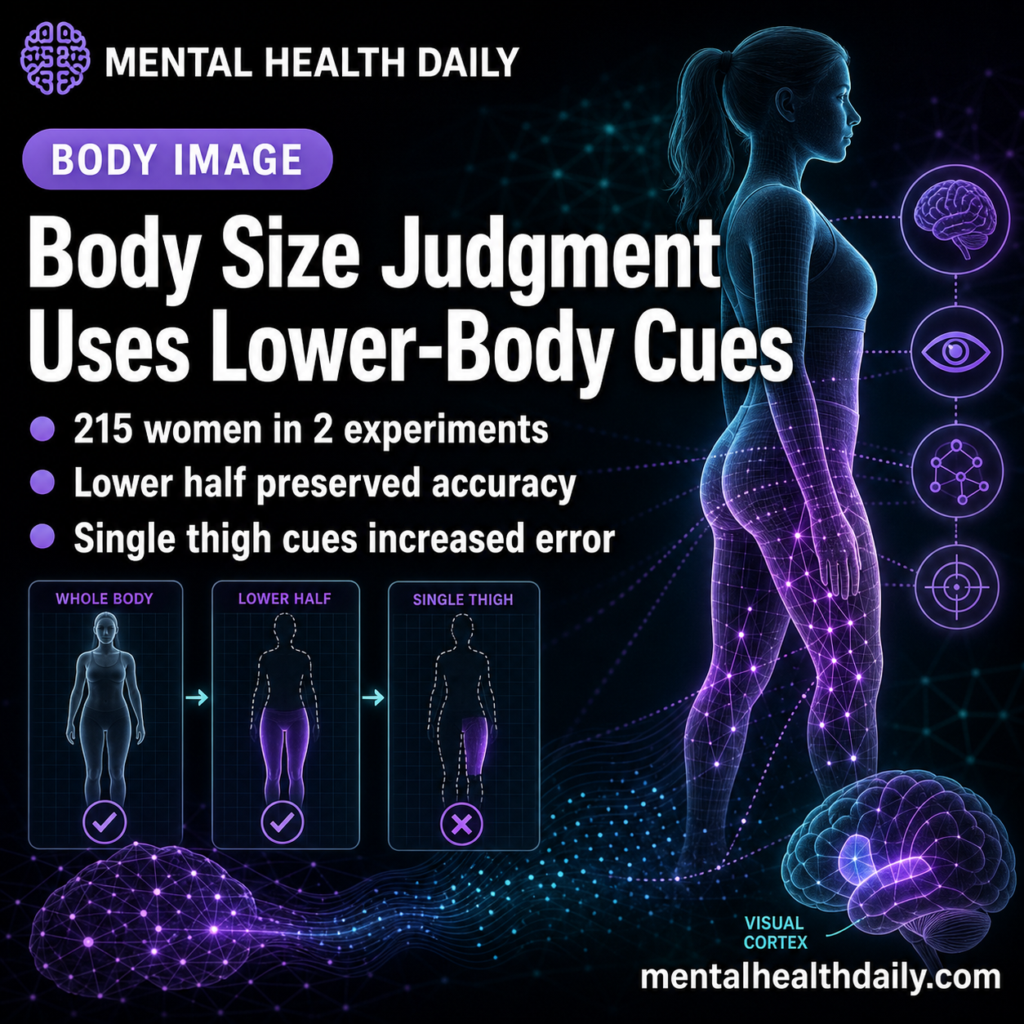
A 2-experiment BMC Biology study found that female body-size judgments did not require a full-body view: bottom-half views preserved accuracy in 99 women, while isolated inner- or outer-thigh views produced more perceptual error than whole-body views in a second 116-woman experiment.1 The result is relevant to body-image research because it points to lower-body feature integration, not a simple “thigh-only” shortcut.
Research Highlights
- Lower-body information carried the size signal: In Experiment 1, 99 women judged bottom-half-only bodies about as accurately as whole bodies, while top-half-only views produced more regression-to-the-mean error than whole-body or bottom-half views.1
- Single thigh regions were not enough: In Experiment 2, 116 women made less accurate judgments when only the outer thigh or inner thigh was visible than when the whole body was visible.1
- Body-size category was clearly discriminated: The main body-size effect in Experiment 1 was large, F(2.48, 242.83) = 2164.72, p < 0.001, so the task detected basic size differences before testing cue effects.1
- Perceptual bias had 2 sources: Regression to the mean pulled judgments toward average body sizes, while serial dependence pulled current judgments toward the body seen on the previous trial.1
- Clinical meaning stays bounded: Body-image disturbance is central in eating disorders, but this study tested visual size judgment in nonclinical perception tasks, not anorexia diagnosis or treatment response.2,3
Body-size judgment means estimating how large a body is from visual information. In body-image research, this is the perceptual side of a larger problem that also includes body dissatisfaction, body checking, avoidance, and fear-driven interpretation of one’s own shape.
Body-image disturbance is clinically important in eating disorders because some patients overestimate or misread body size. The mechanism includes perception: a visual system has to decide which cues count, how much weight to give them, and how strongly recent body images bias the next judgment.
Bottom-Half Views Preserved Body-Size Judgment Accuracy
Marinko et al. used a bodyline task, a visual-perception task in which participants view body images and judge where each body falls on a size scale.1 The task is useful because it separates a person’s average judgment from 2 more specific error patterns.
- Regression to the mean: thin or large bodies are pulled toward average-size judgments, so the person underestimates extremes.
- Serial dependence: the body seen on the previous trial pulls the current judgment toward it, so perception carries short-term visual history.
Experiment 1 tested whether participants needed the whole body or could judge size from partial views. After screening out 5 participants who did not reliably discriminate body-size categories, the analysis included 99 women judging whole-body, top-half, and bottom-half conditions across 7 body-size categories.
Participants clearly distinguished size categories: F(2.48, 242.83) = 2164.72, p < 0.001. The main effect of view condition did not reach significance, F(2, 196) = 2.74, p = 0.067, but body size and view condition interacted, F(7.28, 713.32) = 37.99, p < 0.001.1
The practical pattern was direct. Bottom-half-only views produced judgment accuracy comparable to whole-body views. Top-half-only views produced larger regression-to-the-mean errors, especially at the thin and large ends of the body-size scale.
Isolated Thigh Cues Increased Perceptual Error
Experiment 2 asked a narrower question: if the lower half carries enough information, can one isolated lower-body region carry it by itself? The researchers compared whole-body viewing with isolated inner-thigh and outer-thigh views in 116 women.1
The answer was no. Both isolated thigh-region conditions produced worse body-size judgments than whole-body viewing. For regression-to-the-mean error, the outer-thigh comparison favored a model with a shallower slope and greater error, F(1, 1620) = 152.8, p < 0.001. The inner-thigh comparison was also worse than whole-body viewing, F(1, 1620) = 262, p < 0.001.
Inner-thigh-only viewing performed slightly worse than outer-thigh-only viewing on regression-to-the-mean error, F(1, 1620) = 7.09, p = 0.008. Serial-dependence bias also broadened when only one thigh region was visible. Estimated serial-dependence amplitude was A = 0.43 for whole-body viewing, A = 0.47 for outer-thigh viewing, and A = 0.64 for inner-thigh viewing.1
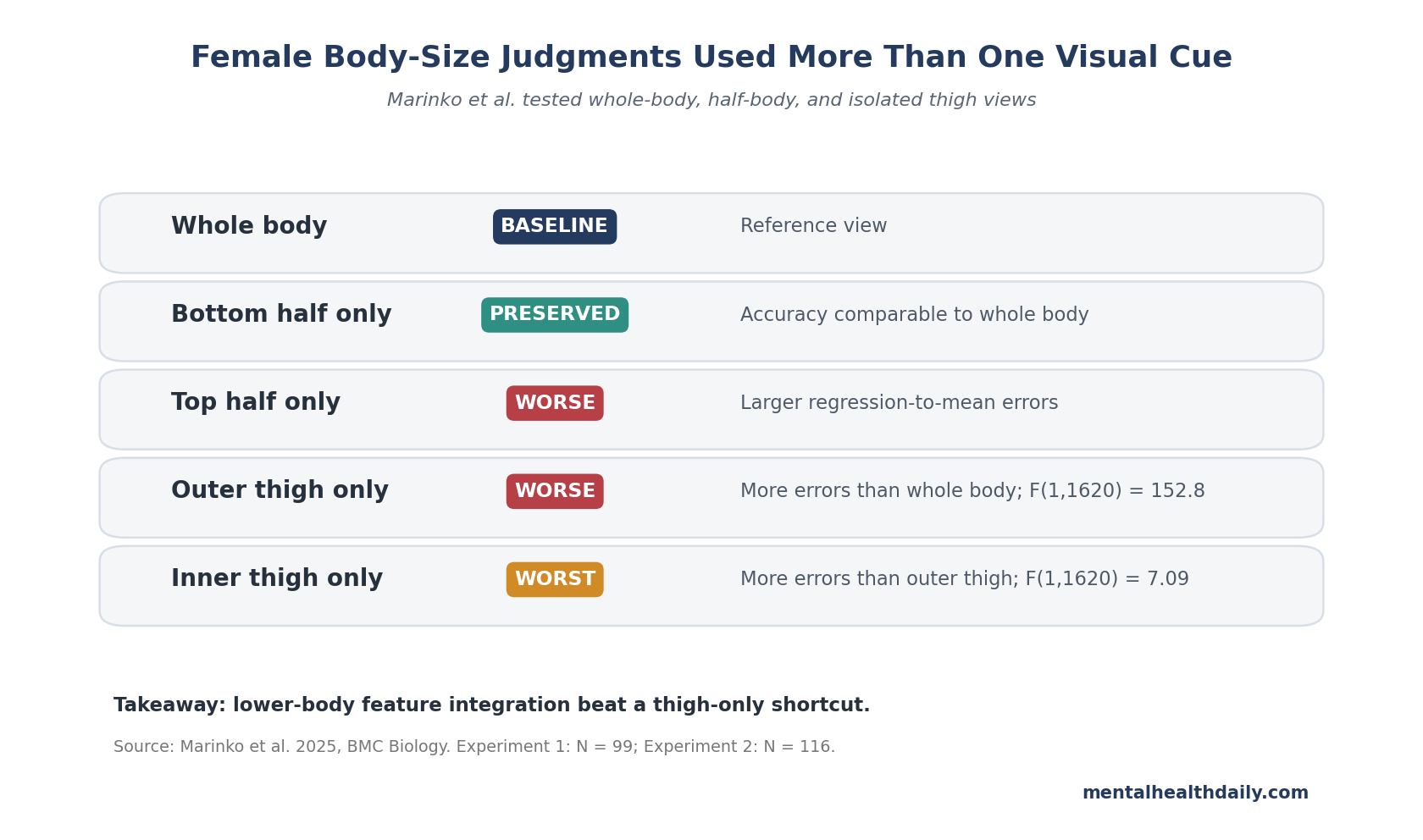
Lower-body feature integration means the perceptual system appears to combine multiple visible cues from the lower body rather than using a single anatomical patch. A bottom-half view gives enough information to estimate size, but stripping that view down to only one thigh region removes context that the visual system normally uses.
Why This Fits Body-Image Research Without Becoming a Clinical Test
Body-image disturbance has long been treated as a core feature of anorexia nervosa and bulimia nervosa. Cash and Deagle’s meta-analysis helped establish that body-image disturbance was not a vague personality complaint; it was a measurable clinical feature across eating-disorder samples.2
More recent measurement work has moved from broad body dissatisfaction toward visual mapping and perceptual markers. Ralph-Nearman et al. used digital body-image mapping in anorexia nervosa and reported that visual disturbance measures related to illness severity.3 That kind of work treats body-image disturbance as partly measurable alongside self-report.
Marinko et al. do not prove that lower-body cue weighting causes eating disorders. Their participants were not a clinical eating-disorder sample, and the task involved judging presented female bodies rather than a person’s own body. The contribution is narrower: if body-size perception depends on integrated lower-body cues, then clinical body-image measures should not assume that one global body outline captures the whole perceptual problem.
Prior Visual-Cue Studies Pointed Toward Feature Integration
Irvine et al. used eye-tracking and a visual masking approach to ask which cues drive self-assessment of body size.4 Their key point was that where people fixate is not necessarily the same as the information their visual system uses. Observers may look centrally, while judgment accuracy depends on body-edge cues that define width and shape.
A 2024 Marinko et al. study tested another version of the same problem: whether internal body features add useful information beyond silhouette shape.5 Removing internal features increased body-size judgment errors and changed serial-dependence patterns. That result argued against a simple outline-only account.
The 2025 lower-body study adds a more specific piece. Full lower-body information can preserve accuracy, but isolated lower-body fragments cannot. Together, the evidence favors a feature-integration model: body-size perception uses multiple visual cues, and accuracy drops when the image removes too much of that cue structure.
The Study Does Not Support a Simple “Thigh Obsession” Claim
Popular framing can easily turn this paper into a claim that people judge female body size by looking at thighs. The actual result is more careful. Bottom-half information was sufficient in Experiment 1, but one isolated thigh region was insufficient in Experiment 2.
That distinction changes the interpretation:
- Supported: lower-body regions contain important information for female body-size judgments.
- Supported: multiple lower-body features appear to work together.
- Not supported: one thigh region alone explains accurate body-size perception.
- Not tested: whether clinical eating-disorder patients use the same cue weighting.
Evidence strength: this is a controlled visual-perception study, so it can identify task-specific judgment mechanisms. It cannot diagnose body-image disturbance, prove causality in eating disorders, or tell clinicians which body region to target in treatment.
Clinical caution: translating the result into eating-disorder care requires studies that test self-body perception, symptom severity, and treatment response directly. Judging standardized images of other bodies is not the same as judging one’s own body under anxiety, mirror exposure, social comparison, or restrictive-eating pressure.
The useful takeaway is therefore methodological. Body-image research should measure which visual cues people use and how those cues are integrated, instead of assuming that global dissatisfaction, gaze location, and perceptual accuracy are the same construct. Lower-body cue weighting may be one measurable piece of that larger system.
Measurement implication: the study supports better cue mapping, not a new body-focus rule. The lower-body signal mattered because it preserved visual structure, not because one isolated feature carried the whole judgment.
Questions About Body-Size Judgment and Body Image
Does this mean thighs cause body-image problems?
No. The study tested visual information used during body-size judgments. It does not show that thigh-focused attention causes body dissatisfaction, eating-disorder symptoms, or clinical body-image disturbance.
Why did bottom-half views work better than top-half views?
The lower body probably preserved more of the visual width and shape information participants used to infer body size. Top-half views lost enough relevant information that thin and large bodies were pulled more strongly toward average-size judgments.
What is serial dependence in plain English?
Serial dependence is the carryover effect from the last thing you saw. If the previous body image was larger or smaller, the next body-size judgment can be pulled slightly in that direction.
Could this help eating-disorder research?
Yes, but indirectly. The result suggests body-image measures should care about which visual cues are available alongside whether someone reports feeling dissatisfied with their body. Clinical studies still need to test whether people with anorexia nervosa, bulimia nervosa, or body dysmorphic symptoms show different cue weighting.
Bottom line: Marinko et al. sharpened the perception side of body-image research. Female body-size judgment was not purely holistic and not reducible to one body part; accuracy depended on multiple lower-body cues working together.
References
- Marinko L, Kennedy BL, Koh KK, Dondzilo L, Bell J. The thighs have it: evidence for the importance of lower body regions in female body size judgments. BMC Biology. 2025;23:338. https://doi.org/10.1186/s12915-025-02444-z
- Cash TF, Deagle EA. The nature and extent of body-image disturbances in anorexia nervosa and bulimia nervosa: a meta-analysis. International Journal of Eating Disorders. 1997;22(2):107-126. doi:10.1002/(sici)1098-108x(199709)22:2<107::aid-eat1>3.0.co;2-j
- Ralph-Nearman C, Arevian AC, Moseman S, et al. Visual mapping of body image disturbance in anorexia nervosa reveals objective markers of illness severity. Scientific Reports. 2021;11:12262. https://doi.org/10.1038/s41598-021-90739-w
- Irvine KR, McCarty K, Pollet TV, Cornelissen KK, Tovee MJ, Cornelissen PL. The visual cues that drive the self-assessment of body size: dissociation between fixation patterns and the key areas of the body for accurate judgement. Body Image. 2019;29:31-46. https://doi.org/10.1016/j.bodyim.2019.02.006
- Marinko L, Kennedy BL, Jarosz V, Alexi J, Dondzilo L, Bell J. Features are more than just filling in the blanks on body size scales. Visual Cognition. 2024;32(3):242-261. https://doi.org/10.1080/13506285.2024.2412627