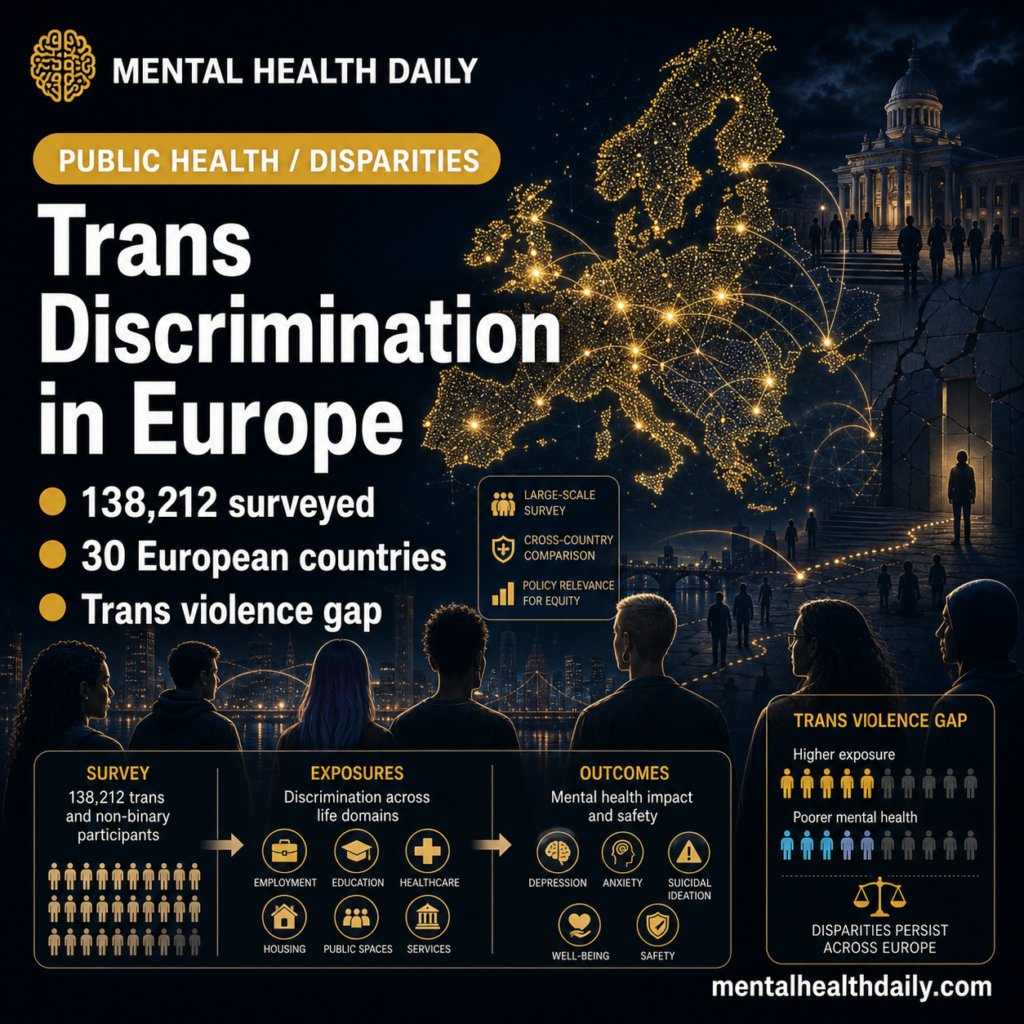
Trans people in Europe reported more discrimination and violence than cisgender lesbian, gay, and bisexual people in a 30-country survey of 138,212 respondents. The gap concentrated in identity-based discrimination, physical or sexual attacks, disability, ethnic-minority status, and gender identity within trans groups.1
Research Highlights
- 30-country gap was large and consistent: trans respondents reported discrimination in more life domains and violence more often than cisgender LGB respondents across Europe.1
- The clearest raw numbers were easy to understand. At least 1 discrimination domain was reported by 58% of trans participants versus 40% of cisgender LGB participants; at least 1 physical or sexual attack was reported by 40% versus 25%.1
- 90-to-11 rights-score range did not erase the gap: stronger national LGBTQ+ rights were tied to slightly less discrimination overall, but trans respondents still reported more harm than cisgender LGB respondents.1
- 2 intersectional risks amplified burden: ethnic-minority and disabled participants reported more discrimination and violence than non-minority and non-disabled participants, with larger added burden when those participants were also trans.1
- 4 mental-health pathways are relevant: discrimination and victimization connect to depression, suicide risk, minority stress, and structural-stigma exposure in LGBTQ+ populations.3,4
The popular mistake is to collapse LGBTQ+ risk into one average. The Evje study is useful because it separates trans respondents from cisgender LGB respondents and then asks whether country, disability, ethnic-minority status, and gender identity change the pattern.1
138,212 Respondents Across 30 European Countries
The study used the 2020 EU LGBTI Survey II, an anonymous opt-in survey collected in 2019. After excluding intersex respondents because they were outside the paper’s analytic scope, the sample included 138,212 respondents from 30 countries. Cisgender LGB respondents made up 118,543 of the sample; trans respondents made up 19,669.1
A compact sample snapshot is useful here:
- Total sample: 138,212 self-identified LGB or trans participants.
- Trans sample: 19,669 participants; 19.8% trans women, 27.7% trans men, and 52.4% nonbinary or gender diverse.
- Cisgender LGB sample: 118,543 participants; 19.2% lesbian women, 49.7% gay men, and 31.2% bisexual individuals.
- Age distribution: 64.1% were between 15 and 29 years old.
- Country context: Rainbow Europe scores ranged from 90 in Malta to 11 in North Macedonia, with a mean of 47.56 out of 100.1
The design matters. This was not a representative prevalence survey of every European LGBTQ+ adult. It was a large opt-in survey designed to capture a wide range of LGBTI experiences. That makes the between-group comparisons useful, but it means the raw percentages should not be treated as exact population prevalence estimates.
Discrimination Was Broader for Trans Respondents
The discrimination measure did not ask “how many times did this happen?” It counted how many of 7 life domains contained identity-based discrimination during the past 12 months: looking for a job, work, housing, healthcare or social services, school or university, cafes/restaurants/bars/nightclubs, and shops.1
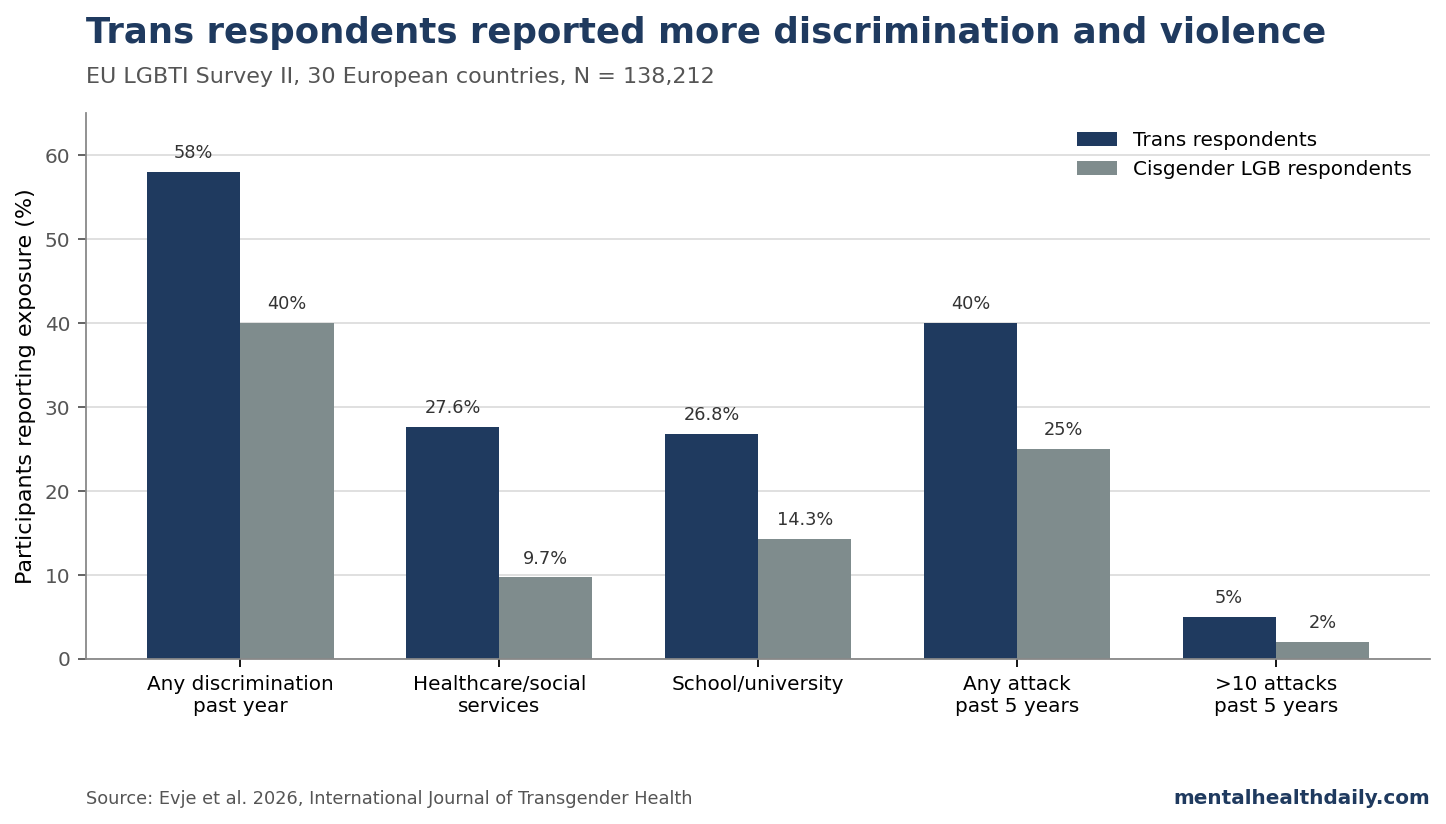
That distinction is important. A person facing repeated discrimination in 1 domain could score lower than someone reporting isolated discrimination across several domains. Still, the pattern was strong. Trans respondents had a higher mean discrimination score than cisgender LGB respondents (1.42 versus 0.77), and 58% of trans participants reported discrimination in at least 1 domain versus 40% of cisgender LGB participants.1
The largest domain-level gaps were clinically intuitive. Healthcare or social-services discrimination was reported by 27.6% of trans respondents versus 9.7% of cisgender LGB respondents. Shop discrimination was 24.4% versus 10.1%. School or university discrimination was 26.8% versus 14.3%. Work discrimination was higher too, but the gap was smaller: 18.3% versus 13.3%.1
Violence Was Higher, Especially for Trans Women and Nonbinary People
The violence item asked about physical or sexual attacks in the last 5 years, with response options ranging from never to “all the time.” Trans respondents had a higher mean violence score than cisgender LGB respondents (1.00 versus 0.56).
More concretely, 40% of trans participants reported being attacked at least once, compared with 25% of cisgender LGB participants. Repeated severe exposure also differed: 5% of trans participants reported more than 10 attacks versus 2% of cisgender LGB participants.1
Within the trans sample, violence was not evenly distributed. Compared with trans men, trans women reported more violence (b = 0.15, SE = 0.03, P < .001), and nonbinary people also reported more violence (b = 0.16, SE = 0.03, P < .001). Discrimination showed a different pattern: trans women and trans men did not significantly differ, while nonbinary people reported discrimination in fewer life domains than trans men.1
That combination should be read carefully. Nonbinary people were not protected in this dataset; the discrimination score measured breadth across named public domains, while the violence item measured attack frequency over 5 years. Different measures can reveal different parts of risk.
Country Rights Scores Helped Less Than Expected
The study included the 2019 Rainbow Europe Country Ranking as a country-level predictor. Higher LGBTQ+ rights scores were associated with slightly lower discrimination overall, but the trans-versus-cisgender LGB discrimination gap did not disappear in countries with stronger legal protections. For violence, national rights did not show a main effect, though lower rights were associated with slightly larger trans-cisgender LGB gaps in violence.1
Legal protection helps, but it is incomplete: better laws and policies probably matter, but they are not a full substitute for social safety. Legal protection can reduce some forms of discrimination while leaving healthcare gatekeeping, public harassment, school climate, employment stigma, and anti-trans mobilization untouched or only partly changed.
Country scores compress different problems: a country can recognize legal gender change, ban some forms of discrimination, or score well on formal equality while still leaving people exposed to hostile clinicians, unsafe schools, weak complaint systems, uneven rural access, or local institutions that do not follow national policy.
The Evje analysis therefore reads best as a legal-context test, not a simple “good country versus bad country” ranking.1 If the outcome is discrimination in healthcare, housing, work, school, shops, and public venues, then a rights score is only 1 layer of exposure.
Enforcement, staff training, documentation rules, local political climate, and public willingness to intervene can still decide whether formal protection becomes day-to-day safety.
This fits adjacent structural-stigma research. Branstrom and Pachankis found that country-level structural stigma, identity concealment, and day-to-day discrimination were linked to transgender people’s life satisfaction across Europe.3 The current paper adds a more direct comparison: even within LGBTQ+ samples, trans respondents carry disproportionate discrimination and violence exposure.1
Disability and Ethnic-Minority Status Amplified the Gap
The paper’s most important analytic move was the interaction test. Being an ethnic-minority participant predicted more discrimination and violence, and the interaction with being trans was significant for both discrimination (b = 0.11, SE = 0.04, P = .002) and violence (b = 0.23, SE = 0.04, P < .001).
Disability showed the same pattern: the trans-by-disability interaction was significant for discrimination (b = 0.14, SE = 0.03, P < .001) and violence (b = 0.07, SE = 0.03, P < .001).1
This is what “intersectional” means when translated into data: the burden is larger than the single-axis comparison would imply. A disabled trans participant, or a trans participant from an ethnic-minority background, may encounter stigma through gender identity, race or ethnicity, disability access, institutional gatekeeping, policing of public space, and healthcare interaction all at once.
Discrimination and Violence Are Mental-Health Exposures
For mental-health interpretation: discrimination and violence are exposure variables. They are not background politics. They are plausible contributors to depression, anxiety, PTSD symptoms, substance use, sleep disturbance, and suicide risk through chronic threat, social exclusion, and minority stress.
For assessment: ask about concrete domains alongside identity labels. Work, school, healthcare, housing, shops, public spaces, and family environments can carry different risks. A generic “any discrimination?” question is weaker than asking where it happens and how often.
For services: legal equality is not enough if the clinic itself is a discrimination site. The 27.6% healthcare/social-services figure in trans respondents is one of the most actionable numbers in the paper.1
For interpretation limits: this is a large survey, not a representative census or a causal trial. It supports risk mapping and policy targeting, not exact prevalence claims for every European country or every trans subgroup.
Questions About Trans Discrimination and Violence in Europe
Did trans people report more discrimination than cisgender LGB people?
Yes. Trans respondents reported discrimination across more life domains, and 58% reported discrimination in at least 1 area during the previous year compared with 40% of cisgender LGB respondents.1
Did stronger LGBTQ+ rights eliminate the gap?
No. Higher country rights scores were tied to slightly less discrimination overall, but trans people still reported worse experiences than cisgender LGB people across Europe.1
Which trans groups reported more violence?
Within the trans sample, trans women and nonbinary people reported more violence than trans men after covariate adjustment.1
How do discrimination and violence enter mental-health risk?
Discrimination and victimization are chronic stress exposures. Prior work links anti-trans policy, structural stigma, violence, and discrimination to worse mental-health outcomes, including depression and suicide-related risk.3,4
References
- Transgender People Experience More Discrimination and Violence Than Cisgender Lesbian, Gay, or Bisexual People: A Multilevel Analysis Across 30 European Countries. Evje J, Fluit S, von Soest T. International Journal of Transgender Health. 2026;27(2):736–750. doi:10.1080/26895269.2024.2440856
- LGBT Discrimination, Harassment and Violence in Germany, Portugal and the UK: A Quantitative Comparative Approach. Bayrakdar S, King AJ. Current Sociology. 2023;71(1):152–172. doi:10.1177/00113921211039271
- Country-Level Structural Stigma, Identity Concealment, and Day-to-Day Discrimination as Determinants of Transgender People’s Life Satisfaction. Branstrom R, Pachankis JE. Social Psychiatry and Psychiatric Epidemiology. 2021;56(9):1537–1545. doi:10.1007/s00127-021-02036-6
- Anti-Transgender Rights Legislation and Internet Searches Pertaining to Depression and Suicide. Cunningham GB, Watanabe NM, Buzuvis E. PLOS One. 2022;17(12):e0279420. doi:10.1371/journal.pone.0279420
- Violence Against Transgender People: A Review of United States Data. Stotzer RL. Aggression and Violent Behavior. 2009;14(3):170–179. doi:10.1016/j.avb.2009.01.006