A 148-worker Swedish longitudinal study found that psychosocial work experience improved after hybrid work was implemented, with total Work Experience Measurement Scale scores rising from 71.2 to 74.3 and the clearest subgroup signal appearing in women: +4.3 points vs. -1.2 points in men.1
Research Highlights
- Work experience improved: total WEMS scores increased from 71.2 before the pandemic to 74.3 after hybrid work, with a 95% CI of 0.8 to 5.4 and p = 0.008.1
- Women carried the subgroup signal: women improved by 4.3 points (95% CI 1.7 to 6.8), while men changed by -1.2 points (95% CI -6.1 to 3.7); sex was the only factor with a significant between-level difference (p = 0.05).1
- Time pressure eased most: time experience rose from 48.5 to 55.7 (p < 0.001), meaning workers reported more ability to finish tasks during normal working hours.1
- Autonomy also increased: autonomy scores rose from 63.6 to 68.0 (p = 0.005), and 97.3% of respondents reported at least some freedom to choose how much they worked from home.1
- Evidence stays context-bound: the study followed 1 Swedish municipality, only 148 people answered both surveys, and the observational design cannot prove that hybrid work alone caused the gains.1
Hybrid work means a work model that combines office work with remote work, usually from home, while keeping digital communication and some face-to-face contact. The mental-health question is not whether the office or home is morally superior; it is whether the mix changes control, time pressure, social support, leadership access, and work-family boundaries.
Psychosocial work environment refers to the parts of work that shape strain and well-being through organization, demands, autonomy, relationships, leadership, and recovery. In this study, those factors were measured with the Work Experience Measurement Scale (WEMS), a 32-item Swedish instrument scored from 0 to 100, where higher scores mean a more positive work experience.1
Women Improved by 4.3 WEMS Points After Hybrid Work
Corneliuson et al. analyzed white-collar workers in a Swedish municipality at 2 time points: 2017, before COVID-19 and before the hybrid-work policy, and 2023, about 1.5 years after national work-from-home restrictions had ended.1
The baseline survey reached 407 of 512 workers. The follow-up survey reached 378 of 554 workers. The longitudinal analysis focused on the 148 people who answered both surveys, which makes the data more useful than a one-time opinion poll but still vulnerable to attrition.
Sample: 117 of 148 respondents were women, 31 were men, mean age was 50.1 years, and 34 workers held managerial positions at follow-up. About 52.8% worked at the office 2 to 3 days per week, while 28.3% worked at the office 4 to 5 days per week.1
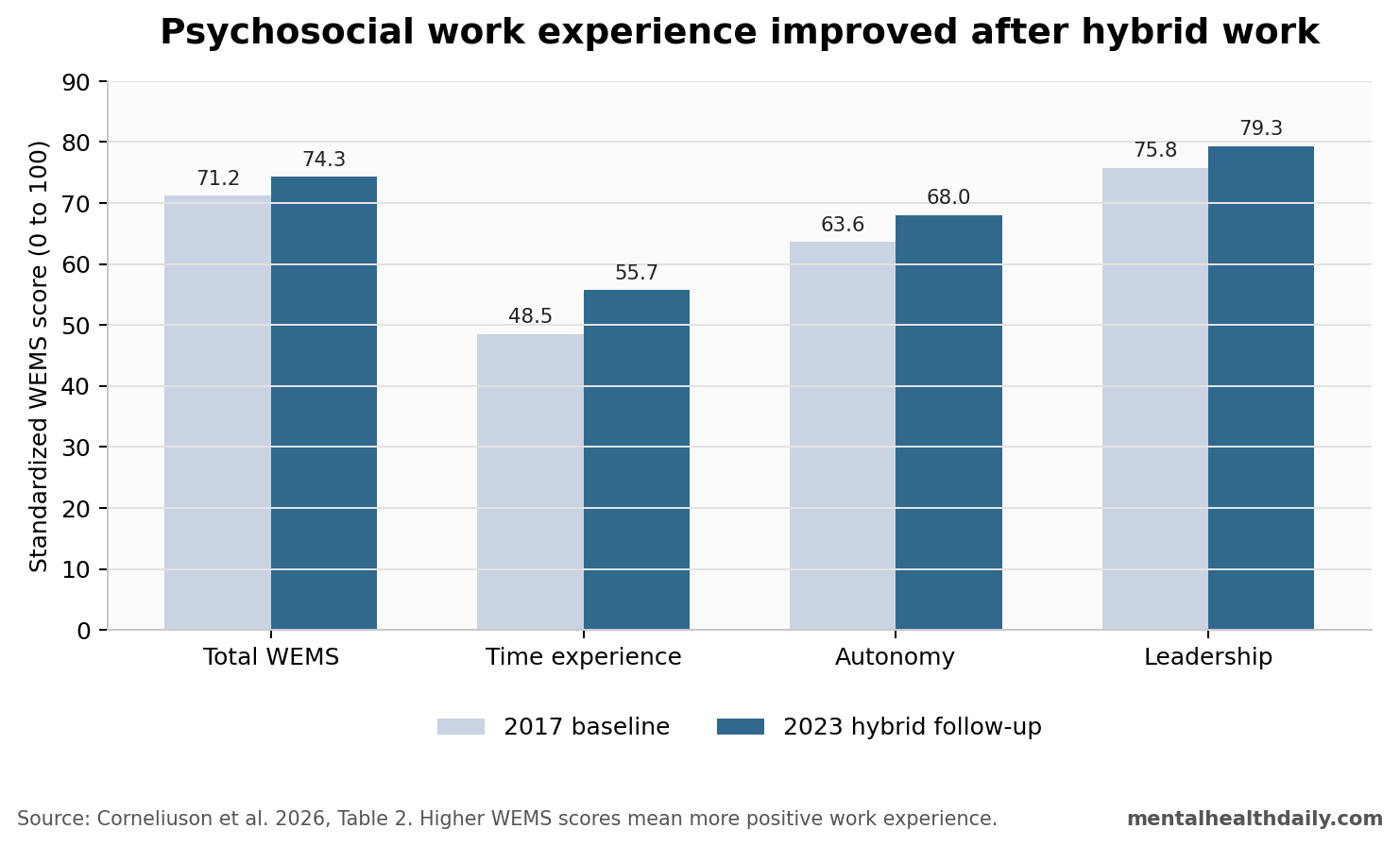
Total WEMS rose from 71.2 to 74.3. Several subscales improved, but sex was the only tested factor where the difference between levels reached statistical significance. Women gained 4.3 points; men did not show a reliable improvement.
Time Experience Improved More Than General Job Feeling
Time experience was the strongest subscale movement. Scores rose from 48.5 to 55.7, with a 95% CI of 3.1 to 11.5 and p < 0.001.1
The WEMS time items are not abstract morale questions. They ask whether workers have enough time during normal working hours, can finish tasks properly, and do not need to work beyond scheduled hours. Each time-experience item improved significantly in the appendix table.
That pattern is important because remote and hybrid work can cut in 2 directions:
- Resource pathway: less commuting, more schedule control, and fewer office interruptions can reduce time pressure.
- Boundary pathway: home work can stretch the workday, blur recovery time, and increase work-family interference.
Gajendran et al. described the same dual-pathway logic in a 2024 meta-analysis of 108 remote-work studies: remote-work intensity can increase autonomy and job satisfaction while also increasing isolation or work-family strain when the setup is poorly matched to the worker.2
Direction of the Swedish signal: time pressure decreased, autonomy increased, and leadership availability improved in this specific organization.
The design cannot show whether hybrid work caused all 3 gains, but the direction is not consistent with a simple “hybrid work ruins work-life boundaries” claim.
Autonomy Was Common, But It Did Not Explain the Main Change
Autonomy improved from 63.6 to 68.0 (p = 0.005). At follow-up, 34.5% of workers reported full freedom to choose work location, 62.8% reported some freedom, and only 2.8% reported no freedom.1
That is a key context detail. Hybrid work with some personal control is not the same exposure as mandatory office attendance, mandatory home work, or a rigid “everyone must be in Tuesday through Thursday” rule. A flexible model can improve perceived control even if employees still spend meaningful time in the office.
Corneliuson et al. did not find that degree of work-location freedom explained WEMS change in the univariate regression. Workers with full freedom gained 2.7 points, those with some freedom gained 3.4 points, and the 3-person no-freedom group gained 1.7 points, with no significant difference across levels.1
Heiden et al. add a useful caution here. In a Swedish white-collar cohort, employees who teleworked more than they preferred reported worse well-being cross-sectionally, but telework mismatch did not predict 10-month change in well-being or burnout.5 Preference fit matters, but it may not behave like a simple dose-response variable.
Leadership Scores Rose, While Manager Scores Did Not
Leadership increased from 75.8 to 79.3 (p = 0.039), and the specific item “My manager is available when I need him/her” improved from 4.76 to 5.18 (p < 0.001).1
That result pushes against a common return-to-office argument: remote work automatically makes leadership inaccessible. In this municipality, employees rated manager availability higher after the hybrid transition.
Managers themselves were a different story. Workers in managerial positions changed by only 0.2 WEMS points, while non-managers gained 4.0 points. The difference did not reach statistical significance (p = 0.17), but the direction fits a practical concern: hybrid work may improve flexibility for employees while adding coordination work for supervisors.1
Evidence-strength note: the manager subgroup included only 28 people in the regression model. The study is better at detecting the broad worker-experience trend than at proving whether managers had a separate burden.
Hybrid Work Evidence Is Stronger for Retention Than for Mental Health
Bloom et al. ran a randomized trial in 1,612 employees at a Chinese technology company and found that hybrid working from home improved retention without damaging performance.4 That is stronger causal evidence than the Swedish municipality study, but it is mainly an employment and performance trial, not a detailed psychosocial-work-environment study.
Vleeshouwers et al. reviewed telework from home and the psychosocial work environment, finding 43 quantitative peer-reviewed studies but rating the evidence low or very low quality overall.3 The review pointed to flexibility and autonomy as possible mediators, while emphasizing the need for better longitudinal designs.
Corneliuson et al. help fill that gap because they measured the same workers years apart, before and after a real organizational shift. The study does not have randomization, but it avoids the weaker design of asking one group of workers at one moment whether they happen to like hybrid work.
The Sex Difference Should Be Treated as a Signal, Not a Slogan
The sex result is the article’s sharpest finding and its easiest one to overstate. Women improved; men did not. But the sample was female-heavy, the male regression subgroup had only 26 people, and the study did not measure the home and workplace mechanisms that would explain the difference.
Several explanations remain plausible:
- Baseline job context: public-sector women may have had more to gain if hybrid work reduced office friction or time pressure.
- Communication patterns: some hybrid arrangements may improve psychological safety or reduce informal workplace costs for women.
- Unmeasured home demands: caregiving and household work could cut either way, depending on support and schedule control.
- Statistical fragility: a small male comparison group makes the sex split vulnerable to noise.
The clean interpretation is narrower than “hybrid work benefits women.” In this Swedish municipal cohort, women reported a measurable improvement in work experience after hybrid work, and the study could not identify another measured worker or job factor that explained the change.
Questions About Hybrid Work and Mental Health
Does this study prove hybrid work improves mental health?
No. It measured psychosocial work experience, not clinical depression, anxiety, burnout diagnosis, or psychiatric treatment. Better work experience can support mental health, but the study should not be read as a clinical-outcome trial.
Was hybrid work better than full office work?
The design compared the same organization before and after hybrid work was implemented, so the average change favored the later hybrid period. It did not randomize workers to hybrid vs. office-only schedules, so other post-pandemic organizational changes could contribute.
How many office days looked best?
The study did not identify a statistically confirmed best number of office days. The 1 to 3 days per month group gained 8.4 points, the 1 day per week group gained 3.5, the 2 to 3 days per week group gained 2.5, and the 4 to 5 days per week group gained 1.4, but differences between levels were not significant.
Should employers focus on autonomy rather than a fixed hybrid formula?
The broader evidence supports that direction. Autonomy and preference fit repeatedly appear as plausible protective factors, while rigid mismatches can hurt well-being. Still, Corneliuson et al. did not prove that autonomy alone caused the WEMS improvement.
What is the practical takeaway for workplace mental health?
A flexible hybrid model can be a mental-health-relevant work design tool when it improves time control, autonomy, and leadership access. It is not a universal cure for workplace strain, and it needs monitoring for boundary problems, manager workload, isolation, and subgroup differences.
References
- Corneliuson C, Babapour Chafi M, Tornevi A, Stjernbrandt A, Wahlström V. Psychosocial work experience after implementing hybrid work: a longitudinal study. BMC Public Health. 2026;26:1359. doi:10.1186/s12889-026-27487-x
- Gajendran RS, Ponnapalli AR, Wang C, Javalagi AA. A dual pathway model of remote work intensity: a meta-analysis of its simultaneous positive and negative effects. Personnel Psychology. 2024;77(4):1351-1386. doi:10.1111/peps.12641
- Vleeshouwers J, Fløvik L, Christensen JO, et al. The relationship between telework from home and the psychosocial work environment: a systematic review. International Archives of Occupational and Environmental Health. 2022;95(10):2025-2051. doi:10.1007/s00420-022-01901-4
- Bloom N, Han R, Liang J. Hybrid working from home improves retention without damaging performance. Nature. 2024;630:920-925. doi:10.1038/s41586-024-07500-2
- Heiden M, Hallman DM, Svensson M, Mathiassen SE, Svensson S, Bergström G. Mismatch between actual and preferred extent of telework: cross-sectional and prospective associations with well-being and burnout. BMC Public Health. 2023;23:1736. doi:10.1186/s12889-023-16683-8