hit counter

Stress Internalization Predicts Memory Decline in Older Chinese Americans

Editorial card showing an older Chinese American adult and a memory-decline trajectory, illustrating the PINE cohort finding that stress internalization predicts cognitive decline.

A 2025 longitudinal analysis of 1,528 older Chinese Americans by Chen et al. in the Journal of Prevention of Alzheimer’s Disease says something more specific than “stress causes Alzheimer’s”: it isn’t the count of stressors that tracks memory decline — it’s a latent trait the authors call stress internalization, a bundle of high perceived stress, …

Read more

Sleep Memory Cues Do Not Boost Parkinson’s Motor Learning

Photoreal illustration of an older adult sleeping with overlay of memory and brain oscillation imagery, conveying sleep-based learning intervention.

Auditory targeted memory reactivation during a 2-hour nap did not improve motor retention in 20 Parkinson’s disease patients or 20 healthy older adults, even though the same cues changed sleep physiology by reducing spindle density and increasing slow-wave density.1 Research Highlights First Parkinson’s TMR test: Micca et al. studied 20 Parkinson’s disease patients and 20 …

Read more

fMRI Biotypes Predicted tDCS Anxiety Response in Older Adults

Photoreal illustration of a clinician fitting a tDCS device on an older adult, with brain network biotype overlays.

A 2026 BETA analysis of 199 older adults found that resting-state fMRI could separate 4 anxiety-related tDCS response patterns, but the result was narrower than “brain scan predicts treatment”: only the Robust tDCS Responder subtype showed a statistically reliable Active vs. Sham anxiety advantage across all participants.1 Research Highlights Only 1 subtype cleared the Active …

Read more

AD8 Dementia Screening in Chinese-Speaking Older Adults

Photoreal illustration of older adult with informant during screening interview, conveying culturally-aligned dementia screening.

Brief screening tools for early dementia risk are essential in primary care. A 2026 study by You et al. evaluated the AD8 informant questionnaire in older Chinese-speaking adults in Australia, mapping how cognitive, functional, social, and language-barrier risks stack before dementia is formally diagnosed.1 Research Highlights The AD8 dementia screening interview is an 8-item informant-based …

Read more

Iceland Psychiatric Data: 21% Diagnosed, 34% on Psychotropics (2026)

MHD featured image for Iceland Psychiatric Health: 21% Diagnosed, 34% on Psychotropics.

Iceland is a registry-rich country with a small enough population that genuinely nationwide health data is feasible — not the survey-based approximations that anchor most psychiatric epidemiology elsewhere. A 2026 PLOS One study used the Iceland Screens, Treats, or Prevents Multiple Myeloma (iStopMM) cohort — 80,759 adults aged 40+, representing 54% of all eligible Icelanders …

Read more

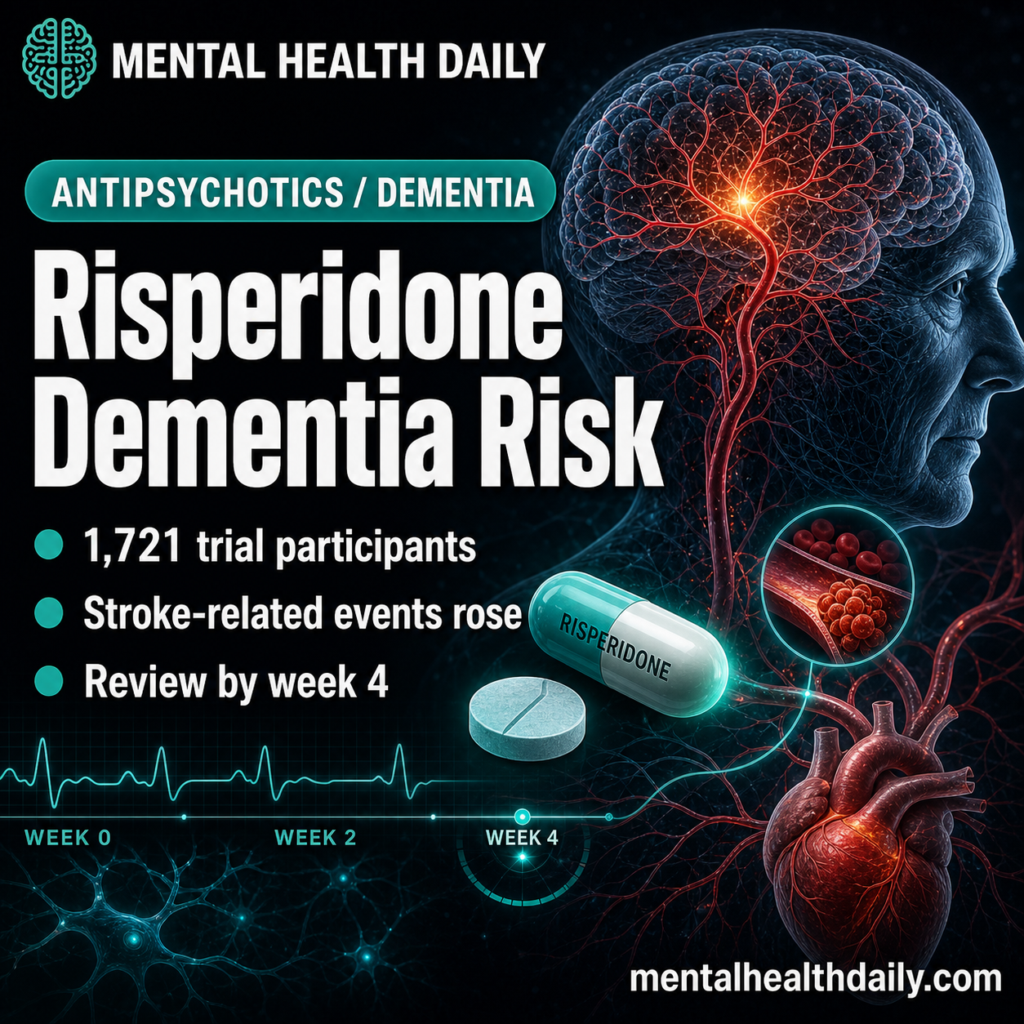
Risperidone Stroke Risk in Dementia: HR 1.28 Across CVD Subgroups

Conceptual illustration of cerebral blood vessels and a pill, representing risperidone-associated stroke risk in dementia patients.

The risperidone-stroke link in dementia is one of the longest-running safety signals in geriatric psychiatry, anchoring the FDA’s 2005 black-box warning on atypical antipsychotic mortality. Popular framing reduces it to “antipsychotics cause stroke in dementia” — a true sentence that flattens a multi-axis decision. Choma’s 2025 analysis of UK primary care records is the largest …

Read more