
A 2026 qualitative study of the For Baby’s Sake domestic-violence program used 83 interviews with 39 parents and found a practical engagement pattern: parenting work gave some mothers and fathers a way into safety planning, violence acknowledgment, and emotional-regulation change.1
Research Highlights
- Longitudinal interviews showed the engagement route: researchers conducted 83 interviews with 39 parents, including 26 mothers and 13 fathers, across baseline, 1-year follow-up, and program-end contact.1
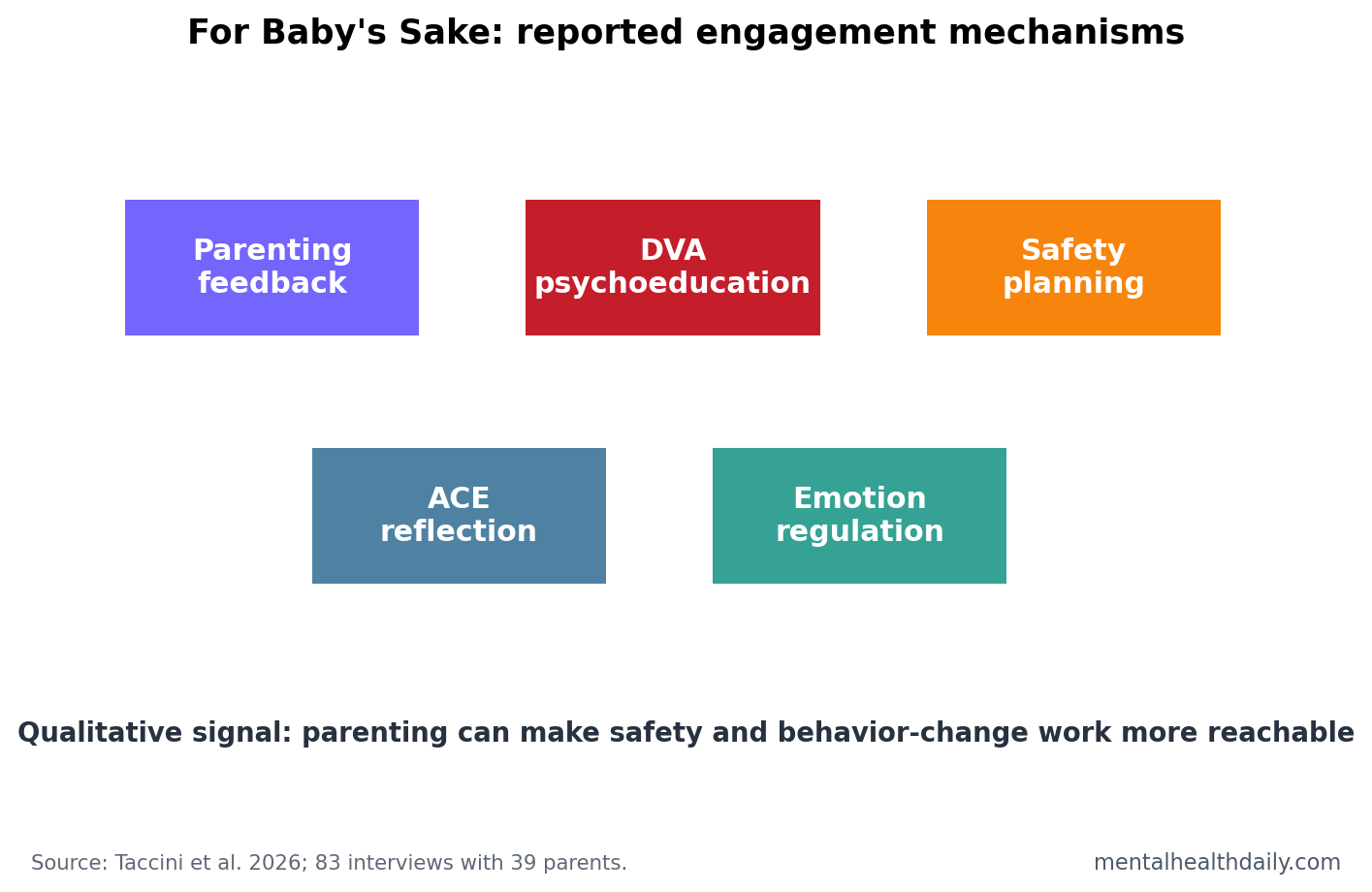
- Parenting work opened the door: parents reported that child-development psychoeducation and video feedback on parent-child interaction made the intervention feel less like accusation and more like concrete skill-building.1
- Father change centered on regulation: fathers who described progress emphasized adverse childhood experiences, anger management, and emotional-regulation skills; by the end, roughly one-third acknowledged abusive behavior.1
- Mental-health burden was already high: baseline table data recorded self-reported mental illness in 44.4% of mothers and 53.8% of fathers.1
- Evidence remains qualitative: the study retained 18 participants at the 2-year interview and cannot prove verified reductions in violence, injury, child maltreatment, or psychiatric symptoms.1
Domestic violence and abuse means violence, coercive control, threats, or abuse by a partner, former partner, or family member. The mental-health link is not secondary: a major meta-analysis found domestic violence exposure associated with depression, anxiety, post-traumatic stress disorder (PTSD), substance use, and suicide attempts.2
Whole-family intervention means the program supports the survivor, works with the person using violence, and treats the child as part of the safety picture. It tries to keep women and children safe while also working with fathers on behavior change and with both parents on child-development and parenting skills.
Domestic violence, trauma symptoms, and parenting problems rarely arrive in neat separate boxes. A mother may be trying to protect an infant while managing fear, depression, financial dependence, and contact with a partner.
A father may want to remain involved with the child while still minimizing coercive control or explosive behavior. A child is exposed to both the relationship climate and the caregiving responses that follow it.
For Baby’s Sake was built around that overlap. The program did not treat parenting as a soft add-on after violence work; it used parenting as one of the motivations for violence work. That is the key MHD read of this paper: parent-child repair can become a behavior-change lever, but only when survivor safety and perpetrator accountability stay central.
83 Interviews Tracked Parents From Pregnancy to Program End
Taccini et al. evaluated For Baby’s Sake, a trauma-informed intervention intended to begin during pregnancy and continue for 2 years after birth.1 Researchers interviewed mothers and fathers separately at the start of the program, around 1 year after enrollment, and near program end.
The sample included 39 participants: 26 mothers and 13 fathers. Baseline interviews included 38 participants. The 1-year follow-up included 27 participants, and the 2-year post-program interview included 18 participants. Dropout matters because families who stay engaged may differ from families with more chaos, less trust, lower income, or higher safety risk.
Attrition also shapes how to read the most optimistic interview material. The parents who remained available at the 2-year interview were not necessarily representative of all families who start a domestic-violence program.
The researchers reported no age, gender, ethnicity, immigration, or educational differences between retained and dropped participants, but lower household income showed a meaningful dropout trend (p = .038). Financial pressure can make safety planning, housing stability, childcare, and program attendance harder at the same time.
- Design: longitudinal qualitative interviews, not a randomized trial.
- Main question: whether parents described a program pathway that could address violence and parenting together.
- Main limitation: interview accounts cannot verify actual violence reduction or child-safety outcomes.
Parenting Feedback Made Violence Work Less Defended
One clear pattern was that parenting became a less threatening entry point. Mothers and fathers described child-development education, reflection on parenting strengths, and discussion of video-recorded parent-child interaction as useful. Video Interaction Guidance is a feedback method in which recorded parent-child moments are reviewed to identify responsive interaction and build on it rather than only criticizing mistakes.
That mechanism fits the intervention problem. Direct confrontation about domestic abuse can trigger denial, shame, fear, or blame-shifting. Parenting feedback gives the same family a concrete target: respond differently to the child, understand the child’s development, and practice regulation before conflict spills into caregiving.
Clinical implication: the parenting component works best as a motivational bridge, not as a way to soften the violence. A father can learn to notice a baby’s cues and still need direct accountability for coercion. A mother can gain confidence in caregiving and still need private safety planning. The useful design feature is sequencing: practical parenting wins can create enough trust and specificity for harder conversations about harm.
Safety Planning and Intergenerational Violence Were Mother’s Entry Points
Mothers reported that psychoeducation about domestic violence and abuse helped them name experiences that had previously been minimized or normalized. Safety planning also mattered because the intervention paired insight with concrete thinking about risk, contact, privacy, and child safety.
Intergenerational transmission means violent or dysregulated relationship patterns can be carried from one generation to the next through trauma exposure, learned conflict behavior, insecure attachment, and repeated family scripts. The study did not show that For Baby’s Sake stopped that transmission, but mothers described the concept as one reason to treat parenting as part of domestic-violence work.
The child is already part of the exposure system, so domestic violence intervention cannot be reduced to adult relationship counseling. Improved play or sensitivity also cannot compensate for ongoing coercive control.
The For Baby’s Sake interviews suggest that the safest formulation is combined: parenting strengthens the reason to change, and violence work defines what change has to include.
Father Change Depended on Acknowledgment and Emotion Regulation
Fathers’ accounts were more mixed. Some fathers acknowledged violence and described trying to change. Others minimized behavior or externalized blame. By the study team’s conclusion, approximately one-third of fathers recognized their own abusive behavior by the end of the intervention.1
The father-facing mechanisms were not abstract. The study repeatedly pointed to:
- Adverse childhood experiences: early exposure to abuse, neglect, household dysfunction, or violence that can shape adult regulation and parenting.
- Emotion regulation: skills for recognizing and changing escalating arousal before anger becomes coercion or violence.
- Anger management: practical strategies for interrupting aggressive responses, not a substitute for accountability.
- Nonjudgmental practice: a stance that lowered defensiveness without treating violence as acceptable.
The father data are also the strongest warning against headline overreach. Some fathers showed readiness to confront violent behavior, while others continued to minimize, rationalize, or shift blame. A whole-family model cannot assume that involvement equals change. It has to keep separate evidence streams: what the father says, what the mother reports, what safety planning requires, and what the child’s environment actually looks like.
The Mental-Health Context Makes Perinatal Timing Important
Pregnancy and early infancy are not neutral windows. Howard et al. found domestic violence associated with perinatal mental disorders, including antenatal and postnatal depression and anxiety.3 In the Taccini et al. sample, self-reported mental illness was common among both mothers and fathers, at 44.4% and 53.8%, respectively.1
Clinical reading: mental illness should not be framed as the cause of domestic violence. A family intervention that ignores trauma symptoms, fear, shame, substance use, sleep disruption, and parental stress will miss part of the pathway through which violence and caregiving problems become linked.
Perinatal timing also gives the program a prevention logic. The first 2 years of life are a period of rapid attachment, sleep disruption, parental identity change, and family-system stress. If domestic violence work waits until parenting patterns are already entrenched, the intervention loses a window in which adults may be more motivated to change for the child.
Qualitative Promise Is Not Proof of Violence Reduction
Evidence-strength note: this was a qualitative interview study. It can identify perceived mechanisms, barriers, and engagement routes. It cannot establish that For Baby’s Sake reduced domestic violence, improved verified child outcomes, or lowered later psychiatric risk.
That limitation should not flatten the finding. The useful claim is narrower: families described parenting as a route into behavior change, and fathers who described progress often framed it through emotion regulation and adverse childhood experiences. For program design, that is meaningful even before outcome trials settle the size of benefit.
Next evidence step: a structured outcome study should separate perceived change from verified safety. Useful outcomes would include repeat violence reports, maternal PTSD and depression symptoms, father behavior-change measures, child developmental indicators, service engagement, dropout, and adverse events. Without those data, the current paper is best treated as a mechanism map for program design.
Questions About Whole-Family Domestic Violence Interventions
Did For Baby’s Sake prove that whole-family programs reduce abuse?
No. This 2026 paper reported parent interview themes, not verified violence outcomes. It supports a plausible engagement model that still needs larger outcome evaluation.
Why include parenting in a domestic-violence program?
Parenting can create a shared reason for change: protecting the child, understanding development, and practicing regulation. Survivor safety planning and perpetrator accountability still define the boundaries of the work.
What is the clinical risk of whole-family work?
Working with multiple family members can become unsafe if it pressures survivors, exposes private disclosures, or treats relationship preservation as the goal. The intervention logic only works when safety, privacy, and accountability stay central.
References
- Taccini F, et al. Can whole-family interventions target violence and parenting simultaneously? A qualitative study of a whole family intervention for domestic violence and abuse. BMC Psychology. 2026. https://doi.org/10.1186/s40359-026-03979-8
- Trevillion K, et al. Experiences of Domestic Violence and Mental Disorders: A Systematic Review and Meta-Analysis. PLOS ONE. 2012. https://doi.org/10.1371/journal.pone.0051740
- Howard LM, et al. Domestic Violence and Perinatal Mental Disorders: A Systematic Review and Meta-Analysis. PLOS Medicine. 2013. https://doi.org/10.1371/journal.pmed.1001452
- Stover CS, et al. Integrating intimate partner violence and parenting intervention into residential substance use disorder treatment for fathers. Journal of Substance Abuse Treatment. 2017. https://doi.org/10.1016/j.jsat.2017.07.013