A 2026 theory paper proposes that Chinese university students giving presentations in English handle their nerves better when the classroom builds their confidence. It is a framework with no new data, but the problem it targets is well documented: speaking anxiety goes with weaker language performance.1
Research Highlights
- A proposal, not a study: the paper sets out 6 testable hypotheses linking 5 classroom features to 5 motivational beliefs and to how well students manage their own presentation preparation and nerves. No students were surveyed or tested.1
- Confidence at the center: self-efficacy, a student’s belief that they can plan and deliver a presentation, is proposed as the main link between anxiety and the strategies students use to cope.1
- Classmates cut both ways: peers can reassure a nervous speaker, but they are also the audience and the judges, and public critique can trigger more anxiety in face-conscious classrooms.1
- Anxiety and language performance: 2 meta-analyses found moderate negative correlations between foreign language anxiety and achievement (r = −0.36 across 105 samples; r = −0.34 across 55 samples).3,4
- Classroom interventions can help: a 2024 meta-analysis of 37 intervention studies found that they reduced foreign language anxiety on average.7
Speaking Anxiety Holds Back Language Learners
Foreign language anxiety is the worry, tension and self-consciousness that some people feel specifically when learning or using another language. Horwitz et al. described it as its own kind of classroom anxiety in 1986 and built the 33-item Foreign Language Classroom Anxiety Scale to measure it.2
Decades of research link this anxiety to weaker results:
- Largest pooled analysis: a 2019 meta-analysis of 105 samples (19,933 participants in 23 countries) found an average correlation of r = −0.36 between second-language anxiety and achievement.3
- Independent check: a separate 2019 meta-analysis of 55 samples and more than 10,000 participants found r = −0.34.4
- Speaking specifically: among 275 advanced academic-English students preparing for Australian universities, speaking anxiety significantly predicted oral achievement.5
A correlation of about −0.35 is moderate. It does not settle direction: anxiety can drag down performance, and struggling with a language can also make people more anxious.
In Chinese universities: a survey of 547 first-year students who were not English majors found that more than one third felt anxious in English class. They feared negative evaluation and were apprehensive about public speaking and tests, and many avoided speaking English in class.6
Why English Presentations Are Especially Stressful
Jingran Wang, Chang’an Wu and Shuang Peng of Northeast Normal University in China focused on academic oral presentations: structured talks in English for class, seminars or conferences. These are now a routine demand on Chinese university students.1
The researchers argued that presentations put 3 kinds of pressure on a speaker that reading or writing do not:1
- Real-time multitasking: finding words, building grammar, managing slides and watching the clock all at once, with no chance to go back and revise.
- High emotional load: speaking in front of others who are judging you makes foreign language speaking anxiety especially likely.
- Body and voice: pace, intonation, eye contact, posture and gestures all have to work together with the words.
Their main interest is self-regulated learning: the strategies students use to steer their own work. For presentations, the paper groups these into 3 clusters:1
- Cognitive: choosing and organizing material, outlining, preparing for questions.
- Metacognitive: planning, spotting weak spots in rehearsal, adjusting on the fly and reflecting afterward.
- Motivation regulation: managing anxiety (for example by reframing the situation), positive self-talk before going on stage and keeping up effort.
5 Classroom Features and 5 Beliefs in the Framework
The framework splits the classroom into 2 dimensions with 5 parts:1
- Presentation task design: how realistic, challenging and personally meaningful the tasks are.
- Process-oriented teacher support: coaching across preparation, from topic choice and slides to rehearsal, plus feedback along the way.
- Study autonomy: students’ say over topics, formats and how they are assessed.
- Teacher social support: the sense that the teacher cares, including about performance anxiety.
- Peer social support: the sense that classmates care and help.
These features are proposed to work mostly through 5 motivational beliefs: how useful presenting seems (utility value), how much students enjoy it (intrinsic interest), their confidence (self-efficacy), a goal of learning the skill (mastery goals) and a goal of looking good next to others (performance goals).1
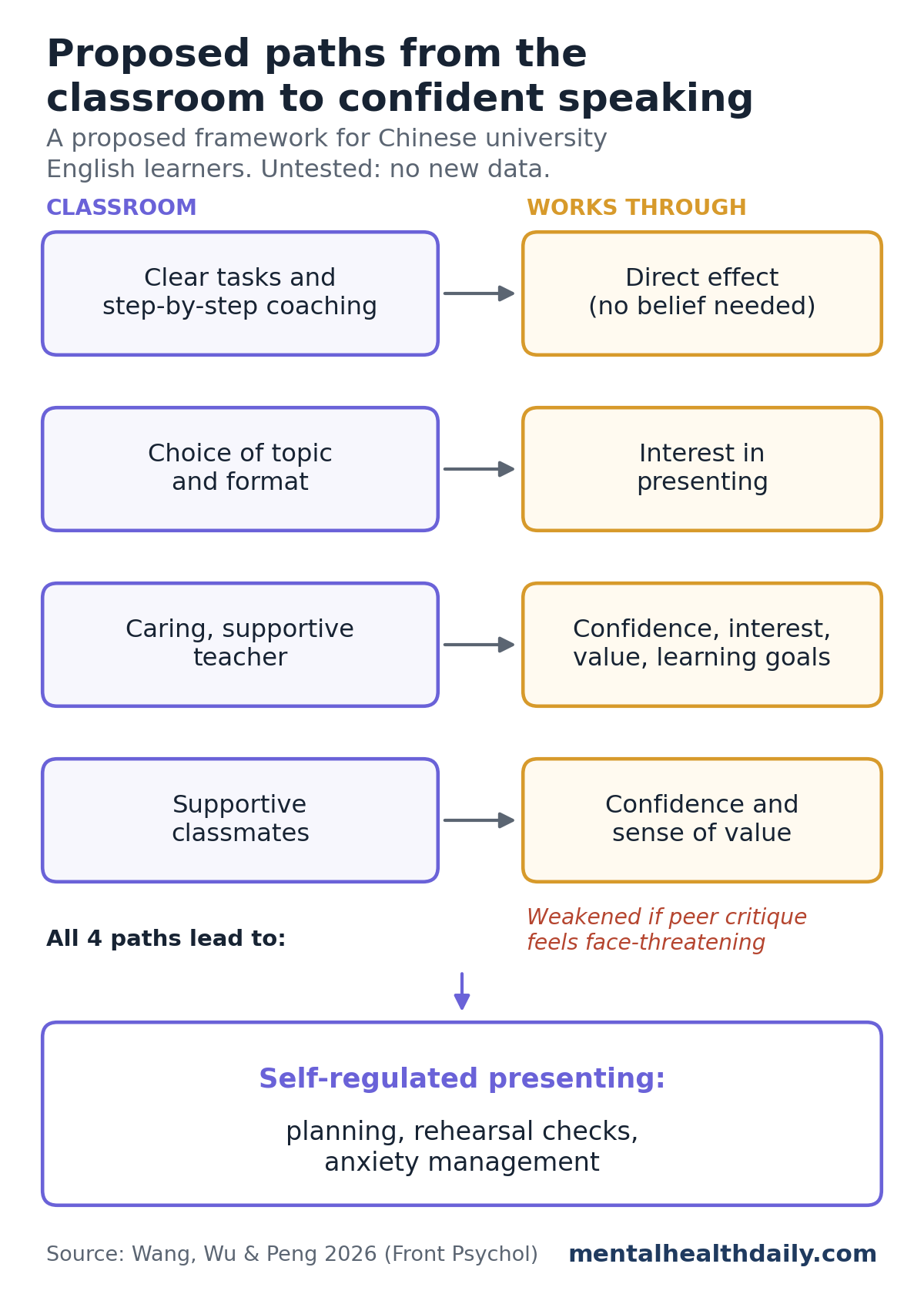
Each classroom feature gets its own proposed route:1
- Tasks and coaching act directly: clear templates and step-by-step guidance help students use good strategies even when their motivation is low.
- Choice works through interest: picking your own topic makes the talk feel like yours, which is expected to drive deeper preparation.
- A supportive teacher works through several beliefs: confidence, interest, sense of value and learning goals, with confidence expected to be the strongest path.
Confidence Is the Proposed Link to Managing Presentation Anxiety
The researchers predict that all 5 beliefs help, with self-efficacy and intrinsic interest the strongest. They give self-efficacy a specific job: it should be most closely linked to motivation-regulation strategies such as calming nerves, while mastery goals should be most closely linked to planning and reflection.1
Their reasoning is that low confidence in presenting tends to amplify anxiety both before and during the talk. A student who believes they can recover from a stumble has more to draw on when nerves rise.1
Teacher influence in Chinese classrooms: the paper expects teacher support to count for more than peer support in Chinese universities, because of the strong cultural respect for teachers in Confucian-heritage education.1
Classmates Can Calm Speaking Anxiety or Add to It
In a reading class, classmates are mostly fellow learners. In a presentation class, they are also the live audience and often the people giving feedback. The researchers call this the audience-evaluator duality.1
On the helpful side, a friendly, non-threatening audience is proposed to build a speaker’s confidence through reassurance and through watching peers succeed. Constructive peer feedback can also show that the talk got its point across.1
Face concerns: the paper notes that “face” (mianzi, a person’s public standing and reputation) is a strong concern in East Asian classrooms. Citing earlier studies, it warns that public peer critique can make Chinese students defensive, more anxious or silent, unless feedback is structured to be safe and constructive.1
That fits the Chinese survey above, where fear of negative evaluation was among the main sources of English-class anxiety.6
Can Classroom Changes Reduce Foreign Language Anxiety?
The framework itself cannot answer this, but intervention research can. A 2024 meta-analysis and systematic review pooled 37 studies of programs aimed at reducing foreign language anxiety in students. Overall, the interventions reduced anxiety (effect size −0.61, p = 0.03), and age was the only one of 7 tested factors that changed how well they worked.7
Based on the framework, the researchers suggest:1
- Teach coping strategies directly: include anxiety management and self-encouragement alongside planning and rehearsal skills.
- Train teachers in emotional support: not just content and language teaching.
- Structure peer feedback: train students to give and receive feedback, use cooperative rehearsal and make evaluation face-sensitive.
- Pair choice with interest: token “free choice” without help finding a meaningful topic is unlikely to help much.
These are reasonable ideas drawn from the theory, not tested recommendations. Whether they change anxiety or presentation quality in Chinese university classrooms is still an open question.
Limitations of This Presentation Anxiety Framework
- No data: every path is a hypothesis. The paper lays out a research plan, including a survey of 400 to 600 students and a 3-wave follow-up from task introduction to after the talk, but none of it has been done.
- Borrowed from reading research: several predicted paths are extended from an earlier study of high-school English reading, a very different task.
- One setting: the framework is built for Chinese college English classes, and the researchers say it would need adapting elsewhere.
- Perceptions, not observations: it relies on how students see their classroom, which may differ from what an observer would record.
- Narrow focus: it leaves out wider influences such as university policies and parents’ expectations.
Classroom speaking anxiety is also different from social anxiety disorder. Fear of public speaking that spreads well beyond class and gets in the way of daily life is worth discussing with a doctor or therapist.
References
- Wang J, Wu C, Peng S. Beyond linguistic competence: shifting classroom environments and motivational paths to foster self-regulated oral presentations—a theoretical framework development. Frontiers in Psychology. 2026;17:1901333. doi:10.3389/fpsyg.2026.1901333
- Horwitz EK, Horwitz MB, Cope J. Foreign language classroom anxiety. The Modern Language Journal. 1986;70(2):125–132. doi:10.1111/j.1540-4781.1986.tb05256.x
- Teimouri Y, Goetze J, Plonsky L. Second language anxiety and achievement: a meta-analysis. Studies in Second Language Acquisition. 2019;41(2):363–387. doi:10.1017/S0272263118000311
- Zhang X. Foreign language anxiety and foreign language performance: a meta-analysis. The Modern Language Journal. 2019;103(4):763–781. doi:10.1111/modl.12590
- Woodrow L. Anxiety and speaking English as a second language. RELC Journal. 2006;37(3):308–328. doi:10.1177/0033688206071315
- Liu M, Jackson J. An exploration of Chinese EFL learners’ unwillingness to communicate and foreign language anxiety. The Modern Language Journal. 2008;92(1):71–86. doi:10.1111/j.1540-4781.2008.00687.x
- Xiong Y, Zhang Q, Zhao L, Liu S, Guan H, Sui Y, Feng J, Lee KMR. A meta-analysis and systematic review of foreign language anxiety interventions among students. Journal of Language and Social Psychology. 2024;43(5–6):620–650. doi:10.1177/0261927X241291258