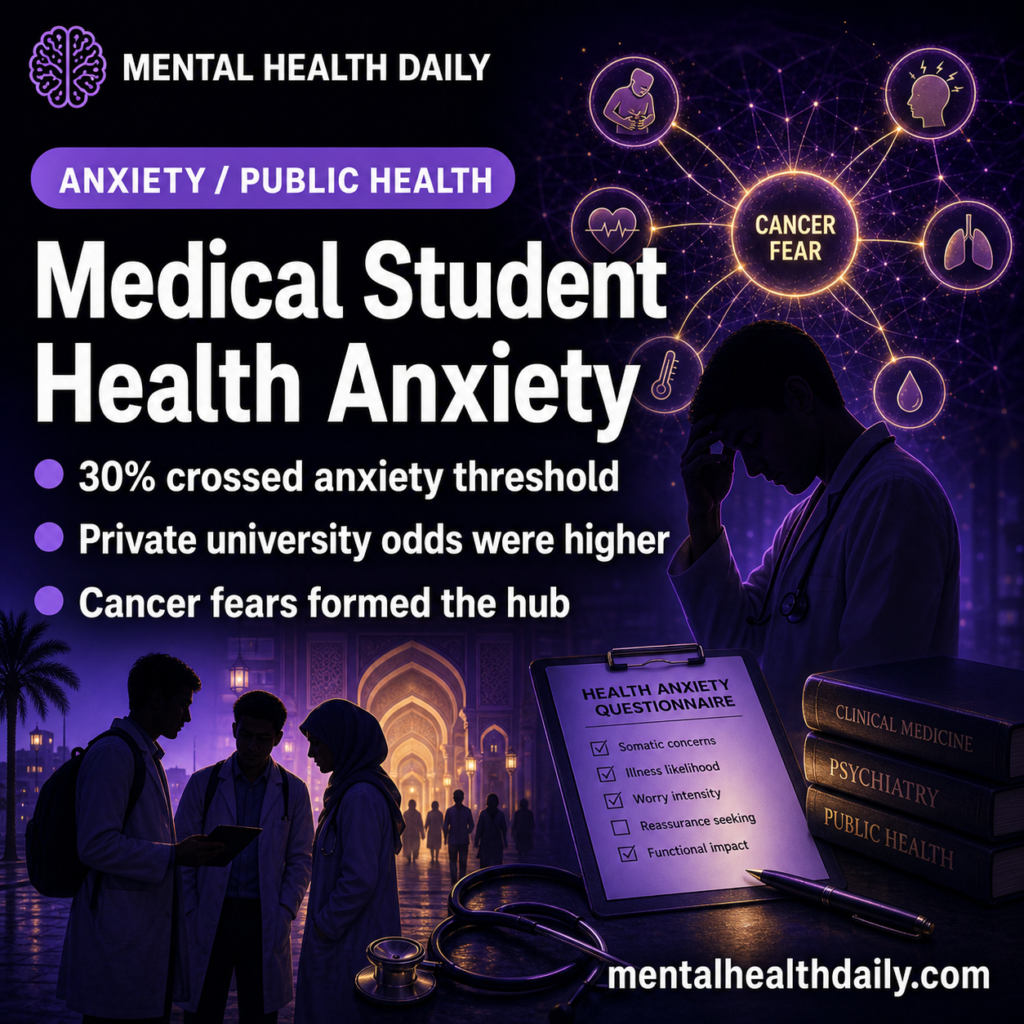
A 2026 multi-university survey involving 650 Saudi medical students found that 30% met a threshold for clinically significant health anxiety, with higher adjusted odds among female students, rural students, private-university students, and students with psychiatric history.1 The result is not a diagnosis of “hypochondria”; it is a screening signal that illness-focused fear may be a substantial student mental-health burden.
Research Highlights
- 30% screened positive: 195 of 650 Saudi medical students met the study threshold for clinically significant health anxiety.1
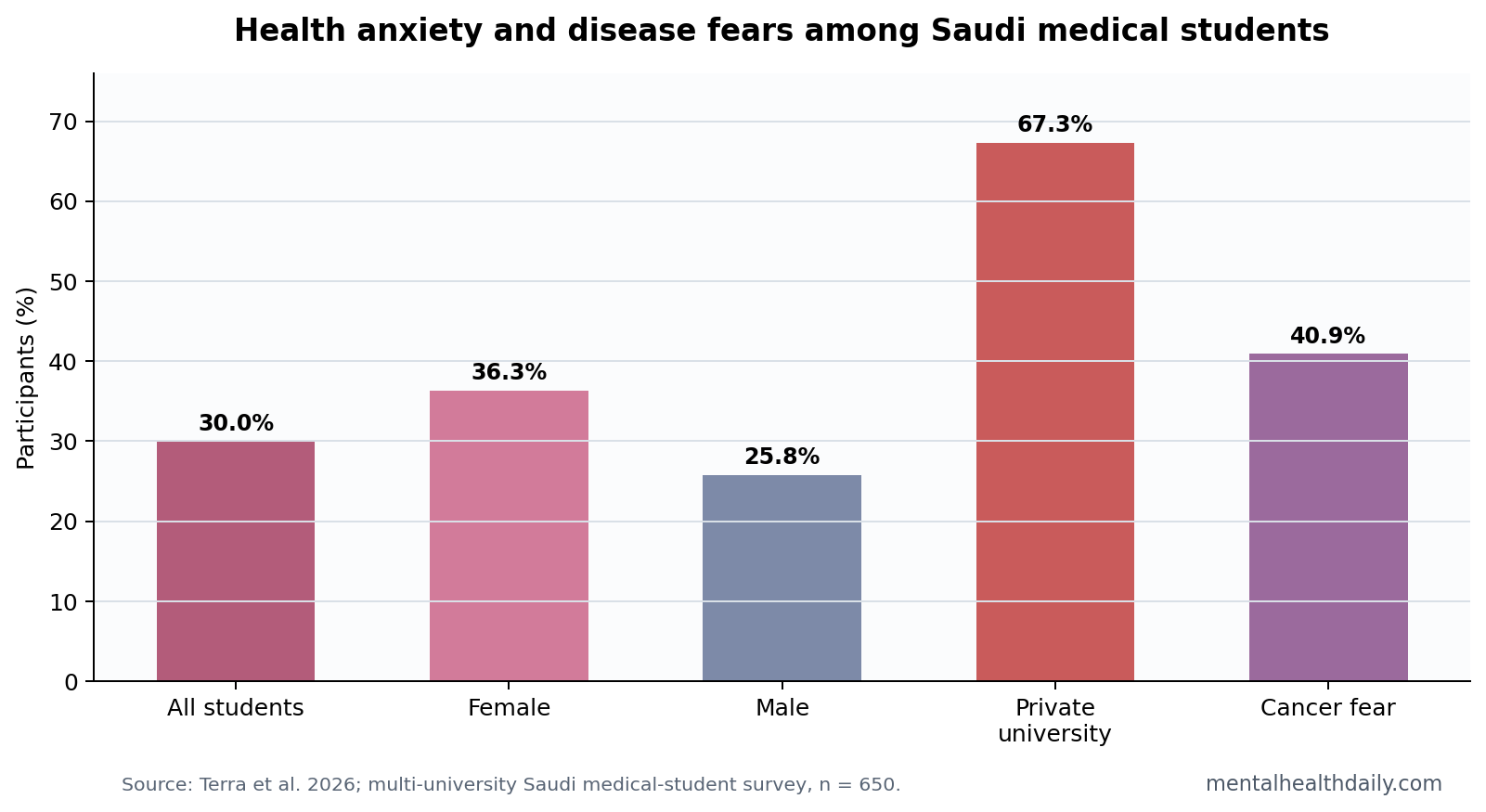
- Female students had higher odds: Prevalence was 36.3% in female students vs. 25.8% in male students, and female sex had AOR 2.33, 95% CI 1.51 to 3.62.1
- Private-university signal was large: Private university enrollment had AOR 6.14, 95% CI 3.66 to 10.5, compared with public university enrollment.1
- Quality of life was lower: Health anxiety correlated with lower SF-12 quality-of-life scores, r = -0.25, p < 0.001.1
- Cancer fear dominated the network: 40.9% of participants endorsed cancer as a primary disease fear, and cancer fears were the principal network hub.1
Health anxiety means persistent fear or preoccupation about having or developing serious illness. It can overlap with illness anxiety disorder, somatic-symptom concern, obsessive checking, reassurance seeking, and ordinary worry after exposure to medical information.
Medical students are a useful but tricky population for this question. They are repeatedly exposed to disease descriptions, clinical scenarios, and exam pressure, but they are also health-literate enough to recognize symptoms and uncertainty. A high screening rate does not prove pathology in every student; it shows that illness fear may be common enough to deserve structured support.
650 Students Across 8 Saudi Universities Completed the Survey
Terra et al. surveyed medical students across 8 Saudi universities, including 5 public and 3 private institutions, between November 2024 and April 2025. The survey used the Short Health Anxiety Inventory, a self-perception of illness question, and the SF-12 quality-of-life instrument.1
Short Health Anxiety Inventory (SHAI) is a questionnaire designed to measure health-related worry, perceived likelihood of illness, and feared consequences. It is useful for screening and research, but it is not a substitute for a diagnostic interview.
The sample included 455 students without health anxiety and 195 with health anxiety under the study threshold. That yields the 30% prevalence estimate.1
Private-University Enrollment Had the Largest Adjusted Odds Ratio
The strongest adjusted predictor was private university enrollment: AOR 6.14, 95% CI 3.66 to 10.5, p < 0.001.1 An adjusted odds ratio estimates how strongly a factor is associated with an outcome after accounting for other variables in the model.
That number is large, but the design does not prove that private universities caused health anxiety. Private institutions may differ in socioeconomic mix, grading pressure, support services, selection effects, survey response patterns, or academic culture. The finding is best treated as an institutional risk signal that needs follow-up.
Female students also had higher health-anxiety prevalence than male students, 36.3% vs. 25.8%, and female sex had AOR 2.33, 95% CI 1.51 to 3.62.1 The model also identified rural residence, Year 2 status, family psychiatric history, and personal psychiatric history as significant predictors.
Quality of Life Fell as Health Anxiety Rose
The health-anxiety score correlated negatively with quality of life, r = -0.25, p < 0.001.1 A correlation of -0.25 is modest, not overwhelming. But in a student population, even modest links can matter if the exposure is common and tied to help-seeking, academic performance, sleep, and reassurance behavior.
The researchers used the SF-12 as an internal quality-of-life comparison. They noted that the score was not directly comparable to norm-based physical and mental component scores. That limitation matters because it prevents broad claims about how impaired the students were compared with the general population.
- Supported: students with higher health anxiety reported lower quality of life in this sample.
- Not supported: the survey cannot prove that health anxiety caused lower quality of life.
- Clinical implication: screening should be paired with support pathways, not used as a label that follows students around.
Cancer Was the Most Common Disease Fear
The disease-fear network was one of the more useful parts of the paper because it moved beyond a total anxiety score. Cancer was the most frequently endorsed primary fear, at 40.9% or 266 students. Cardiovascular fears followed at 29.7%, diabetes fears at 29.1%, ophthalmic fears at 27.8%, and psychiatric fears at 27.7%.1
The network analysis identified cancer fear as the main hub, with betweenness centrality = 0.42.1 Betweenness centrality is a network measure of how often a node sits on the shortest path between other nodes. In plain English, cancer fear appeared to connect multiple illness-fear clusters.
That pattern is plausible in medical training. Cancer is common in teaching, emotionally loaded, and diagnostically broad. It also has ambiguous early symptoms, which can feed checking, catastrophic interpretation, and reassurance seeking.
Regional Studies Show Wide Health-Anxiety Variation
The 30% Saudi estimate is higher than some regional medical-student findings. The Terra paper notes that a United Arab Emirates study found health anxiety in nearly 10% of medical students.3 Another Saudi medical-student study identified illness anxiety disorder in 17% of participants, according to the 2026 paper’s background review.1
Different instruments, thresholds, sampling methods, academic years, countries, and cultural reporting patterns can change estimates sharply. That is why the 30% figure should not be turned into a universal rate for all medical students.
Stein et al. framed illness anxiety as part of a broader spectrum of health-related fear and somatic preoccupation rather than a single simple condition.2 That spectrum model fits medical-student data well: some worry is expected, some is transient, and some becomes impairing enough to justify targeted support.
The Saudi result also needs denominator discipline. A 30% screening rate means 195 of 650 students crossed the questionnaire threshold in this sample.1 Those 195 students likely varied in severity, functional impairment, checking behavior, and need for specialty psychiatric care.
For a medical school, that distinction changes the response. Screening should sort support needs by impairment rather than treating every elevated questionnaire score the same way.
- Mild worry: normalization and better teaching around probabilistic diagnosis may be enough.
- Reassurance loops: repeated symptom checking, avoidance, reassurance seeking, or lost sleep may require structured anxiety treatment.
- Broader risk: panic symptoms, obsessive checking, depression, or suicidal thoughts need a more urgent clinical pathway.
The high private-university odds ratio should be handled the same way. AOR 6.14 is large enough to justify institutional review, but the cross-sectional design cannot tell whether the driver was tuition pressure, academic culture, student selection, support availability, response bias, or another unmeasured factor. Treating the university variable as causal would overread the model.
Rural residence and psychiatric history are more straightforward as screening clues. They point toward visible support pathways before students are in crisis.
Students with less informal access to care, more stigma around disclosure, or prior anxiety vulnerability may need lower-friction entry points. That is an access problem as much as an individual symptom problem.
Screening Should Avoid Punitive Labeling
Evidence-strength note: this was a cross-sectional convenience survey. It can estimate screening burden and associations. It cannot establish causality, diagnose illness anxiety disorder, or prove that any university feature produced the anxiety signal.
Implementation caution: a student who endorses cancer fear or high SHAI scores should be routed toward confidential support, not treated as weak, unstable, or unfit for medicine.
Screening only helps if it leads to confidential care, psychoeducation, and pathways that reduce compulsive checking and avoidance.
A good screening program would also avoid feeding the anxiety it is trying to detect. Repeated reassurance about every symptom can reinforce checking. Better support teaches students how to tolerate diagnostic uncertainty, when to seek appropriate care, and how to stop converting every lecture topic into self-surveillance.
Faculty training matters for the same reason. Instructors can acknowledge that symptom worry is common during medical training while still directing persistent impairment toward confidential care. That response is more useful than joking about “medical student syndrome” or dismissing fear as overreaction.
Useful supports are concrete:
- Confidential screening: brief SHAI-style check-ins with clear privacy protections.
- Early counseling access: low-friction appointments before anxiety becomes disabling.
- Curriculum context: teaching that normalizes transient symptom worry during disease blocks while identifying persistent impairment.
- Referral metrics: tracking wait times, counseling use, score change, and student-reported quality of life.
Questions About Medical-Student Health Anxiety
Does 30% mean 30% had illness anxiety disorder?
No. The study measured clinically significant health anxiety using a questionnaire threshold. Diagnosis would require clinical assessment, impairment evaluation, and differential diagnosis.
Why might medical students fear cancer most often?
Cancer is common, serious, heavily taught, and often associated with ambiguous symptoms. Those features make it a natural hub for illness-focused worry.
What is the most useful school-level response?
Confidential screening plus accessible support is more defensible than broad reassurance campaigns. Students with persistent health anxiety need a path to care, not another lecture about stress.
References
- Terra M, et al. Prevalence and predictors of clinically significant health anxiety among Saudi medical students: A multi-university cross-sectional study. PLOS One. 2026. https://doi.org/10.1371/journal.pone.0347337
- Stein DJ, et al. Illness anxiety and somatic symptom disorder. Dialogues in Clinical Neuroscience. 2017. doi:10.31887/dcns.2017.19.2/dstein
- Middle East Current Psychiatry study of health anxiety among UAE medical students. Middle East Current Psychiatry. 2023. https://doi.org/10.1186/s43045-022-00273-2
- Alhabeeb AA, et al. National screening for anxiety and depression in Saudi Arabia 2022. Frontiers in Public Health. 2023. https://doi.org/10.3389/fpubh.2023.1213851