
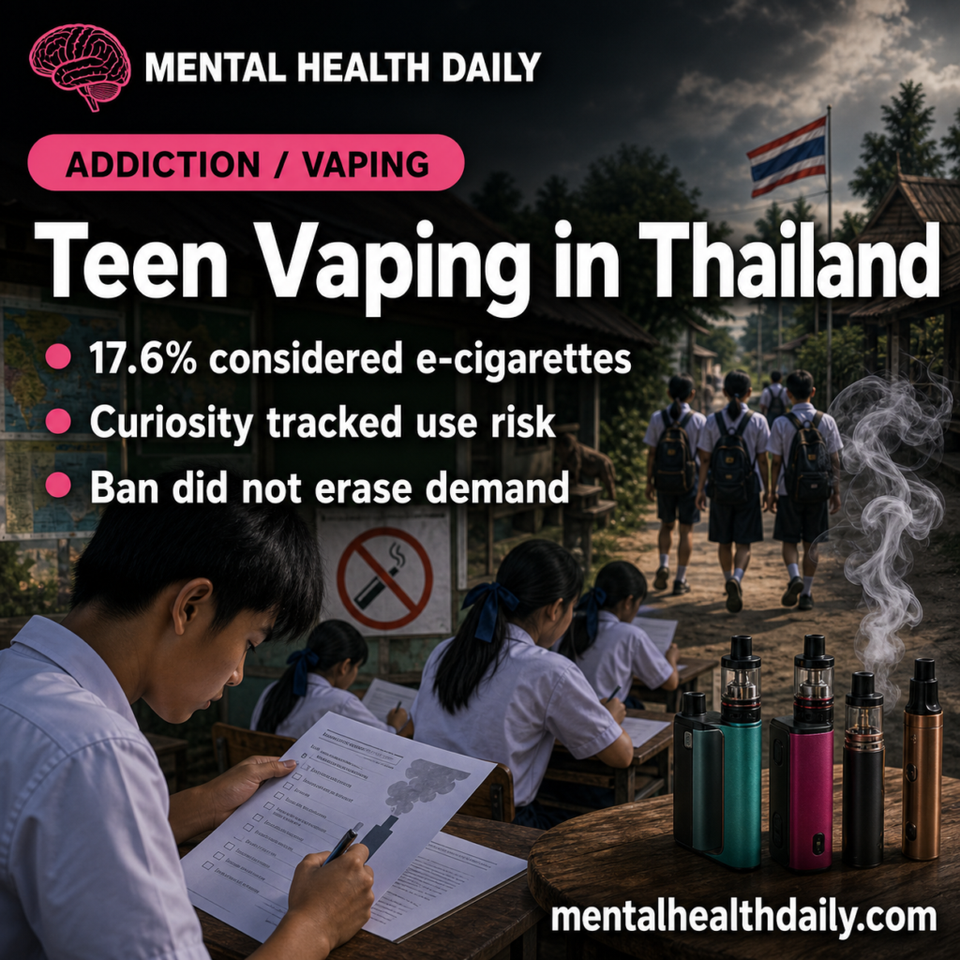
A 2026 cross-sectional school study involving 1,848 rural Thai teenagers found that 17.6% reported a tendency to use e-cigarettes, even though Thailand bans e-cigarette sale and importation.1 The strongest adjusted correlate was having ever considered smoking cigarettes: those teenagers had 6.71 times the odds of e-cigarette use tendency compared with teenagers who had never considered smoking.
Research Highlights
- Vaping tendency was common despite prohibition: 326 of 1,848 students, or 17.6%, reported a tendency to use e-cigarettes.
- Cigarette curiosity dominated the model: teenagers who had ever considered smoking cigarettes had 6.71 times the adjusted odds of e-cigarette use tendency.
- Vapor-risk beliefs predicted susceptibility: believing secondhand vapor was harmless was linked to 3.68 times the adjusted odds of e-cigarette use tendency.
- Social exposure was widespread: 79.7% reported seeing people smoke around them, and 43.5% reported exposure to e-cigarette advertising.
- Evidence strength is limited by design: in 1,848 students, the study can identify associations in participating schools; it cannot prove that any single belief caused later vaping.
E-cigarettes are battery-powered nicotine-delivery devices that heat a liquid into an inhaled aerosol. The aerosol is often called vapor, but it can contain nicotine, solvents, flavoring chemicals, metals, and other compounds. Nicotine exposure during adolescence can alter reward learning, dependence risk, and later substance-use vulnerability because the developing brain is more sensitive to nicotine than the adult brain.
Yinpraphan et al. surveyed students aged 13 to 18 from 19 secondary schools in Chachoengsao, Thailand, during January 2025.1 Analysis of the survey used e-cigarette use tendency as the outcome, meaning willingness, inclination, or risk of use rather than confirmed regular vaping. The outcome measures susceptibility, not biochemical evidence of nicotine exposure.
17.6% of Students Reported E-Cigarette Use Tendency
Sample: 1,848 students. Girls made up 54.7% of the sample, and the mean age was 14.9 years. Of the participating students, 326 reported e-cigarette use tendency and 1,522 did not.
Recruitment caveat: The recruitment pattern should temper the estimate. Researchers approached 39 schools, 19 participated, and 1,848 students completed usable questionnaires. Another 10,292 students were pending participation, 83 denied consent, and 39 questionnaires were incomplete. The result describes participating schools, not every rural Thai teenager.
Still, the 17.6% signal is notable because Thailand has restrictive e-cigarette policy. A ban can reduce formal availability, but it does not erase online marketing, informal sales, peer exposure, curiosity, or misperceptions about harm.
Smoking Curiosity Was the Strongest Adjusted Correlate
The strongest model result was prior consideration of cigarette smoking. Students who had ever considered smoking cigarettes had an adjusted odds ratio of 6.71, 95% confidence interval 4.59 to 9.82, for e-cigarette use tendency compared with students who had never considered smoking.
An adjusted odds ratio compares odds between groups after accounting for other variables in the model. A value above 1 means the outcome was more common in the exposed group. Here, the exposed group was teenagers who had considered smoking, and the outcome was e-cigarette use tendency.
Other adjusted correlates were smaller but still relevant:
- Believing secondhand vapor is harmless: adjusted odds ratio 3.68.
- Monthly income below 5,000 Thai baht: adjusted odds ratio 2.81 compared with 20,000 to 29,999 Thai baht.
- Prior encouragement to use e-cigarettes: adjusted odds ratio 1.95.
- Believing e-cigarettes help smoking cessation: adjusted odds ratio 1.93.
- Considering alcohol use: adjusted odds ratio 1.71.
- Female sex: adjusted odds ratio 1.66.
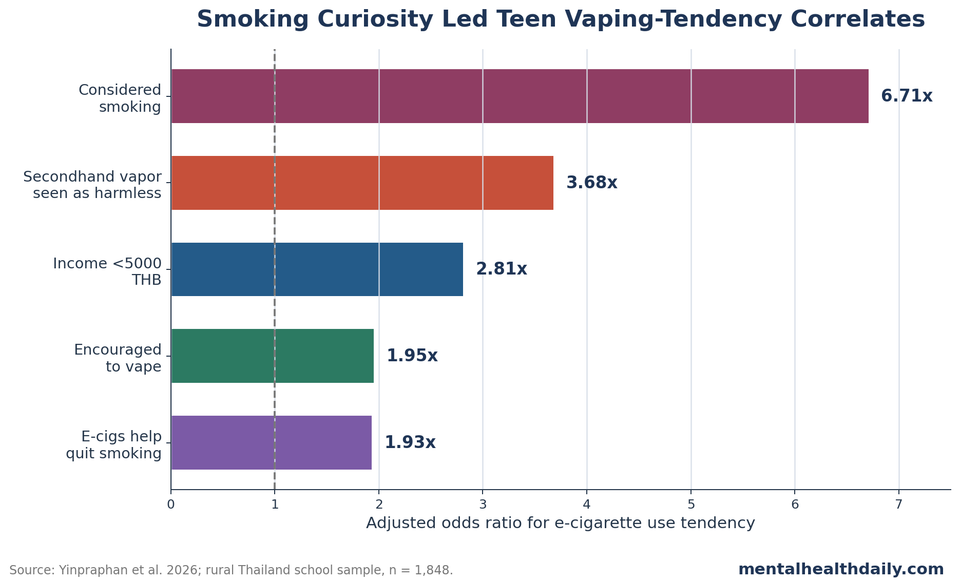
The cigarette-curiosity result does not prove that cigarette curiosity caused vaping tendency. It suggests that e-cigarettes and cigarettes may share a susceptibility pathway: novelty seeking, peer exposure, nicotine interest, family smoking, marketing, stress, or social environments where tobacco products are visible.
E-Cigarette Harm Awareness Was High, but Vapor Misconceptions Still Predicted Risk
Broad awareness: Most students recognized broad harm. The study reported that 92.5% recognized e-cigarettes as harmful, 85.8% associated e-cigarettes with serious disease, and 74.9% knew that sale or purchase was illegal in Thailand.
Specific beliefs: The specific misconception pattern was more important than general awareness. Among students, 36.2% believed e-cigarettes were less harmful than conventional cigarettes, 29.6% believed they were non-addictive, and 27.1% believed e-cigarettes could help people quit smoking. In the adjusted model, the secondhand-vapor belief and smoking-cessation belief remained associated with e-cigarette tendency.
Prevention implication: Broad messages that say vaping is harmful may not be enough. Teenagers can accept a general warning and still believe the product is safer than cigarettes, non-addictive, harmless to bystanders, or useful for quitting. Prevention programs need to correct those specific beliefs directly.
Cardiovascular and respiratory groups have warned that youth vaping is not a harmless substitute for smoking.23 Nicotine can increase dependence risk, and adolescent use may interact with mood symptoms, sleep, attention, and other substance-use patterns.4
Advertising and Peer Exposure Reached Teens Despite the Ban
Exposure: Exposure was common. The study found that 79.7% of students had seen people smoking around them, and 43.5% reported exposure to e-cigarette advertisements. Peer attitudes also mattered: neutral peer attitudes and prior encouragement were associated with higher e-cigarette use tendency.
Informal access: A ban can reduce legal retail channels, but teenagers do not encounter nicotine products only through formal stores. They encounter them through older peers, social media, family, school-adjacent vendors, online sellers, and local norms about smoking. A rural setting does not automatically mean low exposure.
Evidence strength: This was a cross-sectional questionnaire study. It can show which characteristics were associated with e-cigarette use tendency at one time point. It cannot prove temporal order, measure actual nicotine biomarkers, or determine whether changing a belief would reduce vaping initiation.
The outcome also measured tendency rather than confirmed current vaping. That makes the result useful for prevention because susceptibility comes before regular use, but it should not be read as a prevalence estimate for active e-cigarette consumption.
Policy implication: Thailand's ban changes the legal environment, but the survey shows why law alone can leave susceptibility intact. Teenagers can know a product is illegal and harmful while still believing it is less harmful than cigarettes, non-addictive, harmless to bystanders, or useful for quitting smoking. Those beliefs are the mental route that makes experimentation feel low risk.
School prevention: a stronger school message would separate 4 claims: e-cigarettes can deliver addictive nicotine, secondhand aerosol is not harmless air, vaping is not a proven teen smoking-cessation strategy, and flavored products can make initiation easier even when the student does not identify as a smoker.
Family and peer context: 79.7% of students reported seeing people smoke around them. If smoking is visible in the environment, anti-vaping messaging has to address the shared nicotine pathway instead of treating cigarettes and e-cigarettes as unrelated behaviors.
Advertising exposure: 43.5% reported exposure to e-cigarette advertising. Enforcement therefore needs a digital and informal-market component, because a store ban cannot fully control social-media promotion, reseller networks, or peer-to-peer product visibility.
Measurement implication: tendency is an early warning measure. A teenager who reports willingness or curiosity may never become a regular vaper, but prevention has more room to work before nicotine dependence, product access, and peer routines are established.
Implementation implication: the strongest prevention target is a concrete risk sequence schools can actually screen for: cigarette curiosity, alcohol curiosity, peer encouragement, advertising exposure, and the specific belief that secondhand aerosol is harmless.
A student who already accepts the broad claim that e-cigarettes are risky may still need a more specific correction: the device can deliver nicotine, the aerosol can contain more than water vapor, and “helping smokers quit” does not make the product safe for teenagers who have not started smoking. That distinction keeps the message attached to how students compare products in real life.
The strongest model result also argues against treating vaping prevention as a separate silo. Cigarette curiosity, alcohol consideration, peer encouragement, income, and vapor beliefs appeared in the same risk pattern. School programs that address nicotine, alcohol, peer pressure, advertising, and mental-health coping together may fit the data better than a single-product warning campaign.
Questions About Teen Vaping in Thailand
Did 17.6% of students report current vaping?
No. The outcome was e-cigarette use tendency, not confirmed current use. It reflects susceptibility or inclination, which is important for prevention but different from active vaping prevalence.
What was the strongest risk factor?
Having ever considered cigarette smoking was the strongest adjusted correlate, with 6.71 times the odds of e-cigarette use tendency compared with never considering smoking.
Why was the secondhand-vapor belief linked to vaping susceptibility?
Students who believed secondhand vapor was harmless had much higher odds of e-cigarette use tendency. That belief may make vaping seem socially safer and less risky than cigarettes.
Can a ban still leave teenagers exposed?
Yes. Laws can restrict formal sale, but exposure can still occur through peers, online advertising, informal markets, family smoking, and social media.
References
- Prevalence and Associated Factors of E-Cigarette Use Tendency Among Adolescents in a Rural Community, Thailand: A Cross-Sectional Study. Yinpraphan W et al. Tobacco Induced Diseases. 2026;24:21. doi:10.18332/tid/218288
- E-Cigarette Use Among Middle and High School Students. Park-Lee E et al. MMWR. 2024;73:774-778. doi:10.15585/mmwr.mm7335a3
- Cardiopulmonary Impact of Electronic Cigarettes and Vaping Products. Rose JJ et al. Circulation. 2023;148(9):703-728. doi:10.1161/CIR.0000000000001160
- Mental Health and E-Cigarette Use Among Adolescents: A Scoping Review. Javed S et al. Journal of Health and Social Sciences. 2022. doi:10.55729/2000-9666.1053
- Electronic Cigarette Use and Associated Factors Among Thai Youth. Patanavanich R et al. Asian Pacific Journal of Cancer Prevention. 2021;22(7):2199-2207. doi:10.31557/APJCP.2021.22.7.2199
- E-Cigarette Use in Southeast Asia: A Systematic Review. Low A et al. International Journal of Environmental Research and Public Health. 2023;20(5):3883. doi:10.3390/ijerph20053883
- Social Network Influences on Adolescent E-Cigarette Use. Valente TW et al. Substance Use & Misuse. 2023;58(6):809-817. doi:10.1080/10826084.2023.2188429