
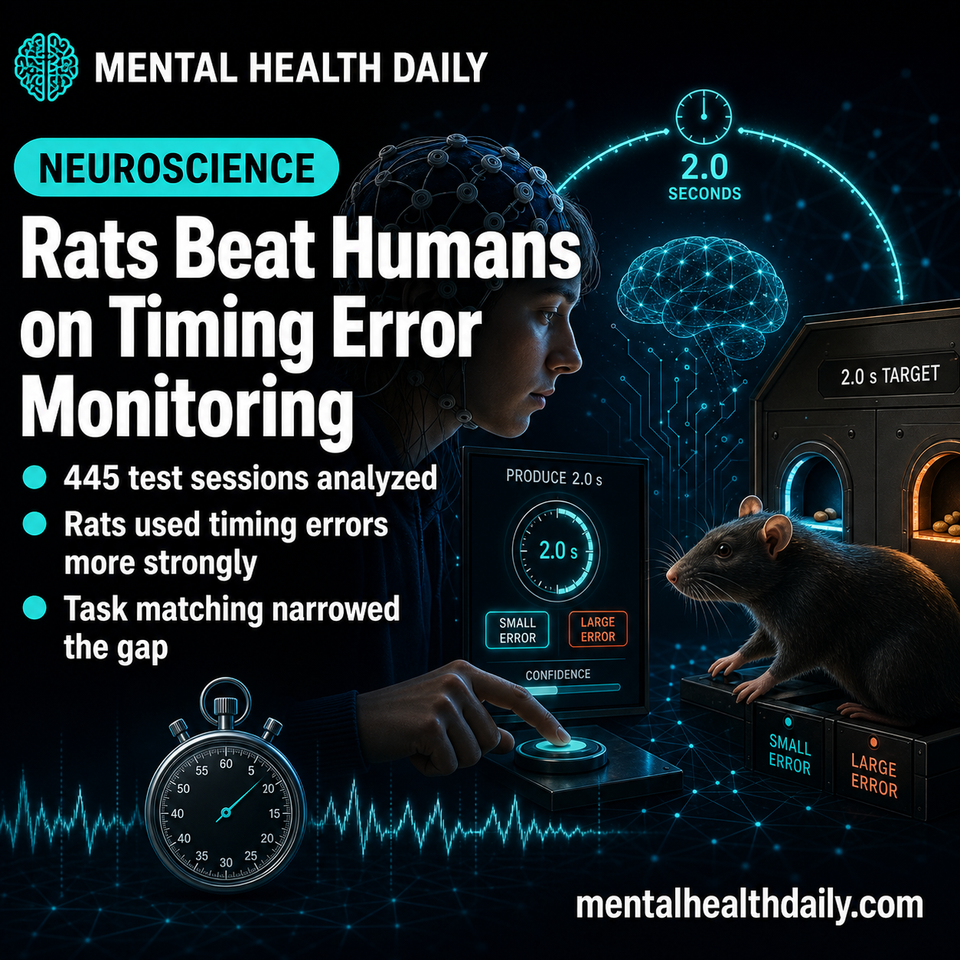
A 2026 iScience study found that both humans and rats could report whether their own 2-second timing responses were small-error or large-error trials, but rats were more accurate on test choices: human accuracy was 55%-57%, rat accuracy was 65%-67%, and the species gap remained significant before task-variable matching.1
Research Highlights
- Both species monitored timing errors: Humans performed above chance, 95% CI 0.517-0.574, p = 0.002, and rats performed higher still, 95% CI 0.645-0.668, p < 0.001, on choices requiring them to classify their own timing error.1
- Rats used the current timing error more strongly: Current-trial time production predicted small-error choices more steeply in rats, β = −0.99, than in humans, β = −0.13, with the species interaction β = −0.86, p < 0.001.1
- Task-rule alignment improved accuracy: Alignment between assigned and choice thresholds predicted more accurate session choices, β = −0.06, 95% CI −0.07 to −0.04, p < 0.001.1
- Reaction times carried strategy information: Humans showed more test-vs.-training slowing than rats, β = −0.38, 95% CI −0.58 to −0.19, p < 0.001, suggesting different decision or exploration strategies.1
- The dataset was narrow but dense: The final analysis included 34 human volunteers, 16 male rats, and 445 valid test sessions after exclusions for biased or invalid sessions.1
Temporal error monitoring means judging how wrong your own timing response just was. In this experiment, the test went beyond pressing for 2 seconds: the same organism had to use the size of its just-made timing error to choose the correct reward option.
Metacognition is often described as thinking about thinking, but the measurable version is more modest: an organism uses information about its own uncertainty, memory, timing, or error state to guide the next choice. Bilgin et al. put that idea into a cross-species timing task and asked whether humans and rats were using the same kind of error information, or only looking similar from the outside.
34 Humans and 16 Rats Classified Their Own 2-Second Timing Errors
The study compared 34 right-handed adults with 16 male Sprague-Dawley rats. Human participants were aged 18-35 years, with a mean age of 26.89 years. Rats were 7 months old when retrained on the 2-second target duration used for direct comparison with the human version of the task.1
The task had 2 layers. First, participants or rats produced a target interval by holding or pressing for at least 2 seconds. Then they had to choose between options linked to reward rules: one option corresponded to a smaller timing error, and the other to a larger timing error.
Small-error choices are the key outcome because they require the subject to use information about its own just-produced duration. A rat cannot explain confidence in words, but it can choose the port that corresponds to a smaller timing error when both ports are available. A human can do the analogous screen-card choice.
After exclusions, the final dataset contained 445 valid test sessions: 115 human sessions and 330 rat sessions. That density matters because each organism contributed repeated sessions, so the researchers used mixed-effects models that accounted for repeated observations inside the same person or rat.1
Rats Beat Humans on Test Choices Before Task-Variable Matching
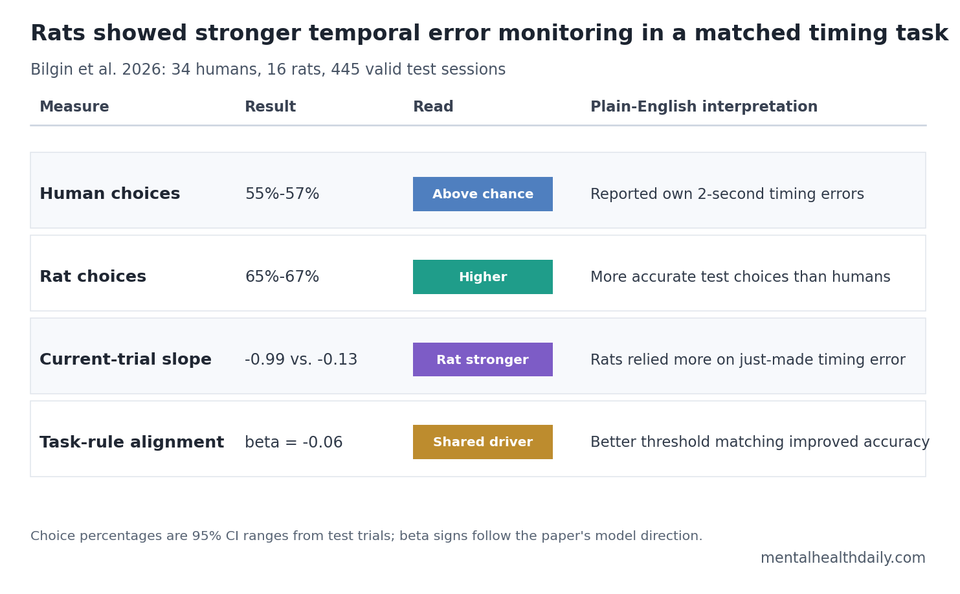
Both species performed above chance when classifying their own timing errors. Human choice accuracy on test trials was above 0.5, with a 95% CI of 0.517-0.574, p = 0.002. Rat accuracy was higher, with a 95% CI of 0.645-0.668, p < 0.001.1
The between-species comparison favored rats: β = 0.09, 95% CI 0.04-0.14, t(441) = 3.40, p < 0.001. Rats also produced the target interval more accurately, β = −0.10, 95% CI −0.15 to −0.05, and more precisely, β = −0.05, 95% CI −0.08 to −0.02.1
That result should not be flattened into a claim that rats are more self-aware than humans. The cleaner reading is narrower: under this highly trained timing-and-reward setup, rats used current-trial timing information more strongly than humans did.
Current-trial timing error carried the rat signal: the probability of choosing the small-error option changed steeply with the just-produced duration in rats, β = −0.99, 95% CI −1.05 to −0.92, p < 0.001. Humans showed the same direction but weaker slope, β = −0.13, 95% CI −0.24 to −0.02, p = 0.017.1
Threshold Alignment Explained Some of the Species Gap
Theta in this task was the decision boundary separating small from large timing errors. The researchers tracked whether the assigned threshold, observed session threshold, and choice-derived threshold lined up. Better alignment meant the organism had a clearer task context.
Session-level accuracy improved as those task variables aligned. The assigned-choice index predicted accuracy at β = −0.06, 95% CI −0.07 to −0.04, p < 0.001; the observed-choice index showed a similar effect, β = −0.06, 95% CI −0.08 to −0.04, p < 0.001.1
When human sessions were matched to rat sessions with similar threshold-alignment values, the accuracy gap narrowed. That comparison does not erase the headline species difference. It shows that some of the rat advantage was tied to how well task variables were represented, not to a mysterious global superiority in metacognition.
Earlier timing work fits that interpretation. Akdogan and Balci showed that humans can monitor whether they are early or late on temporal production tasks, while Kononowicz et al. reported that rats can monitor single-trial errors in self-generated durations.2,3 Oztel and Balci later extended the same idea to mice, again arguing that timing-error monitoring is not uniquely verbal or human.4
Reaction Times Suggested Different Decision Strategies
Reaction time added a second calibration layer. Test trials slowed both species relative to training trials, but the slowing was larger in humans. Human test-vs.-training reaction time differed by β = 0.78, 95% CI 0.67-0.89, while rat reaction time differed by β = 0.39, 95% CI 0.23-0.56; the species comparison was β = −0.38, 95% CI −0.58 to −0.19, p < 0.001.1
Training trials also showed reward-linked speeding. Rats and humans reached or chose faster when anticipating reward delivery than when no reward was expected. That effect was stronger in rats, β = 0.12, 95% CI 0.08-0.17, p < 0.001.1
Confidence proxy: faster choices can sometimes imply stronger internal evidence. Shadlen and Kiani described decision-making measures as a window into cognition, and Gherman and Philiastides showed that human ventromedial prefrontal cortex activity can encode early confidence signals in perceptual decisions.5,6 Bilgin et al. used the same logic cautiously: reaction time may track confidence, but it can also reflect exploration, training history, motivation, and motor demands.
Cross-Species Metacognition Requires Matched Computational Variables
The paper’s strongest contribution is methodological. Comparative cognition can look persuasive when animals and humans perform versions of the same task, but the task still has to measure the same computational variable in both species.
Redish et al. called this computational validity: the model or task should translate the same underlying process across species while guarding against superficially similar behavior.7 Bilgin et al. followed that standard by comparing direct accuracy, current-trial timing slopes, threshold alignment, and reaction-time patterns instead of relying on a single performance score.
Animal metacognition work has a long ambiguity problem. Foote and Crystal reported metacognition-like uncertainty behavior in rats, while broader reviews by Jozefowiez et al. warned that animal “knowing that they know” claims depend heavily on task design and alternative explanations.8,9
The current timing study is useful because it does not need rats to have human-like introspection. It only needs them to use information about their own timing error in a way that predicts choices.
What This Timing Study Can and Cannot Support
Supported: humans and rats can use just-produced timing errors to guide immediate choices in a matched 2-second task. Rats were more accurate before task-variable matching, and their choices depended more strongly on current-trial timing error.
Also supported: task structure partly explains cross-species differences. When threshold alignment was equated, the species gap diminished, which means the headline rat advantage should be read as a task-and-learning result, not a broad ranking of minds.
Not supported: claims about clinical diagnosis, human self-awareness, or general intelligence. This was a narrow experimental task involving healthy adult volunteers and male rats. The design cannot tell us whether timing-error monitoring changes in ADHD, obsessive-compulsive disorder, Parkinson’s disease, psychosis, or depression.
Animal-model caution: the rat sample used only males, so sex effects were not tested. Humans were not recruited with sex as a primary stratification factor, even though the final sample was nearly balanced at 16 men and 18 women. Reward value and motivational state are also hard to equate between hungry rats and human volunteers.
Questions About Temporal Error Monitoring
Does this mean rats have human-like metacognition?
No. The study supports a measurable error-monitoring behavior: rats used information about their own timing error to choose between reward options. Human-like introspective awareness is a different claim and would require different evidence.
Why did rats outperform humans?
Rats had stronger current-trial timing-error slopes and more reward-linked reaction-time behavior. Training history, motor routines, motivation, and threshold alignment probably contributed. The result is not a simple intelligence comparison.
Why is this relevant to mental health?
Error monitoring, timing, confidence, and action selection are core ingredients in cognitive control. Those processes are studied in obsessive-compulsive symptoms, ADHD, addiction, psychosis, Parkinson’s disease, and anxiety, but this study itself was basic comparative neuroscience rather than a clinical trial.
Could the task be used clinically?
Not yet. A 445-session basic-science dataset can sharpen models of timing and metacognition, but it does not validate a screening test or treatment target.
References
- Bilgin SN, Doyere V, Kononowicz TW. Direct comparison of temporal error monitoring in humans and rats. iScience. 2026;29:115531. https://doi.org/10.1016/j.isci.2026.115531
- Akdogan B, Balci F. Are you early or late?: Temporal error monitoring. Journal of Experimental Psychology: General. 2017;146:347-361. https://doi.org/10.1037/xge0000265
- Kononowicz TW, van Wassenhove V, Doyere V. Rodents monitor their error in self-generated duration on a single-trial basis. Proceedings of the National Academy of Sciences. 2022;119:e2108850119. https://doi.org/10.1073/pnas.2108850119
- Oztel T, Balci F. Mice monitor their timing errors. Scientific Reports. 2024;14:23356. https://doi.org/10.1038/s41598-024-71921-2
- Shadlen MN, Kiani R. Decision making as a window on cognition. Neuron. 2013;80:791-806. https://doi.org/10.1016/j.neuron.2013.10.047
- Gherman S, Philiastides MG. Human VMPFC encodes early signatures of confidence in perceptual decisions. eLife. 2018;7:e38293. https://doi.org/10.7554/elife.38293
- Redish AD, Kepecs A, Anderson LM, et al. Computational validity: Using computation to translate behaviours across species. Philosophical Transactions of the Royal Society B. 2022;377:20200525. https://doi.org/10.1098/rstb.2020.0525
- Foote AL, Crystal JD. Metacognition in the rat. Current Biology. 2007;17:551-555. https://doi.org/10.1016/j.cub.2007.01.061
- Jozefowiez J, Staddon JER, Cerutti DT. Metacognition in animals: How do we know that they know? Comparative Cognition & Behavior Reviews. 2009;4:29-39. https://doi.org/10.3819/ccbr.2009.40003