hit counter

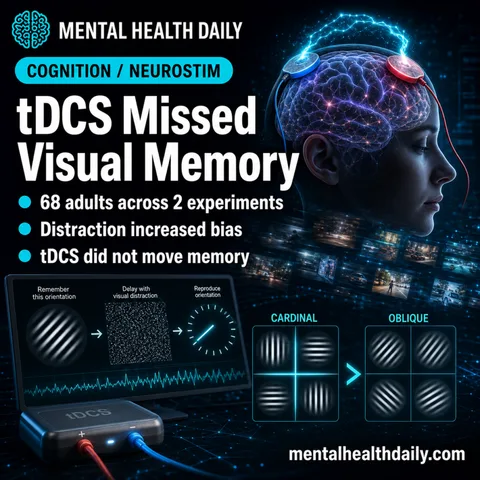
tDCS Failed Visual Working Memory as Distraction Increased Orientation Bias

Editorial card showing visual working memory, tDCS electrodes, and distraction-linked orientation bias in a cognitive neuroscience task.

A 2026 two-experiment study found no visual-working-memory benefit from parietal or occipital transcranial direct current stimulation, while distraction unexpectedly made the cardinal-over-oblique orientation advantage stronger than it was without distraction: the pooled distraction-by-angle interaction had BFinc = 1021.671.1 Research Highlights Distraction strengthened the bias: pooled data from 68 analyzed adults showed a strong distractor-by-angle interaction, …

Read more

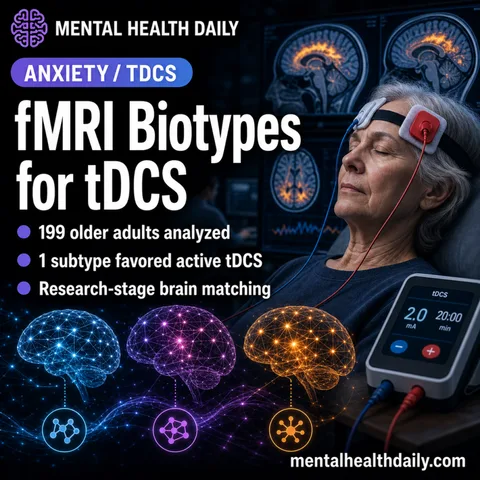
fMRI Biotypes Predicted tDCS Anxiety Response in Older Adults

Photoreal illustration of a clinician fitting a tDCS device on an older adult, with brain network biotype overlays.

A 2026 BETA analysis of 199 older adults found that resting-state fMRI could separate 4 anxiety-related tDCS response patterns, but the result was narrower than “brain scan predicts treatment”: only the Robust tDCS Responder subtype showed a statistically reliable Active vs. Sham anxiety advantage across all participants.1 Research Highlights Only 1 subtype cleared the Active …

Read more

At-Home tDCS Trial (HomeDC) Prematurely Terminated Due to Skin Lesions & Safety Concerns (2023 Study)

Transcranial Direct Current Stimulation (tDCS) is emerging as a promising home-based treatment for Major Depressive Disorder (MDD), offering a non-invasive, cost-effective, and scalable option for patients. This treatment modulates cortical excitability, potentially altering neuronal activity in the brain areas associated with depression. However, a recent randomized controlled trial (RCT), the HomeDC trial, aimed at investigating …

Read more

Cognitive Function Does Not Predict Response to tDCS for Depression (2023 Trial)

Transcranial Direct Current Stimulation (tDCS) has been explored as a potential treatment for major depressive disorder (MDD), particularly for patients who have not responded to traditional treatments like selective serotonin reuptake inhibitors (SSRIs). This non-invasive technique involves applying a weak electrical current to the prefrontal cortex of the brain, aiming to modulate neurocognitive functions. However, …

Read more

tDCS for Fibromyalgia: Efficacy of Transcranial Direct Current Stimulation (2024 Review)

A recent systematic review and meta-analysis aimed to update the understanding of the efficacy and safety of transcranial direct current stimulation (tDCS) for treating fibromyalgia (FM), focusing on its effects on analgesia, antidepressant outcomes, and the reduction of FM’s impact. Highlights: Efficacy of tDCS: The analysis revealed that tDCS is effective in reducing pain intensity, …

Read more

tDCS for Insomnia & Sleep Disturbances: Targeting the Infralimbic Cortex to Ventrolateral Preoptic Area Pathway (2024 Study)

In the quest to effectively treat insomnia, a condition plaguing millions worldwide, scientists are exploring innovative treatments beyond traditional medication. Transcranial Direct Current Stimulation (tDCS) emerges as a promising intervention, offering a non-invasive method to modulate brain activity and enhance sleep quality. A recent study suggests tDCS may treat stress-related sleep disturbances and highlights the …

Read more

tDCS of the DLPFC Treats Anhedonia in Depression & Improves Social Functioning (2024 Study)

In the quest to find more effective treatments for depression, particularly the challenging symptom of anhedonia, Transcranial Direct Current Stimulation (tDCS) emerges as a promising option. This non-invasive brain stimulation technique targets specific brain regions to modulate activity and potentially alleviate symptoms. A recent study has shed light on the efficacy and safety of targeting …

Read more