hit counter

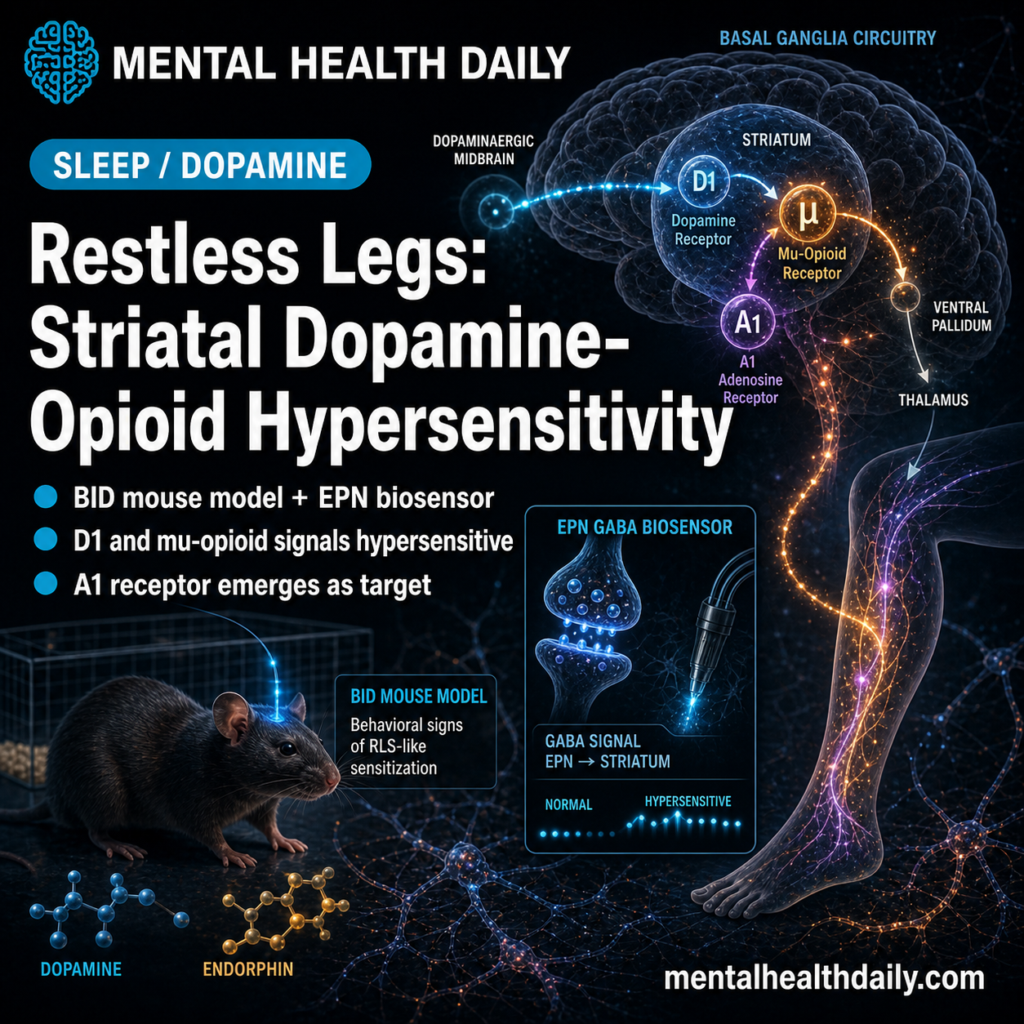
Restless Legs: Striatal Dopamine-Opioid Hypersensitivity

Restless legs syndrome (RLS) and opioid-withdrawal restlessness both produce night-worsening urges to move. A 2026 npj Parkinson’s Disease mouse study tied that overlap to hypersensitive striatal D1-mu-opioid receptor signaling in basal-ganglia motor circuits.1 Research Highlights 2 clinically similar states converged: restless legs syndrome and opioid-withdrawal restlessness both point toward a striatal D1-mu-opioid circuit that regulates …

Read more

Chronic Stress Increased Mouse D1 and D2 Dopamine Receptors

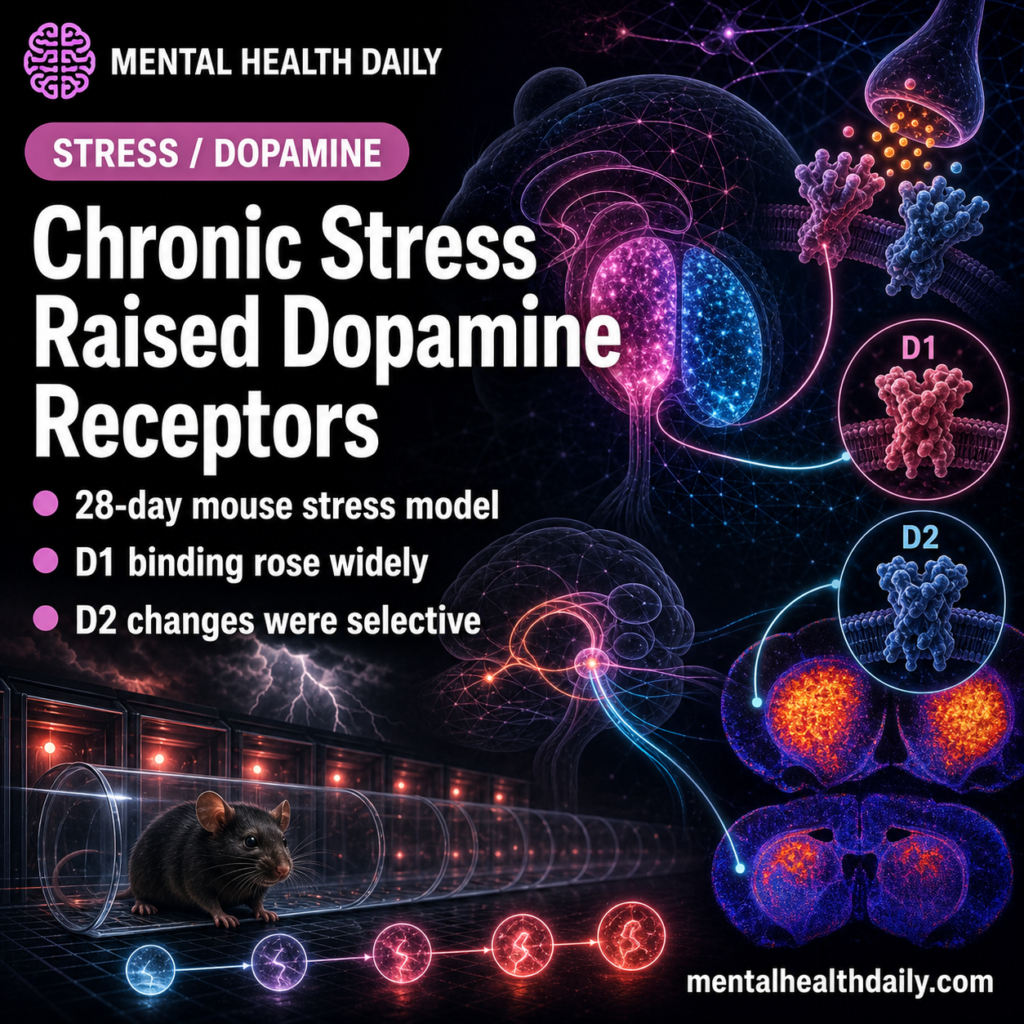
Stylized striatal dopamine receptor map in a mouse stress model, highlighting widespread D1 receptor binding increases and selective D2 changes after chronic mild stress.

Chronic stress is a candidate mechanism for both depression and addiction risk. A 2026 mouse study found that 28 days of unpredictable chronic mild stress increased striatal dopamine D1 receptor binding by 22–48% across nearly every region examined, plus more selective D2 receptor increases — pointing to a stress-driven shift in reward signaling that may …

Read more

Subcortical Connectivity Differs in Schizophrenia, Bipolar, Depression

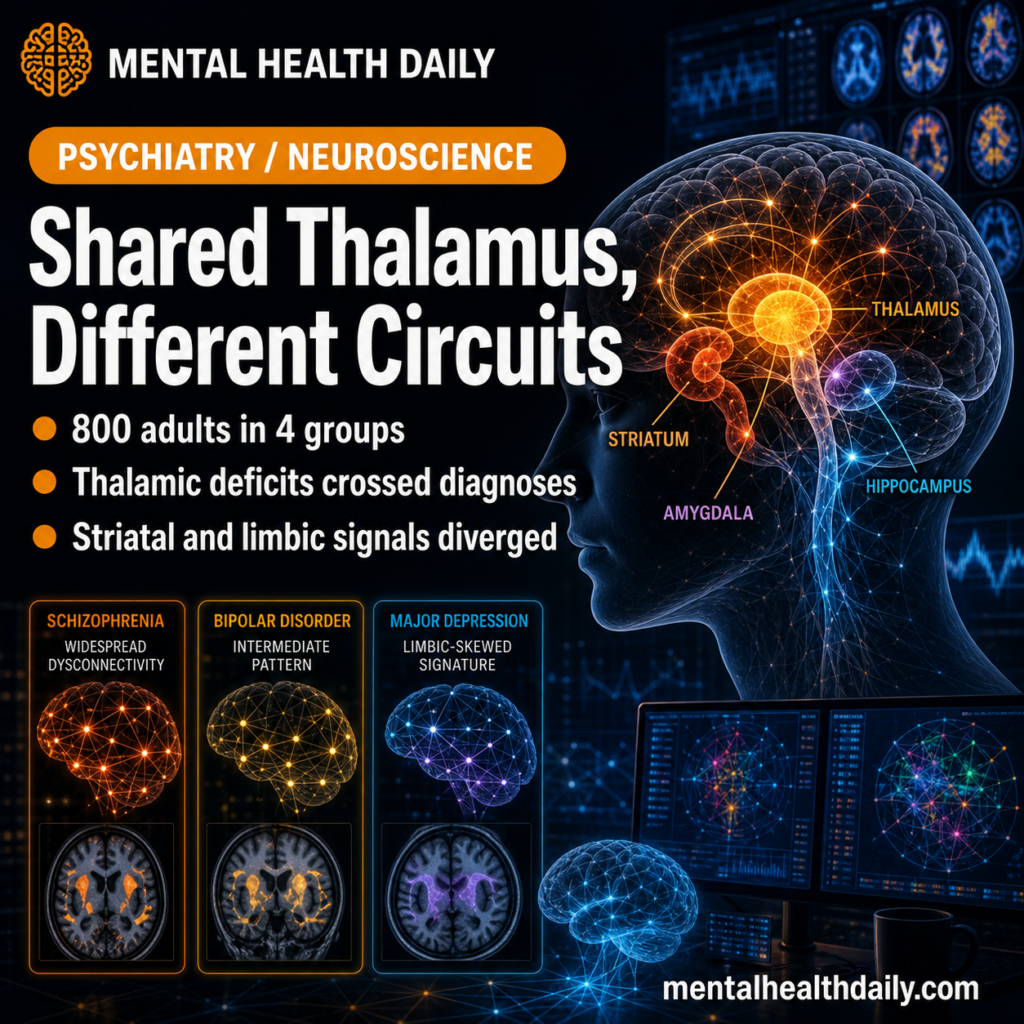
MHD featured image for subcortical connectivity patterns across schizophrenia, bipolar disorder, and depression.

A 2026 resting-state fMRI study of 800 adults found intra-thalamic hypoconnectivity across schizophrenia, bipolar disorder, and major depression, but schizophrenia showed far broader subcortical dysconnectivity than bipolar disorder or depression.1 The calibrated read is that these diagnoses may share a thalamic vulnerability while diverging in striatal and limbic circuitry. Research Highlights Shared thalamic deficit: In …

Read more

Teen Anxiety and Anhedonia Split Reward-Uncertainty fMRI

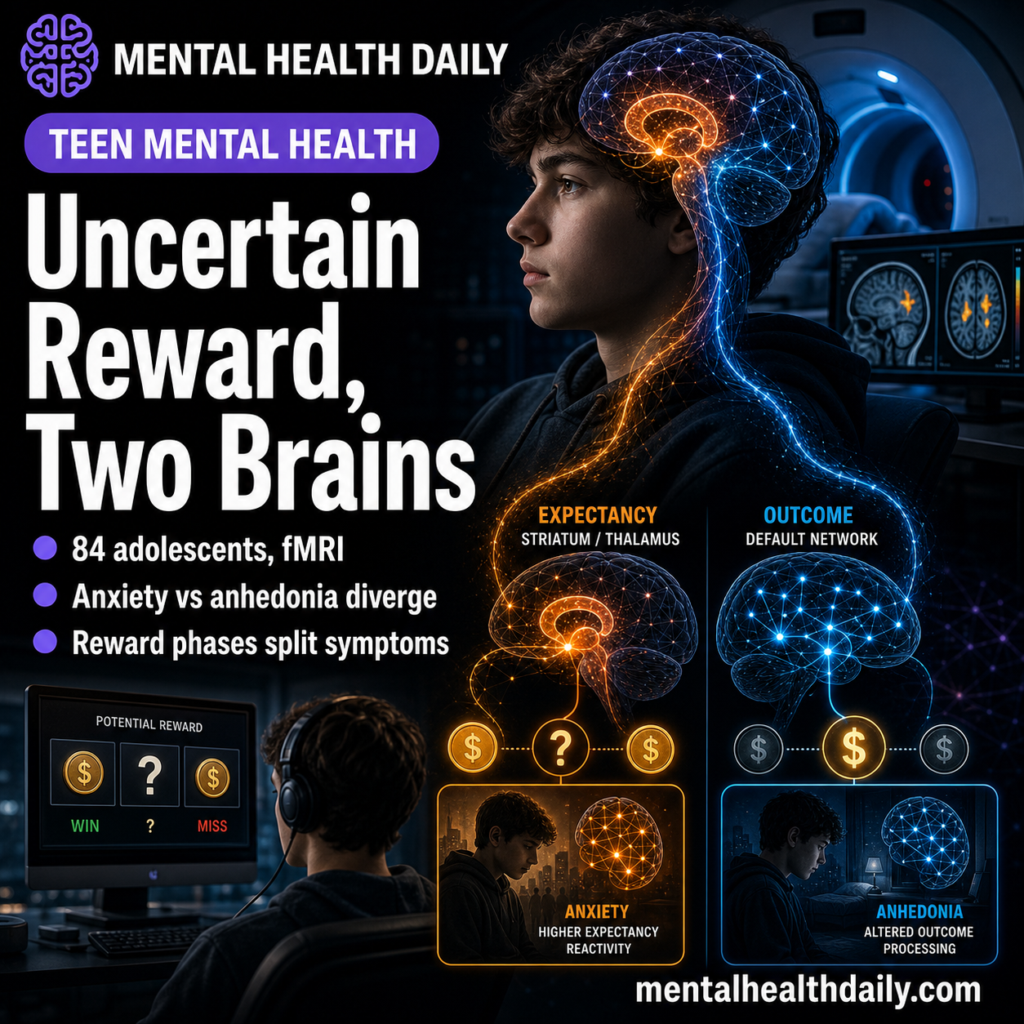
Photoreal illustration of adolescent brain regions with overlapping reward and default-mode network glow, conveying uncertainty processing.

A 2026 fMRI study of 84 medication-free adolescents found that reward uncertainty had its own phase-specific brain pattern: anxiety, depression, and anhedonia separated across different task phases and brain systems.1 The clearest clinical split was narrow but useful: anxiety tracked blunted striatum/thalamus activation during uncertain non-reward expectancy, while depression and anhedonia tracked higher visual/default-network activation …

Read more

Striatal Dopamine Drops From Psychosis to Schizophrenia Remission

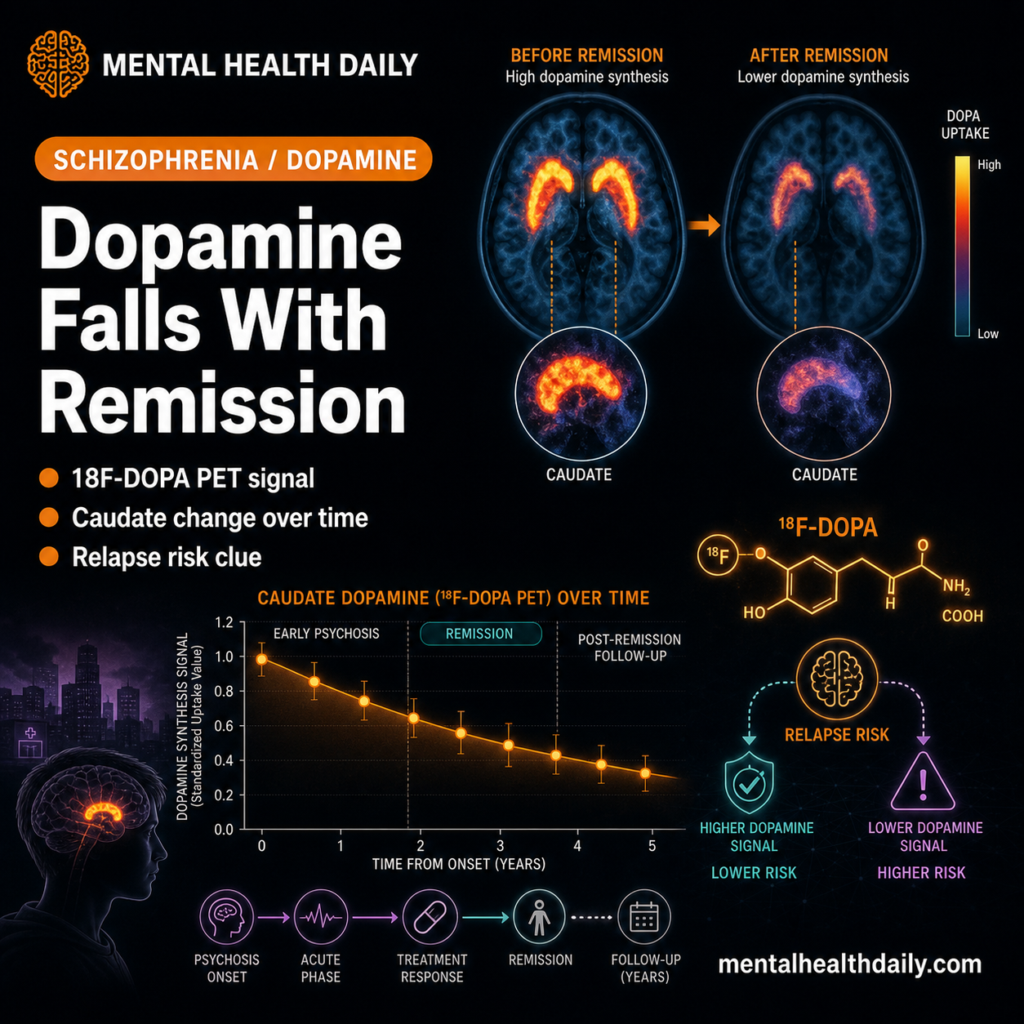
Photoreal illustration of a brain with the striatum highlighted and dopamine synthesis pathways visualized, representing longitudinal PET imaging in schizophrenia.

The dopamine hypothesis of schizophrenia is the field’s longest-running mechanistic story, and most of its supporting evidence has been cross-sectional. A 2026 longitudinal PET study by Schulz and colleagues followed the same 28 patients across psychosis and early remission.1 Research Highlights The dopamine hypothesis of schizophrenia is the field’s longest-running mechanistic story. Cross-sectional 18F-DOPA PET …

Read more