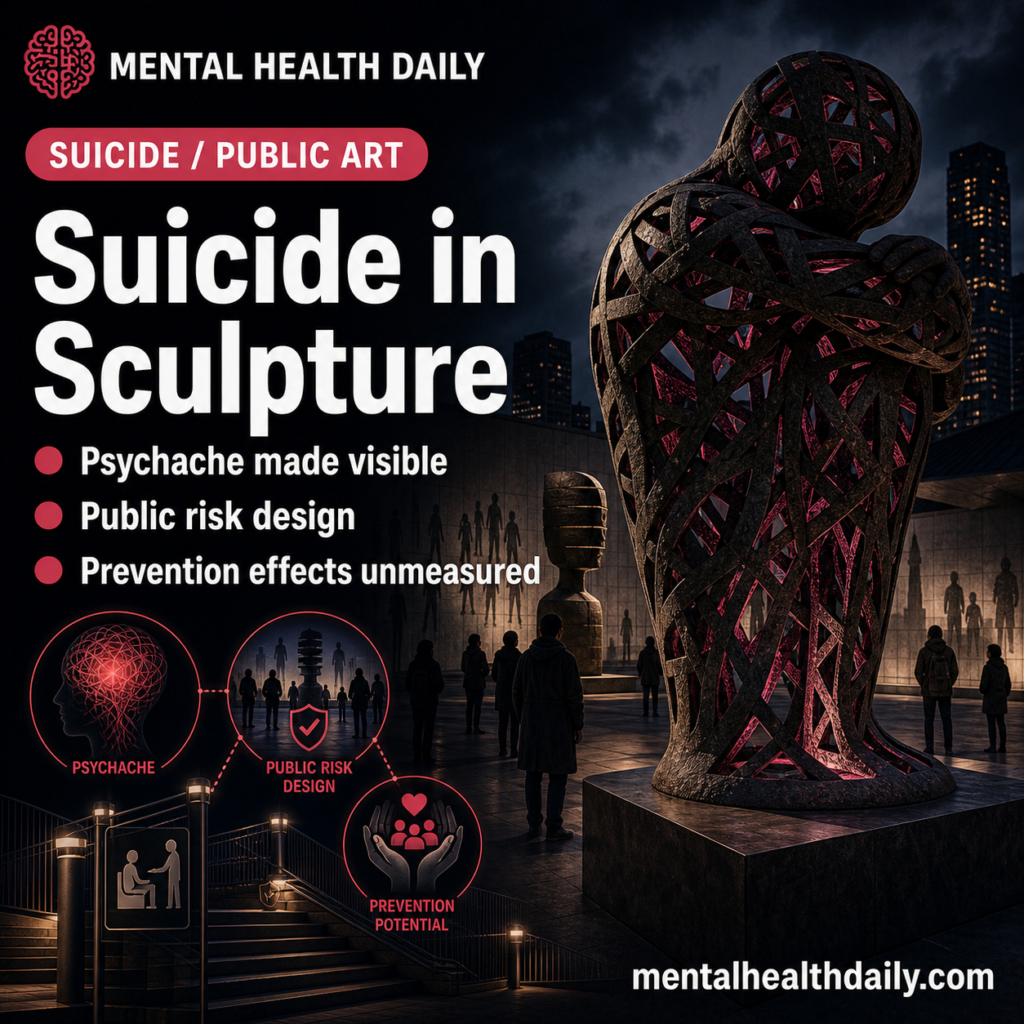
A 2026 qualitative analysis treated suicide-themed sculpture as cultural evidence, showing how public artworks can materialize psychological pain, shame, entrapment, social disconnection, and prevention debates without turning artists or viewers into diagnostic case studies.1
Research Highlights
- 2026 analysis used cultural methods: the researchers used iconographic, semiotic, and contextual analysis rather than clinical diagnosis or outcome measurement.1
- 3 interpretive tools anchored the reading: visual symbols, meaning systems, and social context were used to interpret sculpture without reducing art to pathology.1
- 84 rooftop figures made the statistic visible: Project 84 used 84 life-sized sculptures to represent the weekly number of men dying by suicide in the United Kingdom.1
- 4 Vessel deaths shifted attention to design: the Hudson Yards structure became a suicide-prevention debate after 4 people died by jumping from it.1
- 0 prevention effects were measured: the study can clarify cultural meaning, but it cannot show whether sculpture reduces suicidal behavior or suicide deaths.1
Psychache means unbearable psychological pain: intense mental suffering that can make suicide appear, to the person in crisis, like an escape from intolerable distress. Entrapment means feeling unable to leave a painful situation, identity, relationship, social role, or internal state. These concepts matter in suicide research because they describe subjective pressure alongside diagnosed psychiatric disorder.
Yuksel et al. examined suicide in sculpture across historical periods and contemporary public art. The researchers searched PubMed, Scopus, and Web of Science up to January 2026 and also used museum archives and art-historical catalogs. They selected sculptural works for interpretive case analysis, then read them through psychiatric concepts and cultural context.
This Was Cultural Analysis, Not Retrospective Diagnosis
The study did not claim that a sculpture can diagnose an artist, subject, or viewer. That boundary is essential because retrospective diagnosis turns cultural objects into thin clinical gossip. The researchers instead used sculpture to examine how self-destruction has been represented through posture, material, site, social codes, public display, and the viewer’s physical encounter with the work.
Study snapshot:
- Article type: qualitative thematic analysis with a psychiatric perspective.
- Search scope: PubMed, Scopus, Web of Science, museum archives, and art-historical catalogs through January 2026.
- Analytic tools: iconographic analysis, semiotic interpretation, and contextual reading.
- Main psychiatric themes: psychache, shame, entrapment, social disconnection, public risk, and prevention visibility.
- Main limit: the design cannot measure viewer behavior, suicide rates, help-seeking, contagion, or protective effects.
Iconographic analysis asks what recognizable figures, gestures, objects, and symbols are doing inside the artwork. Semiotic interpretation asks how signs make meaning: a tower, a ledge, a hooded body, a teddy bear, a rooftop crowd, or a narrowed ascent can carry social and emotional meaning without explaining itself in words.
The method fits sculpture because sculpture occupies space with the viewer. A painting of isolation can be seen from a distance; a sculpture of isolation can force a viewer to move around absence, height, exposed bodies, barriers, scale, and public placement. Those physical properties can make suicide-related themes harder to keep abstract.
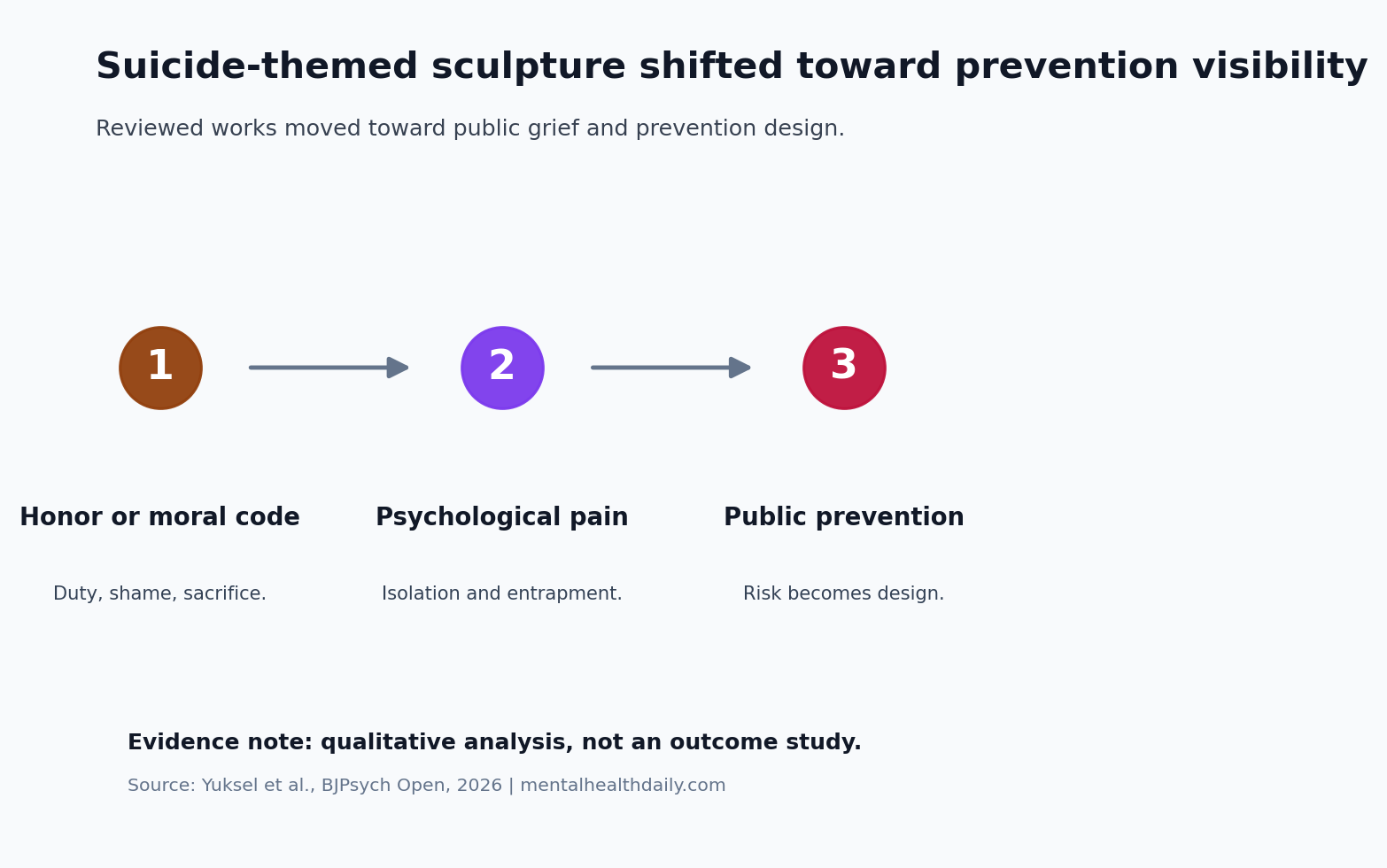
Older Sculptures Often Framed Self-Death Through Honor or Judgment
Historical pattern: the review moved from honor-coded or morally judged self-death toward modern works centered on psychological vulnerability. In antiquity and early modern traditions, representations of self-killing could appear inside accounts of duty, sacrifice, shame, civic virtue, religious judgment, or tragic honor.
Social code: those older frames located the act inside collective moral codes. The viewer was asked to see a person in relation to family, honor, law, empire, religion, or civic order. The self was visible through the social system that defined disgrace and obligation.
Modern shift: modern and contemporary sculpture placed more attention on interior suffering and social rupture. The body could appear isolated, constrained, exposed, fragmented, or withdrawn. The sculpture could make psychache and entrapment visible without needing a clinical label such as depression, psychosis, substance-use disorder, or post-traumatic stress disorder.
Modern Works Made Entrapment and Isolation Spatial
Spatial example: H.C. Westermann’s Suicide Tower from 1965 gave the review one of its clearer spatial examples. A tower works as a vertical sequence, a narrowing route, and a height-based risk environment. The sculpture can be read as movement toward danger rather than a single frozen endpoint.
Theory match: the integrated motivational-volitional model separates the emergence of suicidal ideation from the transition from ideation to attempt. Defeat, humiliation, entrapment, social disconnection, access to means, impulsivity, exposure, and capability can affect different parts of that pathway.
Interpretive limit: the sculpture gives viewers a material form for a process that suicide research often has to describe with diagrams and scales. The ascent, narrowing space, and implied ledge convert risk progression into a physical structure.
Project 84 Turned a Weekly Statistic Into Human Presence
Public statistic: Project 84 placed 84 life-sized sculptures on the roof of the ITV Building in London to represent the weekly number of men dying by suicide in the United Kingdom. The installation was supported by Campaign Against Living Miserably and turned a population statistic into a visible crowd of absent people.
Attention shift: a number such as 84 can be absorbed and forgotten; 84 bodies placed above a city street impose repetition, countability, and public witness. The installation also aligned with a prevention message: male suicide risk involves social access to support, and help-seeking has to become easier before crisis narrows the person’s options.
Outcome limit: a sculpture campaign can increase attention, donations, media coverage, or help-seeking conversations without producing a measurable population-level change. Measuring suicide prevention effects would require separate outcome research with careful controls.
Vessel Showed Why Built Environments Become Prevention Sites
Hotspot debate: the Vessel in New York became part of suicide-prevention debate after 4 people died by suicide after jumping from the structure. Public discussion centered on barriers, netting, access limits, architecture, responsibility, and whether aesthetic design had failed to account for predictable self-harm risk.
Means restriction: reducing access to highly lethal methods or high-risk sites can prevent deaths because suicide crises can be time-limited, method-specific, and sensitive to barriers that create delay, interruption, or rescue opportunity.
Design question: the Vessel debate belongs beside bridge barriers, railway-platform interventions, firearm-storage counseling, medication-pack-size rules, and hotspot surveillance. The actionable question is whether a public structure gives acutely distressed people an unusually available lethal method and whether design changes can reduce that risk without closing the site entirely.
Sculpture Can Support Prevention Without Measuring Outcomes
Public memory: several contemporary works in the review functioned as public memory or prevention prompts rather than clinical interventions. Stille Strijd in Utrecht focused attention on youth suicide. A hooded figure with a teddy bear in Bristol used vulnerability and childhood association to make distress publicly legible. Eugenio Merino’s suicide-themed sculpture involving Damien Hirst raised questions about spectacle, media circulation, and the boundary between critique and exploitation.
Design caution: suicide-themed public art needs careful design and placement. Visualizing suicide can create witness, solidarity, and prevention urgency, but sensational imagery can also intensify identification with death. Safer prevention-oriented works tend to emphasize human presence, help-seeking, loss, interruption, and social responsibility rather than method detail or romanticized fatality.
Evidence-strength note: Yuksel et al. provided a qualitative cultural analysis. The study can identify meanings, motifs, and psychiatric concepts embedded in sculpture. It cannot estimate suicide contagion, prevention efficacy, changes in help-seeking, or mental-health outcomes among viewers.
Public Art Can Clarify Psychache Without Proving Prevention Effects
- Language should include subjective pain: psychache, shame, humiliation, and entrapment may explain crisis experience better than diagnosis alone.
- Public spaces carry suicide-risk design duties: ledges, rooftops, bridges, platforms, and high-access heights require prevention planning when risk becomes predictable.
- Memorial art should avoid method instruction: prevention-oriented sculpture can represent loss and social responsibility without displaying lethal technique in an imitative way.
- Outcome claims require separate research: an artwork can be culturally powerful without evidence that it changes suicide rates or individual risk.
Yuksel et al. made suicide-themed sculpture readable as a psychiatric and public-health archive. The strongest contribution is not diagnosis through art; it is a clearer view of how psychological pain, social meaning, and built environments become visible when self-destruction enters public space.
For prevention teams, the article supports careful public communication: make distress and help-seeking visible, avoid method detail, and treat risky architecture as a design problem when repeated deaths make the risk predictable.
Questions About Suicide in Sculpture
Can sculpture prevent suicide?
Sculpture can support public awareness, memorialization, help-seeking messages, and community discussion. A qualitative art analysis cannot show that sculpture reduces suicidal behavior or suicide deaths.
How does psychache fit suicide-themed sculpture?
Psychache is unbearable psychological pain. In suicide research, it helps describe the internal suffering that can make death seem like relief to a person in crisis.
Why did Vessel become part of suicide-prevention debate?
Vessel became a prevention issue because multiple people died by suicide after jumping from the structure. The public debate focused on whether barriers, netting, access limits, or redesign could reduce site-specific risk.
What should public art avoid when addressing suicide?
Prevention-oriented public art should avoid romanticizing suicide, glamorizing the person who died, or showing detailed method imagery. Safer work emphasizes grief, connection, interruption, and routes to help.
References
- Yuksel RN, Yuksel C, Ozdemir E. Suicide in sculpture: a qualitative thematic analysis and psychiatric perspective. BJPsych Open. 2026;12(3):e105. https://doi.org/10.1192/bjo.2026.11029
- O’Connor RC, Kirtley OJ. The integrated motivational-volitional model of suicidal behaviour. Philosophical Transactions of the Royal Society B. 2018;373(1754):20170268. https://doi.org/10.1098/rstb.2017.0268
- Kleiman EM, Nock MK. Real-time assessment of suicidal thoughts and behaviors. Current Opinion in Psychology. 2018;22:33–37. https://doi.org/10.1016/j.copsyc.2017.07.026
- Pirkis J, Too LS, Spittal MJ, Krysinska K, Robinson J, Cheung YTD. Interventions to reduce suicides at suicide hotspots: a systematic review and meta-analysis. The Lancet Psychiatry. 2015;2(11):994–1001. https://doi.org/10.1016/s2215-0366(15)00266-7
- Stack S. Media coverage as a risk factor in suicide. Journal of Epidemiology & Community Health. 2003;57(4):238–240. https://doi.org/10.1136/jech.57.4.238