A professional esports team’s voices in the minute before a match carried clues about whether it would win, according to a 2026 study of 89 Counter-Strike matches played by one 5-player team. Voice helped most when combined with the gap in team rankings.1
Research Highlights
- Voice plus ranking did best: a decision-tree model using 60 seconds of pre-match team talk and the ranking gap reached an AUC of 77% (95% CI 66–87%) and classified 79% of matches correctly.1
- All 5 combined models beat chance: every algorithm that used both voice and ranking had a confidence interval above the 50% coin-flip line.1
- Voice alone was weaker: only 2 of 5 voice-only models clearly beat chance, with AUCs of 68% and 64%.1
- Ranking alone was not enough: no model using only the ranking gap clearly beat chance.1
- One team, small sample: the models were never tested on other teams, and the study did not measure stress or arousal directly.1
How Researchers Turned 60 Seconds of Team Talk Into a Win Prediction
Gabriel Kadri et al., working at Santa Casa de São Paulo School of Medical Sciences in Brazil, analyzed recordings from a professional team in Counter-Strike: Global Offensive (CS:GO), a 5-vs-5 tactical shooter that demands fast decisions and constant voice coordination.1
For each of 89 official matches, they took the first 60 seconds of team communication, recorded through the players’ own headsets during warm-up just before play. That window was chosen to capture the team’s state going in, before wins and losses inside the game could color how anyone sounded.1
What the computer heard: the audio was cut into 50-millisecond slices, and each slice was described by 68 acoustic features, measurements of how the voice sounds rather than what was said. They included:
- Energy: how much sound power each slice carried
- Spectral features: where the sound energy sat across low and high frequencies, and how fast that shifted
- MFCCs (mel-frequency cepstral coefficients): a standard summary of voice timbre used in speech recognition
- Chroma features: how energy spread across musical pitch classes, a rough index of tone
The whole team was on one audio channel, so the features describe the group’s collective sound, not any one player.1
3 sets of inputs: the researchers trained 5 common machine-learning models (programs that learn patterns from labeled examples) on each of these:
- Voice only: the 68 acoustic features
- Ranking only: the difference between the team’s official league ranking and its opponent’s
- Voice plus ranking: both together
The 5 models ranged from simple straight-line methods (logistic regression and linear discriminant analysis) to a decision tree, which sorts data through a series of yes/no splits, and a random forest, which averages many decision trees. A fifth, k-nearest neighbors, classifies a sample by the most similar examples it has seen.
Testing on unseen matches: models were trained on some matches and tested on others they had never seen, rotating through 5 splits so every match was tested once. Slices from the same match never appeared in both the training and test sets. Each held-out match got a score equal to the share of its slices the model labeled as a win.1
What an AUC of 77% Means
AUC (area under the curve) measures how well a model ranks wins above losses. In plain terms, it is the chance that a randomly picked win gets a higher win score than a randomly picked loss.
- 50%: no better than a coin flip
- 77%: the model put the win ahead about 3 times out of 4
- 100%: every win scored above every loss
Because 89 matches is a small number, the researchers resampled the matches 2,000 times to build a 95% confidence interval around each AUC. They counted a model as beating chance only when the whole interval sat above 50%.1
Voice Plus Ranking Beat Chance in All 5 Models; Ranking Alone in None
Adding voice to the ranking gap gave the best results for every algorithm. The decision tree did best, with an AUC of 77.3% (95% CI 65.8–86.9%) and accuracy of 78.6% (95% CI 69.9–86.7%).1
The other 4 combined models landed between 66.0% and 70.1%, and all 5 had intervals that cleared the coin-flip line.1
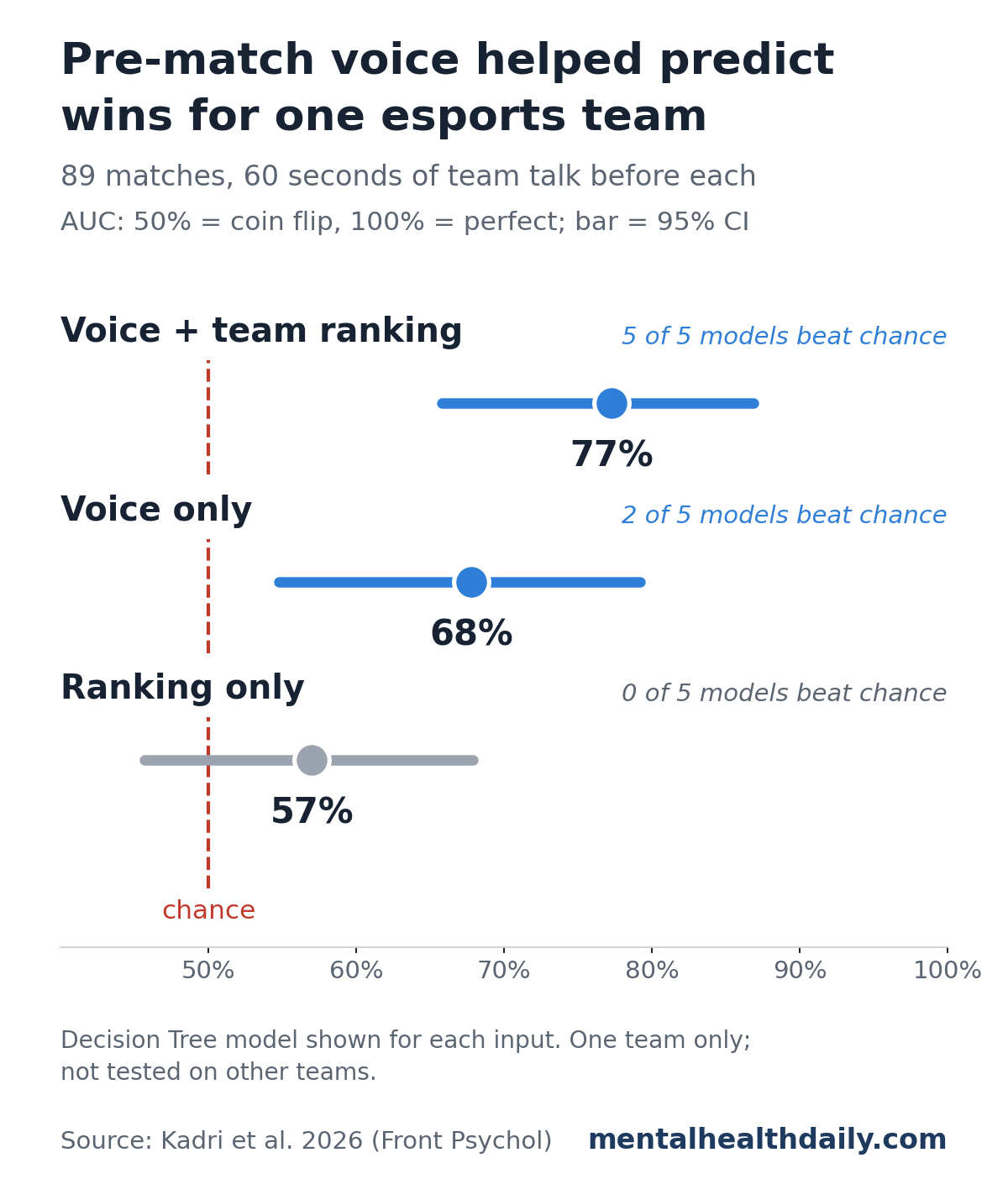
Ranking alone was a surprisingly poor predictor in this dataset. Its best AUC was 57.5%, and no ranking-only model had an interval that excluded chance.1
Yet the ranking gap was the top-weighted input in all 5 combined models. In these models, ranking and voice each carried part of the picture, and predictions were better with both.
No formal head-to-head test: the researchers did not run a statistical test of whether the combined models beat the ranking-only models. They treat that comparison as descriptive only, so the firm result is that all 5 combined models beat chance; whether voice adds to ranking still needs a direct test.1
Voice Alone Clearly Beat Chance in 2 of 5 Models
Without the ranking gap, the evidence was thinner. Only the 2 tree-based models had intervals fully above 50%:1
- Decision tree: AUC 67.8% (95% CI 54.8–79.2%)
- Random forest: AUC 64.0% (95% CI 50.7–76.3%)
Linear discriminant analysis (61.5%), k-nearest neighbors (60.1%) and logistic regression (55.8%) all had intervals that dipped below 50%. Even the 2 winners only just cleared the line, with lower bounds of about 55% and 51%.1
The researchers originally reported that all voice-only models beat chance and removed that claim during revision, after the bootstrap intervals showed otherwise.1
Which sounds the models leaned on: an explanation tool called LIME ranked each model’s most influential features. Tree models leaned most on rapid changes in spectral energy (delta spectral flux), straight-line models on variation in tone (chroma standard deviation), and k-nearest neighbors on spectral centroid, a measure of how bright or high the voice sounds. The researchers treat these rankings as exploratory and did not compare them statistically.1
Why Pre-Match Stress Could Show Up in the Voice
The researchers’ reasoning is that anticipation, stress and mental workload change breathing, throat tension and articulation, which alter how speech sounds. The same states can also affect attention and split-second decisions in a game.1
Each link in that chain has some support:
- Stress and voice pitch: a 2025 meta-analysis of 10 studies (1,148 observations) found that fundamental frequency, the basic pitch of the voice, rose after stress, with a moderate pooled effect (standardized mean difference 0.55). The effect was stronger in women and in spontaneous speech, but it shrank to nonsignificant after a correction for publication bias.2
- Pressure hurts esports performance: in 2 experiments with national- and university-level esports competitors, high pressure raised anxiety and threat appraisals, worsened gaze control and lowered performance, even though players put in more mental effort.3
- Speech as a stress measure: a 2019 review in the journal Stress described speech as a promising way to track stress outside the lab, while flagging open validation problems and privacy concerns about recording conversations.4
The CS:GO study did not measure stress, arousal or anxiety, and it did not test whether those states linked voice to results. The researchers themselves call the stress pathway a conceptual framework rather than a demonstrated mechanism. The voice patterns could also reflect this team’s habits, tactics or even microphone conditions on a given day.1
Limitations of This Esports Voice Study
- One team: all 89 matches came from the same 5 players, so the models may have learned this team’s communication style. They were never tested on another team, game or competitive level.
- Small sample, wide intervals: the best combined model’s AUC could plausibly sit anywhere from about 66% to 87%.
- Retrospective design: the recordings already existed, and the researchers recommend that future studies register their analysis plan in advance.
- Group audio: players were not separated, and headsets and recording conditions varied from session to session.
- Data-handling choices: to balance wins and losses during training, the team used one method (NearMiss undersampling) without comparing alternatives. The researchers say their accuracy estimates may be optimistic until the models are validated further and replicated on outside data.
- Industry ties: 4 of the 6 researchers were employed by Infinity Doctors Inc., whose artificial-intelligence research division is one of the study’s listed affiliations.
What Voice Analysis Could Mean for Esports Teams
A training tool, not a selection tool. If the result holds up in other teams, the researchers picture a practice-only dashboard that compares a standard 60-second warm-up sample with the team’s own usual baseline. A large deviation could prompt a voluntary check-in about fatigue, communication or technical problems.1
Clear limits on use. They state that such a system should not pick lineups, discipline players or suggest a mental health diagnosis. Any real use would need player consent, restricted access and an honest display of uncertainty.1
Next steps: the researchers call for larger samples across many teams, tournaments and games, separate audio for each player, standardized microphones, and checks on whether direct stress or physiological measures add predictive value beyond voice.1
References
- Kadri G, Santos RIM, Aguiar FO, Otani VHO, Uchida RR, Marques LM. Predicting competitive outcomes in professional e-sports from 60-second pre-match voice acoustics using machine learning. Frontiers in Psychology. 2026;17:1819513. doi:10.3389/fpsyg.2026.1819513
- Veiga DL, Almeida TM, Uchida RR, Cordeiro Q. The fundamental frequency of voice as a potential stress biomarker: a systematic review and meta-analysis. Stress and Health. 2025;41:e70112. doi:10.1002/smi.70112
- Sharpe BT, Obine EAC, Birch PDJ, Pocock C, Moore LJ. Performance breakdown under pressure among esports competitors. Sport, Exercise, and Performance Psychology. 2024;13(1):89–109. doi:10.1037/spy0000337
- Slavich GM, Taylor S, Picard RW. Stress measurement using speech: recent advancements, validation issues, and ethical and privacy considerations. Stress. 2019;22(4):408–413. doi:10.1080/10253890.2019.1584180