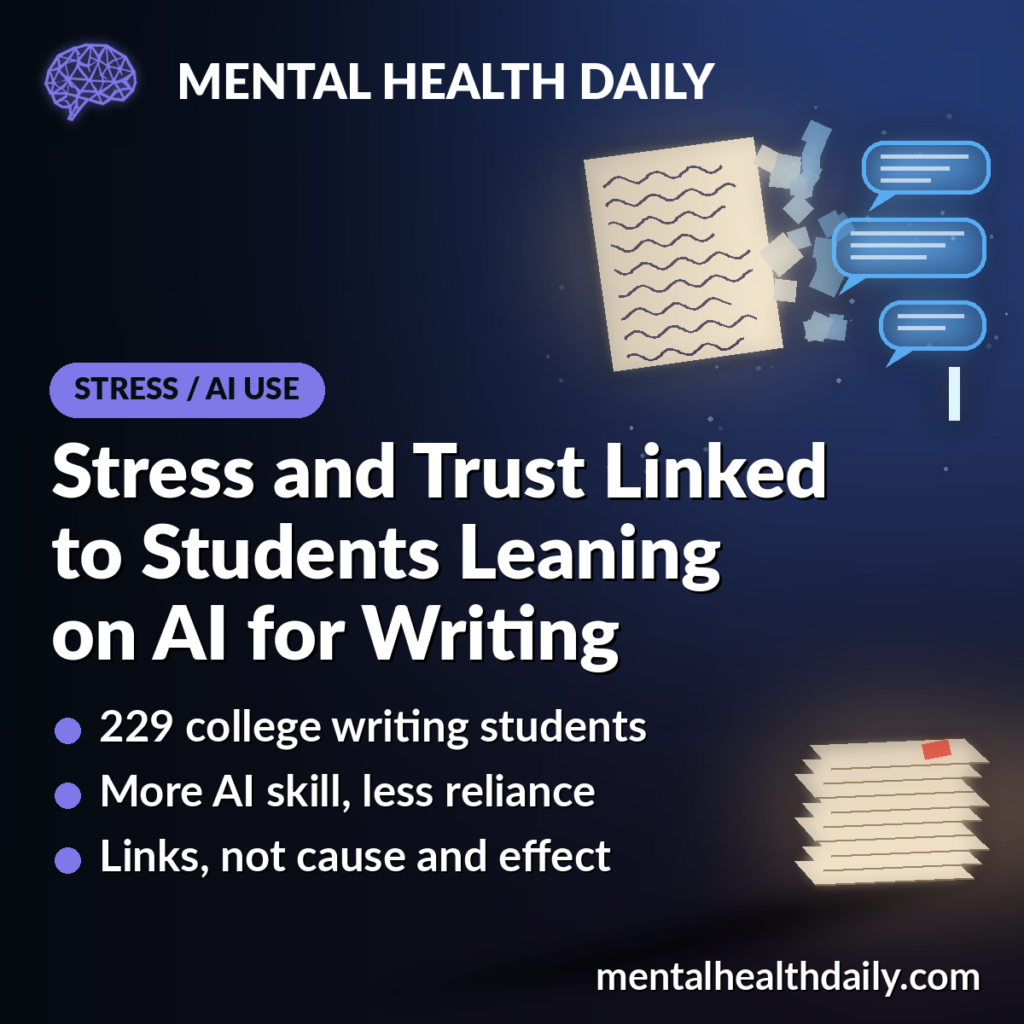
College students who felt more academic stress and trusted AI more reported leaning harder on generative AI for their writing, according to a 2026 survey of 229 journalism students at 2 universities in China. Students with stronger AI literacy reported less dependence once other factors were taken into account.1
Research Highlights
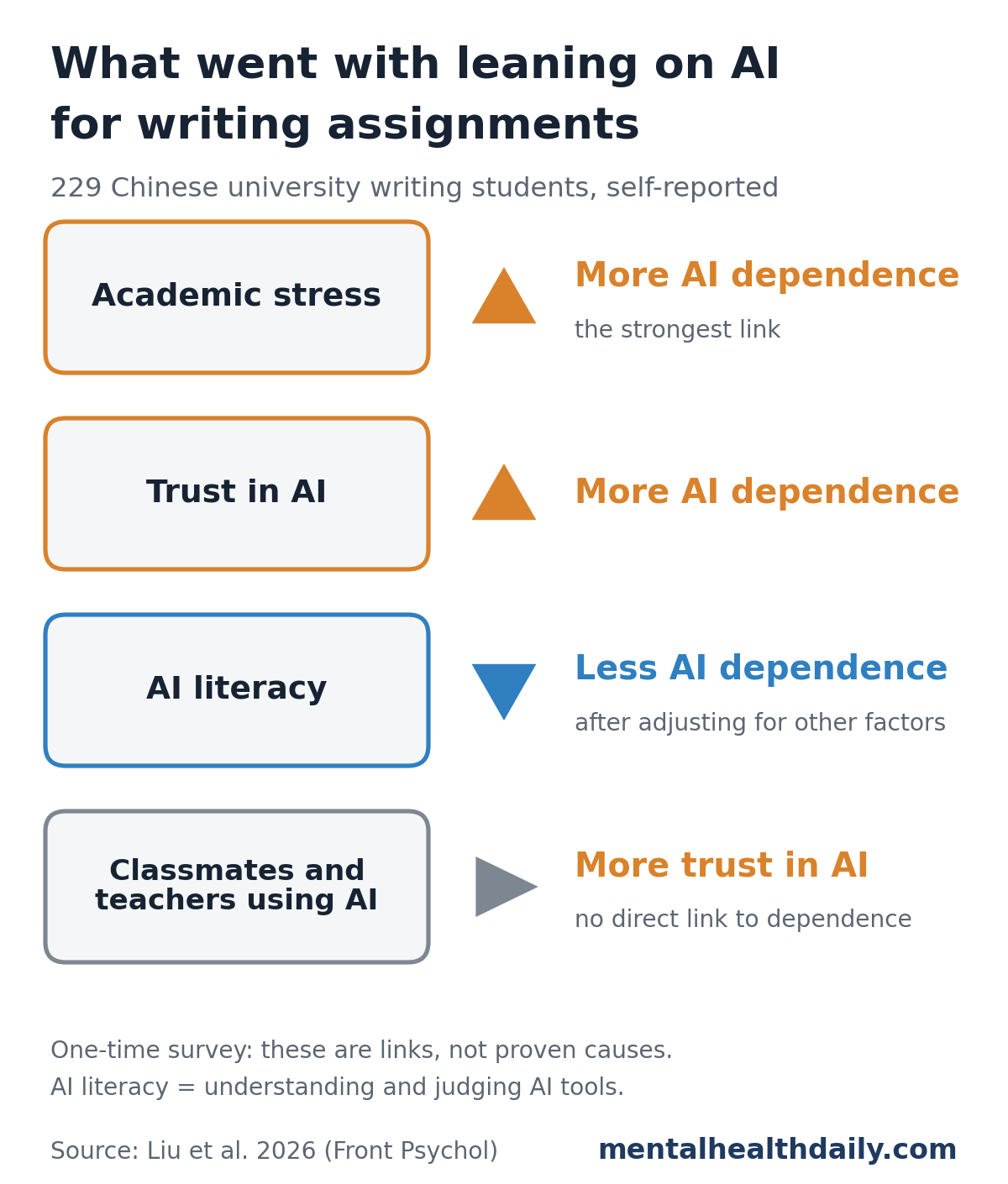
- Stress had the strongest link: students under more academic pressure reported more dependence on AI tools such as ChatGPT and DeepSeek (p < 0.001).1
- Trust in AI went with more reliance: students who trusted AI more reported more dependence, even after an instructor had walked them through AI errors and risks.1
- Classmates and teachers mattered through trust: classmates and teachers using AI were linked to more trust in AI, but had no direct link to dependence.1
- AI literacy pointed the other way: students better at understanding and judging AI reported less dependence in the adjusted model.1
- A one-time self-report survey: the study shows links, not causes, and its dependence score is not a diagnosis of addiction.1
How the Writing-Course Survey Measured AI Dependence
Lili Liu et al. surveyed undergraduates in a required research methods course for journalism and communication students, one at a public university in Fujian province and one in Guangdong province. Of 266 students invited, 229 gave usable answers after the researchers removed incomplete, rushed and straight-line responses.1
Setting: the instructor taught students to use Doubao, DeepSeek, Kimi and ChatGPT to search literature, summarize papers and proofread, and also covered fabricated data, citation rules and AI detection.1
Two weeks later, students wrote a literature review in class for their midterm grade. AI use was optional but had to be marked, and the survey came right after.1
AI was already part of most students’ routines:1
- 48.1% used AI tools at least once a day
- 39.7% used them every few days to weekly
- 57.2% usually spent 30 minutes to 1 hour per session
What “AI dependence” meant here
The researchers measured generative AI dependence with 7 questionnaire items adapted from a Facebook addiction scale and a dependence scale. Two examples: “I would feel anxious if I were forbidden to use AI tools” and “I have tried to reduce the use of AI tools in learning, but found it impossible to persist.”1
Higher scores mean a student reports relying on AI more heavily and finding it harder to step back. The scale borrows wording from addiction research, but it is not a clinical diagnosis.1
The researchers themselves separate dependence (handing off thinking and decisions to AI) from addiction, which involves clinical features such as craving and serious impairment.1
The I-PACE model, in plain terms
The study was built on the I-PACE model (Interaction of Person-Affect-Cognition-Execution), a framework Matthias Brand et al. proposed in 2016 to explain problem internet use such as gaming, gambling and online shopping.2 It breaks the process into 3 parts:
- Person: what a student brings, such as confidence in their own schoolwork, skill with AI, and the people around them.
- Affect and cognition: how they feel and think in the moment, such as stress over a deadline or a belief that the tool can be trusted.
- Execution: the behavior that results, here heavy reliance on AI and trouble cutting back.
Here the framework serves as a map of which traits and feelings travel with heavier reliance, separate from any addiction diagnosis.
The researchers tested these links with structural equation modeling, a statistical method that estimates several connected relationships at once, so each link is adjusted for the others in the model.
Academic Stress and Trust in AI Were Linked to More Dependence
Academic stress had the strongest link of any factor tested. Students who agreed with items such as “I am unable to catch up if I get behind on the work” and “The competition with my peers for grades is quite intense” reported more AI dependence (p < 0.001).1
The researchers read this through stress-coping theory: under pressure, a tool that produces a summary or a paragraph in seconds offers fast relief, and repeated relief can turn occasional help into a habit.1
Trust in AI was also linked to dependence (p < 0.05). Students who agreed with statements such as “I believe AI is honest” reported more dependence.1
That held even though the course had openly shown students that AI can invent facts, which the researchers suggest is hard to spot because false output often reads as polished and plausible.1
Classmates and Teachers Shaped AI Dependence Through Trust
Social influence here meant feeling that classmates, teachers and other important people expected or encouraged AI use, measured with items like “The teacher encourages me to use AI for learning assistance.”1
Its direct link to dependence was not significant (p = 0.251). It was, however, linked to more trust in AI (p < 0.001), and the indirect route from social influence through trust to dependence was significant (95% confidence interval 0.015 to 0.343, which excludes zero).1
In plain terms, seeing others use AI did not by itself go with heavier reliance. It went with believing AI was reliable, and that belief went with heavier reliance.
AI Literacy Was Linked to Less Dependence After Adjustment
AI literacy is a person’s ability to understand how AI tools work, what they are good and bad at, and how to evaluate what they produce. Students with higher AI literacy reported less dependence in the full model (p < 0.05).1
Caveat: on its own, AI literacy had essentially no correlation with dependence (r = −0.006). The negative association showed up only once stress, trust and social influence were accounted for, and AI literacy was itself correlated with several of those factors.1
It is a modest adjusted pattern in one sample; whether AI literacy training reduces dependence would need a trial to test.1
Self-confidence and stress: students’ academic self-efficacy (belief in their own ability to do well) was not linked to their stress level overall. Among students who rated AI as very useful, though, higher self-efficacy went with lower stress.1
What Students Said About Deadlines, Detection and Unclear Rules
The researchers interviewed 8 students chosen to cover a range of grades and analyzed open-ended survey answers. Four themes came up:1
- Efficiency: students used AI to get through heavy homework and tight deadlines. One said, “AI can help me quickly summarize the content and conclusions of literature, and my efficiency in completing assignments doubles.”
- Peer influence: “My classmates are all using AI, and if I don’t use it, our academic gap may be widened.”
- Confidence: many students felt sure they controlled the tools and would not become dependent. Some described mixing output from ChatGPT, DeepSeek and Doubao and rewriting it to avoid detection.
- Unclear rules: “Although teachers require us to use AI responsibly, there is no clear definition of ‘what extent of use can be considered as non-compliant’ at present.”
Students named fabricated data and hard-to-verify content as AI’s biggest flaw. Few mentioned that heavy reliance might weaken their own thinking or ability to learn on their own.1
Other Studies Link Student Stress and Mental Health to AI Dependence
The China results line up with a small but growing set of studies on students and generative AI:
- South Korea: in a survey of 300 university students who used ChatGPT, also built on the I-PACE model, academic stress and performance expectations linked lower academic self-efficacy to more AI dependency. Students listed laziness, misinformation, lower creativity and weaker independent thinking among the downsides.3
- Stress and AI literacy over time: a 2-wave survey of 452 Chinese university students found that a path from low need for cognition (little enjoyment of effortful thinking) to problematic AI use was stronger under high academic stress and weaker with high AI literacy.4
- Teens: in a 2-wave study of 3,843 Chinese adolescents, the share showing AI dependence rose from 17.14% to 24.19%. Earlier mental health problems predicted later AI dependence, but AI dependence did not predict later mental health problems.5
- Critical thinking: in a mixed-methods study of 666 people across age groups, more frequent AI tool use went with lower critical-thinking scores, partly through cognitive offloading (handing mental work to an outside tool). Younger participants relied on AI more.6
Most of this work is cross-sectional or short-term and relies on self-report. Together, these studies point to stress and emotional strain as one common route into heavy AI reliance, with skill at judging AI as a possible buffer.
Limitations of This AI Dependence Survey
- One-time survey: stress, trust and dependence were measured at the same moment, so the study cannot show which came first. Heavy AI reliance could also raise stress or trust.
- Self-report only: no usage logs or classroom observation checked how much students actually relied on AI.
- Narrow sample: one course at 2 universities in China, 81.2% women, with too few men to compare groups.
- Fresh AI training: every student had just been taught to use AI tools for the assignment, which may have shaped their answers.
- Model adjustments: the researchers modified the model after seeing initial fit results, and several reported coefficients differ between the text and tables, so the direction of each link is more dependable than its exact size.
- Small interview group: the themes come from 8 interviews plus open-ended answers.
What This Means for Students and Instructors
Stress is part of the picture. In this sample, the students most likely to lean on AI were the ones who felt most behind and most pressed by grade competition. The researchers recommend easing excessive workload pressure alongside teaching AI literacy and risk awareness.1
Trust deserves checking. Knowing that AI makes mistakes did not stop students from trusting it. Habits such as verifying citations and facts against the original source put that knowledge into practice.
Clearer rules: Students described real confusion about how much AI use was allowed. The researchers recommend that schools spell out where AI is and is not appropriate and keep human review of AI-assisted work.1
For students, a simple check is whether you could still do the core thinking of an assignment without the tool. If AI has become the first step every time a deadline looms, that pattern is worth noticing.
References
- Liu L, Zhuang M, Wang J. Are students dependent on AI in writing courses? Analyzing factors influencing dependence on generative AI through the I-PACE model. Frontiers in Psychology. 2026;17:1905037. doi:10.3389/fpsyg.2026.1905037
- Brand M, Young KS, Laier C, Wölfling K, Potenza MN. Integrating psychological and neurobiological considerations regarding the development and maintenance of specific Internet-use disorders: an Interaction of Person-Affect-Cognition-Execution (I-PACE) model. Neuroscience & Biobehavioral Reviews. 2016;71:252–266. doi:10.1016/j.neubiorev.2016.08.033
- Zhang S, Zhao X, Zhou T, Kim JH. Do you have AI dependency? The roles of academic self-efficacy, academic stress, and performance expectations on problematic AI usage behavior. International Journal of Educational Technology in Higher Education. 2024;21:34. doi:10.1186/s41239-024-00467-0
- Kong Y, Dong T, Yang Z, Fang Y, Chen N. From cognitive need to problematic use: a chained mediation path moderated by academic stress and AI literacy. Frontiers in Psychology. 2026;17:1767454. doi:10.3389/fpsyg.2026.1767454
- Huang S, Lai X, Ke L, Li Y, Wang H, Zhao X, Dai X, Wang Y. AI technology panic—is AI dependence bad for mental health? A cross-lagged panel model and the mediating roles of motivations for AI use among adolescents. Psychology Research and Behavior Management. 2024;17:1087–1102. doi:10.2147/PRBM.S440889
- Gerlich M. AI tools in society: impacts on cognitive offloading and the future of critical thinking. Societies. 2025;15(1):6. doi:10.3390/soc15010006