Chinese teens aged 10 to 15 who trusted the people around them less had more depressive symptoms 2 years later, in a 2026 study that followed 971 teens. Frequent arguments with parents and low satisfaction with teachers were also linked to higher scores.1
Research Highlights
- Social trust ranked first: of 13 factors measured in 2020, trust in family, neighbors, strangers, local officials and doctors carried the most weight in predicting 2022 symptom scores.1
- Family and school factors were linked too: more arguments with parents, lower satisfaction with teachers and more academic pressure were each linked to more symptoms 2 years later.1
- Online habits barely registered: gaming, short videos, online classes and online shopping, measured only as yes or no, had no significant link once the other factors were included.1
- The risk tool was weak: a scoring chart built from these factors told apart teens with and without elevated symptoms only modestly (AUC 0.614), and it is not a screening test.1
- Consistent with earlier work: other long-term studies link family conflict and school connection to teen depression, with the effects running in both directions.4,5
How Researchers Followed 971 Chinese Teens From 2020 to 2022
Depressive symptoms are common in young people. A 2024 meta-analysis of 96 studies estimated that 21.3% of children and adolescents worldwide have at least mild depression or depressive symptoms, and that share has been rising.2
Songli Mei et al. used the China Family Panel Studies (CFPS), a long-running national survey that revisits the same households every few years. They picked teens aged 10 to 15 in the 2020 wave and checked their mood in the 2022 wave.1
Sample: 971 teens with complete data (mean age 12.7; 522 boys), out of 3,360 in the 2020 starting pool.1
Outcome: the 8-item CES-D8, a short questionnaire that asks about low mood, loneliness, poor sleep, sadness and whether life feels enjoyable. Scores run from 0 to 24, and the researchers treated 9 or higher as elevated depression risk.1
The study was built on an ecological model of development: the idea that a child sits at the center of nested circles of influence, from family and school out to the wider community. In 2020, the survey captured 11 such factors, plus age and sex:1
- Community: trust in 5 groups (family, neighbors, strangers, local officials, doctors), and how popular teens felt among their peers
- Family: how many times they talked with parents, and how many times they argued with parents, in the past month
- School: satisfaction with their school, satisfaction with their math, Chinese and foreign-language teachers, and how much academic stress they felt
- Internet: whether they shopped online, gamed online, watched short videos or took online classes (yes or no)
Social Trust Ranked as the Top Predictor of Later Depressive Symptoms
To rank the factors, the team used a random forest, a machine-learning method that builds hundreds of decision trees. Each tree splits teens into smaller and smaller groups using whichever factor best separates higher from lower symptom scores. Factors the trees lean on most often earn higher importance scores.1
Across 500 trees, the top 5 were:1
- Social trust (importance score 1,981)
- Popularity with peers (1,205)
- Arguments with parents (1,096)
- Satisfaction with teachers (1,027)
- Age (1,017)
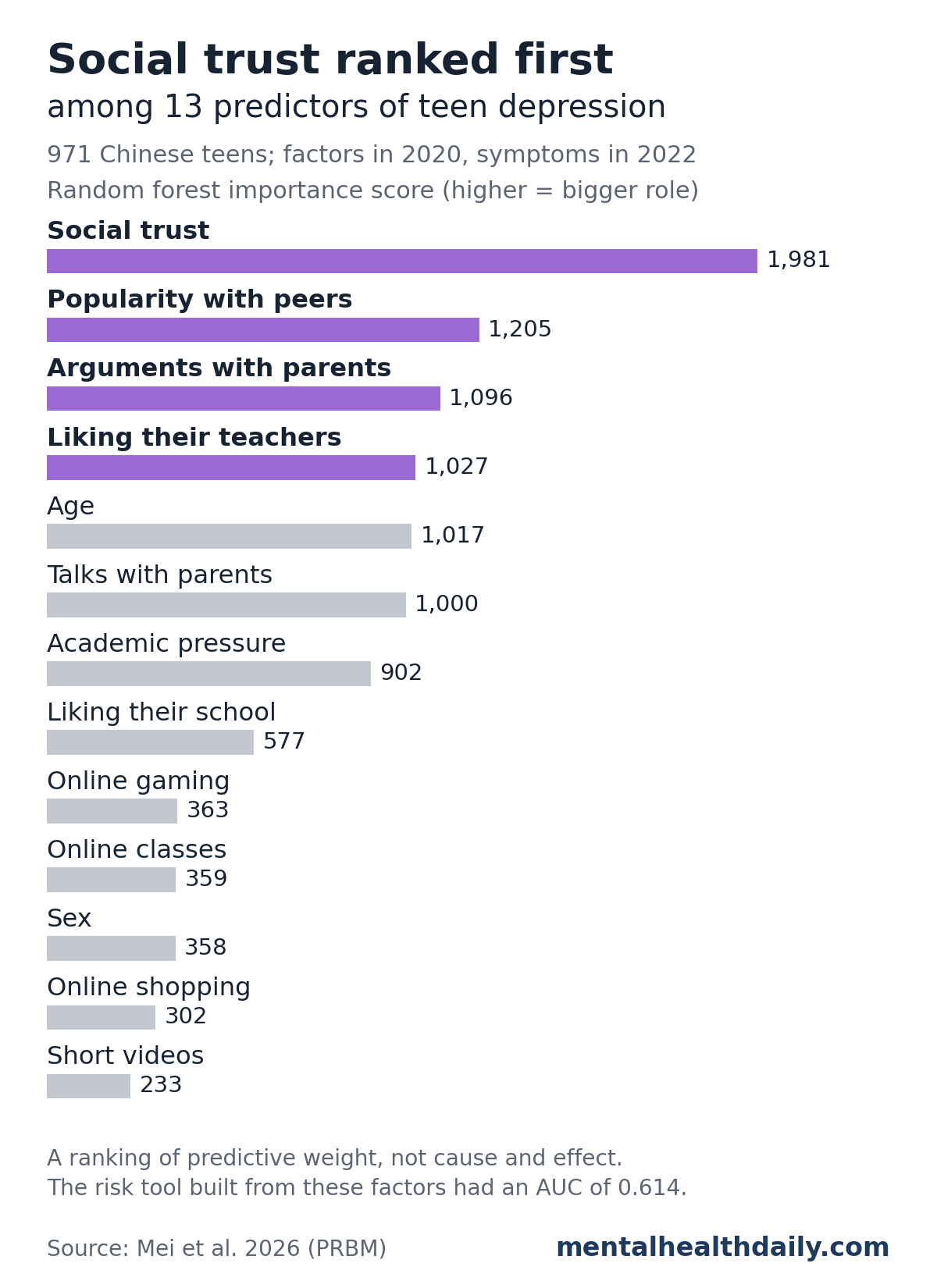
Social trust also held up in a standard regression model that weighed all the factors together: teens with higher trust scores in 2020 had lower symptom scores in 2022 (B = −0.060 per point, p = 0.002). It also ranked first on the second importance measure the team reported.1
The researchers suggest trust works as a kind of background safety net. A teen who sees the wider world as safe and predictable may cope better with stress at home and school.1
Peer popularity is a weaker result than its rank suggests. It placed 2nd on the main importance measure but 10th on the second one, and it had no link to symptoms in the regression model (B = 0.004, p = 0.949).1
One likely reason: the importance score used for the ranking is known to favor factors with many possible values, such as a 0–10 rating, over simple yes-or-no items.3 That same bias could help explain why the yes-or-no internet questions landed at the bottom.
Parent Arguments, Teacher Satisfaction and School Pressure Were Also Linked to Symptoms
In the regression model, 4 of the 11 environmental factors had significant links with 2022 symptom scores:1
- Academic pressure: each step up on a 5-point stress scale went with 0.36 points more on the 24-point CES-D8 (p < 0.001).
- Arguments with parents: each additional argument in the past month went with 0.09 points more (p = 0.005).
- Teacher satisfaction: each point higher on a 3–15 scale went with 0.13 points fewer (p = 0.041).
- Social trust: higher trust went with fewer symptoms, as described above.
Girls scored 0.8 points higher than boys, and each extra year of age added about 0.18 points. Talking with parents more often and liking one’s school had no significant link once the other factors were included.1
Online habits: none of the 4 internet items was significant in the regression. Online shopping had a small positive correlation with symptoms on its own (r = 0.08), and the researchers caution that a yes-or-no question cannot show how much shopping, or why.1
Effect size: taken together, all 13 factors explained only about 6% of the variation in 2022 symptom scores (adjusted R² = 0.063). Most of what shapes a teen’s mood was not captured by these survey items.1
The Depression Risk Chart Was Not Accurate Enough for Screening
The team also built a nomogram: a printed scoring chart in which each factor adds points, and the total converts into an estimated chance of elevated symptoms (CES-D8 of 9 or higher). Theirs used age, sex, arguments with parents, academic pressure, teacher satisfaction and social trust.1
Its accuracy was judged with the AUC (area under the curve). The AUC is the chance that a randomly chosen teen with elevated symptoms gets a higher risk score than a randomly chosen teen without them. An AUC of 0.5 is a coin flip, and 1.0 is perfect.
After correcting for overfitting by retesting the model on 1,000 resampled versions of the data, the nomogram’s AUC was 0.614. That is only modestly better than chance.1
Calibration was good. On average, the predicted risk for groups of teens matched how many actually had elevated symptoms (mean absolute error 0.011). Good calibration with weak discrimination means the chart gets group averages about right but sorts individual teens poorly.1
The chart was never tested in a separate group of teens. The researchers state plainly that it is not currently suitable for clinical screening or for deciding where to send resources.1
Other Studies Link Family Conflict, School Connection and Trust to Teen Depression
The Mei et al. results are consistent with earlier research on each of these circles of influence:
- Family conflict (China): an earlier analysis of 1,772 teens in the same national survey, followed from 2016 to 2020, found that family conflict correlated with depressive symptoms (r = 0.580). Teens’ symptoms also predicted more family conflict at later waves.4
- School connection: a 2025 meta-analysis of 27 long-term studies with 57,074 adolescents found that feeling connected to school predicted fewer later depressive symptoms, and that depressive symptoms predicted weaker school connection later on.5
- Trust (Indonesia): in a national survey of 14,227 people, weaker trust toward one’s neighborhood was linked to a higher chance of severe depressive symptoms.6
Those 2-way findings apply to the new study too. A teen who is already low may argue more at home, feel less connected at school and see other people as less trustworthy, so mood can shape the environment as well as the other way around.4,5
Limitations of This Chinese Teen Depression Study
- No baseline adjustment: 2020 depressive symptoms were not accounted for, so the study cannot show whether low trust or conflict came before the symptoms or followed from them.
- Observational design: the results show links, not cause and effect, and factors such as family income, psychiatric history and genetics were not measured.
- Heavy data loss: only 971 of the 3,360 teens in the 2020 starting pool had complete data for both waves, and survey weights were not applied, so the sample may not represent Chinese teens as a whole.
- Thin measures: several factors rested on single questions, and the internet items were yes or no, with no information on how much time teens spent online.
- Rankings depended on the method: the 2 importance measures ordered several factors differently, and the one used for the headline ranking tends to favor many-valued items.3
- No outside test: both the random forest and the nomogram were checked only within the same data.
What This Means for Parents and Schools
The environment around a teen is linked to mood. Family arguments, relationships with teachers, school pressure and a teen’s sense that people can be trusted all showed links with later symptoms. Each link was small, and the study cannot say that changing one of them would prevent depression.1
The risk chart is a research tool. With an AUC of 0.614, the nomogram would miss many teens with elevated symptoms and flag many without them. Checking on an individual teen still calls for a validated depression questionnaire and a clinician’s assessment.1
Warning signs are worth acting on. Low mood, loss of interest, poor sleep or withdrawal that lasts 2 weeks or more is worth raising with a pediatrician, school counselor or mental health professional.
References
- Mei S, Su Y, Yue J, et al. Ecological Correlates of Depressive Symptoms among Chinese Adolescents: A Random Forest and Nomogram Analysis of CFPS Data. Psychology Research and Behavior Management. 2026;19:632599. doi:10.2147/PRBM.S632599
- Lu B, Lin L, Su X. Global burden of depression or depressive symptoms in children and adolescents: a systematic review and meta-analysis. Journal of Affective Disorders. 2024;354:553–562. doi:10.1016/j.jad.2024.03.074
- Strobl C, Boulesteix AL, Zeileis A, Hothorn T. Bias in random forest variable importance measures: illustrations, sources and a solution. BMC Bioinformatics. 2007;8:25. doi:10.1186/1471-2105-8-25
- Jin Y, Liu J, Li P, et al. Longitudinal associations between family conflict, intergenerational transmission, and adolescents’ depressive symptoms: evidence from China Family Panel studies (2016–2020). Child and Adolescent Psychiatry and Mental Health. 2025;19:10. doi:10.1186/s13034-025-00866-9
- Meng X, Chen Y, Rudasill KM, et al. The reciprocal relationship between school connectedness and adolescent depressive symptoms: a meta-analytic cross-lagged panel analysis. Journal of Youth and Adolescence. 2025;54:2574–2592. doi:10.1007/s10964-025-02212-w
- Fahmi M, Panjaitan NA, Habibie I, Siregar AYM, Amarullah G, Sunjaya DK. Does your neighborhood protect you from being depressed? A study on social trust and depression in Indonesia. BMC Public Health. 2019;19:1371. doi:10.1186/s12889-019-7657-5