
The landmark experiment behind the “scarcity mindset” idea that poverty narrows attention does not show that narrowing, a 2026 reanalysis finds. The game’s rules, not a shift in players’ attention, explained why “poor” players aimed better and borrowed more.1
Research Highlights
- The accuracy edge disappeared on matched shots: “poor” players scored 2.31 vs. 1.67 points per shot over the whole game, but 2.63 vs. 2.53 on the first three shots of each level, which both groups could take (p = 0.72).1
- Over-borrowing came from opportunity: “poor” players faced the choice to borrow on 45% of levels vs. 2% for “rich” players, and when the choice came up they borrowed less often (69% vs. 100%, not quite significant).1
- A new 174-person experiment found no neglect: when both groups got the same insurance offers, “poor” players bought as much good-value insurance as “rich” players and were less likely to buy bad-value insurance (p = 0.005).1
- The original effects still replicate: the reanalysis reproduced the original results and found the same pattern in the original authors’ own 974-person replication; what fails is the attention explanation.13
- Scope: the study tests attentional “tunneling,” not the separate claim that money worries drain mental capacity, and all of it comes from online lab games.1
What the Scarcity Mindset Theory Claims
Scarcity theory, popularized in Sendhil Mullainathan and Eldar Shafir’s book Scarcity, argues that having too little of something (money, time, food) changes how anyone thinks, whatever their personality. It makes 2 main claims.1
- A bandwidth tax. Worry about scarce resources uses up mental capacity. The best-known test is a 2013 Science paper in which prompting thoughts about finances lowered test scores in lower-income but not higher-income shoppers, and farmers scored lower before harvest than after.4
- Tunneling. Scarcity focuses attention on the pressing problem. That brings some benefits, such as using scarce resources more carefully, but attention to anything outside the “tunnel,” like a loan’s interest rate or the future, gets neglected.
The new paper, by Fiona tho Pesch, Antonia Langenhoff and Mahesh Srinivasan at the University of Cologne, UC Berkeley and Stanford, targets the second claim.
According to the authors, direct evidence that scarcity both sharpens focus and causes neglect comes mainly from one study: Shah, Mullainathan and Shafir’s 2012 Science paper “Some consequences of having too little.”12 That paper has shaped books, press coverage and international poverty policy, including a World Bank report.
The “Angry Blueberries” Game
In the key experiment (Study 2), 68 online participants played a computer game, shooting blueberries at targets to earn points that raised their odds in a raffle. Each level had 7 targets, plus 3 bonus points for clearing them all.1
- “Rich” players got 150 shots, 15 per level.
- “Poor” players got 30 shots, 3 per level.
- Borrowing: half the players could borrow. Running out of shots on a level triggered automatic borrowing at 100% interest, costing 2 future shots for each extra shot.
The original results looked like tunneling. “Poor” players took longer to aim and earned more points per shot, which the authors read as greater focus. “Poor” players who could borrow also borrowed a much larger share of their budget (0.24 vs. 0.02) and did worse overall, which was read as neglect of the interest rate.12
Game Rules, Not Focus, Explained the Accuracy Gap
Each level started with 7 targets, so early shots had more to hit. Across all players, the first shot on a level scored 2.81 points on average, the third shot 1.80, and a “rich” player’s 15th shot just 0.69.1
“Poor” players without the borrowing option could only take shots 1 to 3, the most profitable ones. “Rich” players used about 5.7 shots per level, so their average was dragged down by late shots at an emptier screen. Comparing only the first three shots, which both groups took, the gap disappeared.1
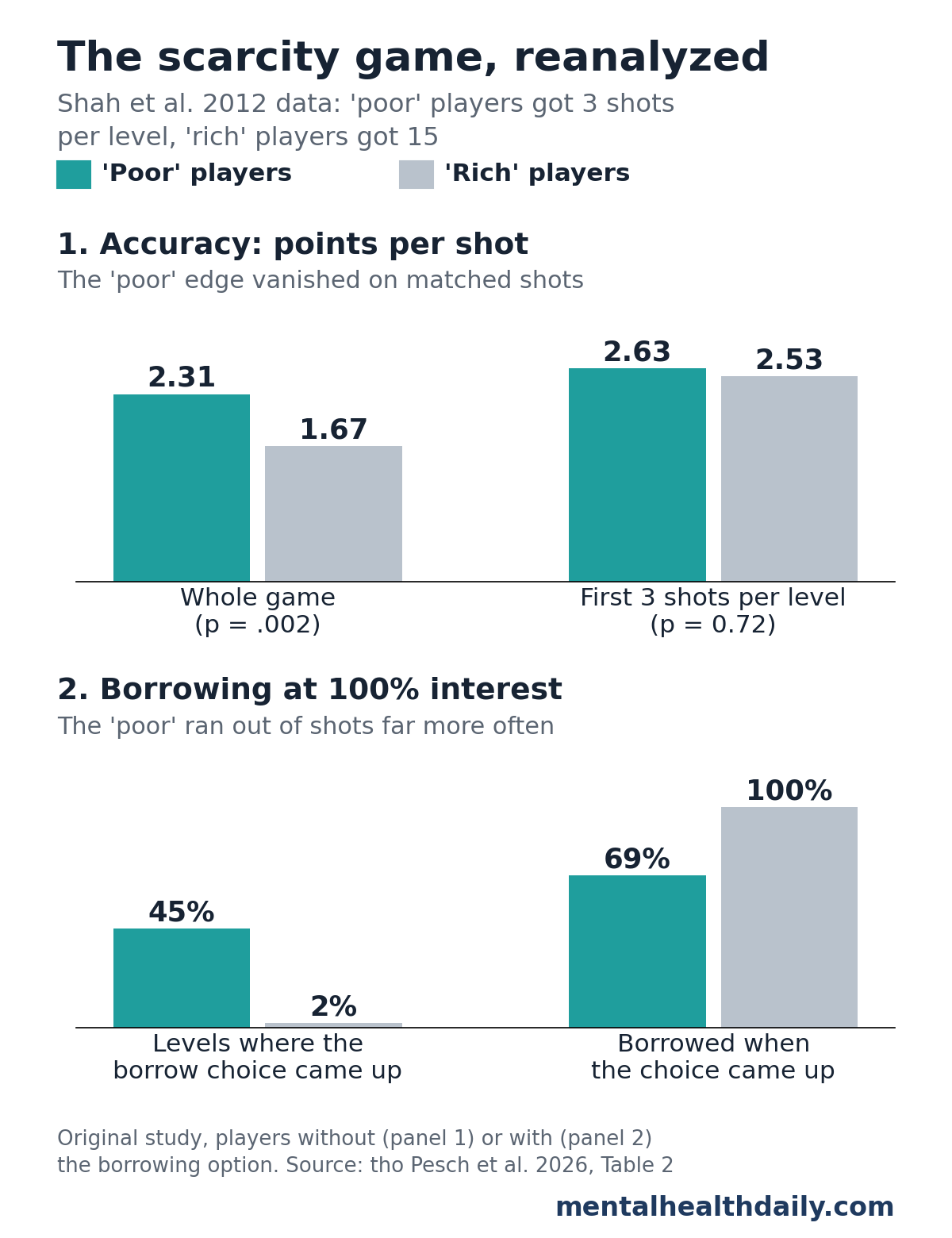
- Whole game: 2.31 vs. 1.67 points per shot (p = 0.002), as originally reported.
- First three shots averaged: 2.63 vs. 2.53 (p = 0.72).
- Each of the first three shots: no significant difference on any of them.
The original study was too small to prove the two groups were equally accurate. The original authors’ 2019 replication with about 1,000 players was large enough, and it showed no meaningful difference on those shots either.13
“Poor” players did aim longer, but that extra time did not buy better shots. The authors note it could just as well reflect hesitation as focus.
Over-Borrowing Came From More Chances to Borrow
Borrowing only kicked in after a player used up the shots for a level with targets still standing. With 3 shots per level, “poor” players hit that wall on 45% of levels; with 15, “rich” players hit it on 2%.1
When the choice actually came up, “poor” players held back in 31% of cases and “rich” players never did. That difference fell just short of significance (p = 0.052), and only 40% of “rich” players ever reached the choice, but it points the opposite way from neglect.
Borrowing hurt everyone’s score; it simply came up far more often for the “poor.”1
The original paper also reported that longer aiming went with more borrowing among “poor” players (r = 0.43), as if focus on aiming crowded out attention to interest. That held only in the subset they analyzed: levels on which “poor” players borrowed. Across everyone who could borrow, the correlation was essentially zero (r = 0.03), and it did not replicate in the 2019 study.1
Supplementary reanalyses of Studies 4 and 5 from the 2012 paper followed the same pattern. Study 1 of that paper had already failed to replicate in a large 2018 project that retested social science experiments from Nature and Science.136
A New Experiment Gave Both Groups the Same Chances
To remove the uneven opportunities, the team ran a preregistered version of the game with 174 online participants (91 “poor,” 83 “rich”). Instead of borrowing, everyone saw an insurance offer on each of the first 10 levels.1
Players could spend current shots to insure a separate field of bonus points against a 50% chance of drought. Eight offers were good value, and 2 were “scam” insurance that cost more than it could pay back. Like borrowing, insurance trades something now for something later, so tunneling predicts that “poor” players should pass up the good deals.
- Good-value insurance: “poor” players bought 4.74 of 8 offers on average and “rich” players 4.92 (p = 0.68), and an equivalence test showed the groups were statistically equivalent.
- Scam insurance: “poor” players were significantly less likely to buy it (p = 0.005).
- Original effects repeated: “poor” players again aimed longer and scored more points per shot over the whole game, and again matched “rich” players on the first three shots.
Contrary to the tunneling prediction, the players with fewer resources were, if anything, more careful with the insurance offers.1
What the Reanalysis Does and Does Not Overturn
The game results themselves hold up. Scarce shots still produced higher points per shot in the original data, the 974-player replication and the new experiment, and more borrowing in both datasets that offered loans. What fails is the explanation that scarcity made people more focused and blind to costs.1
The paper does not test the bandwidth-tax claim from the 2013 Science study, and it does not show that poverty leaves thinking unaffected.4 The wider scarcity literature has had mixed luck in replication. A 2021 audit that retested 20 scarcity studies found “considerable variability in the replicability, with some strong successes and other undeniable failures.”5
The authors also argue that tunneling is too loosely defined to test well. Without a clear rule for what sits inside or outside the tunnel, any choice that improves under scarcity can be credited to focus and any choice that gets worse to neglect.
Their alternative is more structural. People in poverty may not think differently so much as face different choices: like the “poor” players, they run short more often and so meet high-interest loans more often. That reframes over-borrowing as a problem of the options people face, not of a scarcity mindset.1
Limitations
- Lab games, not real poverty. Every study here used points in an online game, which cannot capture the stakes and complexity of real financial hardship.
- Online samples. All participants were recruited through Amazon’s MTurk, which raises data-quality questions, and the original samples were not representative of the US population.
- Smaller than planned. The new experiment preregistered 200 participants but analyzed 174 because of budget limits, and it switched from the planned multilevel analysis to the original authors’ simpler approach.
- No dropout data. The game software did not record who quit, so systematic dropout cannot be ruled out in any of the datasets.
- Narrow target. The paper addresses one paradigm and one mechanism; other scarcity effects need their own tests.
References
- tho Pesch F, Langenhoff AF, Srinivasan M. Revisiting evidence for an attentional tunneling effect caused by scarcity. Nature Communications. 2026;17:10233. doi:10.1038/s41467-026-78074-y
- Shah AK, Mullainathan S, Shafir E. Some consequences of having too little. Science. 2012;338(6107):682–685. doi:10.1126/science.1222426
- Shah AK, Mullainathan S, Shafir E. An exercise in self-replication: replicating Shah, Mullainathan, and Shafir (2012). Journal of Economic Psychology. 2019;75:102127. doi:10.1016/j.joep.2018.12.001
- Mani A, Mullainathan S, Shafir E, Zhao J. Poverty impedes cognitive function. Science. 2013;341(6149):976–980. doi:10.1126/science.1238041
- O’Donnell M, Dev AS, Antonoplis S, et al. Empirical audit and review and an assessment of evidentiary value in research on the psychological consequences of scarcity. Proceedings of the National Academy of Sciences. 2021;118(44):e2103313118. doi:10.1073/pnas.2103313118
- Camerer CF, Dreber A, Holzmeister F, et al. Evaluating the replicability of social science experiments in Nature and Science between 2010 and 2015. Nature Human Behaviour. 2018;2:637–644. doi:10.1038/s41562-018-0399-z