A Wuhan cohort of 2,210 pregnant women found that mid-pregnancy sleep disturbance was common enough to screen for and associated with several birth-outcome signals. Depressive symptoms, pre-pregnancy alcohol use, and moderate-to-severe vomiting raised sleep-disturbance odds, while higher dietary variety was protective.1
Research Highlights
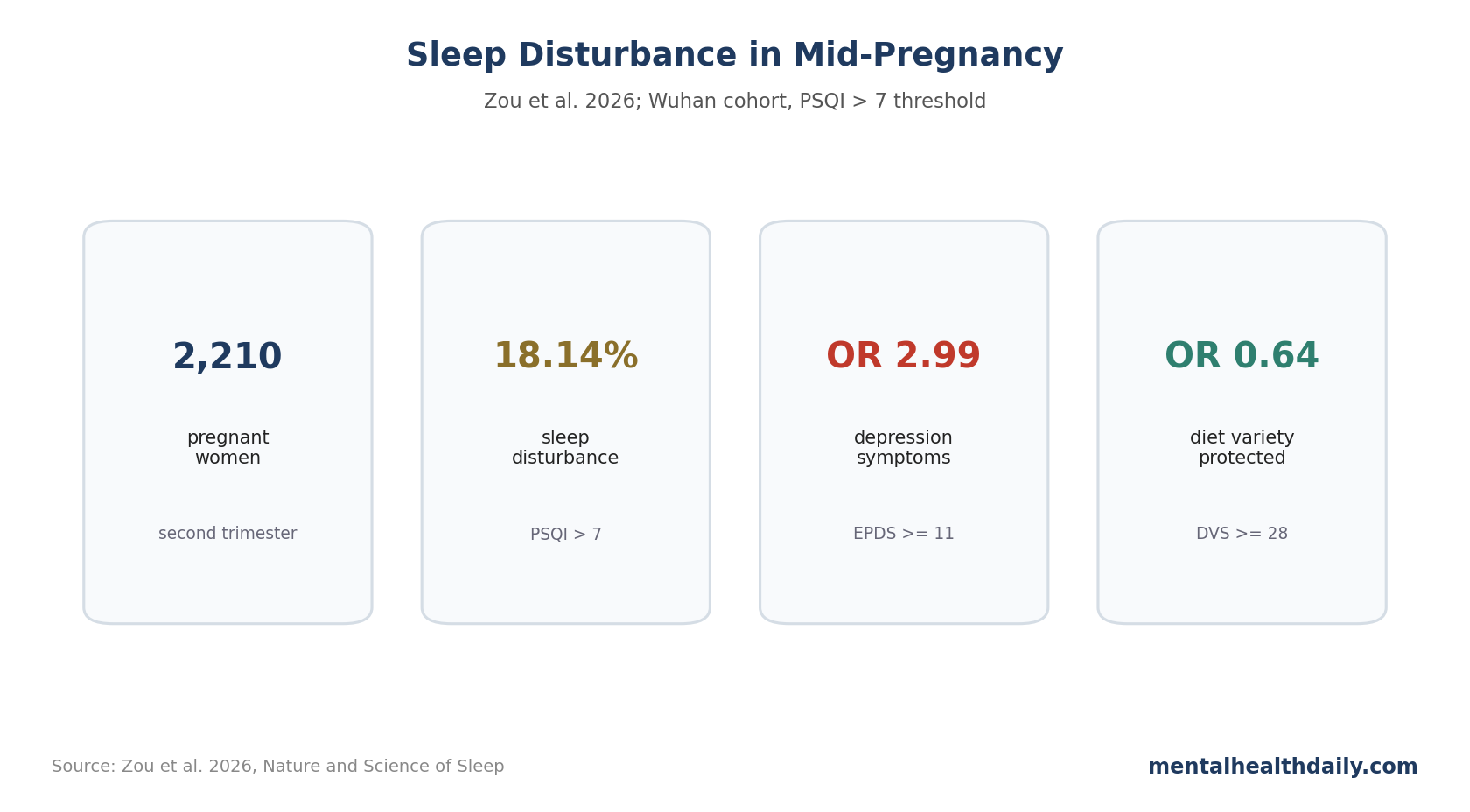
- 18.14% had sleep disturbance: Pittsburgh Sleep Quality Index (PSQI) scores greater than 7 identified sleep disturbance in 2nd-trimester pregnant women.1
- Depressive symptoms were the strongest sleep-risk factor: Edinburgh Postnatal Depression Scale (EPDS) score ≥11 was associated with sleep disturbance, OR = 2.99, p < 0.001.1
- Vomiting and alcohol history also mattered: moderate-to-severe vomiting had OR = 1.81, and pre-pregnancy alcohol consumption had OR = 1.72 for sleep disturbance.1
- Dietary variety was protective: dietary variety score ≥28 had OR = 0.64 for sleep disturbance after adjustment.1
- Birth-outcome links were mixed: sleep disturbance was associated with lower odds of large-for-gestational-age and macrosomia, plus a marginal preterm-birth signal that was more apparent in BMI ≥24 and male-fetus strata than in the full cohort.1
Pregnancy sleep research often focuses on late pregnancy, when discomfort, reflux, nocturia, and fetal movement are more obvious. Zou et al. focused on the 2nd trimester, a period early enough that screening and behavioral intervention may still change the trajectory.
2,210 Second-Trimester Pregnant Women Completed PSQI Screening
Zou et al. recruited pregnant women in Wuhan and assessed sleep quality with the Pittsburgh Sleep Quality Index (PSQI), depressive symptoms with the Edinburgh Postnatal Depression Scale (EPDS), and dietary quality with dietary variety score (DVS). Birth outcomes were collected after delivery.1
- Sample: 2,210 pregnant women with birth-outcome data.
- Sleep threshold: PSQI >7 defined sleep disturbance.
- Sleep prevalence: 18.14% met the sleep-disturbance threshold.
- Average PSQI: mean score was 5.32 with standard deviation 2.60.
The researchers excluded women with pre-pregnancy diagnosed sleep disturbance, which makes the estimate more focused on sleep problems emerging during pregnancy rather than long-standing sleep disorders.
EPDS, Vomiting, and Alcohol History Predicted Sleep Disturbance
The adjusted model identified 3 main risk factors and 1 protective factor. EPDS score ≥11 had the strongest association with sleep disturbance: OR = 2.99, p < 0.001.1
- Pre-pregnancy alcohol consumption: OR = 1.72, p = 0.021.
- Moderate-to-severe vomiting during pregnancy: OR = 1.81, p < 0.001.
- Dietary variety score ≥28: OR = 0.64, p = 0.008.
The risk-factor pattern has plausible pregnancy-specific pathways: depressive symptoms can disturb sleep timing and nighttime rumination, vomiting can wake a patient through discomfort or reflux, and low dietary variety may mark nausea, food insecurity, low appetite, or broader physiologic stress.
Birth-Outcome Associations Pointed in Several Directions
After adjustment, sleep disturbance was associated with lower odds of large-for-gestational-age infants (OR = 0.65, 95% CI 0.45-0.94, p = 0.023) and macrosomia (OR = 0.34, 95% CI 0.13-0.86, p = 0.023). There was also a marginal association with preterm birth: OR = 1.51, 95% CI 0.97-2.35, p = 0.065.1
That pattern should not be flattened into a simple claim that poor sleep worsens every birth outcome. Some associations pointed toward smaller-growth outcomes or preterm risk, while large-for-gestational-age and macrosomia moved lower.
PSQI component analyses suggested that short sleep duration carried broader adverse-outcome signals than the global PSQI category. Because several component-level estimates came from subgroup tables, they should be treated as exploratory rather than as a clean prediction rule for delivery planning.
BMI and Fetal Sex Stratified the Preterm and Low-Birth-Weight Signals
Stratified analyses suggested stronger associations in women with pre-pregnancy BMI ≥24 kg/m² and among male fetuses. In BMI ≥24, sleep disturbance was linked to preterm birth (OR = 2.54) and low birth weight (OR = 2.80), with other subgroup outcomes best treated as exploratory because the table labels require careful reading.1
Among male fetuses, sleep disturbance was associated with preterm birth (OR = 2.15), low birth weight (OR = 2.90), and small-for-gestational-age (OR = 1.58). These subgroup results are useful for hypothesis generation but should not be overused for individual prediction.
Pregnancy sleep meta-analyses already suggest that sleep quality and sleep duration are associated with adverse perinatal outcomes, but estimates vary by trimester, sleep measure, confounding control, and outcome definition.2,3
Mid-Pregnancy Screening Should Trigger Specific Support, Not Generic Sleep Advice
The risk-factor pattern points toward targeted support. If a pregnant woman screens positive for sleep disturbance, the next step should not be a generic handout about sleep hygiene alone.
EPDS screening is central because depressive symptoms had the strongest association with disturbed sleep. A high EPDS score should trigger a mental-health pathway alongside sleep-timing guidance.
Vomiting severity needs its own management. Persistent nausea and vomiting can fragment sleep through discomfort, dehydration, reflux, hunger, worry, and repeated awakenings. Treating nausea may improve sleep more than trying to force sleep in an untreated symptom environment.
Dietary variety is harder to interpret causally, but it is clinically useful. Low variety may mark nausea, food insecurity, low appetite, poor routine, or broader distress. It gives prenatal care teams another reason to ask about nutrition, meal timing, and support at home.
The screening package should be multidomain: PSQI for sleep, EPDS for depression, nausea/vomiting assessment, dietary review, exercise counseling when safe, and referral for suspected sleep apnea or severe insomnia.
- Sleep score: PSQI flags the problem but does not diagnose the mechanism.
- Mood: EPDS helps separate insomnia from depressive symptom clusters.
- Pregnancy symptoms: vomiting, reflux, pain, nocturia, and sleep-disordered breathing need their own management path.
Self-Reported Sleep Is Useful but Not the Whole Sleep Picture
The Pittsburgh Sleep Quality Index is practical in prenatal care because it is inexpensive and easy to administer. It captures subjective sleep quality, latency, duration, disturbance, efficiency, medication use, and daytime dysfunction.
It does not diagnose obstructive sleep apnea, restless legs syndrome, circadian rhythm disorder, or objective sleep fragmentation. Pregnancy can increase risk for several sleep disorders, especially when weight, nasal congestion, reflux, iron status, and blood pressure change.
A high PSQI score should open a differential diagnosis. Some women may need depression care, some need nausea control, some need sleep-apnea evaluation, and others need behavioral support around timing, light, activity, and worry.
The strength here is scale and timing. Its limitation is that questionnaire sleep cannot tell which biological sleep problem is present. Screening is the door; evaluation decides which path follows.
Mechanism check: the same PSQI elevation can reflect mood symptoms, vomiting, reflux, short sleep duration, fragmented sleep, nocturia, pain, or sleep-disordered breathing. Treating the score as a single disease would blur the pathway prenatal care needs to identify and would make follow-up less useful during a real prenatal visit in practice.
Birth-Outcome Signals Need Careful Language
The lower odds of large-for-gestational-age and macrosomia should not be framed as a benefit of poor sleep. In pregnancy epidemiology, a lower odds ratio for large size may coexist with higher risk of fetal growth restriction or preterm birth pathways, depending on context.
The more cautious interpretation is that disturbed sleep may mark altered maternal physiology, appetite, metabolic status, mood, inflammation, or pregnancy complications. The specific outcome direction can vary, so the clinical response should be improving maternal sleep and health rather than targeting infant size.
Exercise and Diet Signals Should Be Treated as Care Opportunities
Exercise during pregnancy was not a significant adjusted predictor in the main sleep-disturbance model, but the broader prenatal literature supports appropriately tailored physical activity for mood, sleep, glycemic control, and general pregnancy health when medically safe.
Dietary variety showed a protective association in this cohort. That should prompt supportive counseling, not blame. Vomiting, food aversions, income, fatigue, cultural food practices, and access all shape what a pregnant woman can realistically eat.
Second-Trimester Timing Makes the Finding More Actionable
The second trimester is late enough for pregnancy-specific symptoms to be present but early enough for care teams to intervene before delivery. That timing is one reason this cohort is clinically useful.
If sleep disturbance is identified only in late pregnancy, there may be little time to change depression treatment, nausea control, sleep positioning, activity routines, nutrition, or sleep-disorder evaluation. Mid-pregnancy screening creates a longer runway.
Because sleep, mood, vomiting, and diet often interact, prenatal visits should avoid treating each complaint as a separate silo. A single integrated check can reveal whether sleep is the symptom, the driver, or both.
Questions About Sleep Disturbance in Mid-Pregnancy
Should PSQI screening be paired with depression screening?
Yes. In this study, EPDS ≥11 was the strongest sleep-disturbance correlate. Pairing sleep and depression screening is more informative than treating insomnia as a standalone complaint.
Does poor sleep cause preterm birth?
No. The study supports an association, especially in some strata, but it cannot prove that poor sleep caused preterm birth because residual confounding and self-reported sleep measurement remain important limitations.
What interventions make sense?
Low-risk first steps include depression screening, nausea/vomiting management, sleep timing regularity, exercise when medically appropriate, dietary support, and targeted referral for severe insomnia or suspected sleep apnea.
References
- Factors affecting sleep quality in pregnant women during mid-pregnancy and its association with birth outcomes. Zou et al. doi:10.2147/nss.s573867
- Sleep quality during pregnancy: a meta-analysis. Sedov et al. doi:10.1016/j.smrv.2017.06.005
- Sleep quality, sleep duration, and pregnancy outcomes. PubMed search. PubMed search
- EPDS, sleep disturbance, and pregnancy depression. PubMed search. PubMed search