hit counter

Esketamine Failed Cost-Effectiveness vs. Cheaper TRD Options at $50K/QALY

Photoreal illustration of a depression-treatment decision with cost and outcome imagery, conveying healthcare-economic decision-making.

Intranasal esketamine — FDA-approved for treatment-resistant depression in 2019 — failed cost-effectiveness benchmarks against four cheaper third-line options in a 2026 Hong Kong modeling study, with incremental cost-effectiveness ratios (ICERs) of US$134,127 to US$312,750 per quality-adjusted life-year (QALY) at a US$50,000/QALY willingness-to-pay (WTP) threshold.1 Combination antidepressant therapy was the most cost-effective strategy modeled. Research Highlights …

Read more

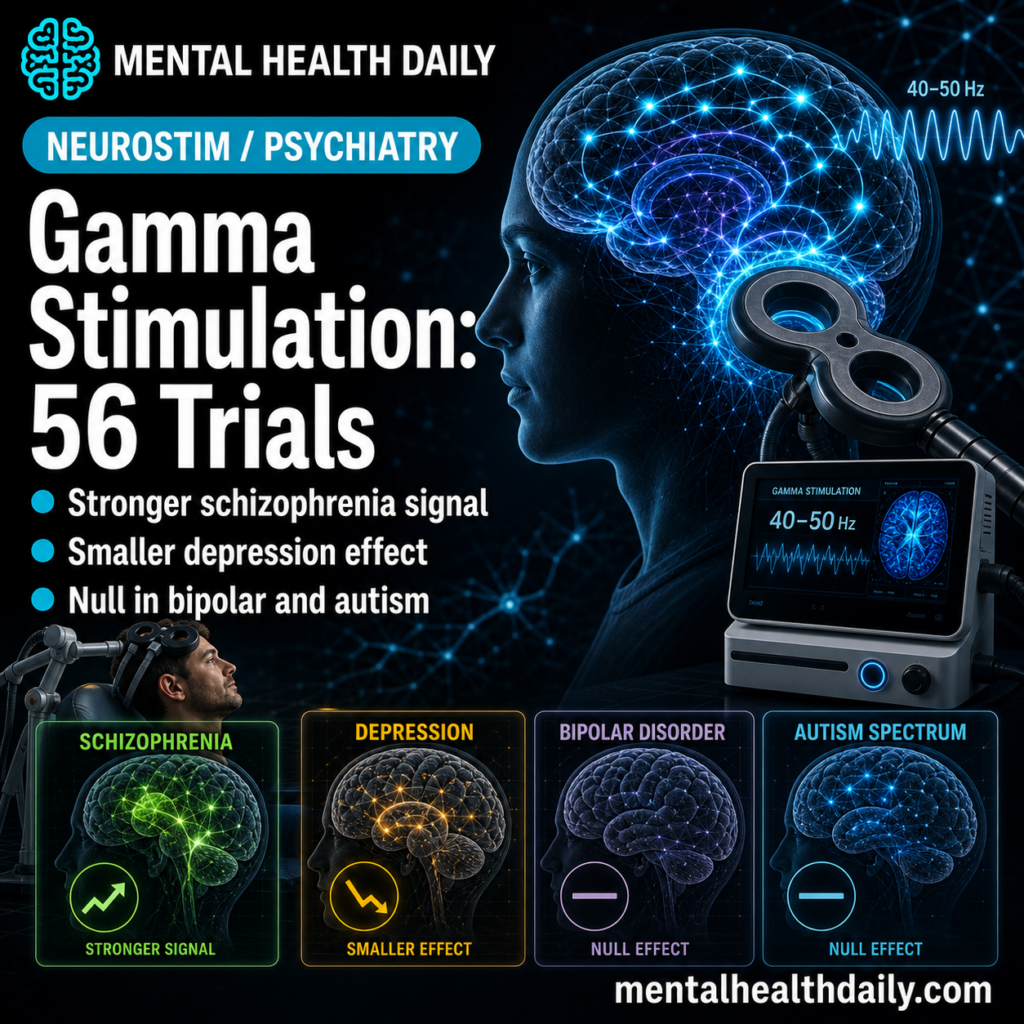
Gamma Brain Stimulation Helps Schizophrenia More Than Depression

Photoreal illustration of gamma-frequency brain stimulation showing TMS coil and oscillation waveforms in 30-50 Hz range over a brain.

A 2026 meta-analysis of 56 controlled trials found the clearest gamma-frequency neuromodulation signal in schizophrenia: overall symptoms improved vs. control (g = −0.46), global cognition improved (g = 0.55), and MDD showed a smaller depression effect than the schizophrenia symptom estimate (g = −0.34). Bipolar disorder and autism stayed directional but nonsignificant, and the paper’s …

Read more

Personalized TMS for Psychiatric Disorders: Targeting Functional Connectivity (FC) in the Brain (2024 Review)

Transcranial Magnetic Stimulation (TMS) has emerged as a beacon of hope in the realm of psychiatry, offering a non-invasive alternative for treating psychiatric disorders. The variability in treatment outcomes highlights the necessity for advancements in personalized approaches. A recent paper analyzed the potential of personalized TMS protocols (customized based on individual brain connectivity) may help …

Read more

Repetitive TMS for Alzheimer’s Disease Alters Brain Waves & Enhances Cognition (2024 Study)

Repetitive transcranial magnetic stimulation (rTMS) is making waves in the field of Alzheimer’s disease (AD) research, offering a glimmer of hope for enhancing cognitive functions in patients. By targeting specific brain regions, rTMS has shown promising results in modulating neural activity and improving cognitive scores. This innovative therapy, coupled with real-time monitoring through electroencephalography (EEG), …

Read more

Accelerated TMS for Depression: Is aTMS More Effective than Standard TMS? (2024 Review)

Depression, a common yet severe mood disorder, affects millions worldwide, posing significant challenges in both diagnosis and treatment. Recent advancements have led to the development of accelerated transcranial magnetic stimulation (aTMS), a novel approach aiming to offer rapid relief for individuals suffering from major depressive disorder (MDD). This revolutionary technique has shown promising results, potentially …

Read more

Symptom Provocation in Psychiatric Disorders: TMS, EEG, Neural Circuits for Personalized Treatment (2023 Review)

Symptom provocation, a cornerstone of psychiatric research and therapy, offers a fascinating glimpse into the intricate relationship between brain activity and psychiatric symptoms. By deliberately triggering symptoms, researchers and clinicians can identify neurophysiological biomarkers and target them with personalized therapies, such as transcranial magnetic stimulation (TMS). This technique not only enhances our understanding of psychiatric …

Read more

Customized Transcranial Magnetic Stimulation (TMS) Protocols for Depression & Psychiatric Disorders Based on Personalized Neuroimaging (2023 Evidence)

Recent advancements in neuroimaging and brain stimulation techniques, particularly Transcranial Magnetic Stimulation (TMS), are revolutionizing the treatment of psychiatric disorders. These technologies, leveraging our understanding of individual brain network architectures, offer the potential for highly personalized treatments. Highlights: Personalization of Treatment: Neuroimaging advancements allow for the personalization of brain stimulation targets, particularly in Transcranial Magnetic …

Read more