hit counter

Transcranial Temporal Interference Stimulation (tTIS) May Improve Parkinson’s Motor Symptoms
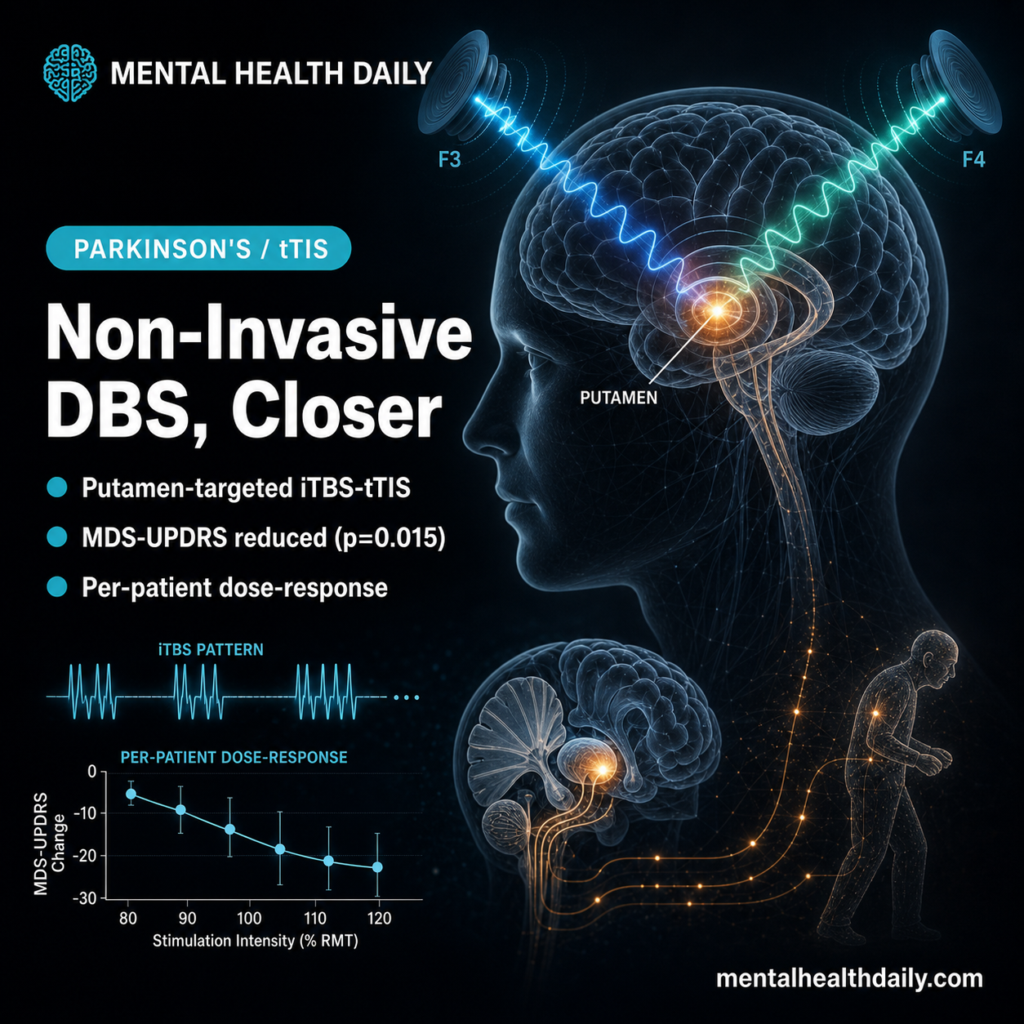
Photoreal illustration of two interfering electric fields converging at deep brain regions, conveying non-invasive deep stimulation in Parkinson's.

Deep brain stimulation works for Parkinson’s, but it requires implanted electrodes. A 2026 randomized crossover trial by Stalter and colleagues tested whether transcranial temporal interference stimulation — a non-invasive technique designed to reach deep targets without exciting overlying cortex — can move the needle on motor symptoms when aimed at the putamen.1 Research Highlights Transcranial …
Read more

Parkinson’s Disease Prevention: Prodromal Symptoms, RBD, Early Intervention Trials

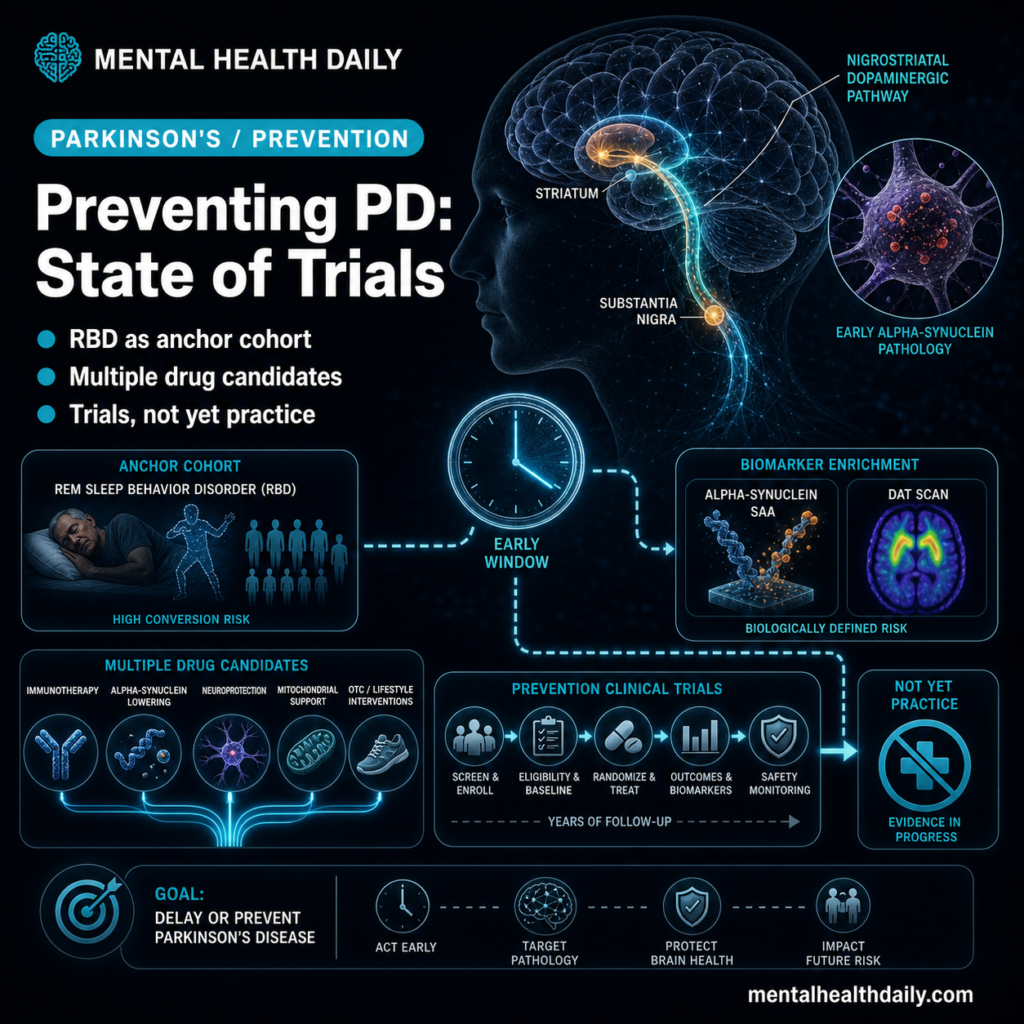
Photoreal illustration of a brain with prodromal pathology and a clock indicating early-window intervention opportunity for Parkinson's prevention.

Parkinson’s disease has a years-to-decades prodromal stage where motor symptoms haven’t yet emerged but pathology is accumulating. A 2026 review by Schaeffer et al. synthesizes the case for (and limits of) intervening during this window — with implications for high-risk individuals weighing whether to enter preventive trials.1 Research Highlights Prodromal Parkinson’s disease is the period …

Read more

GLP-1 Drugs for Parkinson’s: Lixisenatide Signal, Exenatide Miss

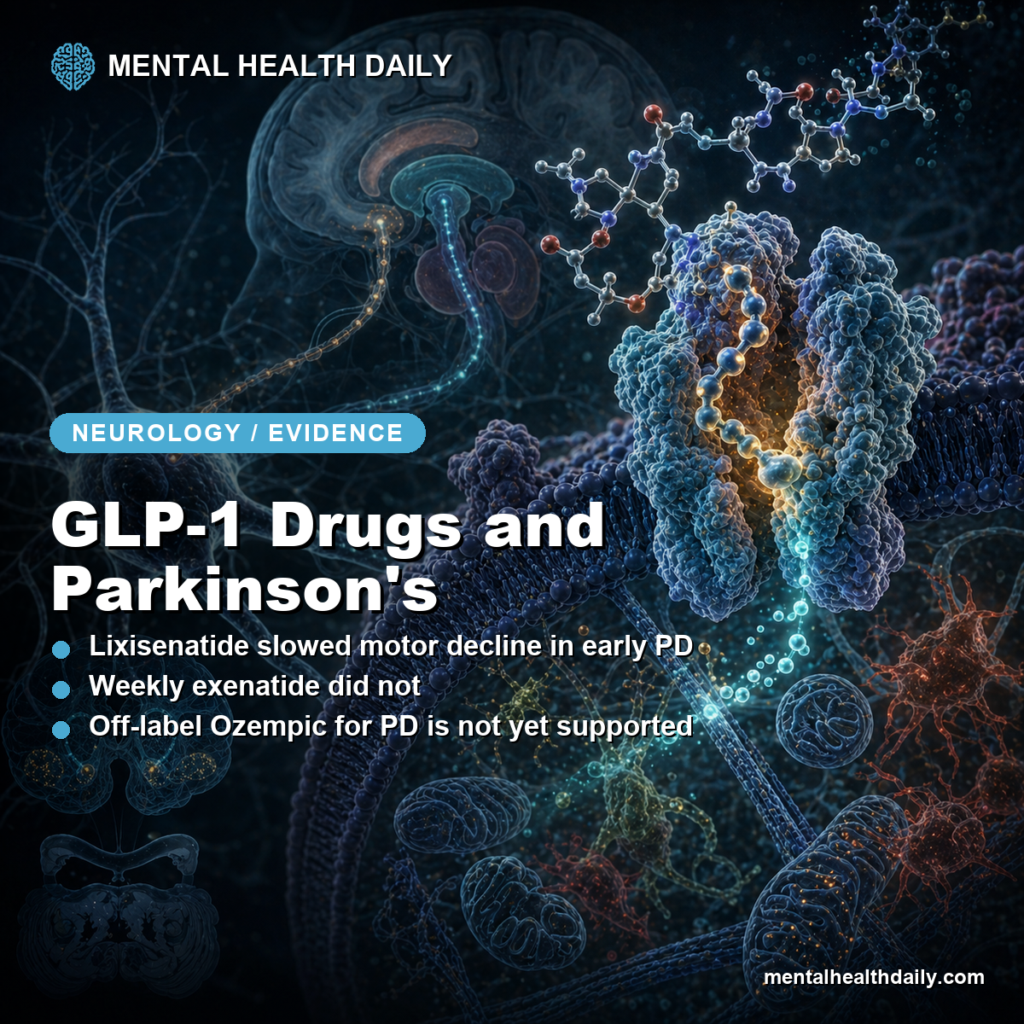
Stylized illustration representing GLP-1 receptor agonists being investigated as potential disease-modifying treatments for Parkinson's disease.

Parkinson’s disease is the second most common neurodegenerative disorder, affecting around 10 million people worldwide. The mental-health burden is heavy: depression affects 40-50% of patients9, anxiety 30-40%, sleep disorders most patients eventually, and dementia about a third of long-duration cases. Standard treatment with levodopa controls motor symptoms but doesn’t slow the underlying neurodegeneration. The clinical …

Read more

BDNF Gene Transfection & Pramiprexole Combo Effectively Treat Parkinson’s Disease in Rat Models (2024 Study)

Parkinson’s disease (PD), a degenerative disorder that predominantly affects the motor system, has long been a challenging condition to manage due to its complex pathology and the limited efficacy of available treatments. However, recent research presents a beacon of hope through a novel combined therapy targeting the core of Parkinson’s disease’s neuronal degradation. This innovative …

Read more

Vitamin D for Prevention & Treatment of Parkinson’s Disease? (2023 Research)

Parkinson’s disease (PD), a prevalent neurodegenerative brain disease, is marked by the loss of dopaminergic neurons in the substantia nigra. Recent research has illuminated the significant role of Vitamin D (VD) in the brain, particularly its neuroprotective effects on these neurons. Highlights: Vitamin D’s Role in the Brain: Beyond its well-known functions in bone health, …

Read more

BPC-157 Peptide for Neurological & CNS Disorders: Preliminary Research

BPC 157, a stable gastric pentadecapeptide, has recently emerged as a promising therapeutic agent due to its multifaceted role in treating various central nervous system disorders. Its ability to mitigate conditions like stroke, schizophrenia, and spinal cord injuries while promoting neural recovery and functional improvement is capturing the interest of the medical community. Highlights: BPC …

Read more

Parkinsons Disease Diagnosis Years in Advance? Retinal Thinning via Optical Coherence Tomography (OCT)

Recent research provides evidence that Parkinson’s disease (PD) is associated with thinning of specific retinal layers that can be detected years before diagnosis. Key facts: Individuals with Parkinson’s disease (PD) had thinner retinal ganglion cell and inner plexiform layers compared to controls. Thinning of the inner nuclear layer, which contains dopamine cells, was also seen …

Read more