hit counter

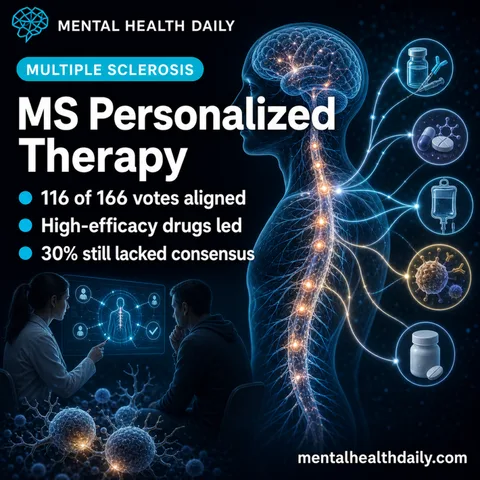
Multiple Sclerosis Personalized Therapy: 70% Delphi Consensus

MHD featured image for personalized multiple sclerosis therapy consensus.

An Italian multiple sclerosis Delphi panel reached consensus on 116 of 166 votes, meaning 70% of expert votes aligned and 30% still exposed disagreement about personalized therapy, patient involvement, and treatment sequencing.1 The result supports individualized MS treatment planning, but it is consensus evidence rather than proof that one disease-modifying therapy fits every high-risk patient. …

Read more

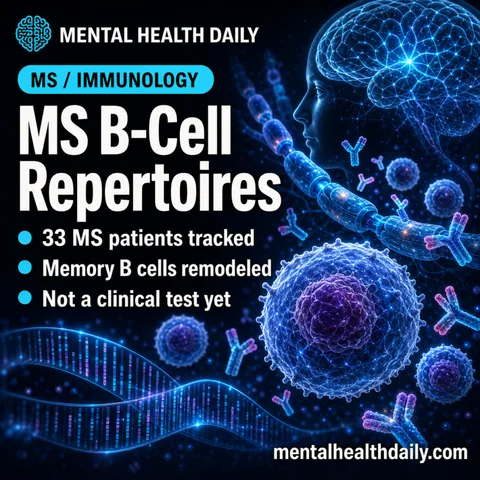
Multiple Sclerosis B-Cell Repertoires Shift After DMD Treatment

MHD featured image for multiple sclerosis, B-cell repertoires, and disease-modifying therapy effects.

A 2026 Journal of Neuroinflammation study involving 33 people with multiple sclerosis and 10 healthy controls found disease-specific B-cell repertoire signatures even when ordinary B-cell subset counts looked modest, then showed that most disease-modifying therapies shifted repertoire diversity after 6 months. Research Highlights Repertoire sequencing found MS signal: Vasilenko et al. analyzed more than 196,100,000 …

Read more

REDDI MEG Classifier Separated 4 Neurodegenerative Diseases at 0.81

MHD featured image for REDDI MEG differential diagnosis research.

A 2026 medRxiv preprint found that REDDI, a resting-state magnetoencephalography machine-learning pipeline, separated mild cognitive impairment, multiple sclerosis, Parkinson’s disease, and amyotrophic lateral sclerosis with 0.81 ± 0.04 balanced accuracy across 5 folds.1 That is a meaningful jump over the prior 67.1% MEG benchmark, but it is still research-stage decision support rather than a clinical …

Read more

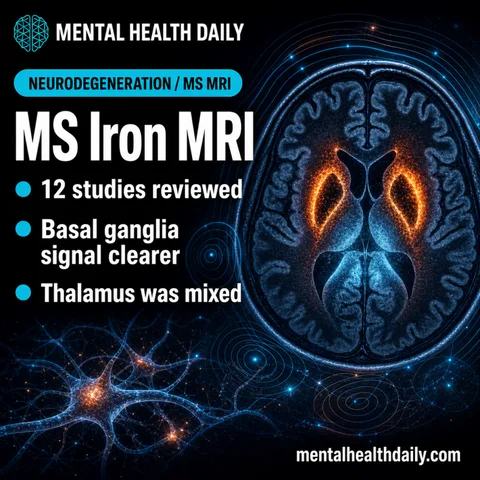
Multiple Sclerosis Iron MRI Linked to Cognitive Impairment in 12 Studies

MHD featured image for multiple sclerosis, iron-sensitive MRI, and cognitive impairment.

A 2026 systematic review of advanced neuroimaging in multiple sclerosis narrowed 600 database records to 12 studies and found the clearest cognition signal in basal ganglia iron-sensitive MRI measures, while thalamic susceptibility was more variable and often tangled with atrophy. Research Highlights Basal ganglia signal was strongest: across 12 studies, elevated susceptibility or iron-related metrics …

Read more

Multiple Sclerosis Frailty Exercise Improved Fatigue in 6 Weeks

MHD featured image for multimodal exercise, frailty, fatigue, and quality of life in multiple sclerosis.

A 2026 pilot randomized trial in 16 frail adults with multiple sclerosis found that 6 weeks of supervised multimodal exercise was feasible: retention was 87.5%, adherence was 97.2%, no adverse events were recorded, and fatigue and quality-of-life scores moved more than they did with waitlist control.1 Research Highlights Feasibility cleared the prespecified bar: 14 of …

Read more

Serum MOG Blood Biomarker Rose During Multiple Sclerosis Relapse

MHD featured image for serum MOG blood biomarker levels and multiple sclerosis relapse activity.

A 2026 medRxiv case-control study found that serum myelin oligodendrocyte glycoprotein was 20.5 pg/ml higher in multiple sclerosis than in healthy donors and 15.3 pg/ml higher during relapse than remission, making it a plausible blood marker of demyelination rather than a replacement for neurofilament light chain. Research Highlights MOG was higher in MS: serum myelin …

Read more

sCD27 Biomarker Flags Autoimmune Disease in Severe Psychiatric Disorders

MHD featured image for sCD27, autoimmune disease, severe psychiatric disorders, and neuroinflammation biomarker triage.

A 2026 immunopsychiatry cohort study found that soluble CD27 (sCD27), a marker of T-cell activation, was positive in cerebrospinal fluid in 23% of severe psychiatric patients selected for suspected immune involvement and in 88% of multiple sclerosis patients used as a positive-control group. In the psychiatric cohort, combined cerebrospinal fluid or blood sCD27 positivity was …

Read more