hit counter

Methylphenidate Reduced Dishonesty and Cheating in 151 Adults; Atomoxetine Had No Effect

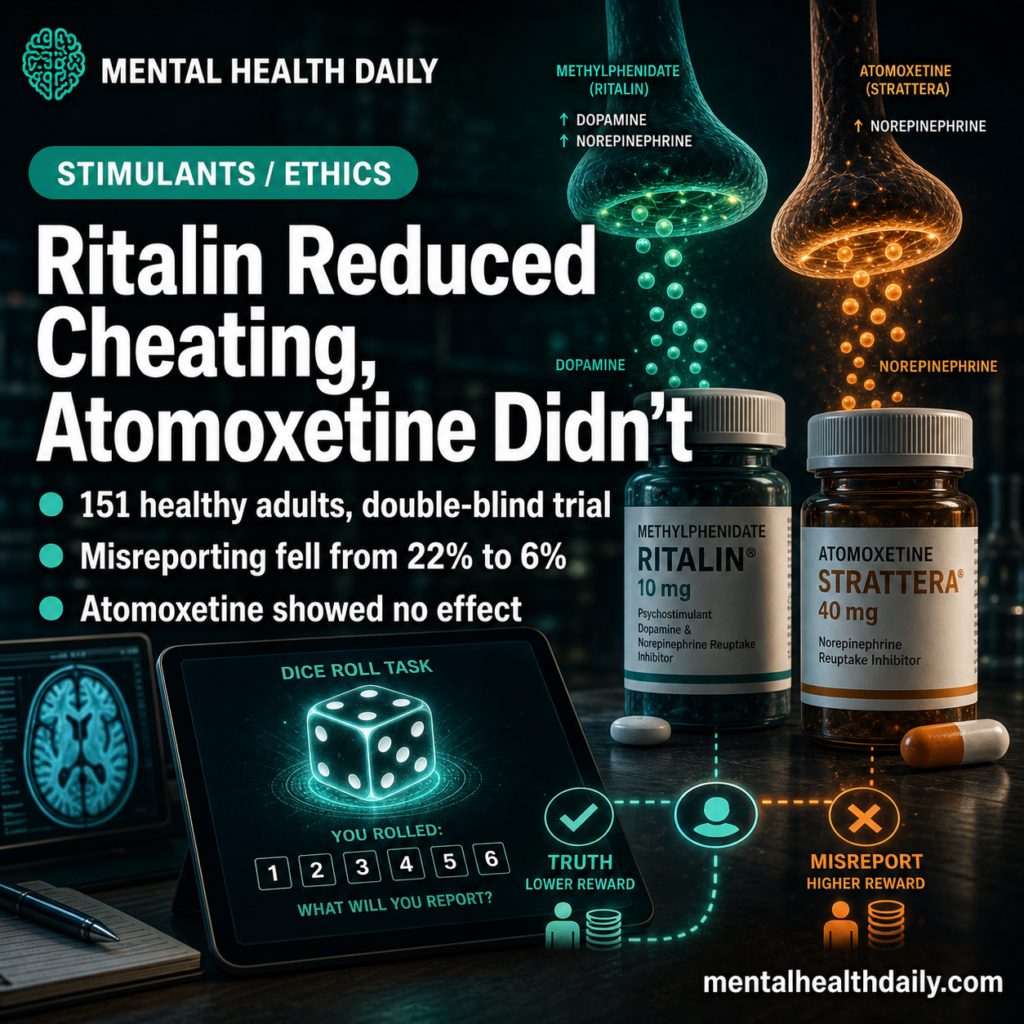
Editorial card showing methylphenidate molecular structure beside a die-rolling task, illustrating a counterintuitive randomized-trial result.

A 2026 double-blind randomized controlled trial by Kappes et al. in Psychopharmacology found something the smart-drug users likely wouldn’t have predicted: a single 30 mg dose of methylphenidate reduced dishonest misreporting on a die-rolling task from ~22% of trials in the placebo arm to ~6% (in the methylphenidate arm).1 Atomoxetine, a noradrenergic comparator, had no …

Read more

Cognitive Enhancement Effects of Caffeine, Methylphenidate, Modafinil (Study)

In the pursuit of peak mental performance, scientific studies have explored the effects of stimulants like methylphenidate, modafinil, and caffeine on cognitive functions such as memory and attention. Recent research utilizing advanced neuroimaging techniques has begun to unravel the intricate ways these substances modulate brain activity and connectivity, offering insights into their potential as cognitive …

Read more

How Long Does Ritalin Stay In Your System?

Ritalin is a psychostimulant drug used medically for the treatment of attention-deficit/hyperactivity disorder (ADHD) and narcolepsy.  It contains the active ingredient methylphenidate, which functions as a catecholamine reuptake inhibitor, primarily of dopamine (DAT) and norepinephrine (NET) transporters.  This reuptake inhibition (NDRI) facilitates increases in extracellular dopamine and norepinephrine concentrations, thereby substantially enhancing neurophysiological arousal. Upon …

Read more

Concerta vs. Vyvanse: Comparison

Methylphenidate is considered the first medication approved for the treatment of the condition known as “hyperactivity” in the 1960s.  As attention-deficit/hyperactivity disorder gained more mainstream attention in the 1990s, the number of diagnoses continued to skyrocket, increasing the demand for new treatments.  By the year 1996, mixed amphetamine salts (i.e. Adderall) were approved for the …

Read more

Ritalin vs. Adderall: Comparison

From a historical perspective, one of the most popular ADHD medications of all time is Ritalin.  It was first approved by the FDA in 1955 for treating a condition referred to as “hyperactivity.”  While there weren’t many diagnoses for hyperactivity in the 1950s, the number of diagnoses skyrocketed in the 1990s, making Ritalin the single …

Read more

Stimulant Psychosis: Causes, Symptoms, & Treatment

Psychosis is often defined as a loss of contact with reality and is generally considered a common symptom of severe mental illness like schizophrenia.  Individuals experiencing psychosis may end up dealing with hallucinations (auditory and/or visual), delusions (beliefs with no basis in reality), and an array of other symptoms.  While schizophrenia is generally a root …

Read more

Norepinephrine-Dopamine Reuptake Inhibitors (NDRIs) List

Norepinephrine Dopamine Reuptake Inhibitors (NDRIs) are drugs that function by inhibiting the reuptake of the neurotransmitters norepinephrine and dopamine. This leads to increased neural concentrations of these activating neurotransmitters, resulting in increased stimulation of the central nervous system.  Certain NDRIs inhibit reuptake of norepinephrine to a greater extent than dopamine (and vice versa). Others may have …

Read more