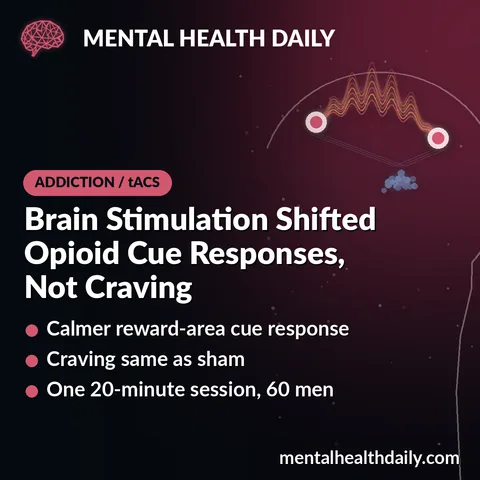
One Session of tACS Changed Opioid-Cue Brain Activity but Not Craving
In 60 men with opioid use disorder, one tACS session changed cue-related brain activity and network coupling. Craving did not differ from sham.
Read article Mental Health DailyResearch. Evidence. Perspective.
Published research on brain stimulation.
In 60 men with opioid use disorder, one tACS session changed cue-related brain activity and network coupling. Craving did not differ from sham.
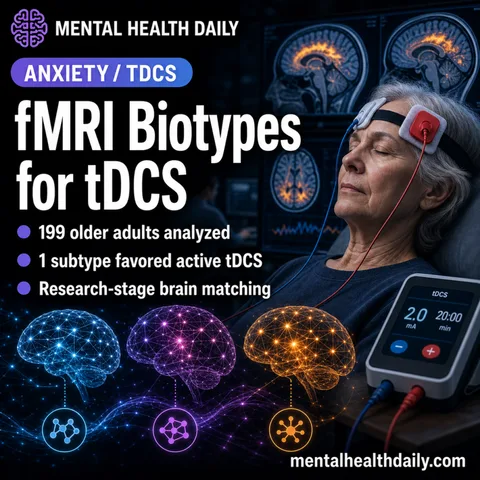
Read articleA 2026 BETA analysis of 199 older adults found that resting-state fMRI could separate 4 anxiety-related tDCS response patterns, but the result was narrower than “brain scan predicts treatmen…
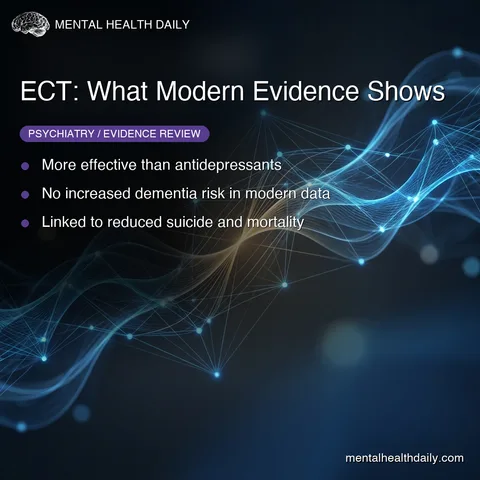
Read articleModern administrative cohorts find no dementia signal for ECT and link it to lower suicide and mortality. The supportive literature carries known biases worth flagging.
Read articleDeep Brain Stimulation (DBS) for Treatment-Resistant Depression (TRD) explores the cutting-edge intersection of technology and neuroscience, offering hope to those for whom traditional treat…
Read articleIn the quest to effectively treat insomnia, a condition plaguing millions worldwide, scientists are exploring innovative treatments beyond traditional medication. Transcranial Direct Current…
Read articleRecent advancements in neuroimaging and brain stimulation techniques, particularly Transcranial Magnetic Stimulation (TMS), are revolutionizing the treatment of psychiatric disorders. These …
Read articleNon-invasive brain stimulation (NIBS) presents a promising frontier for treating bipolar disorder, offering potential alternatives or adjuncts to conventional pharmacotherapy. Emerging evide…
Read article