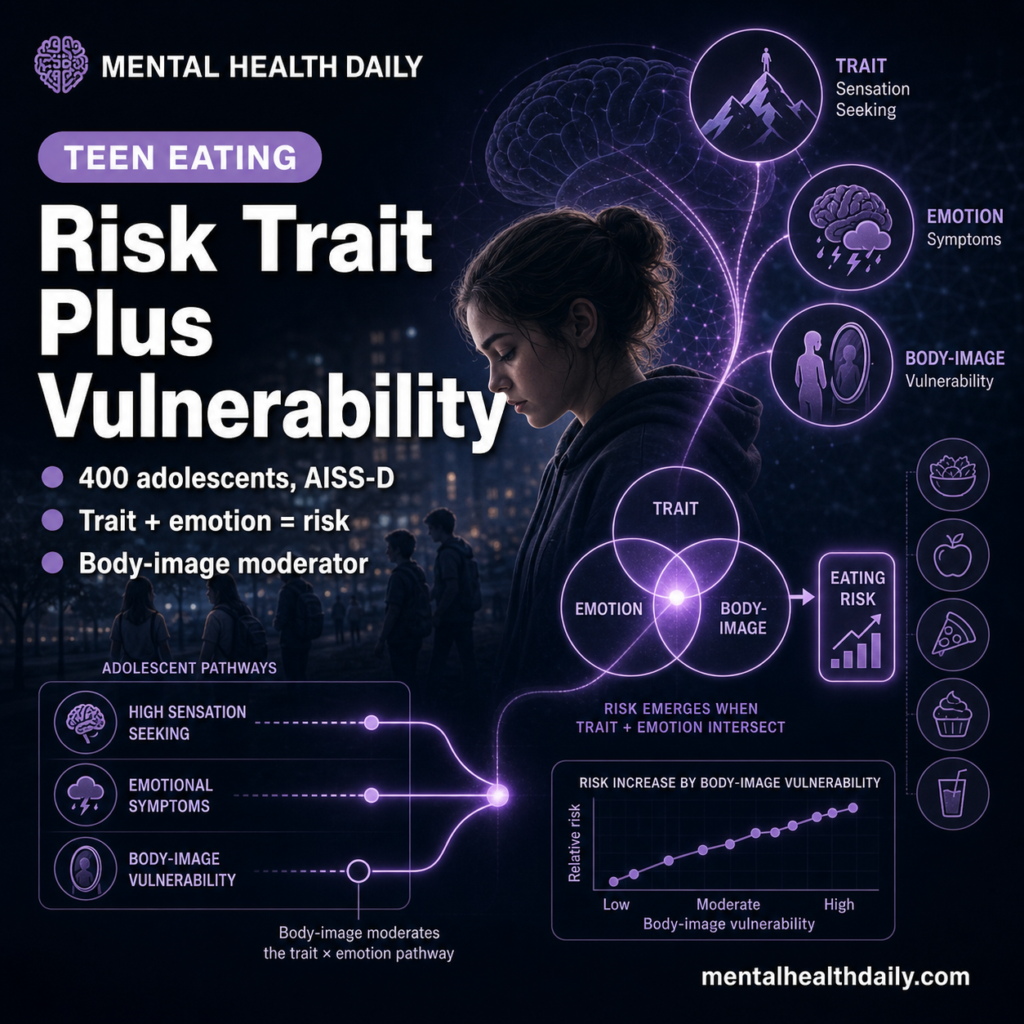
Sensation seeking has long been linked to risky behaviors in teens, but its role in eating-disorder psychopathology has been mixed. A 2026 study by Bogner and colleagues clarifies the picture in 400 German adolescents: sensation seeking matters for disordered eating, but the effects are moderated by weight status and emotional symptoms.1
Research Highlights
- Sensation seeking is a personality trait describing the pursuit of varied, novel, complex, and intense sensations and experiences, and willingness to take risks to obtain them. It peaks at around age 19 and follows an inverted-U pattern across adolescence.2
- The Bogner 2026 study assessed 400 healthy German adolescents (ages 13–15, 52% female) using the Arnett Inventory of Sensation Seeking (AISS-D) and the Eating Disorder Examination Questionnaire for Children (ChEDE-Q).1
- Higher sensation seeking was associated with more dietary restraint (b = 0.13, p adj = 0.03) and substantially more episodes of overeating (b = 0.78, p adj < 0.01) after adjusting for age, sex, and socioeconomic status.1
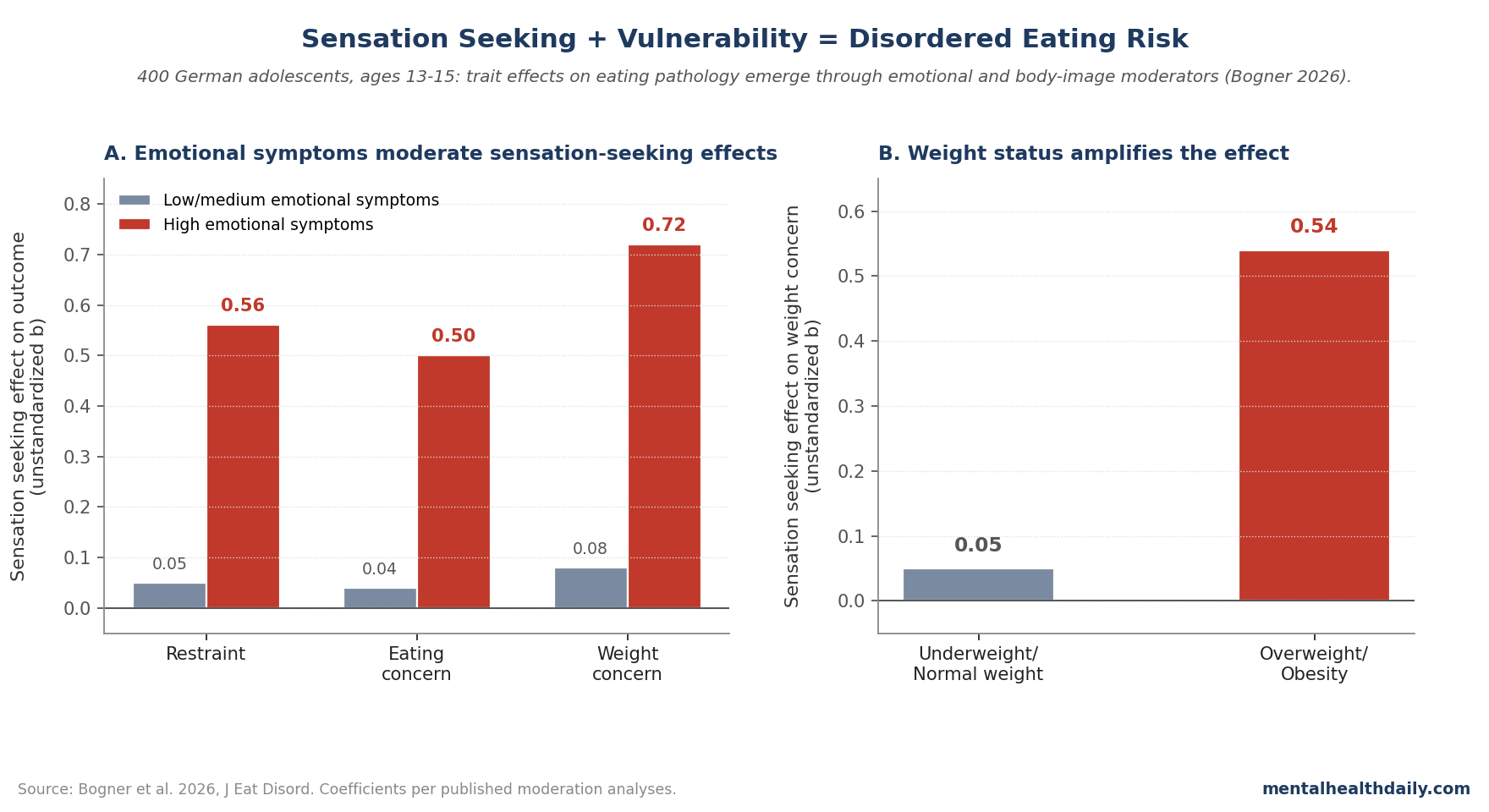
- Effects were moderated by weight status and emotional symptoms. In adolescents with overweight or obesity, sensation seeking strongly predicted weight concerns; in adolescents with high emotional symptoms, sensation seeking predicted multiple eating-disorder dimensions including restraint, eating concern, and weight concern.1
- The pattern fits an emotion-driven sensation-seeking model. Sensation seeking alone is not strongly disorder-driving in healthy-weight adolescents without emotional difficulties; the trait becomes risky when it interacts with body-image stress or affective vulnerability.1
Eating disorders rank among the most lethal psychiatric conditions in adolescents and have rising incidence globally. Identifying which personality and behavioral traits increase risk — and which moderating factors transform a trait from neutral to pathogenic — is central to early intervention.3,4
Prior work has linked sensation seeking to binge eating in young adults but produced mixed findings in adolescents, partly because sensation seeking has been studied largely as a single construct rather than in combination with other vulnerability factors.
This Bogner study addresses this by testing weight status and emotional symptoms as moderators.
Bogner 2026: 400 Adolescents, AISS-D, ChEDE-Q, SDQ
The trigger paper recruited 400 German 13- to 15-year-olds from a community sample. Mean age was 14.7, with roughly equal sex distribution. Most participants had normal weight (68%); 24% had overweight or obesity; 8% had underweight (analyzed with normal-weight peers).1
Three core measures:
- Arnett Inventory of Sensation Seeking (AISS-D): 12-item adolescent version with intensity and novelty subscales. Score combined into a total score (TS).
- Eating Disorder Examination-Questionnaire for Children (ChEDE-Q): Assessed restraint, eating concern, weight concern, shape concern, plus diagnostic-symptom items including overeating episodes, loss-of-control (LOC) eating, and binge-eating episodes.
- Strengths and Difficulties Questionnaire (SDQ): Used to characterize emotional symptoms, conduct problems, hyperactivity/inattention, and peer-relationship difficulties.
All analyses controlled for age, sex, and socioeconomic status. Multiple comparisons were corrected via Benjamini-Hochberg.
The Main-Effect Findings: Restraint and Overeating
Two robust associations survived multiple-comparison correction:
- Sensation seeking predicted more dietary restraint (b = 0.13, p adj = 0.03). Adolescents higher on sensation seeking were more likely to attempt food restriction — a counterintuitive but replicable finding in eating-disorder literature, where dietary restraint operates as both a coping behavior and a precursor to binge episodes.5
- Sensation seeking predicted more overeating episodes (b = 0.78, p adj < 0.01). The effect on overeating was the strongest in absolute magnitude in the dataset.
Associations with eating concern, weight concern, shape concern, LOC eating, and binge-eating episodes trended in the same direction but didn’t survive multiple-comparison correction.
This is consistent with sensation seeking being one piece of a broader risk profile rather than a single dominant factor.1
The Critical Moderation: Emotional Symptoms
The most clinically informative finding wasn’t the main effect — it was the moderation by emotional symptoms.1
In adolescents with high SDQ emotional-symptom scores, sensation seeking was significantly associated with:
- Restraint (b = 0.56, f2 = 0.10, p adj < 0.01)
- Eating concern (b = 0.50, f2 = 0.19, p adj < 0.001)
- Weight concern (b = 0.72, f2 = 0.18, p adj = 0.02)
In adolescents with low or medium emotional symptoms, the same associations were weak or absent. The trait of sensation seeking, in itself, isn’t strongly disorder-relevant; combined with emotional vulnerability, it becomes a meaningful predictor.
This fits an “emotion-driven sensation seeking” framing — where the pursuit of intense experience under affective distress redirects toward maladaptive behavioral targets including disordered eating.6
Weight Status as a Second Moderator
The weight-status moderation was specific to weight concern. In adolescents with overweight or obesity, sensation seeking strongly predicted weight concern (b = 0.54, f2 = 0.20, p adj = 0.02). In normal-weight adolescents, the same association was weak.1
The likely mechanism: heavier adolescents face body-image pressures that amplify the salience of weight as a domain where sensation-seeking impulses get directed. The result extends prior findings that adolescents with overweight or obesity show elevated emotion-driven impulsivity and excessive food intake during intense affective states.7
What This Adds to the Eating-Disorder Risk Picture
Several adjacent literatures converge on the importance of dimensional, interactive risk modeling for adolescent eating-disorder psychopathology.
Negative urgency (the tendency to act rashly under negative affect) has been the most replicated personality predictor of binge eating. Sensation seeking has shown weaker and more inconsistent main effects.8
Interpersonal psychotherapy (IPT) and dialectical behavior therapy (DBT) approaches have targeted emotion-regulation deficits as a transdiagnostic mechanism in adolescent eating pathology. The Bogner moderation pattern supports this by showing that sensation seeking becomes risky specifically through affective vulnerability.9
Body-image-focused interventions for adolescents with overweight or obesity have shown benefit independent of weight outcomes — consistent with the Bogner finding that body image is a critical modifiable target in this subgroup.10
Limitations of the Bogner Analysis
Three caveats deserve weight:
- Cross-sectional design. Sensation seeking and disordered eating were measured at the same time. Whether sensation seeking predicts later eating-disorder onset, persistence, or treatment response requires longitudinal follow-up.
- Self-report measures throughout. Both AISS-D and ChEDE-Q rely on adolescent self-report. Internal consistency for the AISS-D was modest (Cronbach’s α 0.57–0.65) — below ideal psychometric thresholds.
- German community sample, ages 13–15. Generalizability to younger children, late adolescents, and other cultural contexts requires direct testing. Eating-disorder presentation varies meaningfully across these dimensions.
The lack of underweight-vs-normal-weight stratification (combined for sample-size reasons) means the analysis can’t separately characterize sensation seeking in adolescents with restrictive eating disorder presentations.
What Popular Coverage Often Misses
Two framings deserve calibration. First, sensation seeking isn’t inherently pathological — it’s a normal-range personality trait that peaks in late adolescence and contributes to healthy exploration, novelty engagement, and adaptive risk-taking.
Headlines characterizing “adventurous teens” as eating-disorder risks misread the moderation pattern, which says the trait becomes risky only when paired with emotional-symptom or body-image vulnerability.
Second, the strongest finding here is the overeating association — not the higher-profile binge-eating disorder symptoms.
Overeating is more common, less pathological in absolute terms, and possibly the entry point through which sensation seeking eventually contributes to more severe presentations. The early-intervention framing centers on this distinction.
Practical Implications
For clinicians and parents, the Bogner pattern argues for screening that combines personality assessment with affective and body-image screens rather than treating sensation seeking as an independent flag.
A high-sensation-seeking adolescent without emotional difficulties or body-image concerns shows minimal eating-disorder vulnerability in this dataset; the same trait combined with elevated emotional symptoms or overweight/obesity becomes a meaningful prevention target.1
For adolescents themselves, the framing isn’t “sensation seeking is bad” — it’s that intense-experience pursuit channeled through emotional distress can land on maladaptive targets.
Helping adolescents recognize that pull and direct it toward healthier outlets (sport, art, social engagement) is consistent with broader DBT and emotion-regulation framings already used in clinical work.9
FAQs: Sensation Seeking and Adolescent Eating
What is sensation seeking?
A personality trait describing pursuit of varied, novel, complex, and intense experiences, and willingness to take risks to obtain them. It’s normal-range, with high-sensation-seeking individuals tending toward novelty, adventure, and stimulation.2
Is sensation seeking the same as impulsivity?
No. Both are dimensions of broader impulse-related personality, but sensation seeking specifically describes the pursuit of intense or novel sensations, while impulsivity (especially negative urgency) describes acting rashly under affect. They overlap but are dissociable.8
How was disordered eating measured?
Using the ChEDE-Q, a child version of the Eating Disorder Examination Questionnaire, which assesses restraint, eating concern, weight concern, shape concern, and specific eating-related symptoms including overeating, loss-of-control eating, and binge-eating episodes.1
Why does sensation seeking predict more dietary restraint?
Counterintuitively, restraint is one of the most replicated risk markers for eating-disorder psychopathology. Restriction is itself a behavior that requires intensity, control, and pursuit of an extreme sensation (hunger, control over the body) — consistent with sensation-seeking framing.5
What does emotional symptoms mean here?
SDQ emotional-symptom items capture worry, anxiety, low mood, somatic complaints, and unhappiness. High emotional symptoms identify adolescents with internalizing-type vulnerability.1
Should parents worry about a sensation-seeking teen?
Not in isolation. The Bogner data suggest sensation seeking is meaningfully linked to disordered eating only when paired with emotional symptoms or body-image vulnerability. The constructive question is whether those moderating factors are present, not whether the personality trait is.
Are these effects clinically large?
The effect sizes are small to medium (f2 = 0.10–0.20). The patterns are statistically significant and replicated across multiple ChEDE-Q dimensions, but no single trait predicts adolescent eating-disorder onset; the value is in identifying interactive risk profiles.1
Does this study apply to adolescents with eating disorder diagnoses?
The sample was a community population, not clinically diagnosed. Replication in clinical samples is needed to test whether sensation-seeking effects look the same once a disorder is established or whether they reflect a different (premorbid) risk pathway.
References
- Bogner M, et al. Disordered eating in adolescence: the role of sensation seeking. Journal of Eating Disorders. 2026;14:96. doi:10.1186/s40337-026-01620-y
- Zuckerman M. Sensation seeking and risky behavior. American Psychological Association; 2007. doi:10.1037/11555-000
- Smink FRE, van Hoeken D, Hoek HW. Epidemiology of eating disorders: incidence, prevalence and mortality rates. Current Psychiatry Reports. 2012;14(4):406–414. doi:10.1007/s11920-012-0282-y
- Galmiche M, Déchelotte P, Lambert G, Tavolacci MP. Prevalence of eating disorders over the 2000–2018 period: a systematic literature review. American Journal of Clinical Nutrition. 2019;109(5):1402–1413. doi:10.1093/ajcn/nqy342
- Stice E. Risk and maintenance factors for eating pathology: a meta-analytic review. Psychological Bulletin. 2002;128(5):825–848. doi:10.1037/0033-2909.128.5.825
- Cyders MA, Smith GT. Emotion-based dispositions to rash action: positive and negative urgency. Psychological Bulletin. 2008;134(6):807–828. doi:10.1037/a0013341
- Delgado-Rico E, Rio-Valle JS, Gonzalez-Jimenez E, Campoy C, Verdejo-Garcia A. BMI predicts emotion-driven impulsivity and cognitive inflexibility in adolescents with excess weight. Obesity. 2012;20(8):1604–1610. doi:10.1038/oby.2012.47
- Fischer S, Smith GT, Cyders MA. Another look at impulsivity: a meta-analytic review comparing specific dispositions to rash action in their relationship to bulimic symptoms. Clinical Psychology Review. 2008;28(8):1413–1425. doi:10.1016/j.cpr.2008.09.001
- Linehan MM, Wilks CR. The course and evolution of dialectical behavior therapy. American Journal of Psychotherapy. 2015;69(2):97–110. doi:10.1176/appi.psychotherapy.2015.69.2.97
- Sharpe H, Patalay P, Choo TH, et al. Bidirectional associations between body dissatisfaction and depressive symptoms from adolescence through early adulthood. Development and Psychopathology. 2018;30(4):1447–1458. doi:10.1017/s0954579417001663