
Among 296 Norwegian university students, believing worry is uncontrollable and dangerous was strongly linked to neuroticism: the tendency to feel anxious, sad, irritable and easily stressed. This link remained after accounting for the other 4 major personality traits in a 2026 study.1 An exploratory model drew an arrow from worry beliefs to neuroticism, but the one-time survey could not show which came first.
Research Highlights
- Strongest link in the network: negative beliefs about worry and neuroticism shared a partial correlation of .55 after accounting for the other 4 Big Five traits, the largest connection among the 6 measures.1
- Most connected measure: the worry beliefs had the highest expected influence (0.67), a summary of how strongly a measure connects to everything else in the network.1
- An exploratory arrow, not a time sequence: the model drew an arrow from worry beliefs to neuroticism. That connection contributed most to model fit and pointed the same way in 84% of 10,000 resampled versions of the data.1
- Not proof of cause: the data come from a single survey of mostly young female psychology students, and the researchers state that the reverse direction or a shared cause cannot be ruled out.1
- Treatment link: in a randomized trial for generalized anxiety disorder, metacognitive therapy, which targets these beliefs, reduced neuroticism more than standard cognitive behavioral therapy.6
What Negative Metacognitive Beliefs About Worry Are
Metacognitive beliefs are beliefs about your own thinking. The negative kind, central to psychologist Adrian Wells’ metacognitive model, are convictions that worry is uncontrollable and dangerous: “once I start worrying I can’t stop,” or “my worrying could make me lose my mind.”
In Wells’ model (formally the Self-Regulatory Executive Function, or S-REF, model), these beliefs keep people stuck in what he calls the cognitive attentional syndrome: repeated worry and rumination, constant scanning for threats, and coping by avoidance. If you think worry can’t be controlled, you don’t try other ways of handling it, so the loop keeps running.1
The usual measure is the Metacognitions Questionnaire-30 (MCQ-30), a 30-item self-report scale with 5 subscales of 6 items each. Its negative-beliefs subscale covers negative beliefs about the uncontrollability and danger of worry, scored from 6 to 24, with higher scores meaning stronger beliefs.2
The Big Five is the most widely used map of personality. Each trait runs on a spectrum:
- Neuroticism: the tendency to feel anxious, sad, irritable, and easily stressed
- Extraversion: sociability, energy, and positive emotion
- Openness: curiosity and interest in new ideas and experiences
- Agreeableness: warmth, trust, and cooperativeness
- Conscientiousness: organization, self-discipline, and reliability
Neuroticism is the trait most consistently linked to mental illness. A meta-analysis of 175 studies found that people with anxiety, depressive, and substance use disorders all scored high on neuroticism (average Cohen’s d = 1.65, a very large difference) and low on conscientiousness.3
How the 296-Student Personality Study Was Run
Henrik Nordahl et al., a team from the Norwegian University of Science and Technology and the University of Manchester that included Wells, analyzed an anonymous pen-and-paper survey from an introductory personality psychology course.1
- Sample: 296 students; 77.7% women; average age 22; 199 in their first year of university
- Personality: the full 240-item NEO-PI-R (Revised NEO Personality Inventory), scored against Norwegian norms for age and sex
- Worry beliefs: the MCQ-30 negative-beliefs subscale
- Incentive: none; participation was voluntary with no course credit
Earlier studies had linked these beliefs to neuroticism using short personality scales and simple correlations.1 This study used the long-form inventory and 2 analyses designed to separate each trait’s own link from the overlap among traits.
Partial-correlation network. Each of the 6 measures is a node, and each line between 2 nodes is a partial correlation: how strongly they move together after the other 4 are held constant. A statistical penalty trims weak links to zero, leaving only connections that stand out.
Directed acyclic graph (DAG). A computer search tries many arrangements of one-way arrows among the 6 measures and keeps the one that best fits the pattern of which variables become unrelated once others are accounted for. The researchers repeated this on 10,000 resampled versions of the data and kept arrows that appeared in about half of them or more.1
Worry Beliefs Had the Strongest Unique Link to Neuroticism
In the network, the line between negative worry beliefs and neuroticism was the thickest, at .55. The plain correlation before adjusting for other traits was .63, so most of the link held up once the other traits were accounted for. The next strongest line, at .32, connected openness and extraversion.1
The worry beliefs also had smaller positive links of their own with conscientiousness and openness. Those smaller links differ from earlier studies using simple correlations, which found negative links with extraversion, agreeableness, and conscientiousness and no link with openness.1
Centrality. Network researchers summarize how important each node is in a few ways:
- Expected influence (the sum of a node’s connections, counting negative links as negative): worry beliefs ranked highest at 0.67; neuroticism scored 0.11
- Betweenness (how often a node sits on the shortest path between 2 others): neuroticism ranked highest at 7.0, acting as the bridge between the other traits
- Shared variance: the other 5 measures together accounted for 49% of the variation in neuroticism and 43% in worry beliefs
A stability check on expected influence came out at 0.44, which the researchers say calls for caution about the exact ranking of nodes.1
What “Directional” Means in This Network Analysis
A partial-correlation network shows which measures are connected but not which way the connection runs. The DAG adds arrows. When an arrow runs from A to B, it means that, among the arrangements the search could find, the one that fits these data best puts A before B.
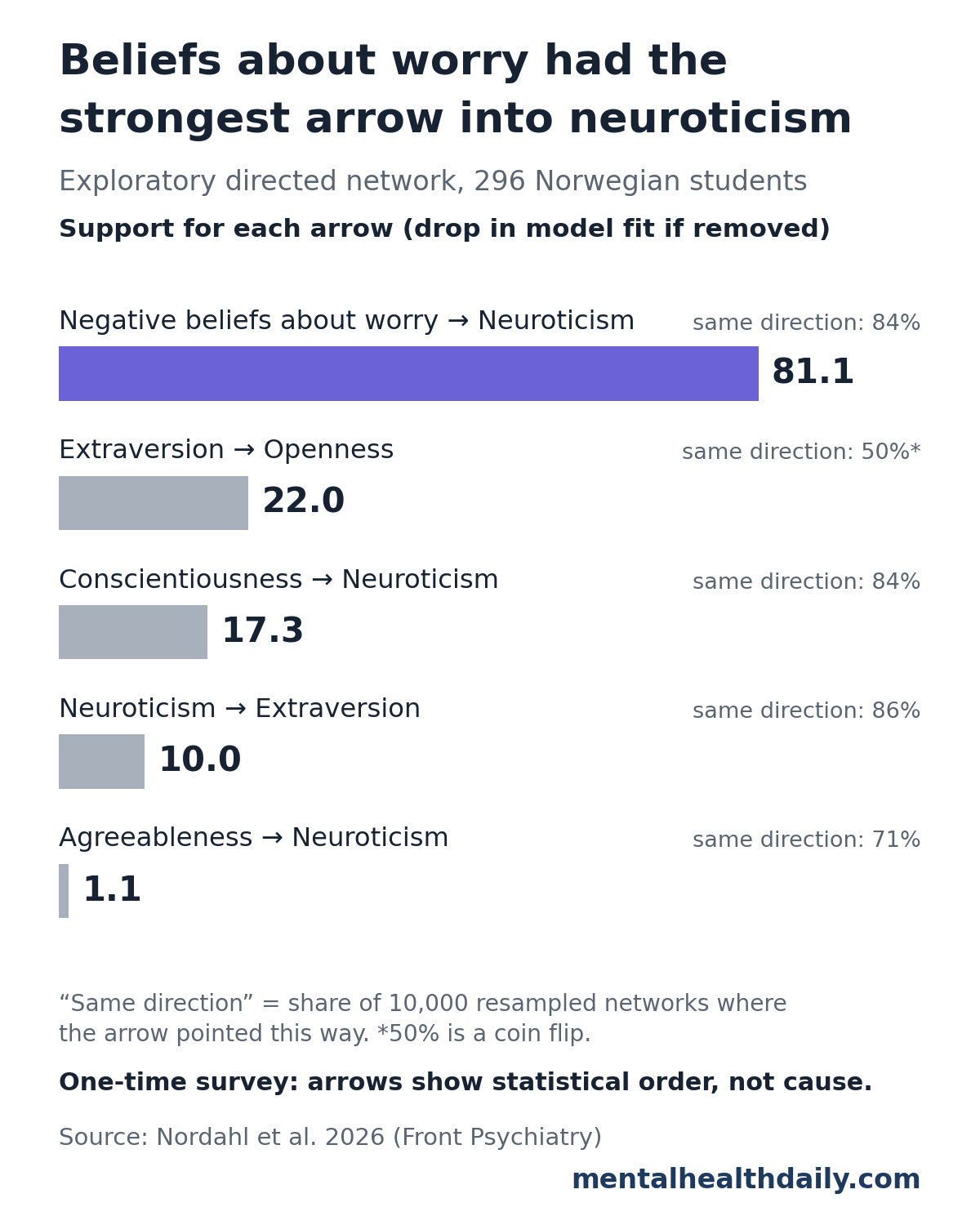
At the top of the ordering sat 3 measures, each with an arrow into neuroticism:
- Negative worry beliefs: model fit fell by 81.11 BIC units (Bayesian Information Criterion, a fit score where bigger drops mean more support) when this arrow was removed, and the arrow pointed this way in 84% of resampled networks
- Conscientiousness: a 17.26 drop, also 84% in this direction
- Agreeableness: a 1.15 drop, 71% in this direction
Neuroticism then pointed to extraversion (86%), and extraversion connected to openness. That last arrow pointed each way exactly half the time, so its direction carries no information.1
Why this is not cause and effect. Reading a DAG as causal requires that no important variable was left out, the model is correctly specified, and nothing unmeasured drives both sides. None of that can be checked with a single cross-sectional survey. Trait neuroticism could foster negative beliefs about worry, or a third factor could raise both.1
The researchers also point out that the S-REF model already predicted this ordering, so finding it is consistent with the model but does not independently test it. They present the direction as a hypothesis for longitudinal or experimental studies.1
Earlier Studies of Worry Beliefs, Trait Anxiety, and Therapy
Some evidence over time already exists. In a 2019 study from the same group, 982 participants completed measures of metacognitive beliefs and trait anxiety, and 425 repeated them 8 weeks later. Metacognitive beliefs accounted for 83% of the variation in anxiety-proneness at a single time point, and negative beliefs predicted later trait anxiety and depression-proneness.4 An 8-week gap is short, and that study did not measure the full Big Five.
Metacognitive therapy (MCT) targets these beliefs directly. Instead of challenging what a person worries about, as standard cognitive behavioral therapy (CBT) does, MCT tests the belief that worry is uncontrollable, for example by having patients postpone worry to a set time and notice that they can.
- MCT vs. CBT for generalized anxiety disorder: a Norwegian trial randomized 81 adults to MCT (32), CBT (28), or a wait-list (21). Both therapies worked, but MCT led to higher recovery rates (65% vs. 38%), and the gap held at 2 years.5
- Personality change in the same trial: among 55 patients who completed the full NEO-PI-R before and after 12 sessions, neuroticism fell and extraversion and openness rose across both therapies, with a larger drop in neuroticism after MCT than after CBT.6
- Broader evidence: a 2018 meta-analysis of 25 MCT studies, 15 of them randomized, found large effects vs. wait-lists (Hedges’ g = 2.06) and moderate advantages over cognitive and behavioral treatments at post-treatment (g = 0.69) and follow-up (g = 0.37), while calling for larger trials.7
These trials fit the idea that changing worry beliefs can lower neuroticism. The 2026 study itself did not test treatment, and the researchers state that their data do not show that changing these beliefs would change personality.1
Limitations of This Student Network Study
- One time point. All measures were collected once, so the arrows show a statistical ordering, not a sequence in time.
- Narrow sample. Psychology students, mostly young women, recruited during a lecture. No data were collected on symptoms, diagnoses, or treatment, so the results say nothing direct about clinical groups.
- Overlapping content. Neuroticism includes a tendency to worry, so part of the link may reflect similar questionnaire content or the shared self-report format.
- One slice of metacognition. Only the negative-beliefs subscale was modeled, not the other 4 MCQ-30 subscales.
- Sample size. The data came from an existing dataset without a planned power calculation for network analysis.
What the Results Mean for Worry and Neuroticism
Neuroticism is often treated as a fixed risk factor for anxiety and depression. This study points to a more specific belief, that worry can’t be controlled and is harmful, as one of the strongest unique correlates of that trait.1
That belief is also something therapy can work on. The trial evidence from metacognitive therapy fits that picture, and the clear next step is a longitudinal study that measures worry beliefs and personality repeatedly, to see which changes first.16
References
- Nordahl H, Anyan F, Hjemdal O, Wells A. Partial and directional relationships between negative metacognitive beliefs and the big five personality traits. Frontiers in Psychiatry. 2026;17:1897206. doi:10.3389/fpsyt.2026.1897206
- Wells A, Cartwright-Hatton S. A short form of the metacognitions questionnaire: properties of the MCQ-30. Behaviour Research and Therapy. 2004;42(4):385–396. doi:10.1016/S0005-7967(03)00147-5
- Kotov R, Gamez W, Schmidt F, Watson D. Linking “big” personality traits to anxiety, depressive, and substance use disorders: a meta-analysis. Psychological Bulletin. 2010;136(5):768–821. doi:10.1037/a0020327
- Nordahl H, Hjemdal O, Hagen R, Nordahl HM, Wells A. What lies beneath trait-anxiety? Testing the self-regulatory executive function model of vulnerability. Frontiers in Psychology. 2019;10:122. doi:10.3389/fpsyg.2019.00122
- Nordahl HM, Borkovec TD, Hagen R, et al. Metacognitive therapy versus cognitive–behavioural therapy in adults with generalised anxiety disorder. BJPsych Open. 2018;4(5):393–400. doi:10.1192/bjo.2018.54
- Kennair LEO, Solem S, Hagen R, Havnen A, Nysæter TE, Hjemdal O. Change in personality traits and facets (Revised NEO Personality Inventory) following metacognitive therapy or cognitive behaviour therapy for generalized anxiety disorder: results from a randomized controlled trial. Clinical Psychology & Psychotherapy. 2021;28:872–881. doi:10.1002/cpp.2541
- Normann N, Morina N. The efficacy of metacognitive therapy: a systematic review and meta-analysis. Frontiers in Psychology. 2018;9:2211. doi:10.3389/fpsyg.2018.02211