hit counter

SSRI Pharmacogenomic Testing: CYP2D6, CYP2C19, Remission
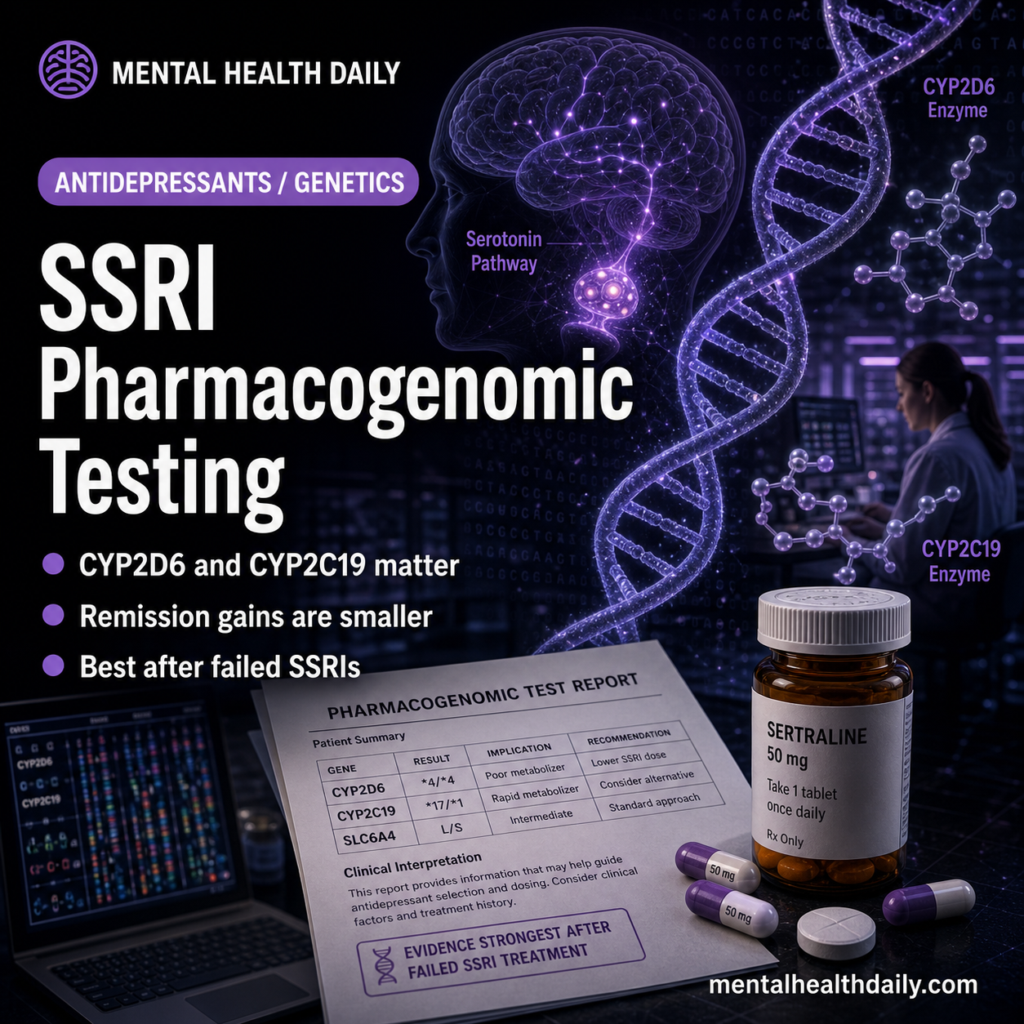
MHD featured image for SSRI Pharmacogenomic Testing: CYP2D6, CYP2C19, Remission.

A 2026 methylome-wide association study by Shen et al. found 48 CpG methylation sites tied to the quadratic CYP2C19 metabolizer-status term in 18,396 Generation Scotland participants, with 19 sites showing non-linear patterns and targeted replication in 1,238 older adults.1 That supports CYP2C19 as real biology beneath SSRI pharmacogenomics, but it does not prove universal antidepressant …

Read more

Post-Stroke Depression Tracks Serotonin-Acetylcholine Damage

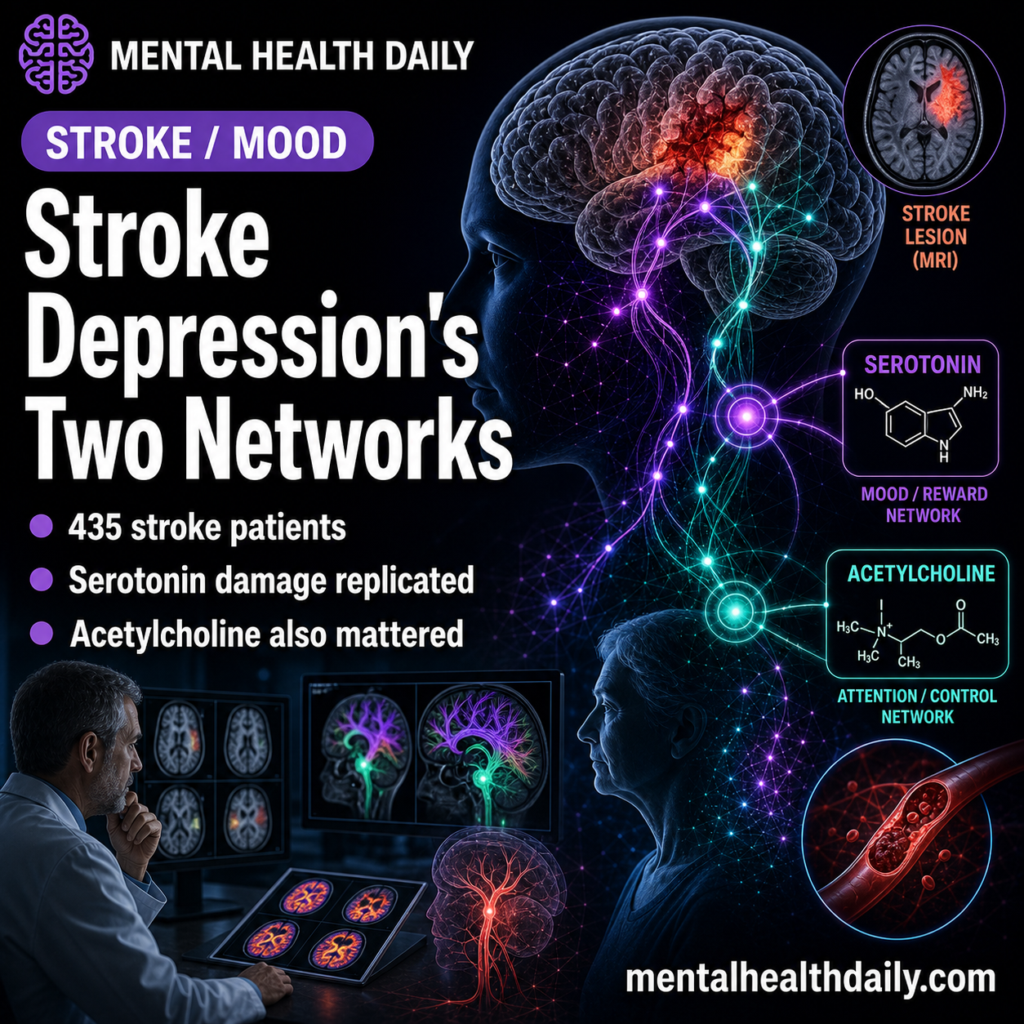
Photoreal illustration of stroke lesion with overlapping neurotransmitter network damage, conveying mechanism of post-stroke depression.

A 2026 two-cohort connectome study found that post-stroke depressive symptoms tracked damage to networks weighted by the serotonin transporter and vesicular acetylcholine transporter: 5-HTT damage predicted depression in Leipzig (OR 2.4, 95% CI 1.15–5.02) and Oxford (OR 2.05, 95% CI 1.03–4.09), while VAChT damage also replicated across both cohorts.1 The dopamine part of the original …

Read more

Empagliflozin for Depression: Effective Adjunct with SSRIs (2024 Clinical Trial)

Major Depressive Disorder (MDD) impacts millions globally, making it a significant public health challenge. Traditional treatments like Selective Serotonin Reuptake Inhibitors (SSRIs) don’t work for everyone, highlighting the need for innovative approaches. Recent clinical trials exploring the use of empagliflozin, a medication originally used to lower blood sugar in diabetes patients, have shown promising results …

Read more

Abnormal Brain EEG Activity Doesn’t Predict Antidepressant Efficacy in Depression (2023 Study)

Depression is a multifaceted mental health condition that presents significant challenges in both diagnosis and treatment. Recent studies have explored the potential of electroencephalography (EEG) as a predictive tool for treatment outcomes in major depressive disorder (MDD), with particular focus on the response to antidepressants like escitalopram. Highlights: EEG Abnormalities & Antidepressant Response: Contrary to …

Read more

Sex-Specific Biomarkers in Antidepressant Treatment for Depression: Male vs. Female (2023 Review)

Depression, a complex and multifaceted disorder, presents differently in men and women, not only in symptoms but also in how each sex/gender responds to treatment. This divergence has led scientists to explore the molecular mechanisms behind these differences, revealing intricate biological and neurochemical pathways. Highlights: Sex-Specific Prevalence and Symptoms: Women are twice as likely as …

Read more

Lactofem Probiotic as Adjunct to SSRI Antidepressants May Enhance Mood & Sexual Satisfaction in Women (2024 Study)

The link between mental health and sexual function is complex and multifaceted, with depressive disorders particularly affecting individuals’ sexual satisfaction and functionality. Recent research has highlighted the potential benefits of probiotics in mitigating these impacts, especially among women undergoing treatment with Selective Serotonin Reuptake Inhibitors (SSRIs). A new study conducted in Iran provides promising evidence …

Read more

Escitalopram (Lexapro) Normalizes Brain Connectivity in Major Depression (2024 Study)

Major Depressive Disorder (MDD) significantly alters the brain’s network connectivity, with disturbances in the default mode network (DMN), salience network (SN), and dorsal attention network (DAN). A new study reveals how escitalopram, a common antidepressant, can partially reverse these abnormalities, offering insights into the biological underpinnings of its therapeutic effects. This research deepens our understanding …

Read more