hit counter

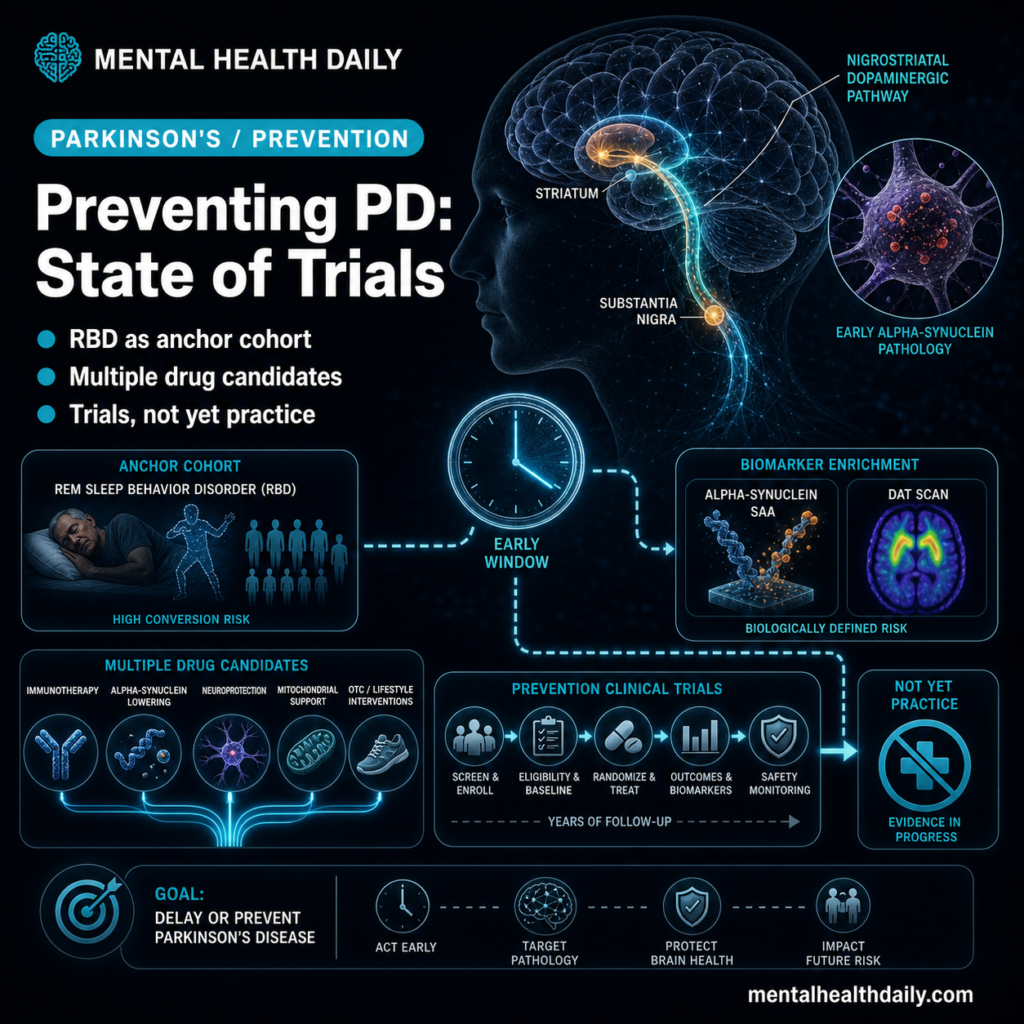
Parkinson’s Disease Prevention: Prodromal Symptoms, RBD, Early Intervention Trials

Photoreal illustration of a brain with prodromal pathology and a clock indicating early-window intervention opportunity for Parkinson's prevention.

Parkinson’s disease has a years-to-decades prodromal stage where motor symptoms haven’t yet emerged but pathology is accumulating. A 2026 review by Schaeffer et al. synthesizes the case for (and limits of) intervening during this window — with implications for high-risk individuals weighing whether to enter preventive trials.1 Research Highlights Prodromal Parkinson’s disease is the period …

Read more

Low Adiponectin Levels in Children with Autism Spectrum Disorder (ASD): Correlation with Symptom Severity (2024 Study)

In the intricate puzzle of autism spectrum disorders (ASD), emerging research highlights a fascinating piece: the role of adiponectin, an anti-inflammatory adipokine, in the development and severity of ASD in children. With the backdrop of increasing ASD prevalence and the quest for biomarkers for early identification, the exploration of adiponectin offers a promising avenue for …

Read more

Serum Neurofilament Light (sNfL) as Biomarker for Bipolar Disorder? (2024 Study)

Bipolar Disorder (BD), a complex psychiatric condition, is under constant study to better understand its pathophysiology and improve diagnostic and treatment strategies. Recent research has focused on the role of serum neurofilament light (sNfL), a marker for neuro-axonal injury, in BD. Highlights: Individuals with BD for more than three years exhibit higher sNfL levels compared …

Read more

MicroRNAs as Blood-Based Biomarkers for Early ADHD Diagnosis in Children

Attention-deficit/hyperactivity disorder (ADHD) is a common childhood-onset neurodevelopmental disorder characterized by developmentally inappropriate levels of inattention, hyperactivity, and impulsivity. While highly heritable, the heterogeneity of clinical presentation suggests complex interactions between genetic and environmental risk factors. A new study suggests that it may be possible to diagnose ADHD or detect ADHD susceptibility risk in children …

Read more