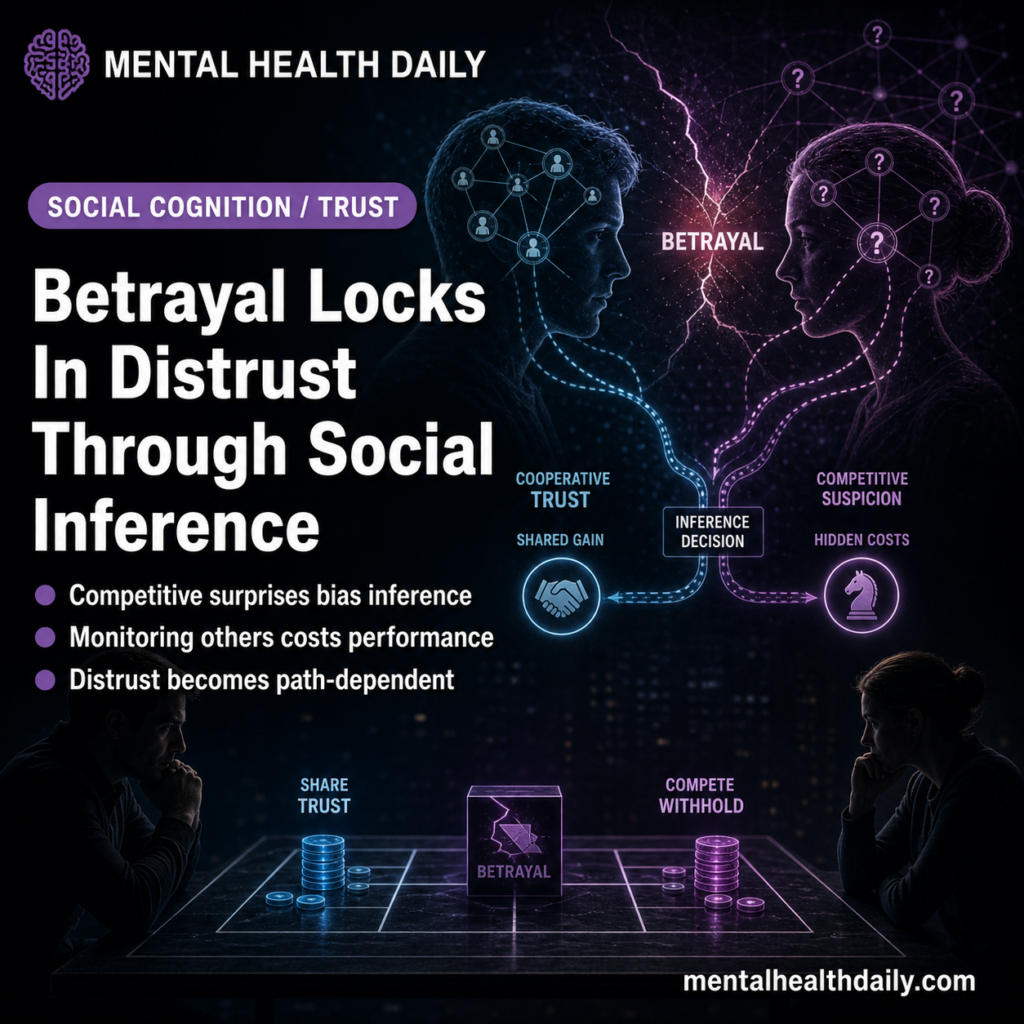
Betrayal does not just make people less trusting. It can also change what they pay attention to afterward. After a negative social surprise, people may start scanning more closely for signs of threat, which can make distrust easier to confirm and harder to undo.
Research Highlights
- Selective observation: Son and Yoo 2026 modeled social inference as a partial-observability problem, meaning people choose what social information to sample instead of receiving all of it for free.
- Negative asymmetry: after competitive surprises, participants overestimated later competitiveness; cooperative surprises did not produce an equal and opposite trust boost.
- Hysteresis: social beliefs showed path dependence, so current trust judgments depended on the order of prior experiences rather than only the latest behavior.
- Attention cost: monitoring the opponent came at the expense of controlling one’s own avatar, giving the model a concrete cost-of-observation tradeoff.
- Clinical implication: the framework fits PTSD, borderline personality disorder, and interpersonal depression hypotheses, but it remains a lab model rather than a treatment trial.
A negative social surprise can shift attention toward threat-monitoring.
Once that happens, the observer keeps sampling the social world in a way that makes distrust easier to confirm, even when later behavior is less threatening.1
Partial Observability: Attention Changes Social Evidence
Most computational theory-of-mind models assume that the observer has access to the relevant behavioral data. The observer then updates beliefs about another person’s goals, intentions, or traits using something like Bayesian inference.2
Son and Yoo focus on a basic constraint that most formal models smooth over: people cannot observe everything. Watching someone’s face may mean missing their hands; monitoring tone may mean missing context; tracking another person’s behavior may pull attention away from one’s own task.
That makes social inference a sampling problem before it is an interpretation problem. The observer first chooses what to watch, and that choice determines what evidence becomes available.
Researchers tested this idea in a pursuit task. Participants chased a target while a computerized opponent behaved more competitively or cooperatively than expected, and participants had to allocate attention between their own avatar and the opponent.1
- More opponent monitoring: more social information about the opponent’s behavior.
- Less self-monitoring: worse precision in the participant’s own pursuit performance.
- Core tradeoff: social vigilance had a measurable performance cost.
This is where the finding becomes clinically useful. Hypervigilance is not just anxiety or fear. It is a shift in attention: the person starts monitoring for danger, betrayal, rejection, or inconsistency, often at the expense of noticing safer or more neutral cues.
Competitive Surprises Led to Asymmetric Bias
After the computerized opponent acted more competitively than expected, participants later inferred that same opponent’s hidden intention as more competitive than the actual F value warranted.
The opposite pattern did not mirror it. A cooperatively surprising opponent did not produce an equal overestimation of cooperativeness.1
This asymmetry lines up with a large social-psychology literature: bad information usually carries more weight than good information in trust, threat, and interpersonal judgment.3
This research adds a computational mechanism for why the bias can persist.
And the mechanism goes beyond memory. Bad events can change what the observer chooses to sample afterward.
Once attention shifts toward competitive cues, the observer collects more threat-relevant evidence.
That evidence then supports the updated belief that the other person is competitive, untrustworthy, or unsafe.
Hysteresis: Distrust Outlasts Improved Behavior
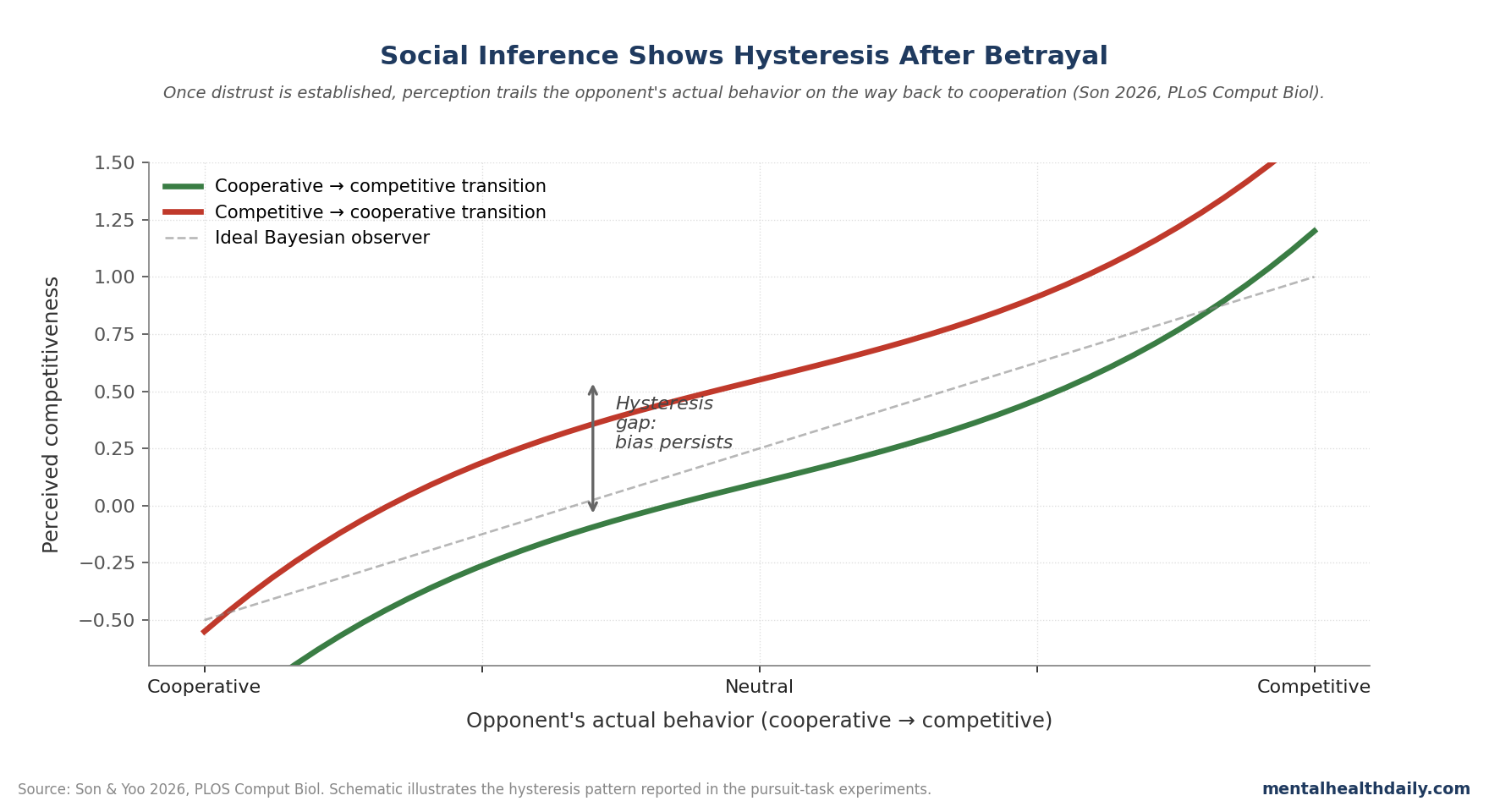
Hysteresis means a system’s current state depends on its history. In this study, social inference did not reset cleanly when the opponent’s behavior changed.
The same current evidence could be interpreted differently depending on the sequence that came before it. A competitive surprise followed by better behavior did not return participants to the same state as if the competitive surprise had never happened.
That matters because real trust repair often fails in exactly this way. The injured person may see some positive behavior, but the attention system has already shifted toward monitoring for signs of threat.
Three steps make the pattern sticky:
- Negative surprise updates the belief. The other person now seems more competitive, unsafe, selfish, or unreliable.
- The new belief changes sampling. Attention moves toward evidence that can detect the expected threat.
- The sampling pattern reinforces the belief. More threat-relevant observations are collected, while benign evidence receives less attention.
The framework gives the “trust is broken” slogan a mechanism. Distrust can keep being regenerated by the observer’s own post-betrayal attention strategy.
PTSD, Borderline Personality, and Interpersonal Depression
This was not a clinical trial, but the clinical fit is obvious enough to take seriously.
PTSD after interpersonal trauma: threat monitoring can become a dominant observation policy. The person is not merely misreading neutral cues; they may be over-sampling cues most likely to confirm danger.
Borderline personality disorder: rapid shifts in trust and threat appraisal may partly reflect unstable attention-allocation strategies. Small signals can produce large belief updates when the sampling policy is already tuned for rejection or betrayal.4
Depression with interpersonal pessimism: the belief that others do not care may be reinforced by selective sampling of neglect, rejection, or non-response. Behavioral activation and attention-training approaches may help partly because they change what evidence enters the system.
Trust repair may require more than new positive experiences. It may require changing what gets monitored, weighted, and rehearsed.
That distinction separates 2 problems that often get blurred together. One problem is whether the other person is safe now. The other is whether the observer’s attention system can collect enough non-threat evidence to update that belief.
A relationship can improve while the sampling pattern remains stuck. That mismatch is often where repair stalls clinically.
In therapy language, that distinction matters because reassurance alone often fails. A patient may hear the reassurance, but still spend the next day scanning tone, delay, eye contact, or small inconsistencies for confirmation that the danger is back.
More targeted interventions would have to work at the sampling level:
- Attention mapping: identify which cues the person monitors after a betrayal trigger.
- Evidence balancing: deliberately sample neutral and prosocial cues, not only threat-confirming cues.
- Behavioral experiments: test whether changed observation patterns produce different trust estimates over time.
- Safety boundaries: distinguish adaptive distrust in an unsafe relationship from outdated threat-monitoring in a safer context.
The model avoids naive positivity. Distrust can be appropriate after betrayal, but it can also become self-maintaining when attention keeps selecting evidence from the most threatening parts of the social field.
Where the Lab Model Still Needs Restraint
The task is artificial. Participants interacted with a computerized opponent in a pursuit task. That is not the same as betrayal by a spouse, parent, friend, employer, or clinician.
The stakes were limited. Real betrayal carries attachment, safety, financial, social, and identity consequences that a lab task cannot reproduce.
The clinical translation is theoretical. The model fits PTSD, borderline personality disorder, and interpersonal depression, but it does not prove that changing observation strategy improves symptoms.
Other models may explain part of the same pattern. Reinforcement-learning models with negativity-weighted prediction errors could produce similar asymmetry through different machinery.
Still, the research gives a useful mechanism: distrust can become a way of sampling the social world, not just a belief about another person.
Questions About Social Inference and Trust
Why do negative social experiences last longer than positive ones?
Negative social experiences can change both memory and attention. Son and Yoo add that they may also change the sampling strategy, so later evidence is collected through a more threat-focused lens.
Can trust recover after betrayal?
Sometimes, but ordinary positive behavior may not be enough if the injured person continues sampling mostly threat-relevant cues. Repair usually requires consistency, time, and a change in what the observer can safely attend to.
Does this mean distrust is irrational?
No. After betrayal, distrust may be adaptive. The problem is overgeneralization: a strategy that was protective in one context can become costly when it keeps generating distrust after conditions change.
How does this relate to PTSD treatment?
Many PTSD treatments work partly by changing attention, appraisal, and threat prediction. This model supports that logic, but it does not by itself test a PTSD intervention.
Why include borderline personality disorder?
Borderline personality disorder often involves unstable trust, rejection sensitivity, and rapid social reappraisal. A selective-observation model gives one plausible mechanism for how small cues can become large shifts in perceived threat.
References
- Son S, Yoo SBM. Selective observation following betrayal shapes the social inference landscape. PLoS Comput Biol. 2026;22(4):e1014200. doi:10.1371/journal.pcbi.1014200
- Baker CL, Saxe R, Tenenbaum JB. Bayesian theory of mind: modeling joint belief-desire attribution. Proc Cogn Sci Soc. 2011. eScholarship
- Baumeister RF et al. Bad is stronger than good. Rev Gen Psychol. 2001;5(4):323-370. doi:10.1037/1089-2680.5.4.323
- Fonagy P, Luyten P. A developmental, mentalization-based approach to the understanding and treatment of borderline personality disorder. Dev Psychopathol. 2009;21(4):1355-1381. doi:10.1017/s0954579409990198
- Heider F, Simmel M. An experimental study of apparent behavior. Am J Psychol. 1944;57(2):243-259. doi:10.2307/1416950