hit counter

Methylphenidate Reduced Dishonesty and Cheating in 151 Adults; Atomoxetine Had No Effect
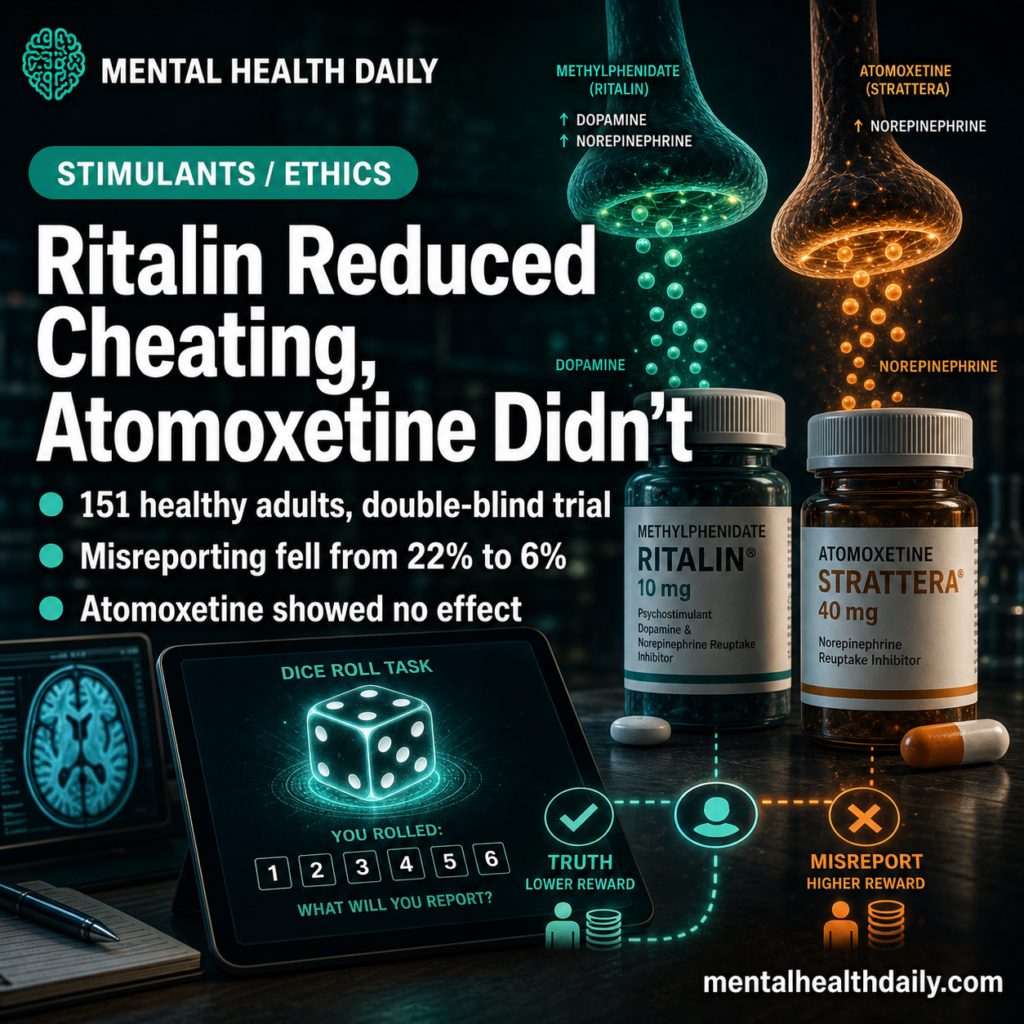
Editorial card showing methylphenidate molecular structure beside a die-rolling task, illustrating a counterintuitive randomized-trial result.

A 2026 double-blind randomized controlled trial by Kappes et al. in Psychopharmacology found something the smart-drug users likely wouldn’t have predicted: a single 30 mg dose of methylphenidate reduced dishonest misreporting on a die-rolling task from ~22% of trials in the placebo arm to ~6% (in the methylphenidate arm).1 Atomoxetine, a noradrenergic comparator, had no …

Read more

How Long Does Ritalin Stay In Your System?

Ritalin is a psychostimulant drug used medically for the treatment of attention-deficit/hyperactivity disorder (ADHD) and narcolepsy.  It contains the active ingredient methylphenidate, which functions as a catecholamine reuptake inhibitor, primarily of dopamine (DAT) and norepinephrine (NET) transporters.  This reuptake inhibition (NDRI) facilitates increases in extracellular dopamine and norepinephrine concentrations, thereby substantially enhancing neurophysiological arousal. Upon …

Read more

Ritalin vs. Adderall: Comparison

From a historical perspective, one of the most popular ADHD medications of all time is Ritalin.  It was first approved by the FDA in 1955 for treating a condition referred to as “hyperactivity.”  While there weren’t many diagnoses for hyperactivity in the 1950s, the number of diagnoses skyrocketed in the 1990s, making Ritalin the single …

Read more

Ritalin (Methylphenidate) Withdrawal Symptoms + Duration

Ritalin (Methylphenidate) is a psychostimulant drug used primarily to help treat ADHD (attention-deficit hyperactivity disorder). It is also prescribed to individuals diagnosed with narcolepsy to help promote wakefulness. This stimulant has been thoroughly researched for over half-a-century and has a great track record for reducing symptoms associated with ADHD including inattentiveness and hyperactivity. This drug …

Read more