hit counter

Stress Social Deficits Reversed by Amygdala-Oxytocin Circuit Suppression

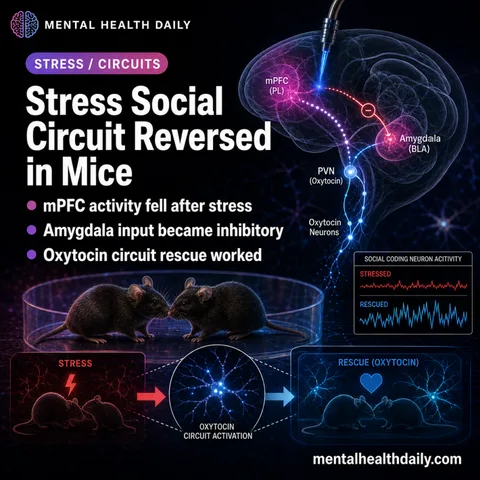
MHD featured image for stress-induced social changes, mPFC, amygdala, and oxytocin circuits.

A 2026 mouse circuit study found that restraint stress progressively reduced medial prefrontal social coding: mPFC excitatory-neuron transient rates fell to roughly 70-80% of baseline after acute stress and nearly 50% after chronic stress, while suppressing either basolateral-amygdala input or hypothalamic oxytocin input restored social discrimination and behavior.1 The result is a circuit-specific oxytocin finding, …

Read more

Entorhinal Dopamine Fails Early in Alzheimer’s Mice

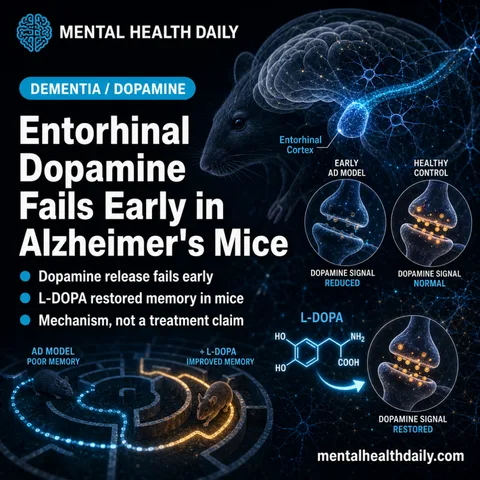
Editorial card showing the lateral entorhinal cortex with dopamine projections from the midbrain, illustrating an early-Alzheimer's mechanism finding rescued by L-DOPA in mice.

A 2026 Nature Neuroscience study from the Igarashi lab proposes a circuit-level answer for why the lateral entorhinal cortex (LEC) is the first cortical region to falter in Alzheimer’s: dopamine inputs from the VTA and substantia nigra to the LEC go functionally silent at the earliest disease stage in an APP knock-in mouse — before …

Read more

KNT-127 for Anxiety: Delta Opioid Receptor Agonist via PL-BLA Pathway (2023 Study)

Recent scientific advancements have illuminated the crucial role of the prelimbic cortex to basolateral amygdala (PL-BLA) pathway in regulating anxiety-like behaviors. Utilizing cutting-edge optogenetic techniques and selective delta-opioid receptor (DOP) agonists, researchers have begun to decode the complex neural circuitry underlying anxiety disorders. Highlights: PL-BLA Pathway Significance: The connection between the prelimbic cortex (PL) and …

Read more

New Epilepsy Treatments (2023): Neurostimulation, CBD, Gene Therapy for Seizures

Epilepsy affects over 50 million people worldwide, making it one of the most common neurological disorders globally. For many living with epilepsy, achieving reliable seizure control remains a significant challenge, underscoring the need for continued innovation in treatment approaches. Exciting new developments in the field are providing clinicians with an expanding array of therapeutic options …

Read more