hit counter

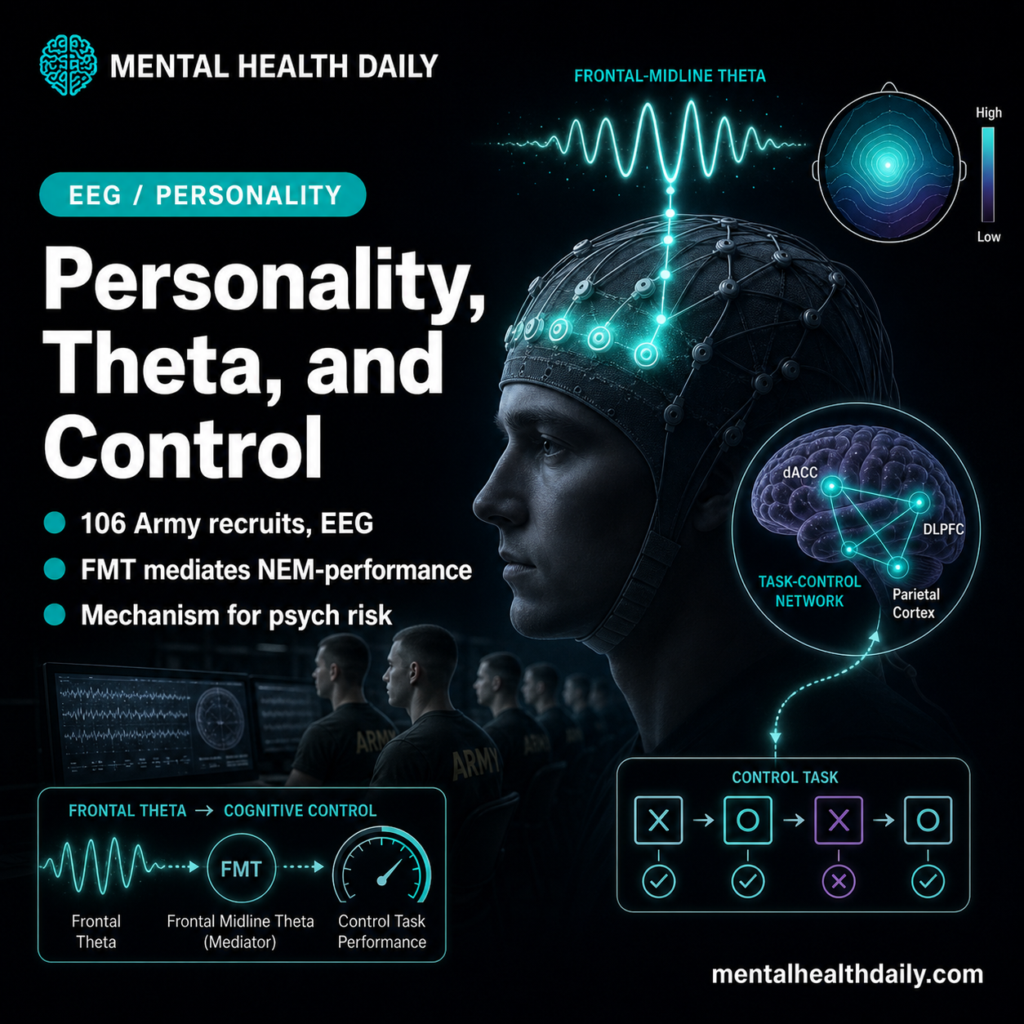
Negative Emotionality Reduces Frontal Midline Theta in 106 Recruits

Photoreal illustration of frontal-midline brain activity overlaid on a stylized portrait, conveying personality-brain link in cognitive control.

A 2026 EEG study of 106 Army National Guard recruits found that higher negative emotionality predicted poorer Go/No-Go discrimination (β = −.234, 95% CI −.392 to −.076) and lower frontal midline theta (β = −.149, 95% CI −.290 to −.001). The key result was not a vague personality-brain link: frontal midline theta, not occipital alpha, …

Read more

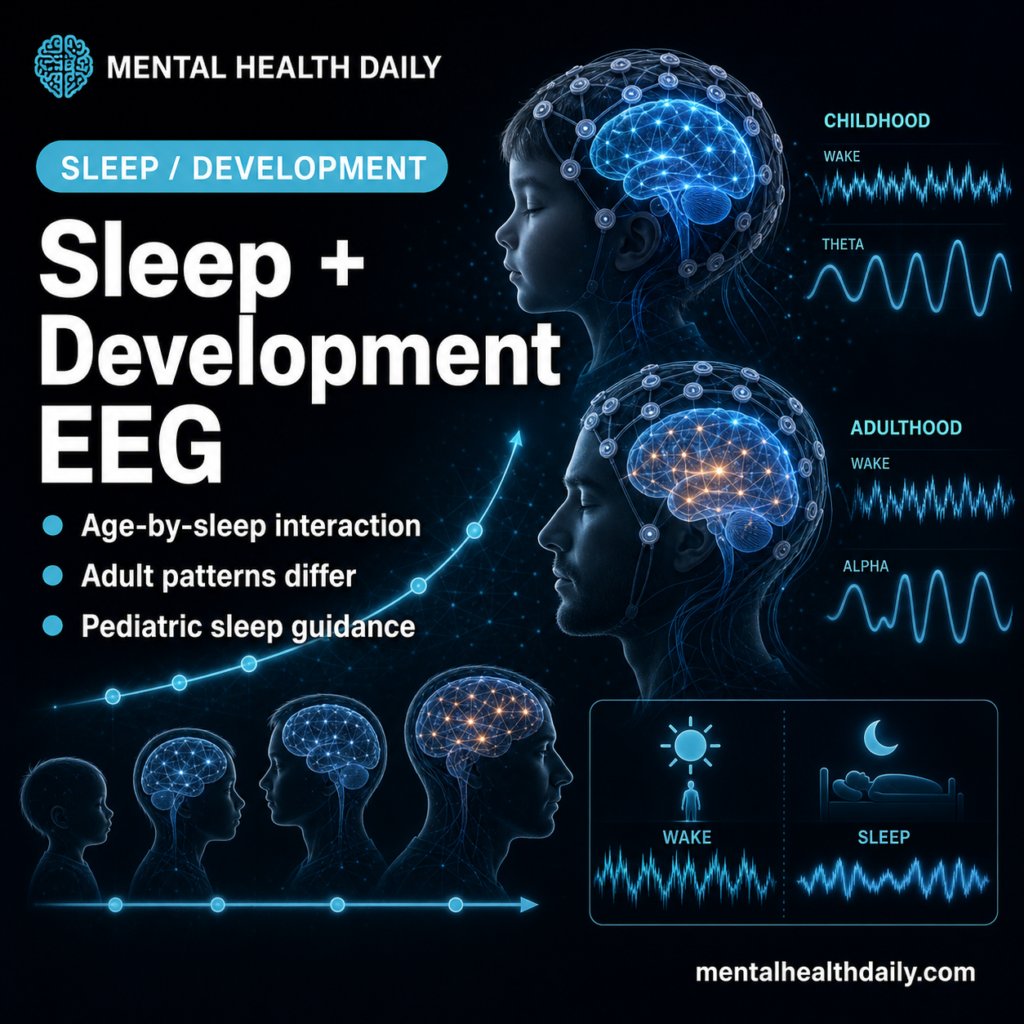
EEG Alpha Density Decreased in Children, Increased in Adults

Photoreal illustration of children and adults with overlay of EEG brain rhythms, conveying developmental differences in sleep effects on brain activity.

A 2026 eNeuro analysis of 163 people ages 3.5–24.7 found that wake EEG amplitude behaved like a sleep-pressure marker, but wake alpha-density changed in opposite directions across development: it decreased overnight in children and increased overnight in adolescents and adults.1 Research Highlights Alpha density flipped by age: In 163 participants ages 3.5–24.7, oscillation density showed …

Read more

Abnormal Brain EEG Activity Doesn’t Predict Antidepressant Efficacy in Depression (2023 Study)

Depression is a multifaceted mental health condition that presents significant challenges in both diagnosis and treatment. Recent studies have explored the potential of electroencephalography (EEG) as a predictive tool for treatment outcomes in major depressive disorder (MDD), with particular focus on the response to antidepressants like escitalopram. Highlights: EEG Abnormalities & Antidepressant Response: Contrary to …

Read more

Repetitive TMS for Alzheimer’s Disease Alters Brain Waves & Enhances Cognition (2024 Study)

Repetitive transcranial magnetic stimulation (rTMS) is making waves in the field of Alzheimer’s disease (AD) research, offering a glimmer of hope for enhancing cognitive functions in patients. By targeting specific brain regions, rTMS has shown promising results in modulating neural activity and improving cognitive scores. This innovative therapy, coupled with real-time monitoring through electroencephalography (EEG), …

Read more

Symptom Provocation in Psychiatric Disorders: TMS, EEG, Neural Circuits for Personalized Treatment (2023 Review)

Symptom provocation, a cornerstone of psychiatric research and therapy, offers a fascinating glimpse into the intricate relationship between brain activity and psychiatric symptoms. By deliberately triggering symptoms, researchers and clinicians can identify neurophysiological biomarkers and target them with personalized therapies, such as transcranial magnetic stimulation (TMS). This technique not only enhances our understanding of psychiatric …

Read more

Abnormal EEG Microstates Linked to Major Depression & Related Cognitive Impairment (2024 Study)

In the quest to understand the enigmatic nature of depression, scientists are turning to the intricate patterns of brain activity, seeking clues hidden within the electrical storm of thoughts and emotions. By examining electroencephalography (EEG) microstates—brief, recurring patterns of brain activity—researchers have begun to piece together how depression alters the fundamental dynamics of the brain. …

Read more

Alpha Brain Waves (8-10 Hz) & Default Mode Network Linked to Self-Control (Behavioral Inhibition) (2023 Study)

In recent scientific endeavors, researchers are probing into the complex web of interactions that define our brain’s functioning. Focusing on the subtle interplay between alpha wave activity, the Default Mode Network (DMN), and behavioral inhibition, these studies are uncovering new layers of understanding about how our brains operate during different states of activity and rest. …

Read more