
A 2026 review graded 14 brain-stimulation and other device-based treatments for treatment-resistant depression, and only electroconvulsive therapy (ECT) and transcranial magnetic stimulation (TMS) earned top-level evidence and a first-line rating. Vagus nerve stimulation came next; most newer techniques still belong in clinical trials.1
Research Highlights
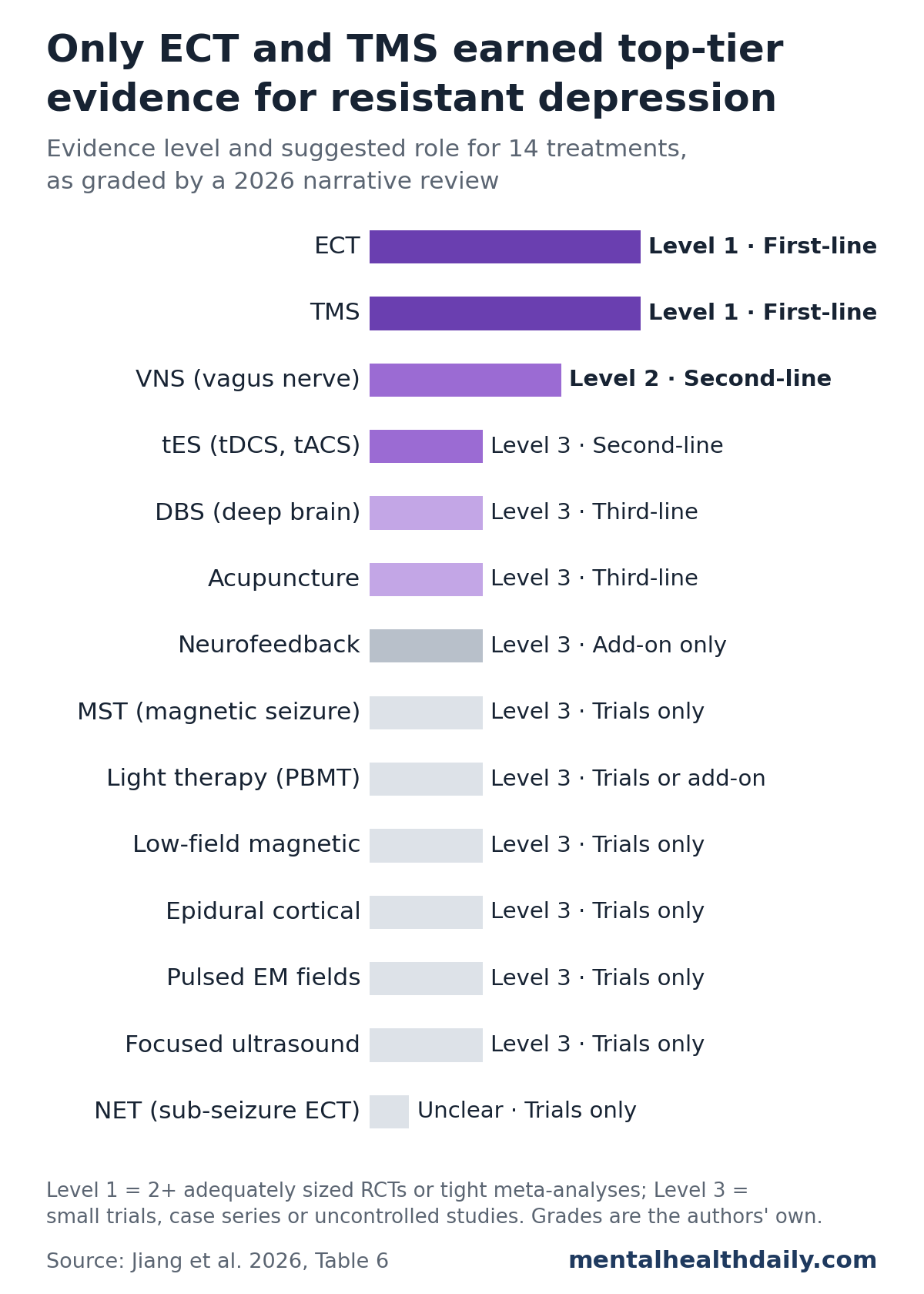
- Two first-line options: ECT and TMS were the only treatments rated Level 1 for both effectiveness and safety, and the only ones placed first-line.1
- VNS in second place: implanted vagus nerve stimulation got Level 2 evidence, and the authors argue it should move up to second-line for people prone to relapse.1
- Most others are Level 3: 10 of the 14 treatments, including deep brain stimulation, magnetic seizure therapy, and focused ultrasound, rest on small trials, case series, or uncontrolled studies.1
- Narrative review: the authors assigned the grades themselves, without a reported search strategy or pooled analysis, in Neuropsychiatric Disease and Treatment (published September 20, 2026).1
What “Physical Therapy” Means Here
The paper’s title says “physical therapy,” but it is not about physiotherapy or exercise. The authors use the term for treatments that change brain activity with an outside physical force: electric or magnetic fields, light, sound, or ultrasound.1
Treatment-resistant depression (TRD) usually means depression that has not responded to at least 2 antidepressants taken at an adequate dose for long enough. The review notes that countries still define it differently, and it cites estimates that about 30% of people with severe major depression develop TRD.1
How the Review Graded the Evidence
The authors borrowed a 4-level scale from an earlier review of repetitive TMS (rTMS) by part of the same team:1
- Level 1: meta-analyses with narrow confidence intervals and/or at least 2 adequately sized randomized controlled trials (RCTs), preferably placebo-controlled
- Level 2: a meta-analysis with wide confidence intervals and/or at least 1 adequately sized RCT
- Level 3: small RCTs, non-randomized prospective studies, case series, or high-quality retrospective studies
- Level 4: expert opinion
A first-line rating needs Level 1 or 2 evidence plus clinical support. Second-line needs Level 3 or better, and third-line can rest on expert opinion. The authors then rated each treatment and named the patients it suits best.1
ECT and TMS: The Two First-Line Treatments
ECT passes a brief electric current through the scalp under general anesthesia to trigger a controlled seizure. The review cites response rates above 40% in TRD. Relapse is common, and ongoing maintenance ECT brings relapse rates down to about 40%.1
Memory difficulties are a major drawback. Some improve after treatment, but gaps in personal memories can persist: a study involving 20 patients found autobiographical-memory impairment still present 3 months after ECT.4 Muscle aches, headache, and nausea are also common.1
TMS uses a magnetic coil held against the head to induce small currents in the cortex, usually the left dorsolateral prefrontal cortex (a front-of-brain region involved in mood and planning). Reported remission rates in TRD range from about 30% to 90%, a spread the authors put down to different settings and outcome criteria.1
Side effects are mostly headache, dizziness, and muscle aches; the most serious risk is a seizure. The US Food and Drug Administration cleared a fast version called intermittent theta-burst stimulation (iTBS) in 2018.1 In the THREE-D trial of more than 400 patients, a roughly 3-minute iTBS session worked as well as standard 10 Hz rTMS over 4 weeks, with similar side effects.3
Which comes first? Guidelines differ. The review says rTMS is generally tried before ECT for people without psychosis or acute high risk, while ECT is preferred for psychotic depression, severe suicidal thoughts, or illness that needs a fast response.1
ECT now has a drug rival too. In the ELEKT-D trial of 403 people with nonpsychotic TRD, 55.4% responded to IV ketamine and 41.2% to ECT, showing ketamine was not worse than ECT. ECT was linked to a temporary drop in memory recall that recovered over follow-up.2
VNS: A Case for Moving It Up
Vagus nerve stimulation (VNS) uses a pacemaker-like device implanted in the chest, wired to the vagus nerve in the left side of the neck. The FDA approved it for TRD in 2005.1
- Benefit: remission in about 30%, and response in about 40% to 50% after the implant
- Side effects: mostly headache, cough, and voice change
- Catch: symptoms worsened in one study when the battery ran down and had to be replaced
Canada’s CANMAT guideline lists VNS as third-line. The authors rate it Level 2 and propose second-line use for people whose depression keeps coming back.1
Promising but Still Experimental
Ten treatments landed at Level 3. The review places them by how much clinical support they have:1
- Transcranial electrical stimulation (tES): weak scalp currents (tDCS and tACS), rated second-line for severe depression or as an add-on. CANMAT lists tDCS as third-line, and no study has yet tested tACS in TRD.
- Deep brain stimulation (DBS): electrodes implanted deep in the brain, rated third-line for frequently relapsing TRD. Studies report benefit in roughly 30% to 60%, with surgical risks of bleeding and infection.
- Acupuncture and neurofeedback: third-line and add-on roles for milder or partly responding depression.
- Magnetic seizure therapy (MST): a seizure triggered by magnets instead of electrical current. A randomized study of 73 people with depression found no significant difference from ECT over 6 months, and other studies saw fewer memory problems. Guidelines still call MST experimental.
- Trials only: light therapy (photobiomodulation), low-field magnetic stimulation, epidural cortical stimulation, pulsed electromagnetic fields, and focused ultrasound.
A 14th technique, nonconvulsive electrotherapy (ECT-style current kept below the seizure threshold), did not have enough evidence to grade.1
Why the Response Rates Can’t Rank These Treatments
The review’s summary table gives a response or remission figure for each treatment: 40% for ECT, 30% to 70% for TMS, 30% to 40% for VNS, and 40% to 70% for MST.1
Those numbers come from different studies with different patients, definitions, and follow-up times. Several of the higher figures for newer treatments come from small samples, some under 10 people. They show what has been reported, not which treatment works best.
Limitations
- Narrative review. No search strategy, inclusion rules, or risk-of-bias checks are reported for the main grading, so the evidence levels are the authors’ judgment.
- Borrowed scale. The grading system comes from the team’s own earlier review, and every treatment got the same level for effectiveness and safety.
- Small inconsistencies. The discussion calls DBS second-line while the grading table says third-line, and tES gets a second-line rating despite no TRD studies of tACS.
- Thin evidence below the top tier. Much of the support for newer techniques is case reports or studies with fewer than 30 people.
The grades for ECT and TMS match major guidelines, so the top of the ranking is on solid ground. The ordering of the Level 3 treatments is much less certain.
What This Means for People With Treatment-Resistant Depression
- Two well-tested options exist. If 2 or more antidepressants have not helped, ECT and TMS are the brain-stimulation treatments with the strongest evidence.
- The choice depends on the situation. TMS needs no anesthesia and is often tried first; ECT is usually favored when depression is severe, psychotic, or urgent.
- Newer devices are worth watching, not chasing. Most belong in research centers or clinical trials for now.
Treatment decisions belong with a psychiatrist who knows your history. If you are having thoughts of suicide, call or text 988 (the Suicide and Crisis Lifeline in the US) or contact local emergency services.
References
- Jiang W, Xing H, Bai Y, et al. Physical therapy for treatment-resistant depression: a comprehensive review of efficacy, safety, and evidence grading. Neuropsychiatric Disease and Treatment. 2026;22:623902. doi:10.2147/NDT.S623902
- Anand A, Mathew SJ, Sanacora G, et al. Ketamine versus ECT for nonpsychotic treatment-resistant major depression. New England Journal of Medicine. 2023;388(25):2315–2325. doi:10.1056/NEJMoa2302399 (PubMed)
- Blumberger DM, Vila-Rodriguez F, Thorpe KE, et al. Effectiveness of theta burst versus high-frequency repetitive transcranial magnetic stimulation in patients with depression (THREE-D): a randomised non-inferiority trial. Lancet. 2018;391:1683–1692. doi:10.1016/S0140-6736(18)30295-2 (PubMed)
- Napierala M, Bodnar A, Chlopocka-Wozniak M, Permoda-Osip A, Rybakowski J. Electroconvulsive therapy and autobiographical memory in patients with treatment-resistant depression. Psychiatria Polska. 2019;53(3):589–597. doi:10.12740/PP/85787